


 |
ENS612S-ECONOMICS OF NAMIBIA AND SACU COUNTRIES-1ST OPP-NOV 2025 |
|
|
1 Page 1 |
▲back to top |
nAmlBIA UnlVERSITY
OF SCIEnCE Ano T ECHnOLOGY
FACULTY OF COMMERCE, HUMAN SCIENCES AND EDUCATION
DEPARTMENT OF ECONOMICS, ACCOUNTING AND FINANCE
QUALIFICATION: BACHELOR OF ECONOMICS
QUALIFICATION CODE: 07BECO
LEVEL: 6
COURSE CODE: ENS612S
COURSE NAME: ECONOMICS OF NAMIBIA AND
SACU COUNTRIES
SESSION: NOVEMBER 2025
DURATION : 3 HOURS
PAPER: THEORY
MARKS: 100
FIRST OPPORTUNITY PAPER
EXAMINER(S) MR. MALLY LIKUKELA
MODERATOR: MR MAKAISAPI TJIUMBIRUA
INSTRUCTIONS
1. There are five (5) sections in this paper.
2. Candidates must answer all Questions.
3. Write clearly and neatly.
4. Number the answers clearly.
PERMISSIBLE MATERIALS
1. Examination paper.
2. Examination script.
THIS QUESTION PAPER CONSISTS OF 5 PAGES (Including this front page)
|
|
2 Page 2 |
▲back to top |
SECTION A: MULTIPLE CHOICE
1. Brewing of alcoholic and non-alcoholic beverages falls under:
a) Secondary Industry
b) Primary Industry
c) Tertiary Industry
d) Namibia Brewery
[10 MARKS]
2. Diamond Polishing falls under:
a) Primary Industry
b) Secondary Industry
c) Tertiary Industry
d) None of the above
3. The following is the main causes of inflation in Namibia
a) Imported inflation
b) Excess supply of Money
c) All of the these
d) High fuel prices
4. Which of the following is not a policy for dealing with unemployment
a) Promotion of investment
b) Education and training
c) Protection of local producers
d) Mandatory vaccination for all workers
5. The Executive Branch
a) Oversee and implements policies contained in legislation
b) Interprets constitution and laws
c) The highest decision and policy making institution in a democratic state
d) All of the above
6. Goods that are thought to be good for someone regardless of the person's own
preferences are known as:
a) Mandatory goods
b) Merit goods
c) Normal goods
d) Inferior goods
7. Comparative advantages occur:
a) When one country cannot produce a good or service at a lower opportunity cost
than another.
b) When a country is able to produce a good or service at a lower cost per unit than the
cost at which any other entity produces that good or service .
c) When one country can produce a good or service at a lower opportunity cost than
another.
d) When a country is able to produce a good or service at a lower cost per unit than the
cost at which any other entity produces that good or service.
2
|
|
3 Page 3 |
▲back to top |
8. Which of the institutions does not form part of the SADC institutions
a) The Committee of Heads of States
b) The Council of Ministers
c) The Secretariat
d) SADC Military Council
9. Market for transaction of short-term funds
a) Money Markets
b) Capital Markets
c) Credit Markets
d) None of the above
10. A form of Government where only a few people have power is known as:
a) Dictatorship
b) Oligarchy
c) Democracy
d) Autocracy
SECTION B: TRUE OR FALSE
[10 MARKS]
1. Namibia is a member of all regional economic groups
2. Diamond processing sector falls both under primary industry and secondary industry.
3. Namibia's Agricultural (livestock) sector is well known for producing and exporting high
quality species of horse mackerel, and other varieties of sea animals.
4. Economic integration reduces cost of trading amongst member countries.
5. In a free market system, Government brings buyers and sellers together.
6. The branch of government responsible for drafting, approving and amending laws is
known as the Judiciary
7. Neighbors' loud music, smoke, air pollution, contagious diseases is an example of a
third party effect- known as externality in the field of economics.
8. Inflation is not an increase in the prices in a particular industry
9. Companies that operate under the EPZ regime are required to pay very low corporate
tax.
10. Monetary policy is the usage of tax and public expenditures to influence macro-
economic variables.
3
|
|
4 Page 4 |
▲back to top |
SECTION C:
[40 MARKS]
Question 1:
[10 Marks]
Define the following terms
1. Economic Integration
2. Comparative advantage
3. Privatization
4. Public Debt
5. Absolute advantage
QUESTION2
[10 Marks]
Demonstrate how governments use macroeconomic policies to achieve the following
objectives. Illustrate using appropriate examples.
1. Boost economic growth
2. Keep inflation low
3. Stabilize the business cycle
4. Reduce unemployment
5. Reduce government and international deficits
QUESTION 3:
Discuss the main aims of the CMA in detail
[20 Marks]
SECTION D:
[40 MARKS]
Question 1:
[15 Marks]
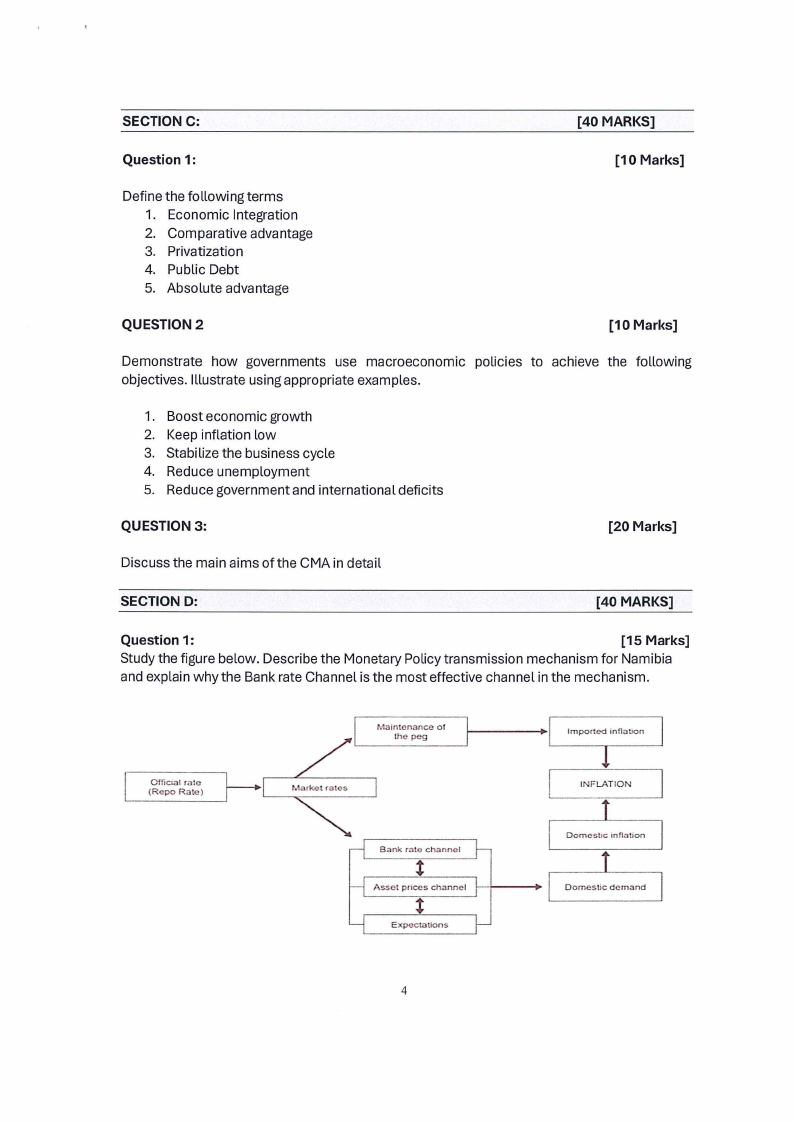
Study the figure below. Describe the Monetary Policy transmission mechanism for Namibia
and explain why the Bank rate Channel is the most effective channel in the mechanism.
Maintenance of
the peg
> - - - - - - - ,•~ • Imported inflauo n
Official rate
(Repo Rate)
Market rates
B ank r.:ite c hannel
t
Asse t pnces channel
t
E xpecta tion s
INFLATION
D omesllc infla tion
Domestic demand
4
|
|
5 Page 5 |
▲back to top |
Question 2:
Discuss the main disadvantages of Privatization.
Question 3
Discuss in detail the main role of government in the economy
[10 Marks]
[15 Marks]
5