


 |
LPM802S - LeadeshipAnd Project Management - 2nd Opp - Nov 2025 |
|
|
1 Page 1 |
▲back to top |
" nAm I BIA un IVE RSITY
OF SCIEnCE Ano TECHnOLOGY
FACULTY OF MANAGEMENT SCIENCES
DEPARTMENT OF MARKETING AND LOGISTICS
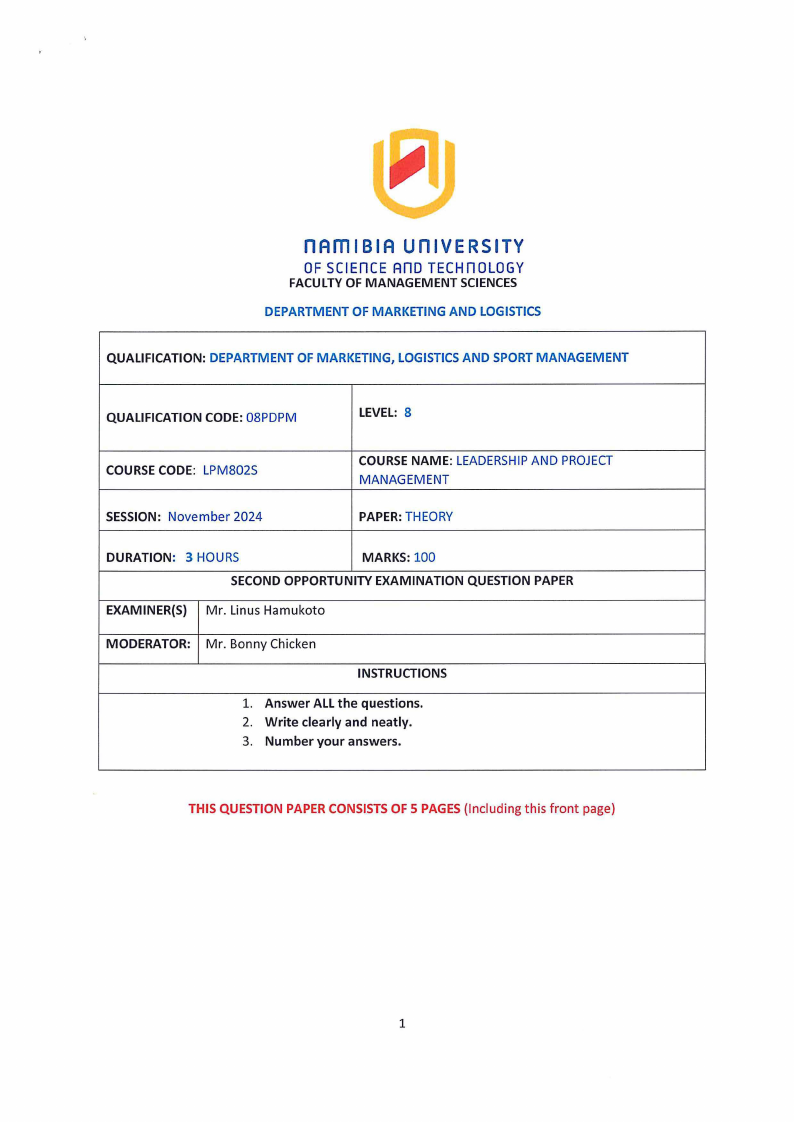
QUALIFICATION: DEPARTMENT OF MARKETING, LOGISTICS AND SPORT MANAGEMENT
QUALIFICATION CODE: 08PDPM
LEVEL: 8
COURSE CODE: LPM802S
SESSION: November 2024
COURSE NAME: LEADERSHIP AND PROJECT
MANAGEMENT
PAPER: THEORY
DURATION : 3 HOURS
MARKS: 100
SECOND OPPORTUNITY EXAMINATION QUESTION PAPER
EXAMINER(S) Mr. Linus Hamukoto
MODERATOR: Mr. Bonny Chicken
INSTRUCTIONS
1. Answer ALL the questions.
2. Write clearly and neatly.
3. Number your answers.
THIS QUESTION PAPER CONSISTS OF 5 PAGES (Including t his front page)
1
|
|
2 Page 2 |
▲back to top |
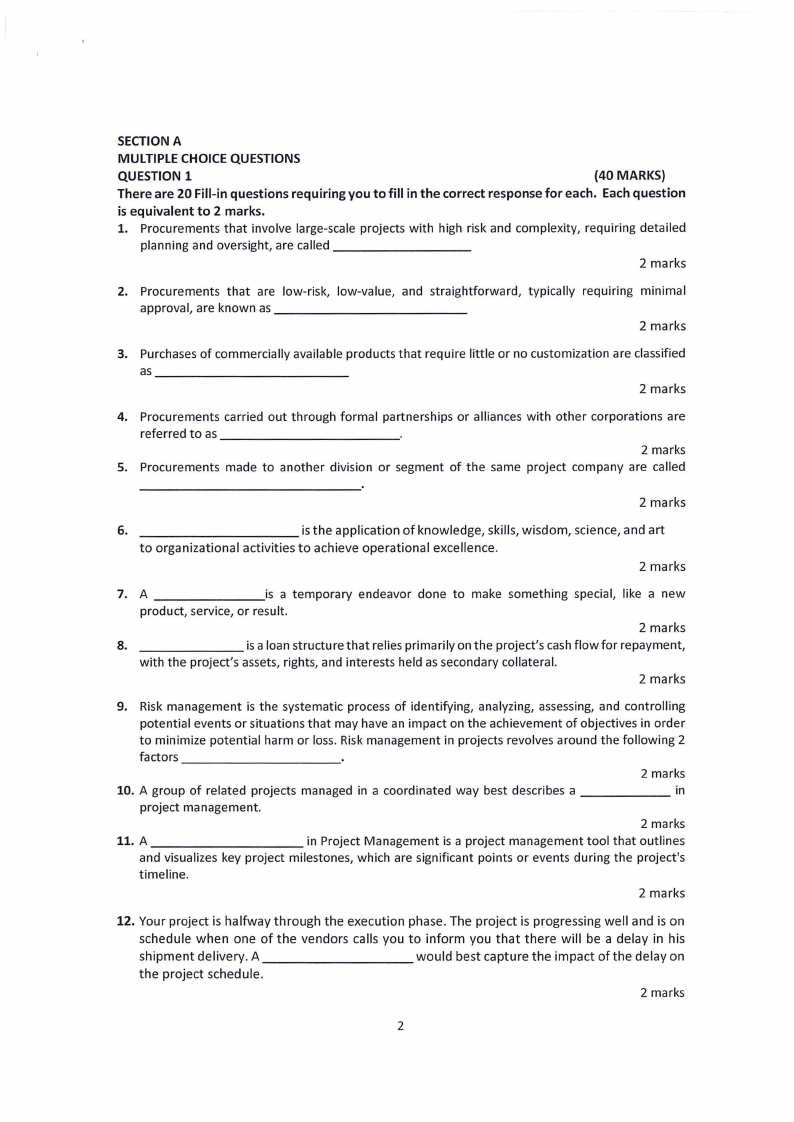
SECTION A
MULTIPLE CHOICE QUESTIONS
QUESTION 1
(40 MARKS)
There are 20 Fill-in questions requiring you to fill in the correct response for each. Each question
is equivalent to 2 marks.
1. Procurements that involve large-scale projects with high risk and complexity, requiring detailed
planning and oversight, are called _ _ _ _ _ _ _ __
2 marks
2. Procurements that are low-risk, low-value, and straightforward, typically requiring minimal
approval, are known as _ _ _ _ _ _ _ _ _ _ _ __
2 marks
3. Purchases of commercially available products that require little or no customization are classified
as _ _ _ _ _ _ _ _ _ _ _ __
2 marks
4. Procurements carried out through formal partnerships or alliances with other corporations are
referred to as _ _ _ _ _ _ _ _ _ _ __
2 marks
5. Procurements made to another division or segment of the same project company are called
2 marks
6. _ _ _ _ _ _ _ _ _ _ is the application of knowledge, skills, wisdom, science, and art
to organizational activities to achieve operational excellence.
2 marks
7. A _ _ _ _ _ _ _is a temporary endeavor done to make something special, like a new
product, service, or result.
2 marks
8. _ _ _ _ _ _ _ is a loan structure that relies primarily on the project's cash flow for repayment,
with the project's assets, rights, and interests held as secondary collateral.
2 marks
9. Risk management is the systematic process of identifying, analyzing, assessing, and controlling
potential events or situations that may have an impact on the achievement of objectives in order
to minimize potential harm or loss. Risk management in projects revolves around the following 2
factors ___________
2 marks
10. A group of related projects managed in a coordinated way best describes a _ _ _ _ _ _ in
project management.
2 marks
11. A _ _ _ _ _ _ _ _ _ _ in Project Management is a project management tool that outlines
and visualizes key project milestones, which are significant points or events during the project's
timeline.
2 marks
12. Your project is halfway through the execution phase . The project is progressing well and is on
schedule when one of the vendors calls you to inform you that there will be a delay in his
shipment delivery. A __________ would best capture the impact of the delay on
the project schedule.
2 marks
2
|
|
3 Page 3 |
▲back to top |
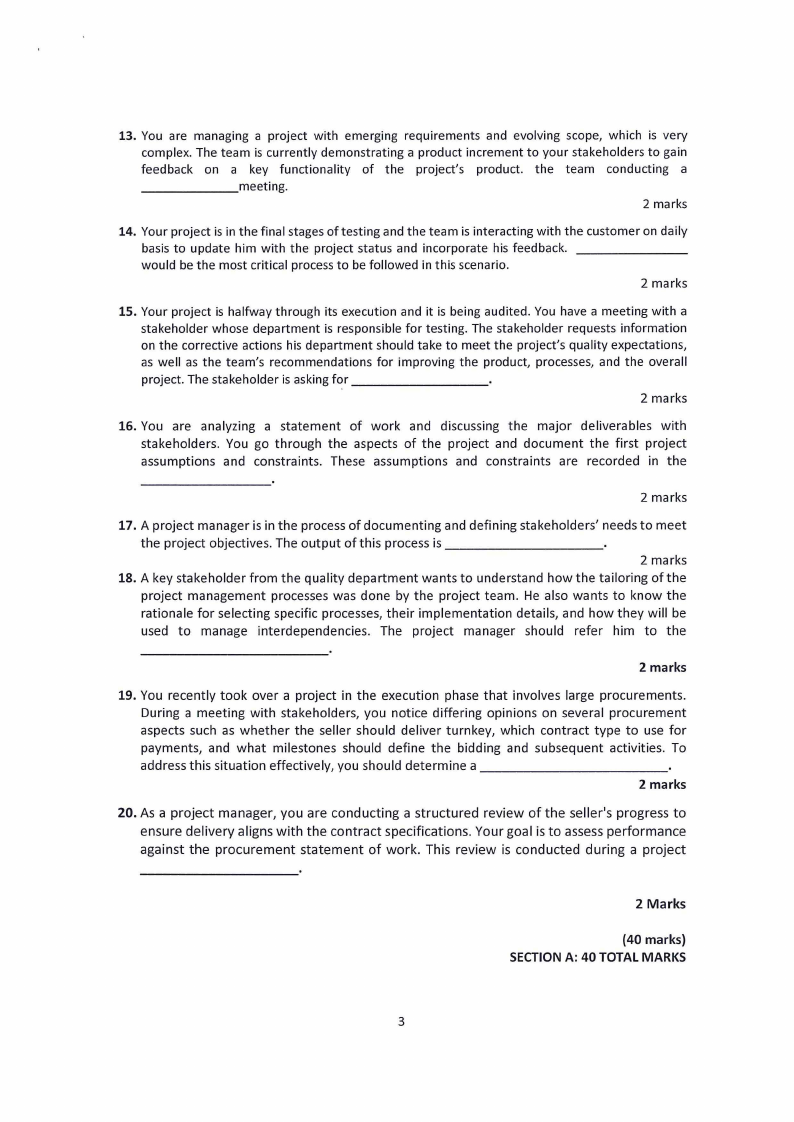
13. You are managing a project with emerging requirements and evolving scope, which is very
complex. The team is currently demonstrating a product increment to your stakeholders to gain
feedback on a key funct ionality of the project's product. the team conducting a
_ _ _ _ _ _meeting.
2 marks
14. Your project is in the final stages of testing and the team is interacting with the customer on daily
basis to update him with the project status and incorporate his feedback.
would be the most critical process to be followed in this scenario.
2 marks
15. Your project is halfway through its execution and it is being audited . You have a meeting with a
stakeholder whose department is responsible for testing. The stakeholder requests information
on the corrective actions his department should take to meet the project's quality expectations,
as well as the team's recommendations for improving the product, processes, and the overall
project. The stakeholder is asking for _ _ _ _ _ _ _ __
2 marks
16. You are analyzing a statement of work and discussing the major deliverables with
stakeholders. You go through the aspects of the project and document the first project
assumptions and constraints. These assumptions and constraints are recorded in the
2 marks
17. A project manager is in the process of documenting and defin ing stakeholders' needs to meet
the project objectives. The output of this process is _ _ _ _ _ _ _ _ __
2 marks
18. A key stakeholder from the quality department wants to understand how the tailoring of the
project management processes was done by the project team. He also wants to know the
rationale for selecting specific processes, their implementation details, and how they will be
used to manage interdependencies. The project manager should refer him to the
2 marks
19. You recently took over a project in the execution phase that involves large procurements.
During a meeting with stakeholders, you notice differing opinions on several procurement
aspects such as whether the seller should deliver turnkey, which contract type to use for
payments, and what milestones shou ld define the bidding and subsequent activities. To
address this situation effectively, you should determine a ____________
2 marks
20. As a project manager, you are conducting a structured review of the seller's progress to
ensure delivery aligns with the contract specifications. Your goal is to assess performance
against the procurement statement of work. This review is conducted during a project
2 Marks
(40 marks)
SECTION A: 40 TOTAL MARKS
3
|
|
4 Page 4 |
▲back to top |
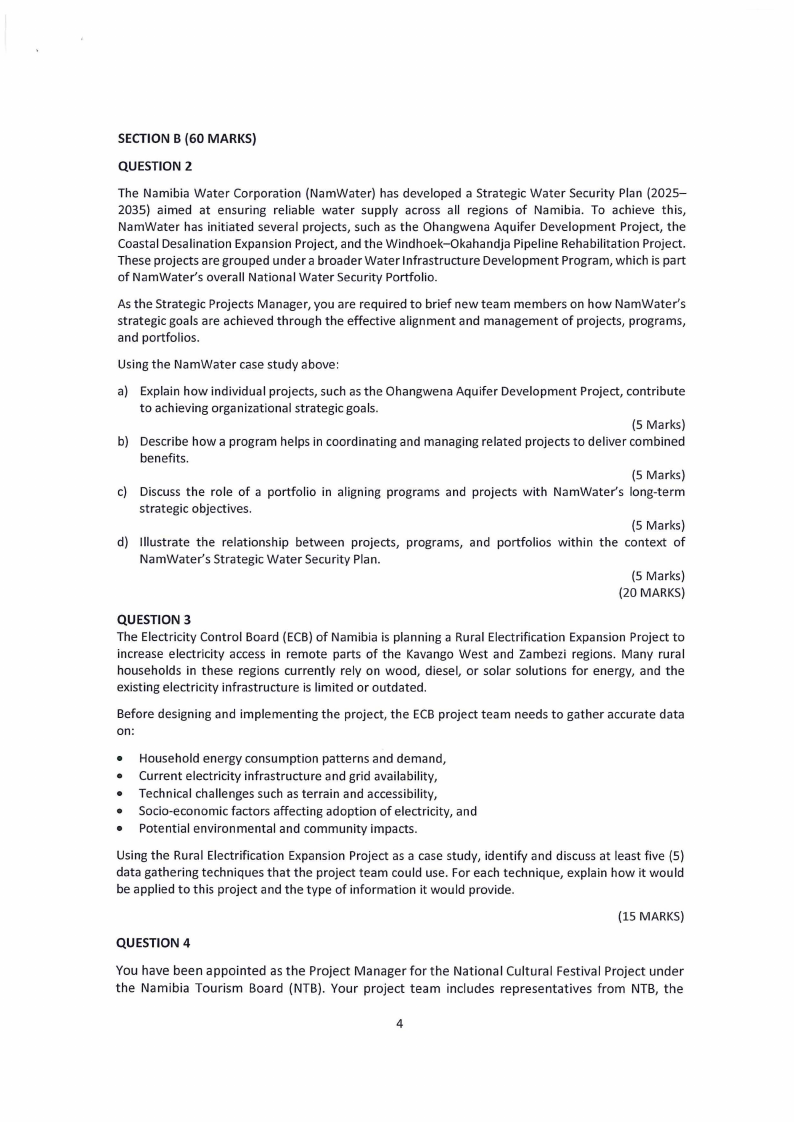
SECTION B (60 MARKS)
QUESTION 2
The Namibia Water Corporation (NamWater) has developed a Strategic Water Security Plan (2025-
2035) aimed at ensuring reliable water supply across all regions of Namibia. To achieve this,
NamWater has initiated several projects, such as the Oha ngwena Aquifer Development Project, the
Coastal Desalination Expansion Project, and the Windhoek-Okahandja Pipeline Rehabilitation Project.
These projects are grouped under a broader Water Infrastructure Development Program, which is part
of NamWater's overall National Water Security Portfolio.
As the Strategic Projects Manager, you are required to brief new team members on how NamWater's
strategic goals are achieved through the effective alignment and management of projects, programs,
and portfolios.
Using the NamWater case study above:
a) Explain how individual projects, such as the Ohangwena Aquifer Development Project, contribute
to achieving organizational strategic goals.
(5 Marks)
b) Describe how a program helps in coordinating and managing related projects to deliver combined
benefits.
(5 Marks)
c) Discuss the role of a portfolio in aligning programs and projects with NamWater's long-term
strategic objectives.
(5 Marks)
d) Illustrate the relationship between projects, programs, and portfol ios within the context of
NamWater' s Strategic Water Security Plan.
(5 Marks)
(20 MARKS)
QUESTION 3
The Electricity Control Board (ECB) of Namibia is planning a Rural Electrification Expansion Project to
increase electricity access in remote parts of the Kavango West and Zambezi regions. Many rural
households in these regions currently rely on wood, diesel, or solar solutions for energy, and the
existing electricity infrastructure is limited or outdated .
Before designing and implementing the project, the ECB project team needs to gather accurate data
on:
• Household energy consumption patterns and demand,
• Current electricity infrastructure and grid availability,
• Technical challenges such as terrain and accessibility,
• Socio-economic factors affecting adoption of electricity, and
• Potential environmental and community impacts.
Using the Rural Electrification Expansion Project as a case study, identify and discuss at least five (5)
data gathering techniques that the project team could use. For each technique, explain how it would
be applied to this project and the type of information it would provide.
(15 MARKS)
QUESTION 4
You have been appointed as the Project Manager for the National Cultural Festival Project under
the Namibia Tourism Board (NTB) . Your project team includes representatives from NTB, the
4
|
|
5 Page 5 |
▲back to top |
Ministry of Environment and Tourism, local municipalities, tourism operators, and cultural
organizations .
You are required to explain the different techniques of voting to your team to enable them to
select one preferred option for key project decisions, such as the festival location, main
attractions, or budget allocation.
Using this scenario, describe the following voting and decision-making techniques, including how
each could be applied, the expected outcome, and possible advantages or challenges:
• Unanimity
• Majority
• Plu rality
• Autocratic decision-making
• Multicriteria Decision Analysis (MCDA)
(20 MARKS)
QUESTION 5
The Ministry of Health in Namibia is planning a project to upgrade regional hospitals by procuring
new medical equipment and construction services. As the project manager, you are tasked with
preparing the Project Procurement Management Plan to guide the procurement process and
ensure transparency, accountability, and timely delivery.
Using this scenario, list any five (5) key components that should be included in the Project
Procurement Management Plan to ensure effective procurement planning and management.
(5 Marks)
SECTION B: 60 TOTAL MARKS
TOTAL: 100 MARKS
5