


 |
SHR811S - STRATEGIC HRM - 1ST OPP - JUNE 2025 |
|
|
1 Page 1 |
▲back to top |
nAm I BI A un IVERSITY
OF SCIEn CE Ano TECHn OLOGY
FACULTY OF COMMERCE, HUMAN SCIENCES AND EDUCATION
DEPARTMENT OF GOVERNANCE AND MANAGEMENT SCIENCES
QUALIFICATION: HONOURS BACHELOR OF HUMAN RESOURCES MANAGEMENT
QUALIFICATION CODE: 08HBHRM
LEVEL: 8
COURSE CODE: SHR811S
COURSE NAME: STRATEGIC HUMAN
RESOURCES MANAGEMENT
SESSION: JUNE 2025
DURATION: 3 HOURS
PAPER: THEORY
MARKS: 100
FIRST OPPORTUNITY EXAMINATION PAPER
EXAMINER(S) DR SIMEON AMUNKETE
MODERATOR: MS CHARMAINE KASUTO
INSTRUCTIONS
1. Answer all the questions: Ensure that you attempt every question provided in the
examination paper.
2. Write clearly and neatly: Make sure your writing is clear and easy to read.
3. Number the answers clearly: Ensure that the numbering is clear and placed
before each answer
PERMISSIBLE MATERIALS
1. Examination paper.
2. Examination script.
THIS EXAMINATION QUESTION PAPER CONSISTS OF 3 PAGES (Including this front
page)
1
|
|
2 Page 2 |
▲back to top |
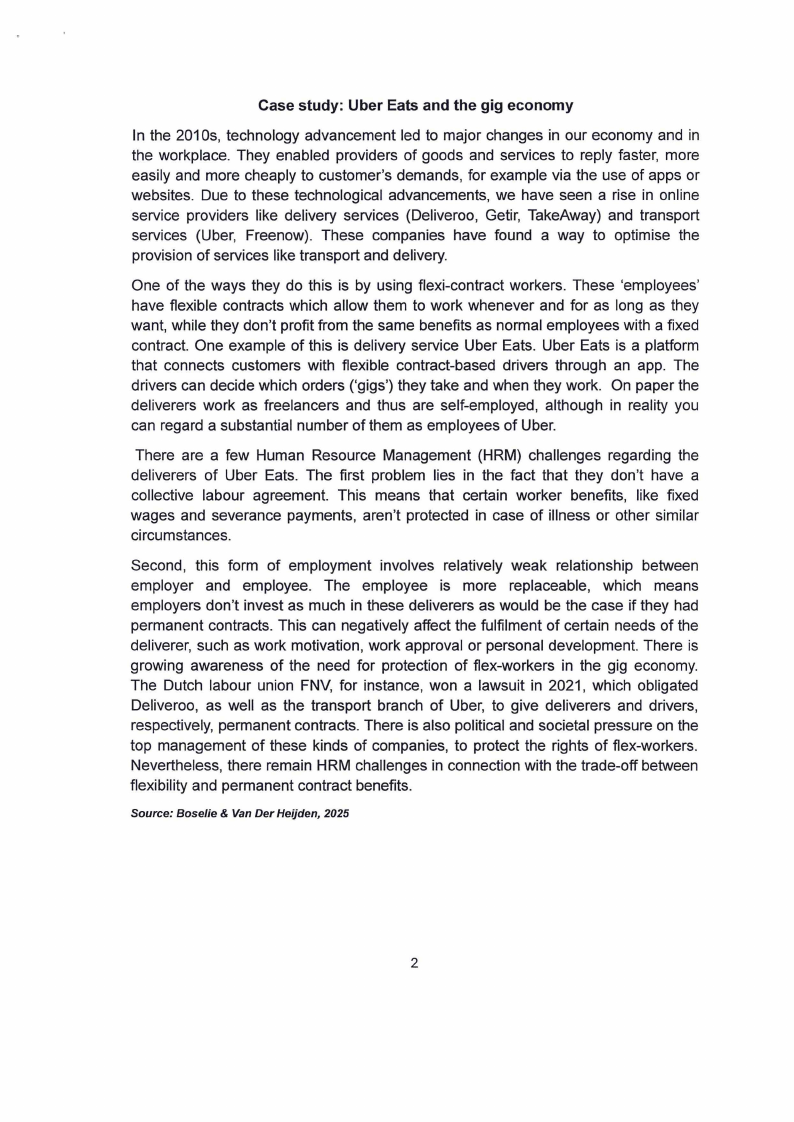
Case study: Uber Eats and the gig economy
In the 201Os, technology advancement led to major changes in our economy and in
the workplace. They enabled providers of goods and services to reply faster, more
easily and more cheaply to customer's demands, for example via the use of apps or
websites. Due to these technological advancements, we have seen a rise in online
service providers like delivery services (Deliveroo, Getir, TakeAway) and transport
services (Uber, Freenow). These companies have found a way to optimise the
provision of services like transport and delivery.
One of the ways they do this is by using flexi-contract workers. These 'employees'
have flexible contracts which allow them to work whenever and for as long as they
want, while they don't profit from the same benefits as normal employees with a fixed
contract. One example of this is delivery service Uber Eats. Uber Eats is a platform
that connects customers with flexible contract-based drivers through an app. The
drivers can decide which orders ('gigs') they take and when they work. On paper the
deliverers work as freelancers and thus are self-employed, although in reality you
can regard a substantial number of them as employees of Uber.
There are a few Human Resource Management (HRM) challenges regarding the
deliverers of Uber Eats. The first problem lies in the fact that they don't have a
collective labour agreement. This means that certain worker benefits, like fixed
wages and severance payments, aren't protected in case of illness or other similar
circumstances.
Second, this form of employment involves relatively weak relationship between
employer and employee. The employee is more replaceable, which means
employers don't invest as much in these deliverers as would be the case if they had
permanent contracts. This can negatively affect the fulfilment of certain needs of the
deliverer, such as work motivation, work approval or personal development. There is
growing awareness of the need for protection of flex-workers in the gig economy.
The Dutch labour union FNV, for instance, won a lawsuit in 2021, which obligated
Deliveroo, as well as the transport branch of Uber, to give deliverers and drivers,
respectively, permanent contracts. There is also political and societal pressure on the
top management of these kinds of companies, to protect the rights of flex-workers.
Nevertheless, there remain HRM challenges in connection with the trade-off between
flexibility and permanent contract benefits.
Source: Boselie & Van Der Heijden, 2025
2
|
|
3 Page 3 |
▲back to top |
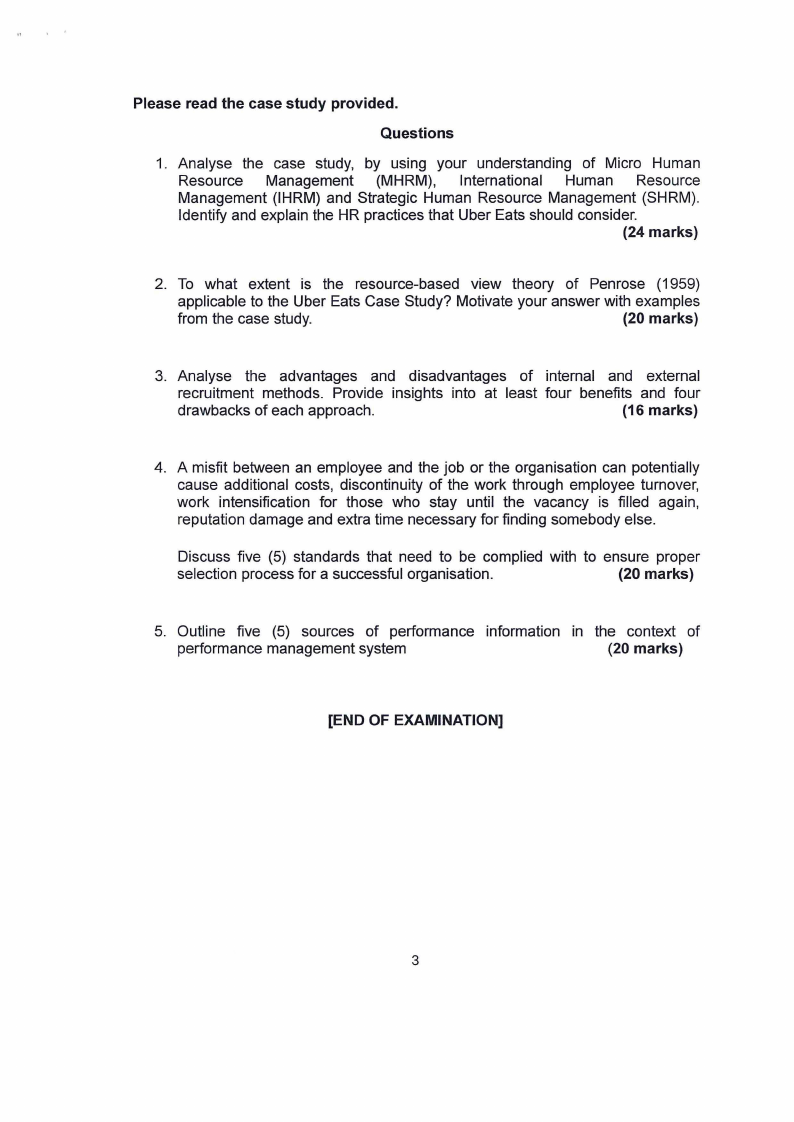
Please read the case study provided.
Questions
1. Analyse the case study, by using your understanding of Micro Human
Resource Management (MHRM), International Human Resource
Management (IHRM) and Strategic Human Resource Management (SHRM).
Identify and explain the HR practices that Uber Eats should consider.
(24 marks)
2. To what extent is the resource-based view theory of Penrose (1959)
applicable to the Uber Eats Case Study? Motivate your answer with examples
from the case study.
(20 marks)
3. Analyse the advantages and disadvantages of internal and external
recruitment methods. Provide insights into at least four benefits and four
drawbacks of each approach.
(16 marks)
4. A misfit between an employee and the job or the organisation can potentially
cause additional costs, discontinuity of the work through employee turnover,
work intensification for those who stay until the vacancy is filled again,
reputation damage and extra time necessary for finding somebody else.
Discuss five (5) standards that need to be complied with to ensure proper
selection process for a successful organisation.
(20 marks)
5. Outline five (5) sources of performance information in the context of
performance management system
(20 marks)
[END OF EXAMINATION]
3