


 |
SHR811S - STRATEGIC HRM - 2ND OPP - JUNE 2025 |
|
|
1 Page 1 |
▲back to top |
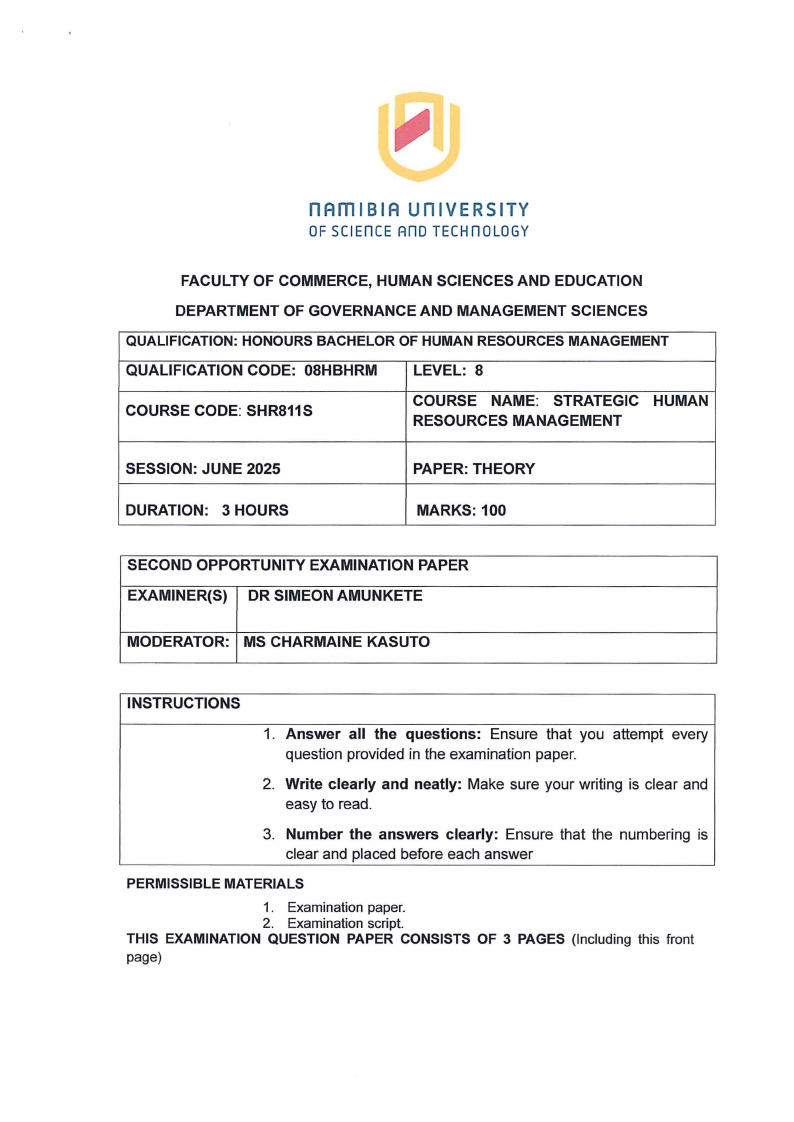
nAmlBIA unlVERSITY
OF SCIEnCE Ano TECHnOLOGY
FACULTY OF COMMERCE, HUMAN SCIENCES AND EDUCATION
DEPARTMENT OF GOVERNANCE AND MANAGEMENT SCIENCES
QUALIFICATION: HONOURS BACHELOR OF HUMAN RESOURCES MANAGEMENT
QUALIFICATION CODE: 08HBHRM
LEVEL: 8
COURSE CODE: SHR811S
COURSE NAME: STRATEGIC HUMAN
RESOURCES MANAGEMENT
SESSION: JUNE 2025
DURATION: 3 HOURS
PAPER: THEORY
MARKS: 100
SECOND OPPORTUNITY EXAMINATION PAPER
EXAMINER(S) DR SIMEON AMUNKETE
MODERATOR: MS CHARMAINE KASUTO
INSTRUCTIONS
1. Answer all the questions: Ensure that you attempt every
question provided in the examination paper.
2. Write clearly and neatly: Make sure your writing is clear and
easy to read.
3. Number the answers clearly: Ensure that the numbering is
clear and placed before each answer
PERMISSIBLE MATERIALS
1. Examination paper.
2. Examination script.
THIS EXAMINATION QUESTION PAPER CONSISTS OF 3 PAGES (Including this front
page)
|
|
2 Page 2 |
▲back to top |
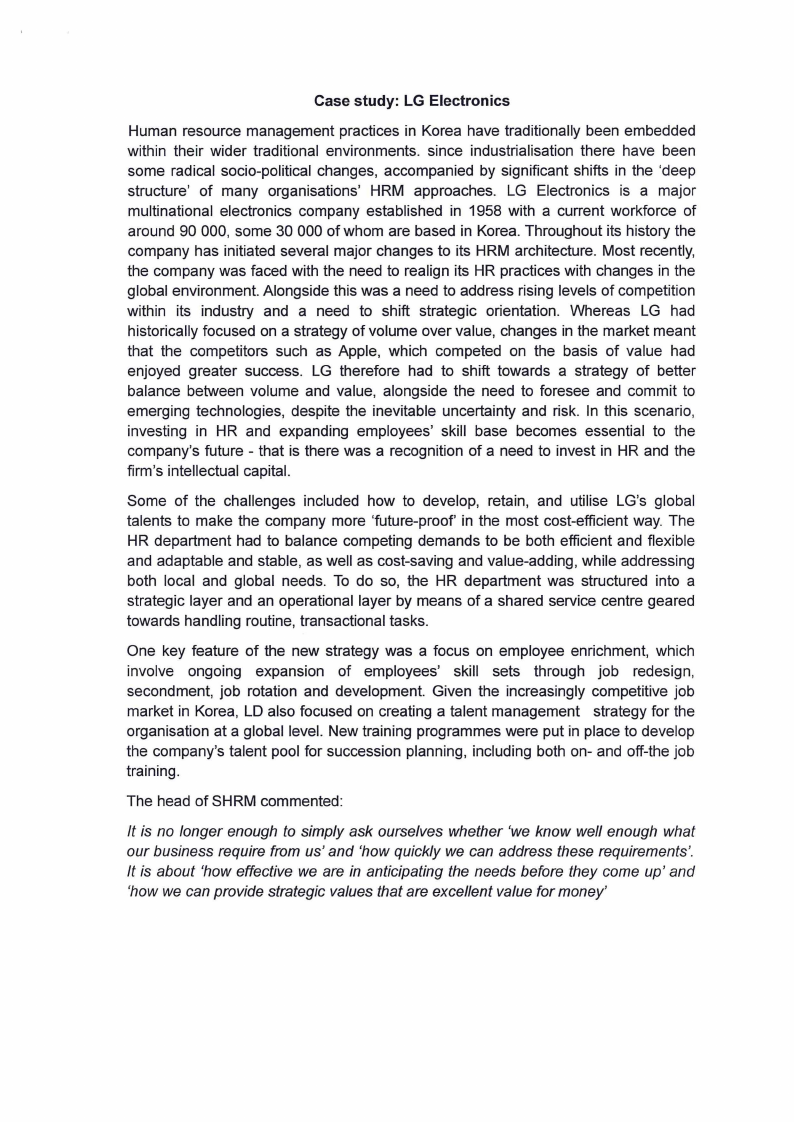
Case study: LG Electronics
Human resource management practices in Korea have traditionally been embedded
within their wider traditional environments. since industrialisation there have been
some radical socio-political changes, accompanied by significant shifts in the 'deep
structure' of many organisations' HRM approaches. LG Electronics is a major
multinational electronics company established in 1958 with a current workforce of
around 90 000, some 30 000 of whom are based in Korea. Throughout its history the
company has initiated several major changes to its HRM architecture. Most recently,
the company was faced with the need to realign its HR practices with changes in the
global environment. Alongside this was a need to address rising levels of competition
within its industry and a need to shift strategic orientation. Whereas LG had
historically focused on a strategy of volume over value, changes in the market meant
that the competitors such as Apple, which competed on the basis of value had
enjoyed greater success. LG therefore had to shift towards a strategy of better
balance between volume and value, alongside the need to foresee and commit to
emerging technologies, despite the inevitable uncertainty and risk. In this scenario,
investing in HR and expanding employees' skill base becomes essential to the
company's future - that is there was a recognition of a need to invest in HR and the
firm's intellectual capital.
Some of the challenges included how to develop, retain, and utilise LG's global
talents to make the company more 'future-proof' in the most cost-efficient way. The
HR department had to balance competing demands to be both efficient and flexible
and adaptable and stable, as well as cost-saving and value-adding, while addressing
both local and global needs. To do so, the HR department was structured into a
strategic layer and an operational layer by means of a shared service centre geared
towards handling routine, transactional tasks.
One key feature of the new strategy was a focus on employee enrichment, which
involve ongoing expansion of employees' skill sets through job redesign,
secondment, job rotation and development. Given the increasingly competitive job
market in Korea, LD also focused on creating a talent management strategy for the
organisation at a global level. New training programmes were put in place to develop
the company's talent pool for succession planning, including both on- and off-the job
training.
The head of SHRM commented:
It is no longer enough to simply ask ourselves whether 'we know well enough what
our business require from us' and 'how quickly we can address these requirements'.
It is about 'how effective we are in anticipating the needs before they come up' and
'how we can provide strategic values that are excellent value for money'
|
|
3 Page 3 |
▲back to top |
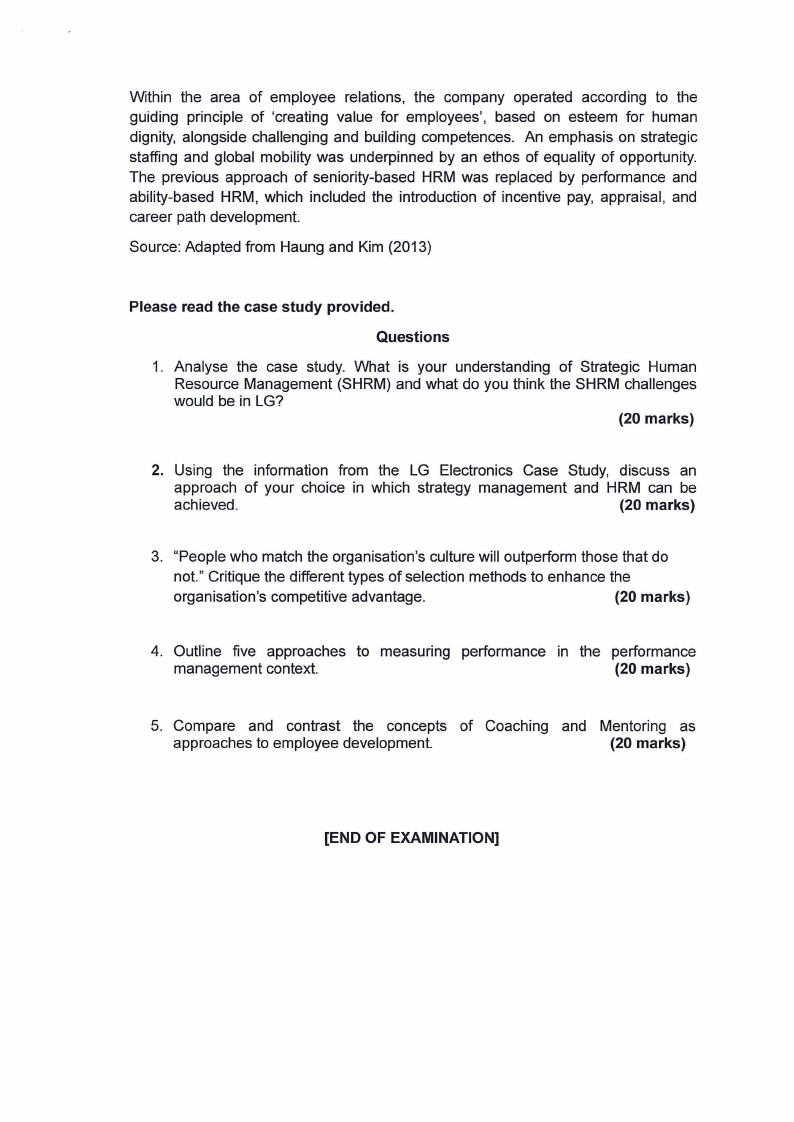
Within the area of employee relations, the company operated according to the
guiding principle of 'creating value for employees', based on esteem for human
dignity, alongside challenging and building competences. An emphasis on strategic
staffing and global mobility was underpinned by an ethos of equality of opportunity.
The previous approach of seniority-based HRM was replaced by performance and
ability-based HRM, which included the introduction of incentive pay, appraisal, and
career path development.
Source: Adapted from Haung and Kim (2013)
Please read the case study provided.
Questions
1. Analyse the case study. What is your understanding of Strategic Human
Resource Management (SHRM) and what do you think the SHRM challenges
would be in LG?
(20 marks)
2. Using the information from the LG Electronics Case Study, discuss an
approach of your choice in which strategy management and HRM can be
achieved.
(20 marks)
3. "People who match the organisation's culture will outperform those that do
not." Critique the different types of selection methods to enhance the
organisation's competitive advantage.
(20 marks)
4. Outline five approaches to measuring performance in the performance
management context.
(20 marks)
5. Compare and contrast the concepts of Coaching and Mentoring as
approaches to employee development.
(20 marks)
[END OF EXAMINATION]