


 |
PPM712S - PRODUCT PRICING MANAGEMENT - 2ND OPP - JULY 2025 |
|
|
1 Page 1 |
▲back to top |
nAmlBIA UnlVERSITY
OF SCIEnCE Ano TECHnOLOGY
FACULTY OF COMMERCE, HUMAN SCIENCESAND EDUCATION
DEPARTMENT OF MARKETING, LOGISTICSAND SPORT MANAGEMENT
QUALIFICATION: BACHELOR OF MARKETING
QUALIFICATION CODE: 07BMAK
LEVEL: 7
COURSE CODE: PPM712S
COURSE NAME: PRODUCTPRICINGMANAGEMENT
SESSION: JUNE 2025
PAPER: THEORY
DURATION: 3 HOURS
MARKS: 100
SECOND OPPORTUNITY EXAMINATION QUESTION PAPER
EXAMINER
MR. C. KAZONDOVI
MODERATOR: MS. L. PRINZONSKY
INSTRUCTIONS
1. Answer ALL the questions.
2. Write clearly and neatly.
3. Number the answers clearly.
4. Use the tables provided on page [8] to answer Questions 6 & 7:
Detach and insert into your answer booklet.
5. Write as legible as possible, and as precise as possible.
6. Read each question carefully.
7. Use a non-programmable calculator (STRICTLYNO USEOF
CELLPHONE/MOBILECALCULATOR).
8. Round of your answers to two (2) Decimal places.
THIS QUESTION PAPER CONSISTS OF 8 PAGES (Including this front page)
1
|
|
2 Page 2 |
▲back to top |
Question 1
[15 marks]
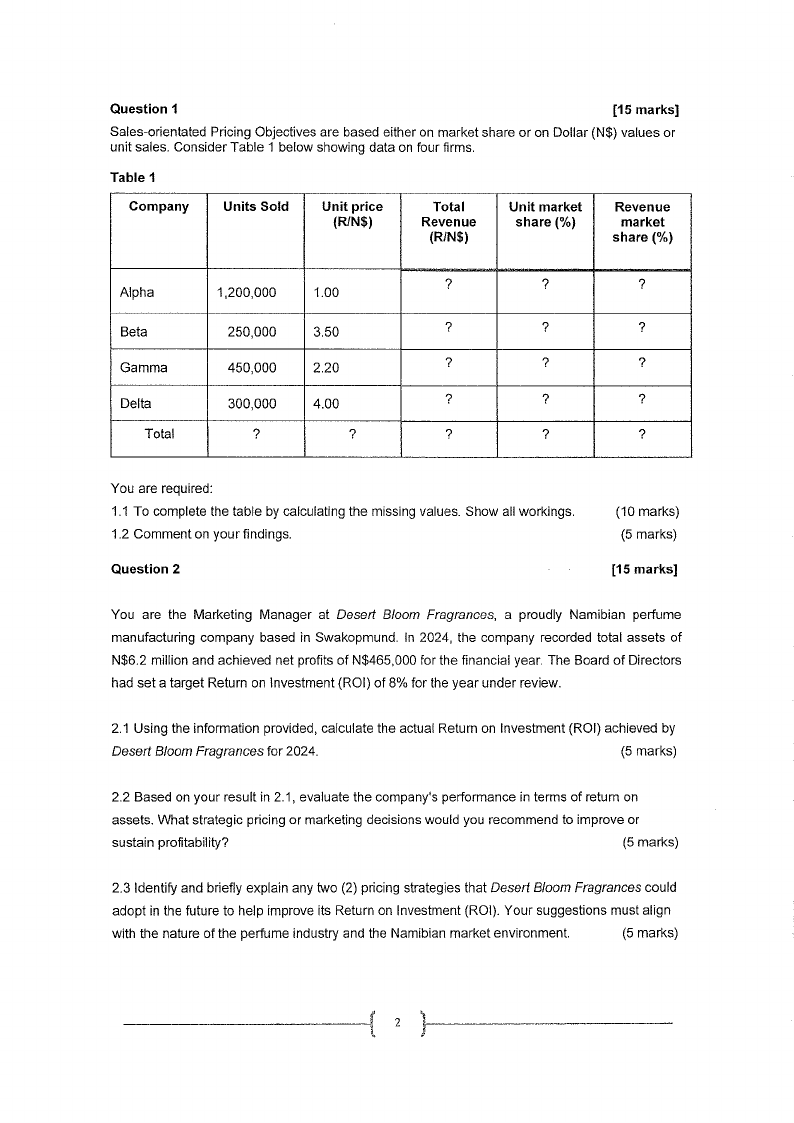
Sales-orientated Pricing Objectives are based either on market share or on Dollar (N$) values or
unit sales. Consider Table 1 below showing data on four firms.
Table 1
Company
Units Sold
Unit price
(R/N$)
Total
Revenue
(RIN$)
Unit market
share(%)
Revenue
market
share(%)
Alpha
1,200,000
1.00
?
?
?
Beta
250,000
3.50
?
?
?
Gamma
450,000
2.20
?
?
?
Delta
300,000
4.00
?
?
?
Total
?
?
?
?
?
You are required:
1.1 To complete the table by calculating the missing values. Show all workings.
1.2 Comment on your findings.
Question 2
(10 marks)
(5 marks)
[15 marks]
You are the Marketing Manager at Desert Bloom Fragrances, a proudly Namibian perfume
manufacturing company based in Swakopmund. In 2024, the company recorded total assets of
N$6.2 million and achieved net profits of N$465,000 for the financial year. The Board of Directors
had set a target Return on Investment (ROI) of 8% for the year under review.
2.1 Using the information provided, calculate the actual Return on Investment (ROI) achieved by
Desert Bloom Fragrances for 2024.
(5 marks)
2.2 Based on your result in 2.1, evaluate the company's performance in terms of return on
assets. What strategic pricing or marketing decisions would you recommend to improve or
sustain profitability?
(5 marks)
2.3 Identify and briefly explain any two (2) pricing strategies that Desert Bloom Fragrances could
adopt in the future to help improve its Return on Investment (ROI). Your suggestions must align
with the nature of the perfume industry and the Namibian market environment.
(5 marks)
---------------;'
t2
|
|
3 Page 3 |
▲back to top |
Question 3
[10 marks]
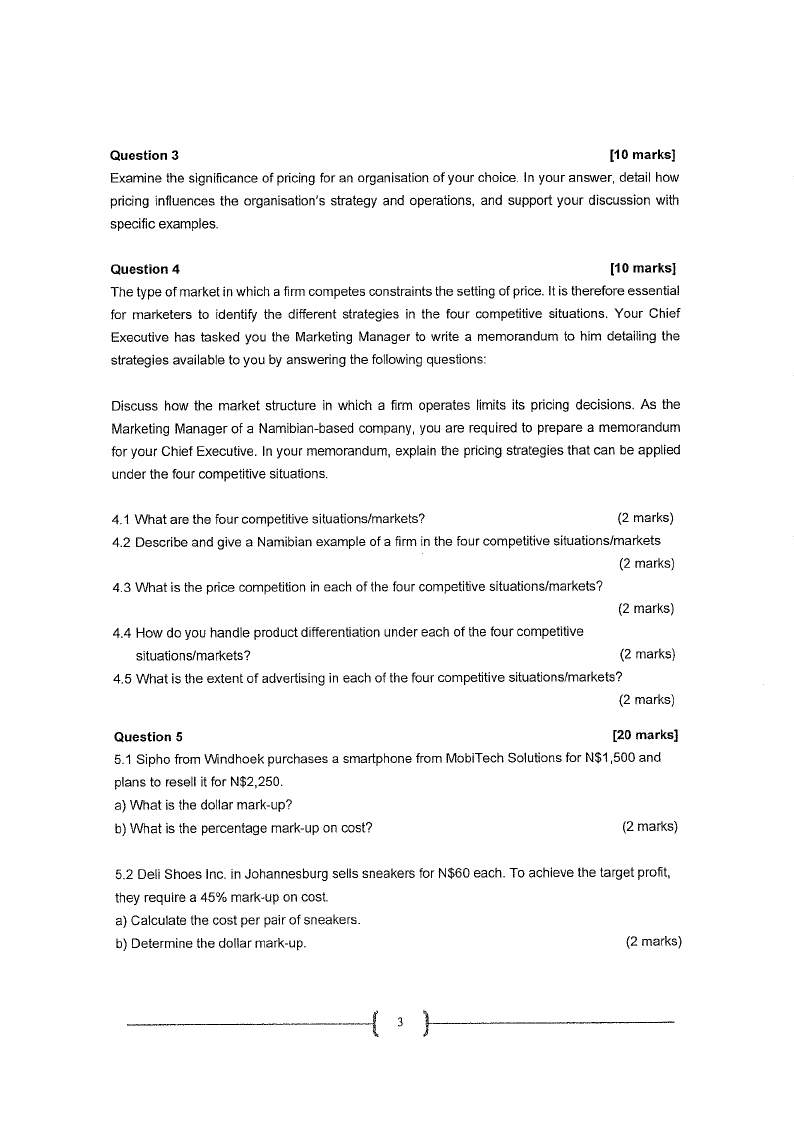
Examine the significance of pricing for an organisation of your choice. In your answer, detail how
pricing influences the organisation's strategy and operations, and support your discussion with
specific examples.
Question 4
[10 marks)
The type of market in which a firm competes constraints the setting of price. It is therefore essential
for marketers to identify the different strategies in the four competitive situations. Your Chief
Executive has tasked you the Marketing Manager to write a memorandum to him detailing the
strategies available to you by answering the following questions:
Discuss how the market structure in which a firm operates limits its pricing decisions. As the
Marketing Manager of a Namibian-based company, you are required to prepare a memorandum
for your Chief Executive. In your memorandum, explain the pricing strategies that can be applied
under the four competitive situations.
4.1 What are the four competitive situations/markets?
(2 marks)
4.2 Describe and give a Namibian example of a firm in the four competitive situations/markets
(2 marks)
4.3 What is the price competition in each of the four competitive situations/markets?
(2 marks)
4.4 How do you handle product differentiation under each of the four competitive
situations/markets?
(2 marks)
4.5 What is the extent of advertising in each of the four competitive situations/markets?
(2 marks)
Question 5
[20 marks]
5.1 Sipho from Windhoek purchases a smartphone from MobiTech Solutions for N$1,500 and
plans to resell it for N$2,250.
a) What is the dollar mark-up?
b) What is the percentage mark-up on cost?
(2 marks)
5.2 Deli Shoes Inc. in Johannesburg sells sneakers for N$60 each. To achieve the target profit,
they require a 45% mark-up on cost.
a) Calculate the cost per pair of sneakers.
b) Determine the dollar mark-up.
(2 marks)
3
|
|
4 Page 4 |
▲back to top |
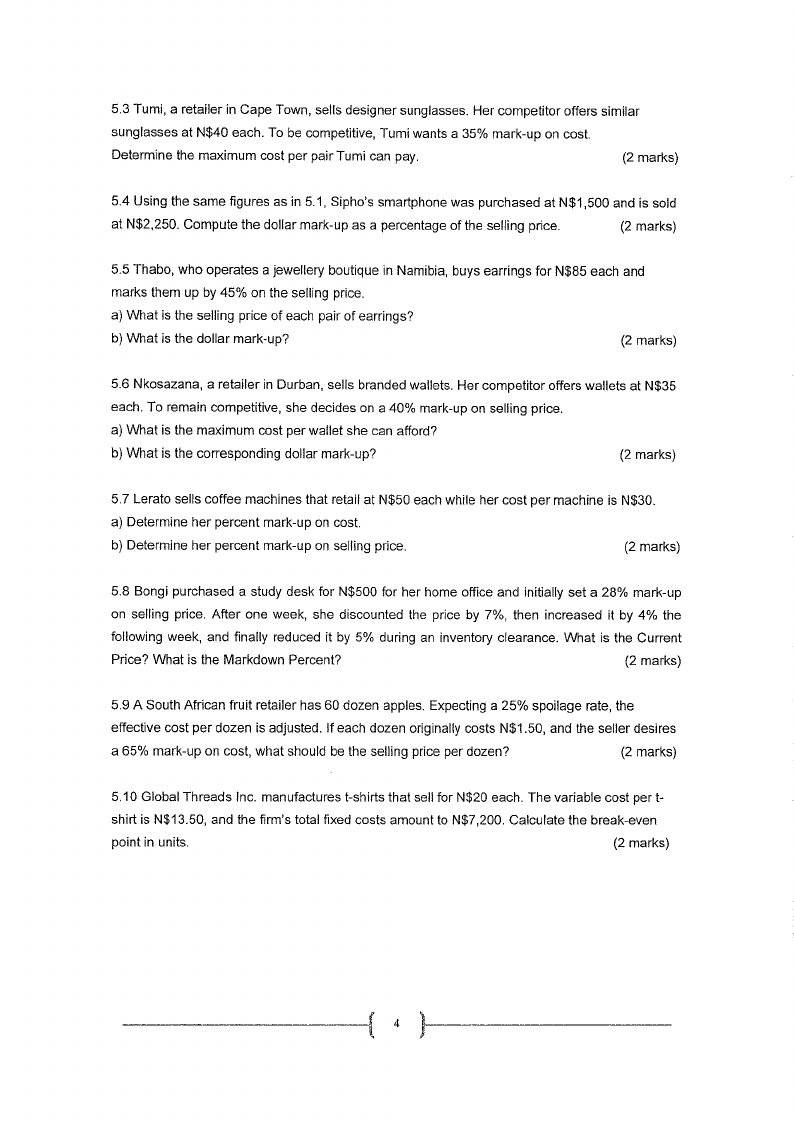
5.3 Tumi, a retailer in Cape Town, sells designer sunglasses. Her competitor offers similar
sunglasses at N$40 each. To be competitive, Tumi wants a 35% mark-up on cost.
Determine the maximum cost per pair Tumi can pay.
(2 marks}
5.4 Using the same figures as in 5.1, Sipho's smartphone was purchased at N$1,500 and is sold
at N$2,250. Compute the dollar mark-up as a percentage of the selling price.
(2 marks)
5.5 Thabo, who operates a jewellery boutique in Namibia, buys earrings for N$85 each and
marks them up by 45% on the selling price.
a) What is the selling price of each pair of earrings?
b) What is the dollar mark-up?
(2 marks)
5.6 Nkosazana, a retailer in Durban, sells branded wallets. Her competitor offers wallets at N$35
each. To remain competitive, she decides on a 40% mark-up on selling price.
a) What is the maximum cost per wallet she can afford?
b) What is the corresponding dollar mark-up?
(2 marks)
5.7 Lerato sells coffee machines that retail at N$50 each while her cost per machine is N$30.
a) Determine her percent mark-up on cost.
b) Determine her percent mark-up on selling price.
(2 marks)
5.8 Bongi purchased a study desk for N$500 for her home office and initially set a 28% mark-up
on selling price. After one week, she discounted the price by 7%, then increased it by 4% the
following week, and finally reduced it by 5% during an inventory clearance. What is the Current
Price? What is the Markdown Percent?
(2 marks)
5.9 A South African fruit retailer has 60 dozen apples. Expecting a 25% spoilage rate, the
effective cost per dozen is adjusted. If each dozen originally costs N$1.50, and the seller desires
a 65% mark-up on cost, what should be the selling price per dozen?
(2 marks)
5.10 Global Threads Inc. manufactures t-shirts that sell for N$20 each. The variable cost per!-
shirt is N$13.50, and the firm's total fixed costs amount to N$7,200. Calculate the break-even
point in units.
(2 marks)
l4
|
|
5 Page 5 |
▲back to top |
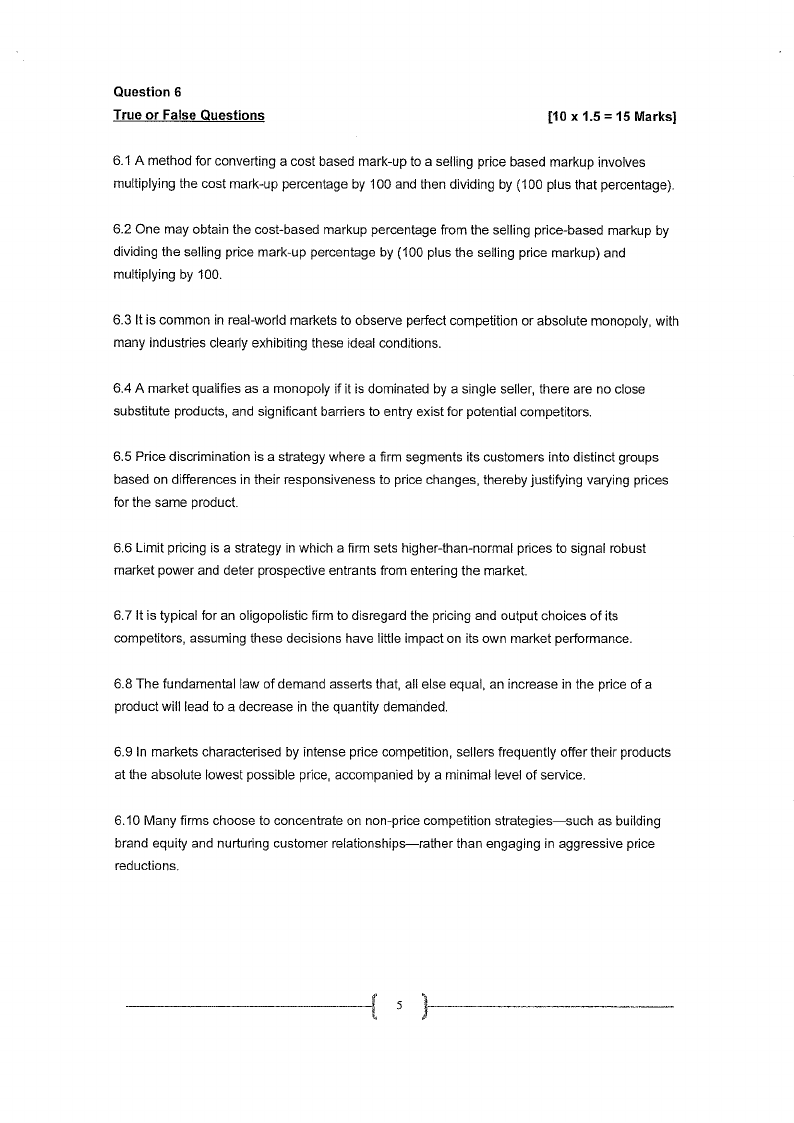
Question 6
True or False Questions
[10 x 1.5 = 15 Marks]
6.1 A method for converting a cost based mark-up to a selling price based markup involves
multiplying the cost mark-up percentage by 100 and then dividing by (100 plus that percentage).
6.2 One may obtain the cost-based markup percentage from the selling price-based markup by
dividing the selling price mark-up percentage by (100 plus the selling price markup) and
multiplying by 100.
6.3 It is common in real-world markets to observe perfect competition or absolute monopoly, with
many industries clearly exhibiting these ideal conditions.
6.4 A market qualifies as a monopoly if it is dominated by a single seller, there are no close
substitute products, and significant barriers to entry exist for potential competitors.
6.5 Price discrimination is a strategy where a firm segments its customers into distinct groups
based on differences in their responsiveness to price changes, thereby justifying varying prices
for the same product
6.6 Limit pricing is a strategy in which a firm sets higher-than-normal prices to signal robust
market power and deter prospective entrants from entering the market
6.7 It is typical for an oligopolistic firm to disregard the pricing and output choices of its
competitors, assuming these decisions have little impact on its own market performance.
6.8 The fundamental law of demand asserts that, all else equal, an increase in the price of a
product will lead to a decrease in the quantity demanded.
6.9 In markets characterised by intense price competition, sellers frequently offer their products
at the absolute lowest possible price, accompanied by a minimal level of service.
6.10 Many firms choose to concentrate on non-price competition strategies-such as building
brand equity and nurturing customer relationships-rather than engaging in aggressive price
reductions.
l5
|
|
6 Page 6 |
▲back to top |
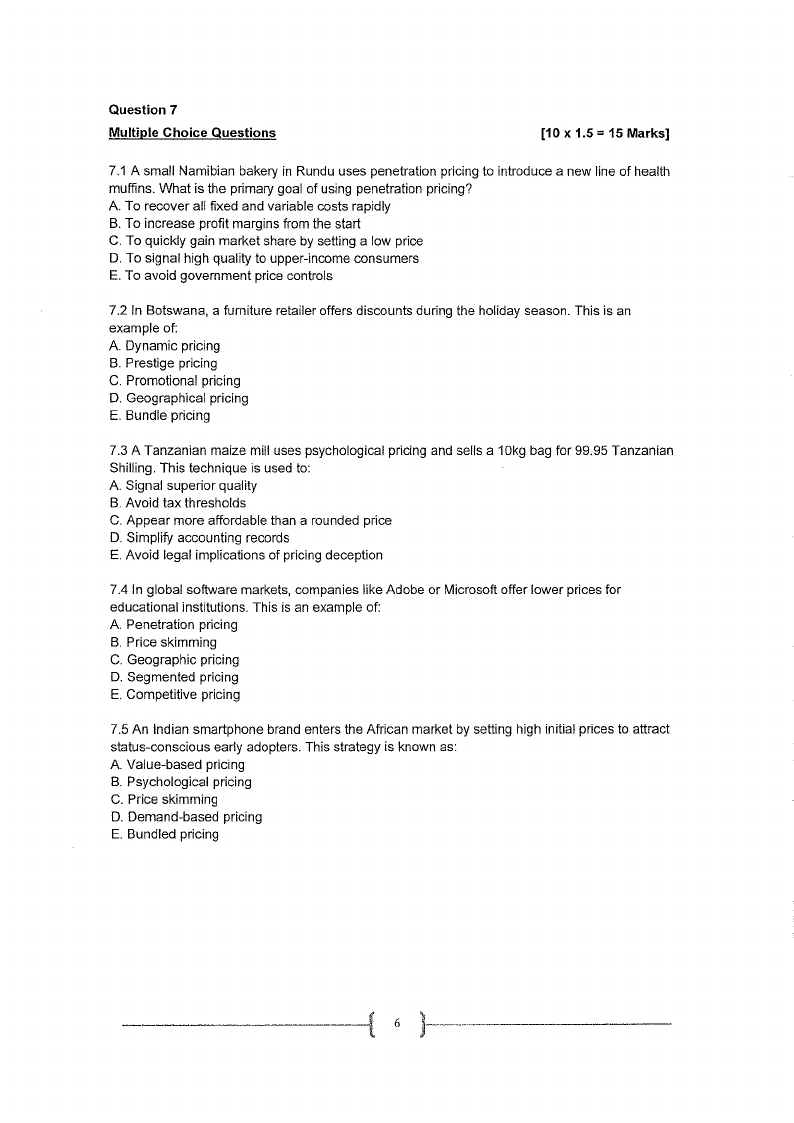
Question 7
Multiple Choice Questions
[10 x 1.5 = 15 Marks]
7.1 A small Namibian bakery in Rundu uses penetration pricing to introduce a new line of health
muffins. What is the primary goal of using penetration pricing?
A. To recover all fixed and variable costs rapidly
B. To increase profit margins from the start
C. To quickly gain market share by setting a low price
D. To signal high quality to upper-income consumers
E. To avoid government price controls
7.2 In Botswana, a furniture retailer offers discounts during the holiday season. This is an
example of:
A. Dynamic pricing
B. Prestige pricing
C. Promotional pricing
D. Geographical pricing
E. Bundle pricing
7.3 A Tanzanian maize mill uses psychological pricing and sells a 10kg bag for 99.95 Tanzanian
Shilling. This technique is used to:
A. Signal superior quality
B. Avoid tax thresholds
C. Appear more affordable than a rounded price
D. Simplify accounting records
E. Avoid legal implications of pricing deception
7.4 In global software markets, companies like Adobe or Microsoft offer lower prices for
educational institutions. This is an example of:
A. Penetration pricing
B. Price skimming
C. Geographic pricing
D. Segmented pricing
E. Competitive pricing
7.5 An Indian smartphone brand enters the African market by setting high initial prices to attract
status-conscious early adopters. This strategy is known as:
A. Value-based pricing
B. Psychological pricing
C. Price skimming
D. Demand-based pricing
E. Bundled pricing
|
|
7 Page 7 |
▲back to top |
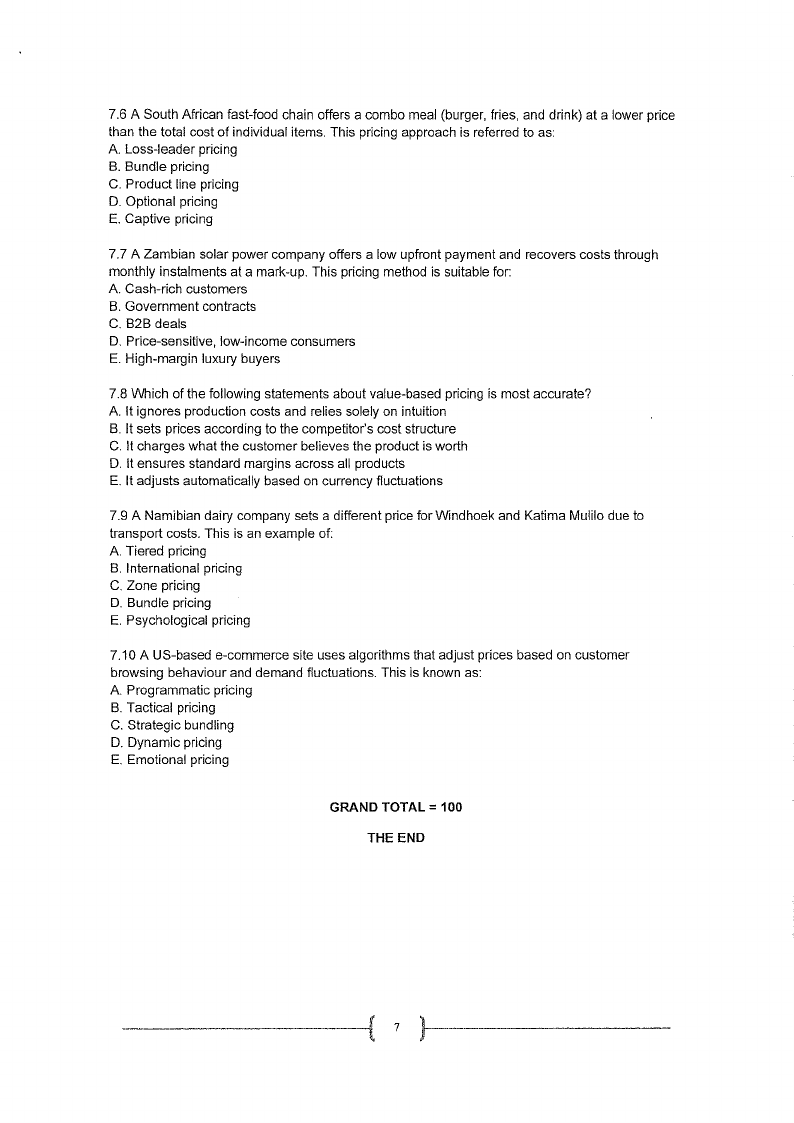
7.6 A South African fast-food chain offers a combo meal (burger, fries, and drink) at a lower price
than the total cost of individual items. This pricing approach is referred to as:
A. Loss-leader pricing
B. Bundle pricing
C. Product line pricing
D. Optional pricing
E. Captive pricing
7.7 A Zambian solar power company offers a low upfront payment and recovers costs through
monthly instalments at a mark-up. This pricing method is suitable for:
A. Cash-rich customers
B. Government contracts
C. B2B deals
D. Price-sensitive, low-income consumers
E. High-margin luxury buyers
7.8 Which of the following statements about value-based pricing is most accurate?
A. It ignores production costs and relies solely on intuition
B. It sets prices according to the competitor's cost structure
C. It charges what the customer believes the product is worth
D. It ensures standard margins across all products
E. It adjusts automatically based on currency fluctuations
7.9 A Namibian dairy company sets a different price for Windhoek and Kalima Mulilo due to
transport costs. This is an example of:
A. Tiered pricing
B. International pricing
C. Zone pricing
D. Bundle pricing
E. Psychological pricing
7.10 A US-based e-commerce site uses algorithms that adjust prices based on customer
browsing behaviour and demand fluctuations. This is known as:
A. Programmatic pricing
B. Tactical pricing
C. Strategic bundling
D. Dynamic pricing
E. Emotional pricing
GRAND TOTAL= 100
THE END
7
|
|
8 Page 8 |
▲back to top |
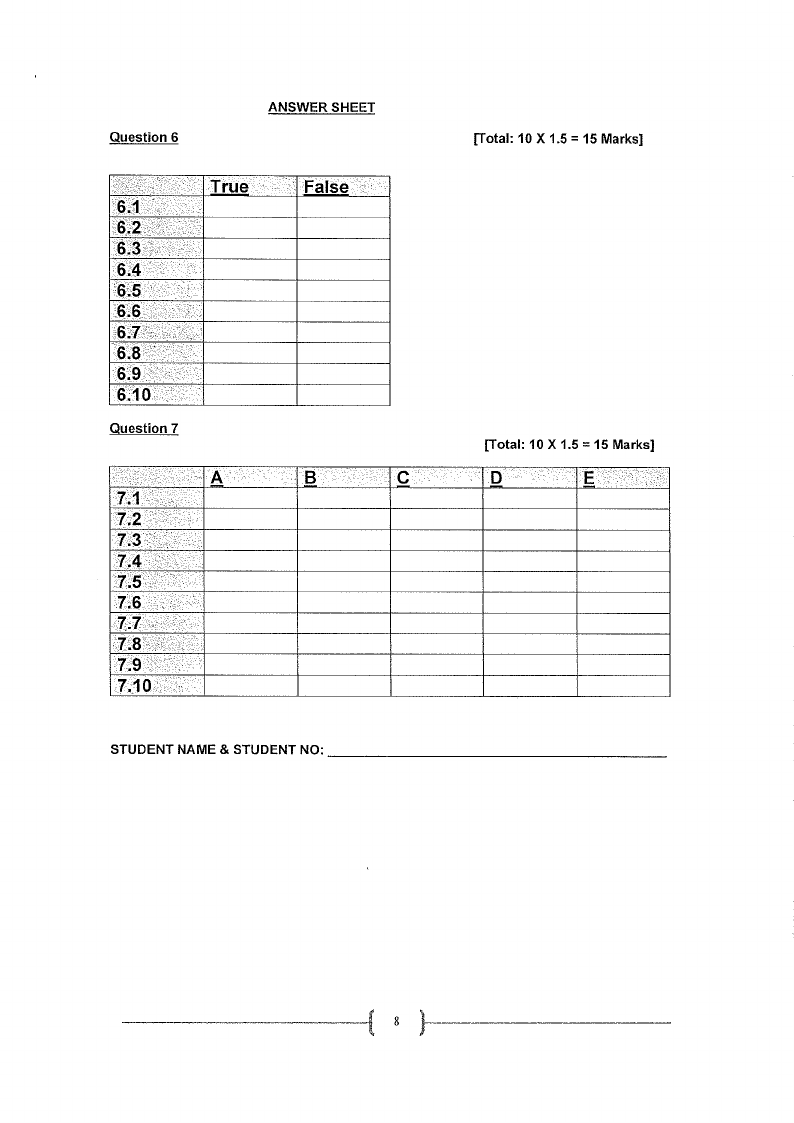
Question 6
ANSWER SHEET
True
False·
.6:3
6:4
[Total: 10 X 1.5 = 15 Marks]
6.10
Question 7
[Total: 10 X 1.5 = 15 Marks]
STUDENT NAME & STUDENT NO: _________________
_
8