


 |
ISM521C-INTRODUCATION TO SUPPLY CHAIN MANAGEMENT-2ND OPP-JULY2025 |
|
|
1 Page 1 |
▲back to top |
nAmlBIA
UnlVERSITY
OF SCIEnCE Ano
TECHnOLOGY
HAROLDPUPKEWITZ
GraduateSchoolof Business
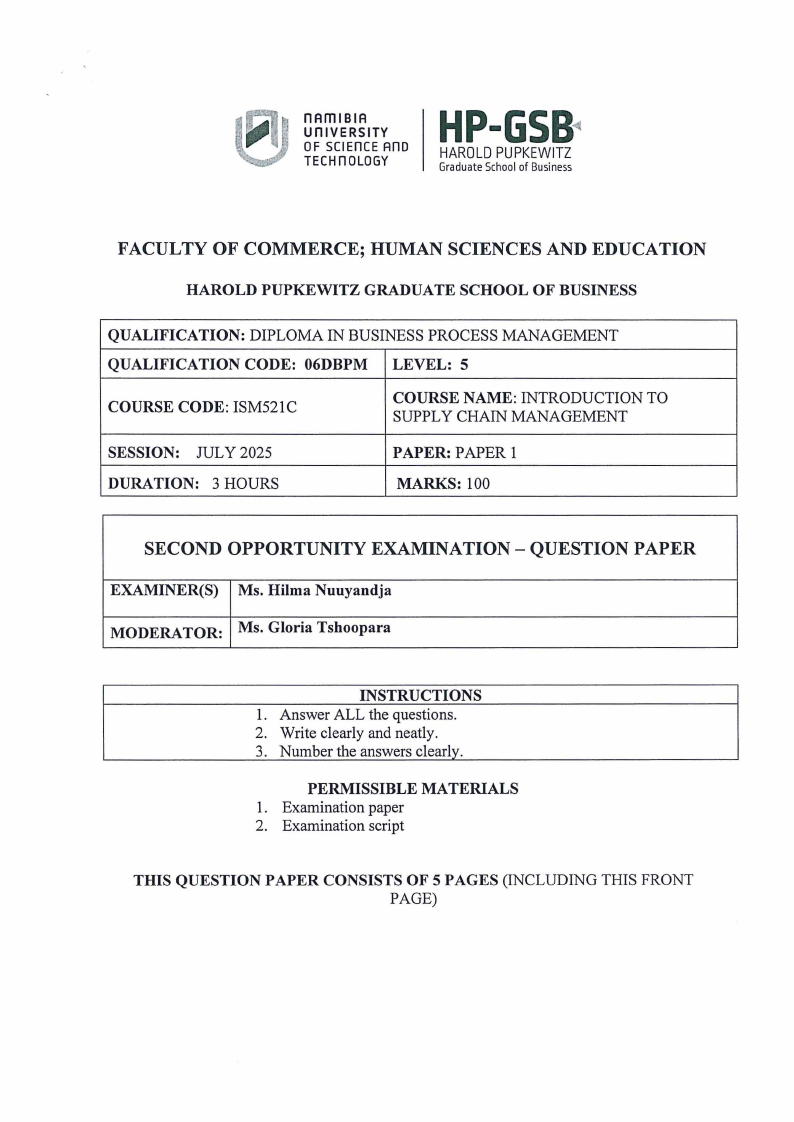
FACULTY OF COMMERCE; HUMAN SCIENCES AND EDUCATION
HAROLD PUPKEWITZ GRADUATE SCHOOL OF BUSINESS
QUALIFICATION: DIPLOMA IN BUSINESS PROCESS MANAGEMENT
QUALIFICATION CODE: 06DBPM LEVEL: 5
COURSE CODE: ISM521C
COURSE NAME: INTRODUCTION TO
SUPPLY CHAIN MANAGEMENT
SESSION: JULY2025
DURATION: 3 HOURS
PAPER: PAPER 1
MARKS: 100
SECOND OPPORTUNITY EXAMINATION -QUESTION PAPER
EXAMINER(S) Ms. Hilma Nuuyandja
MODERATOR: Ms. Gloria Tshoopara
INSTRUCTIONS
1. Answer ALL the questions.
2. Write clearly and neatly.
3. Number the answers clearly.
PERMISSIBLE MATERIALS
1. Examination paper
2. Examination script
THIS QUESTION PAPER CONSISTS OF 5 PAGES (INCLUDING THIS FRONT
PAGE)
|
|
2 Page 2 |
▲back to top |
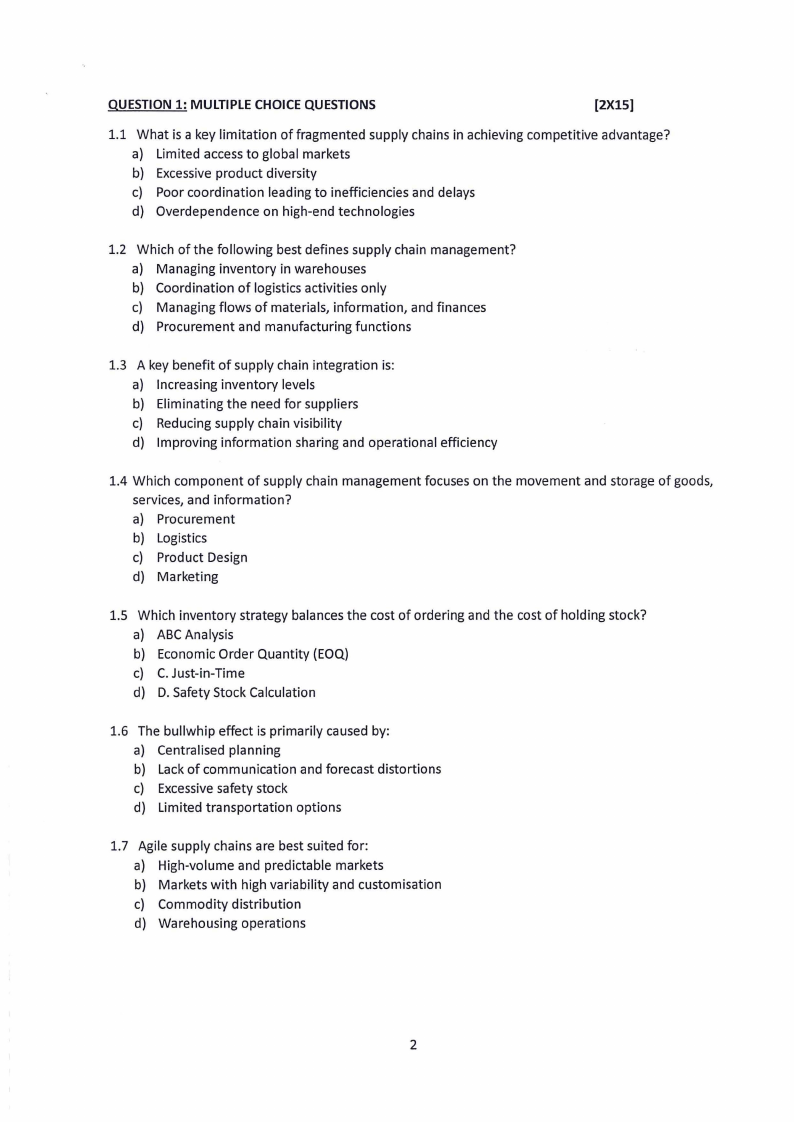
QUESTION1: MULTIPLECHOICEQUESTIONS
[2X15]
1.1 What is a key limitation of fragmented supply chains in achieving competitive advantage?
a) Limited access to global markets
b) Excessiveproduct diversity
c) Poor coordination leading to inefficiencies and delays
d) Overdependence on high-end technologies
1.2 Which of the following best defines supply chain management?
a) Managing inventory in warehouses
b) Coordination of logistics activities only
c) Managing flows of materials, information, and finances
d) Procurement and manufacturing functions
1.3 A key benefit of supply chain integration is:
a) Increasing inventory levels
b) Eliminating the need for suppliers
c) Reducing supply chain visibility
d) Improving information sharing and operational efficiency
1.4 Which component of supply chain management focuses on the movement and storage of goods,
services, and information?
a) Procurement
b) Logistics
c) Product Design
d) Marketing
1.5 Which inventory strategy balances the cost of ordering and the cost of holding stock?
a) ABCAnalysis
b) Economic Order Quantity {EOQ)
c) C. Just-in-Time
d) D. Safety Stock Calculation
1.6 The bullwhip effect is primarily caused by:
a) Centralised planning
b) Lack of communication and forecast distortions
c) Excessivesafety stock
d) Limited transportation options
1.7 Agile supply chains are best suited for:
a) High-volume and predictable markets
b) Markets with high variability and customisation
c) Commodity distribution
d) Warehousing operations
2
|
|
3 Page 3 |
▲back to top |
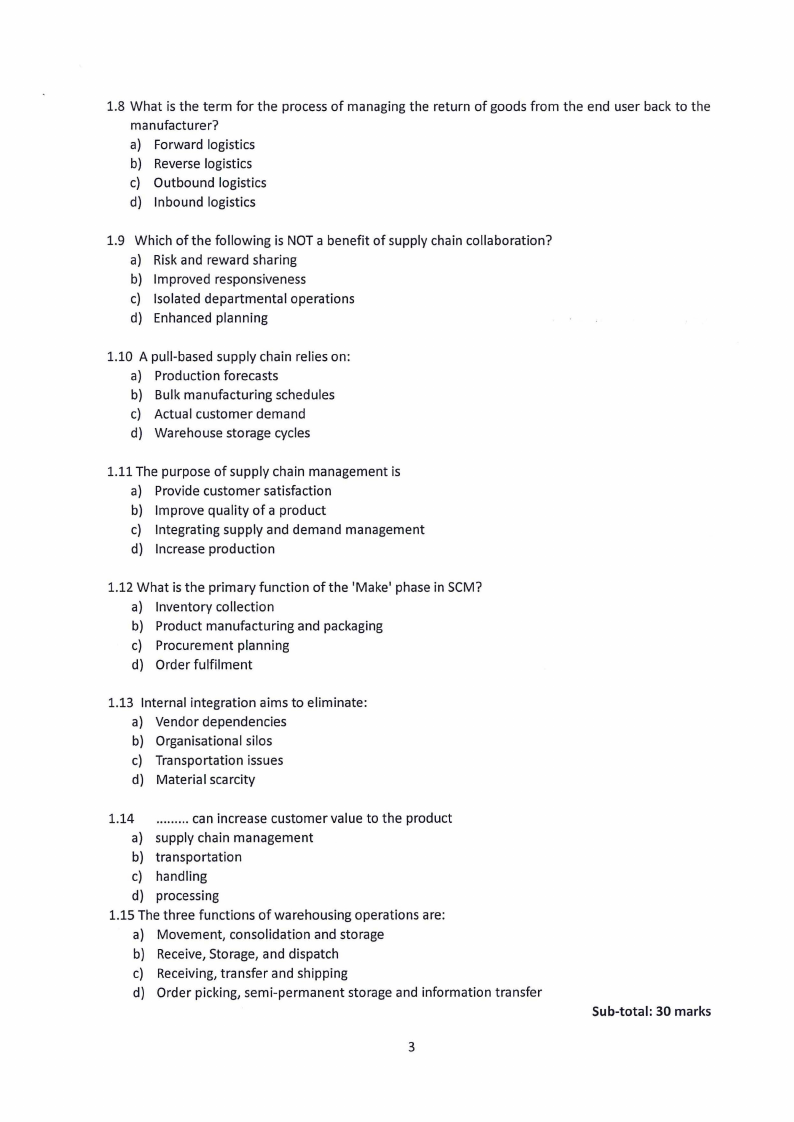
1.8 What is the term for the process of managing the return of goods from the end user back to the
manufacturer?
a) Forward logistics
b) Reverse logistics
c) Outbound logistics
d) Inbound logistics
1.9 Which of the following is NOT a benefit of supply chain collaboration?
a) Riskand reward sharing
b) Improved responsiveness
c) Isolated departmental operations
d) Enhanced planning
1.10 A pull-based supply chain relies on:
a) Production forecasts
b) Bulk manufacturing schedules
c) Actual customer demand
d) Warehouse storage cycles
1.11 The purpose of supply chain management is
a) Provide customer satisfaction
b) Improve quality of a product
c) Integrating supply and demand management
d) Increase production
1.12 What is the primary function of the 'Make' phase in SCM?
a) Inventory collection
b) Product manufacturing and packaging
c) Procurement planning
d) Order fulfilment
1.13 Internal integration aims to eliminate:
a) Vendor dependencies
b) Organisational silos
c) Transportation issues
d) Material scarcity
1.14 ......... can increase customer value to the product
a) supply chain management
b) transportation
c) handling
d) processing
1.15 The three functions of warehousing operations are:
a) Movement, consolidation and storage
b) Receive,Storage, and dispatch
c) Receiving, transfer and shipping
d) Order picking, semi-permanent storage and information transfer
Sub-total: 30 marks
3
|
|
4 Page 4 |
▲back to top |
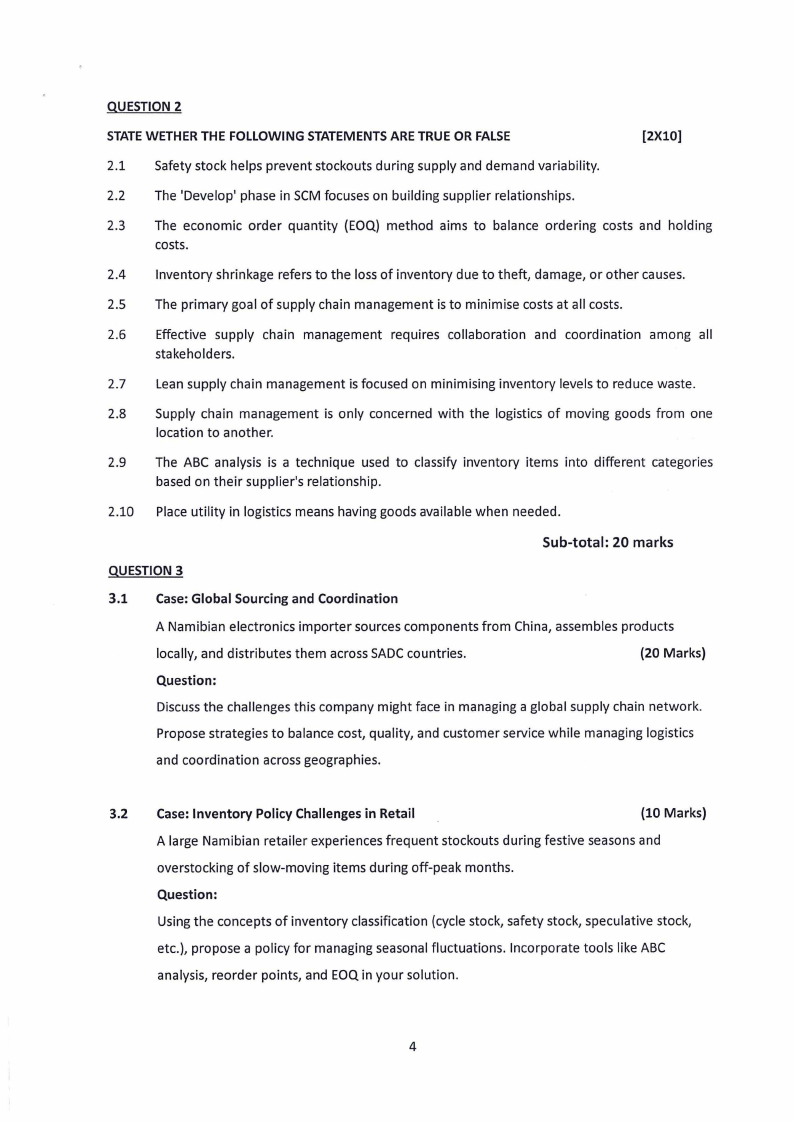
QUESTION 2
STATEWETHERTHE FOLLOWING STATEMENTSARETRUE OR FALSE
[2X10]
2.1 Safety stock helps prevent stockouts during supply and demand variability.
2.2 The 'Develop' phase in SCM focuses on building supplier relationships.
2.3 The economic order quantity {EOQ) method aims to balance ordering costs and holding
costs.
2.4 Inventory shrinkage refers to the loss of inventory due to theft, damage, or other causes.
2.5 The primary goal of supply chain management is to minimise costs at all costs.
2.6 Effective supply chain management requires collaboration and coordination among all
stakeholders.
2.7 Lean supply chain management is focused on minimising inventory levels to reduce waste.
2.8 Supply chain management is only concerned with the logistics of moving goods from one
location to another.
2.9 The ABC analysis is a technique used to classify inventory items into different categories
based on their supplier's relationship.
2.10 Place utility in logistics means having goods available when needed.
Sub-total: 20 marks
QUESTION 3
3.1 Case: Global Sourcing and Coordination
A Namibian electronics importer sources components from China, assembles products
locally, and distributes them across SADCcountries.
(20 Marks)
Question:
Discussthe challenges this company might face in managing a global supply chain network.
Propose strategies to balance cost, quality, and customer service while managing logistics
and coordination across geographies.
3.2 Case: Inventory Policy Challenges in Retail
{10 Marks)
A large Namibian retailer experiences frequent stockouts during festive seasons and
overstocking of slow-moving items during off-peak months.
Question:
Using the concepts of inventory classification (cycle stock, safety stock, speculative stock,
etc.), propose a policy for managing seasonal fluctuations. Incorporate tools like ABC
analysis, reorder points, and EOQ in your solution.
4
|
|
5 Page 5 |
▲back to top |
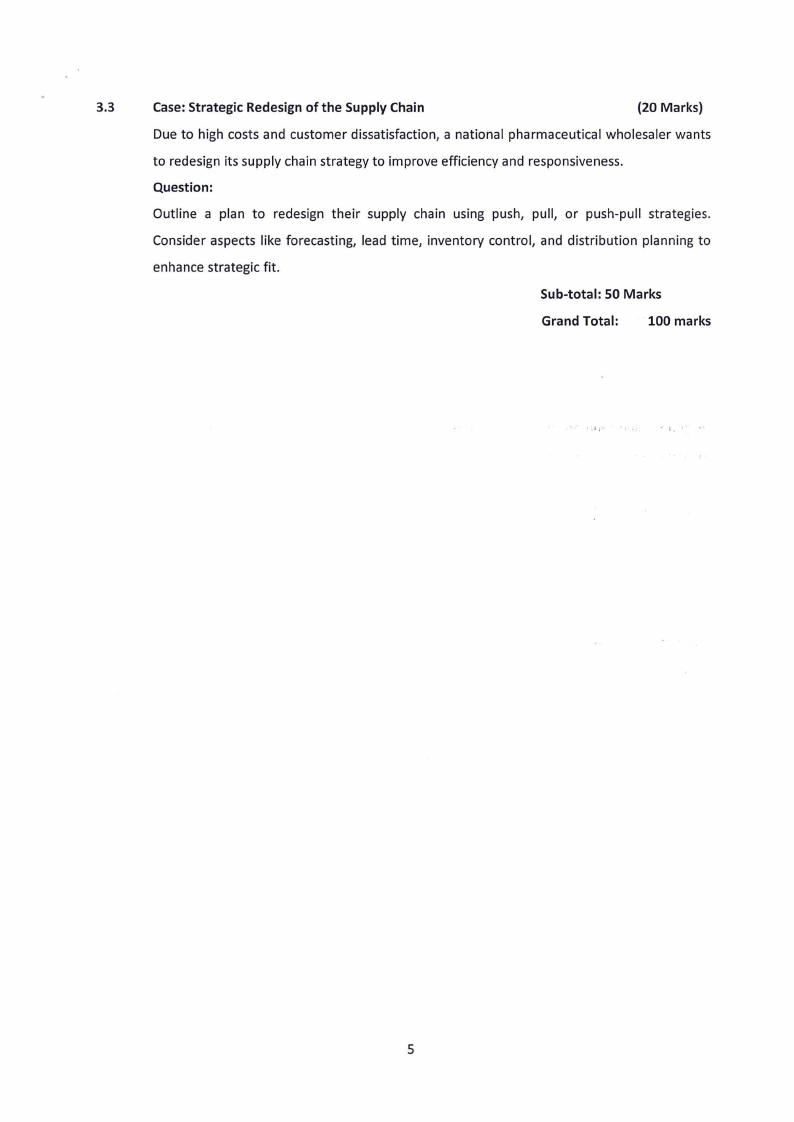
3.3
Case: Strategic Redesign of the Supply Chain
(20 Marks)
Due to high costs and customer dissatisfaction, a national pharmaceutical wholesaler wants
to redesign its supply chain strategy to improve efficiency and responsiveness.
Question:
Outline a plan to redesign their supply chain using push, pull, or push-pull strategies.
Consider aspects like forecasting, lead time, inventory control, and distribution planning to
enhance strategic fit.
Sub-total: 50 Marks
Grand Total:
100 marks
5