CCG620S - COUNSELLING AND CAREER GUIDANCE - 2ND OPP - DECEMBER 2025


CCG620S - COUNSELLING AND CAREER GUIDANCE - 2ND OPP - DECEMBER 2025


1 Page 1

▲back to top


nAm I 81. A Un IVE. RS ITY
OF SCIEnCE Ano TECHnOLOGY
FACULTY OF COMMERCE, HUMAN SCIENCES AND EDUCATION
DEPARTMENT OF TECHNICAL AND VOCATIONAL EDUCATION AND TRAINING
QUALIFICATION: DIPLOMA IN TECHNICAL AND VOCATIONAL EDUCATION AND
TRAINING: TRAINER
QUALIFICATION CODE: 06DTVT
LEVEL: 6
COURSE CODE: CCG620S
COURSE NAME: COUNSELLING AND CAREER
GUIDANCE
SESSION: DECEMBER 2025
DURATION: 3 HOURS
PAPER 2
MARKS: 100
EXAMINER:
SECOND OPPORTUNITY EXAMINATION PAPER
Dr. 0. KACHEPA
MODERATOR: Dr. M. TJIVIKUA
INSTRUCTIONS
1. This question paper consists of Sections A and B.
2. Answer all the questions carefully.
3. Number the answers clearly.
4. Please ensure your writing is legible, neat, and presentable.
THIS PAPER CONSISTS OF 9 PAGES (Including this front page)

2 Page 2

▲back to top


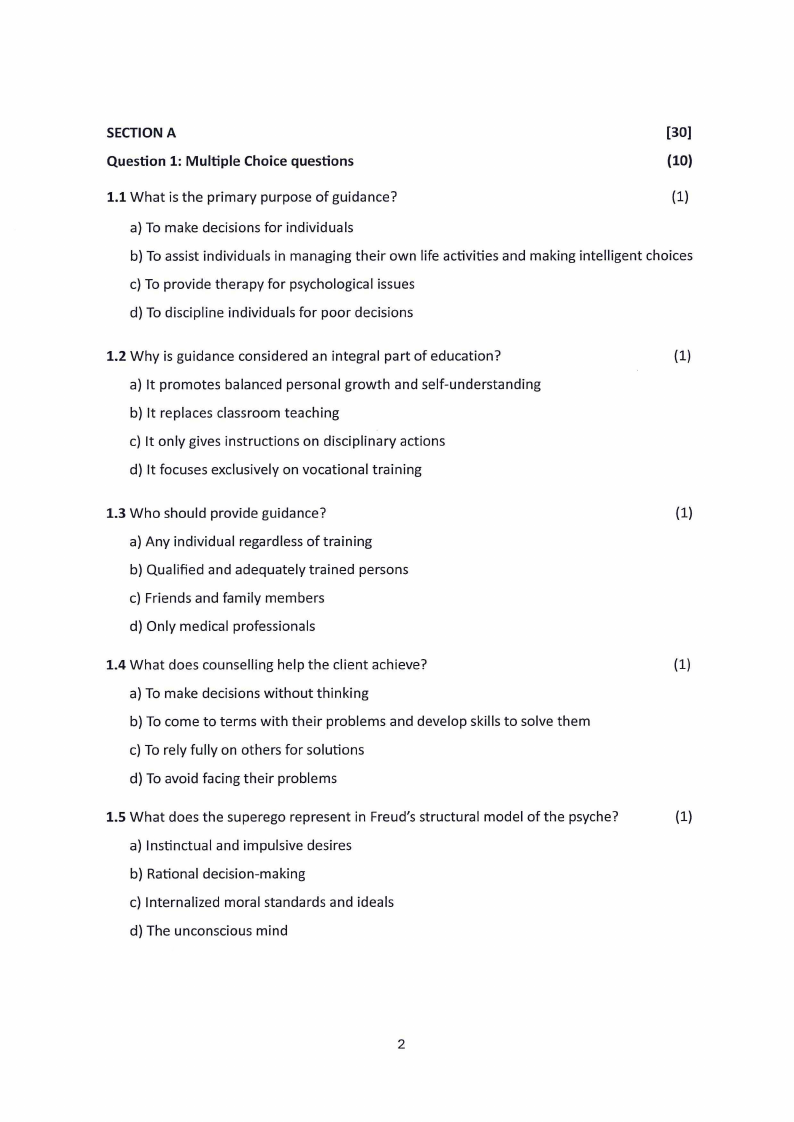
SECTION A
[30)
Question 1: Multiple Choice questions
(10)
1.1 What is the primary purpose of guidance?
(1)
a) To make decisions for individuals
b) To assist individuals in managing their own life activities and making intelligent choices
c) To provide therapy for psychological issues
d) To discipline individuals for poor decisions
1.2 Why is guidance considered an integral part of education?
(1)
a) It promotes balanced personal growth and self-understanding
b) It replaces classroom teaching
c) It only gives instructions on disciplinary actions
d) It focuses exclusively on vocational training
1.3 Who should provide guidance?
(1)
a) Any individual regardless of training
b) Qualified and adequately trained persons
c) Friends and family members
d) Only medical professionals
1.4 What does counselling help the client achieve?
(1)
a) To make decisions without thinking
b) To come to terms with their problems and develop skills to solve them
c) To rely fully on others for solutions
d) To avoid facing their problems
1.5 What does the superego represent in Freud's structural model of the psyche?
(1)
a) Instinctual and impulsive desires
b) Rational decision-making
c) Internalized moral standards and ideals
d) The unconscious mind
2

3 Page 3

▲back to top


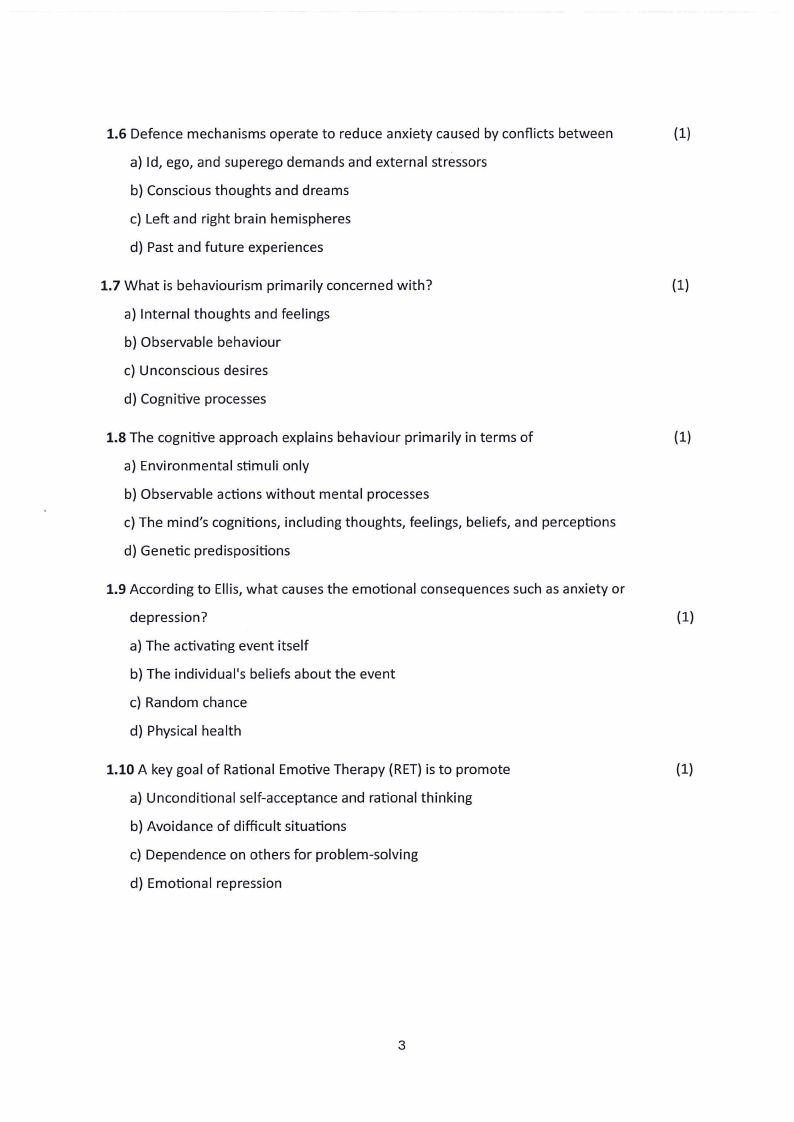
1.6 Defence mechanisms operate to reduce anxiety caused by conflicts between
(1}
a} Id, ego, and superego demands and external stressors
b} Conscious thoughts and dreams
c} Left and right brain hemispheres
d} Past and future experiences
1.7 What is behaviourism primarily concerned with?
(1}
a} Internal thoughts and feelings
b} Observable behaviour
c} Unconscious desires
d} Cognitive processes
1.8 The cognitive approach explains behaviour primarily in terms of
(1}
a} Environmental stimuli only
b} Observable actions without mental processes
c} The mind's cognitions, including thoughts, feelings, beliefs, and perceptions
d} Genetic predispositions
1.9 According to Ellis, what causes the emotional consequences such as anxiety or
depression?
(1}
a} The activating event itself
b} The individual's beliefs about the event
c} Random chance
d} Physical health
1.10 A key goal of Rational Emotive Therapy (RET} is to promote
(1}
a} Unconditional self-acceptance and rational thinking
b} Avoidance of difficult situations
c} Dependence on others for problem-solving
d} Emotional repression
3

4 Page 4

▲back to top


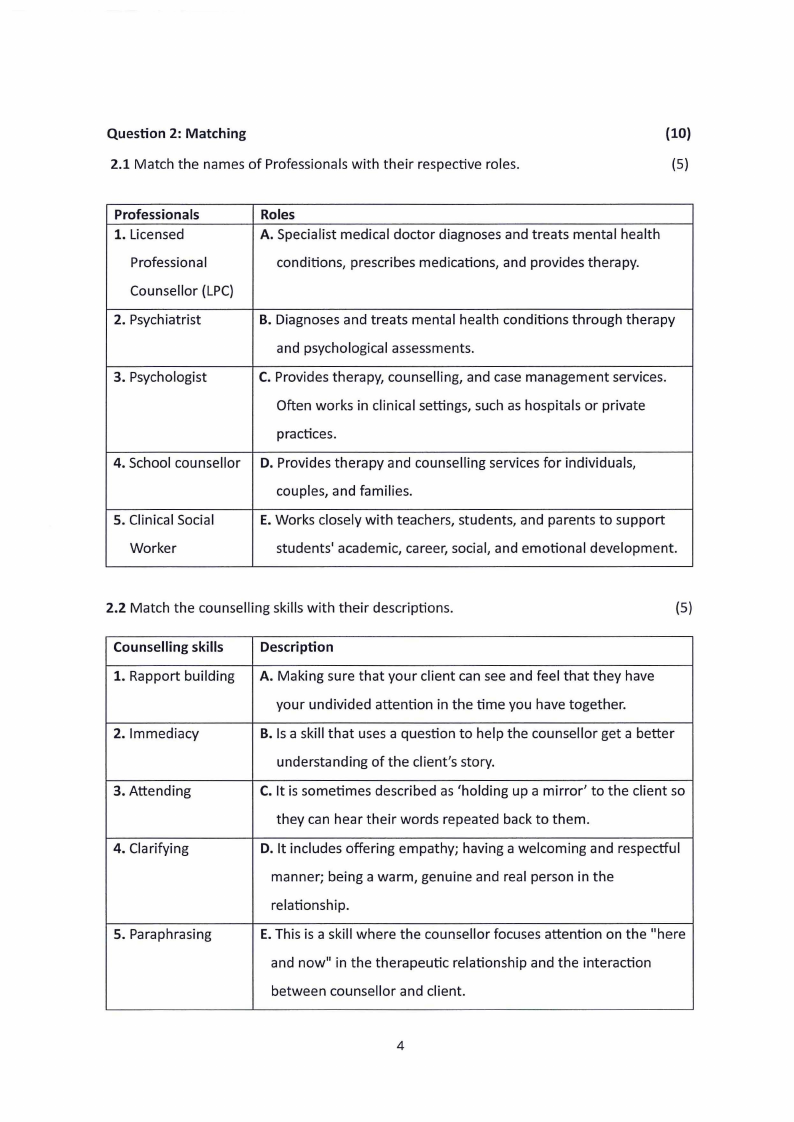
Question 2: Matching
(10)
2.1 Match the names of Professionals with their respective roles.
(5)
Professionals
1. Licensed
Roles
A. Specialist medical doctor diagnoses and treats mental health
Professional
conditions, prescribes medications, and provides therapy.
Counsellor (LPC)
2. Psychiatrist
B. Diagnoses and treats mental health conditions through therapy
and psychological assessments.
3. Psychologist
C. Provides therapy, counselling, and case management services.
Often works in clinical settings, such as hospitals or private
practices.
4. School counsellor D. Provides therapy and counselling services for individuals,
couples, and families.
5. Clinical Social
E. Works closely with teachers, students, and parents to support
Worker
students' academic, career, social, and emotional development.
2.2 Match the counselling skills with their descriptions.
(5)
Counselling skills
1. Rapport building
2. Immediacy
3. Attending
4. Clarifying
5. Paraphrasing
Description
A. Making sure that your client can see and feel that they have
your undivided attention in the time you have together.
B. Is a skill that uses a question to help the counsellor get a better
understanding of the client's story.
C. It is sometimes described as 'holding up a mirror' to the client so
they can hear their words repeated back to them.
D. It includes offering empathy; having a welcoming and respectful
manner; being a warm, genuine and real person in the
relationship.
E. This is a skill where the counsellor focuses attention on the "here
and now" in the therapeutic relationship and the interaction
between counsellor and client.
4

5 Page 5

▲back to top


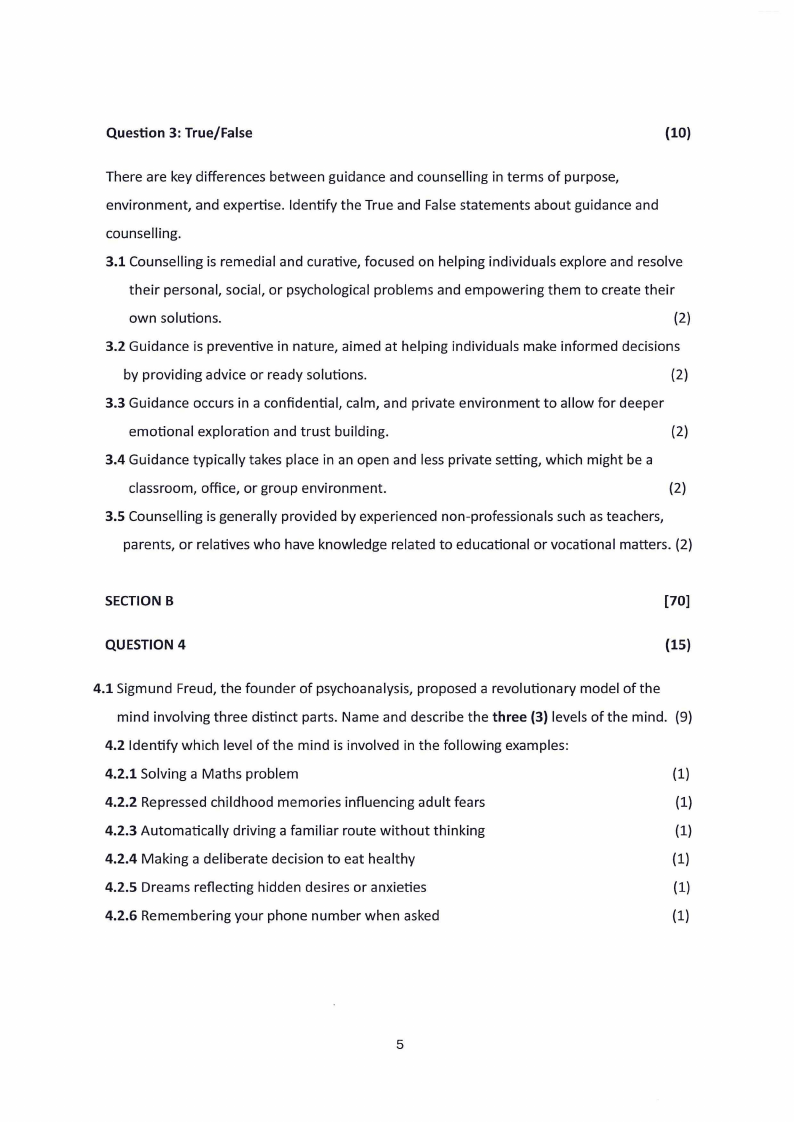
Question 3: True/False
(10)
There are key differences between guidance and counselling in terms of purpose,
environment, and expertise. Identify the True and False statements about guidance and
counselling.
3.1 Counselling is remedial and curative, focused on helping individuals explore and resolve
their personal, social, or psychological problems and empowering them to create their
own solutions.
(2)
3.2 Guidance is preventive in nature, aimed at helping individuals make informed decisions
by providing advice or ready solutions.
(2)
3.3 Guidance occurs in a confidential, calm, and private environment to allow for deeper
emotional exploration and trust building.
(2)
3.4 Guidance typically takes place in an open and less private setting, which might be a
classroom, office, or group environment.
(2)
3.5 Counselling is generally provided by experienced non-professionals such as teachers,
parents, or relatives who have knowledge related to educational or vocational matters. (2)
SECTION B
[70]
QUESTION 4
(15)
4.1 Sigmund Freud, the founder of psychoanalysis, proposed a revolutionary model of the
mind involving three distinct parts. Name and describe the three (3) levels of the mind. (9)
4.2 Identify which level of the mind is involved in the following examples:
4.2.1 Solving a Maths problem
(1)
4.2.2 Repressed childhood memories influencing adult fears
(1)
4.2.3 Automatically driving a familiar route without thinking
(1)
4.2.4 Making a deliberate decision to eat healthy
(1)
4.2.5 Dreams reflecting hidden desires or anxieties
(1)
4.2.6 Remembering your phone number when asked
(1)
5

6 Page 6

▲back to top


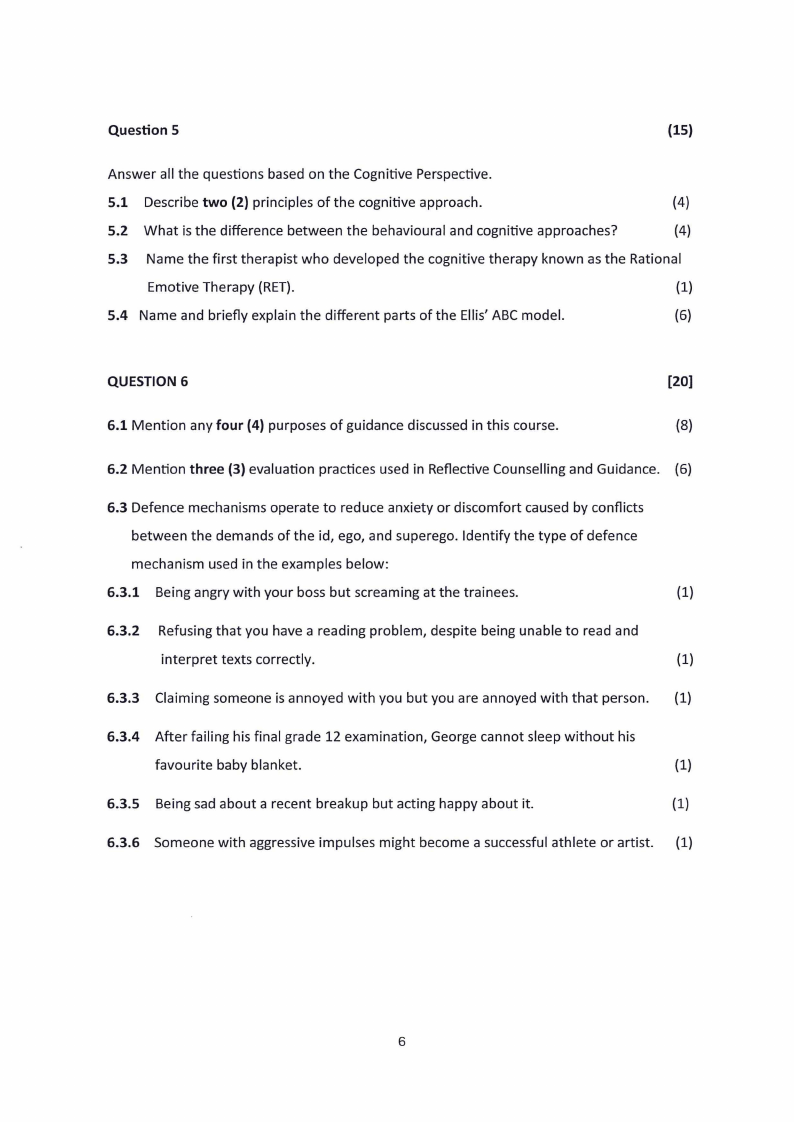
Question 5
(15)
Answer all the questions based on the Cognitive Perspective.
5.1 Describe two (2) principles of the cognitive approach.
(4)
5.2 What is the difference between the behavioural and cognitive approaches?
(4)
5.3 Name the first therapist who developed the cognitive therapy known as the Rational
Emotive Therapy (RET).
(1)
5.4 Name and briefly explain the different parts of the Ellis' ABC model.
(6)
QUESTION 6
[20)
6.1 Mention any four (4) purposes of guidance discussed in this course.
(8)
6.2 Mention three (3) evaluation practices used in Reflective Counselling and Guidance. (6)
6.3 Defence mechanisms operate to reduce anxiety or discomfort caused by conflicts
between the demands of the id, ego, and superego. Identify the type of defence
mechanism used in the examples below:
6.3.1 Being angry with your boss but screaming at the trainees.
(1)
6.3.2 Refusing that you have a reading problem, despite being unable to read and
interpret texts correctly.
(1)
6.3.3 Claiming someone is annoyed with you but you are annoyed with that person. (1)
6.3.4 After failing his final grade 12 examination, George cannot sleep without his
favourite baby blanket.
(1)
6.3.5 Being sad about a recent breakup but acting happy about it.
(1)
6.3.6 Someone with aggressive impulses might become a successful athlete or artist. (1)
6

7 Page 7

▲back to top


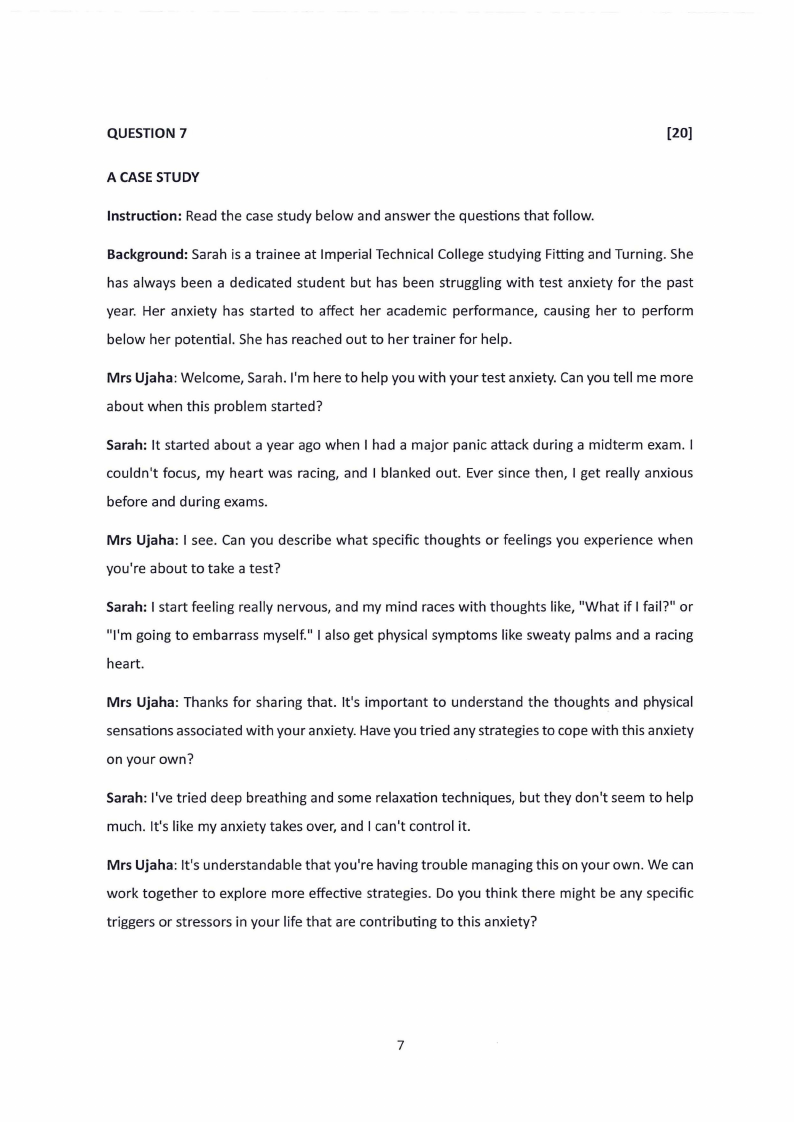
QUESTION 7
[20)
A CASE STUDY
Instruction: Read the case study below and answer the questions that follow.
Background: Sarah is a trainee at Imperial Technical College studying Fitting and Turning. She
has always been a dedicated student but has been struggling with test anxiety for the past
year. Her anxiety has started to affect her academic performance, causing her to perform
below her potential. She has reached out to her trainer for help.
Mrs Ujaha: Welcome, Sarah. I'm here to help you with your test anxiety. Can you tell me more
about when this problem started?
Sarah: It started about a year ago when I had a major panic attack during a midterm exam. I
couldn't focus, my heart was racing, and I blanked out. Ever since then, I get really anxious
before and during exams.
Mrs Ujaha: I see. Can you describe what specific thoughts or feelings you experience when
you're about to take a test?
Sarah: I start feeling really nervous, and my mind races with thoughts like, "What if I fail?" or
"I'm going to embarrass myself." I also get physical symptoms like sweaty palms and a racing
heart.
Mrs Ujaha: Thanks for sharing that. It's important to understand the thoughts and physical
sensations associated with your anxiety. Have you tried any strategies to cope with this anxiety
on your own?
Sarah: I've tried deep breathing and some relaxation techn iques, but they don't seem to help
much. It's like my anxiety takes over, and I can't control it.
Mrs Ujaha: It's understandable that you're having trouble managing this on your own. We can
work together to explore more effective strategies. Do you think there might be any specific
triggers or stressors in your life that are contributing to this anxiety?
7

8 Page 8

▲back to top


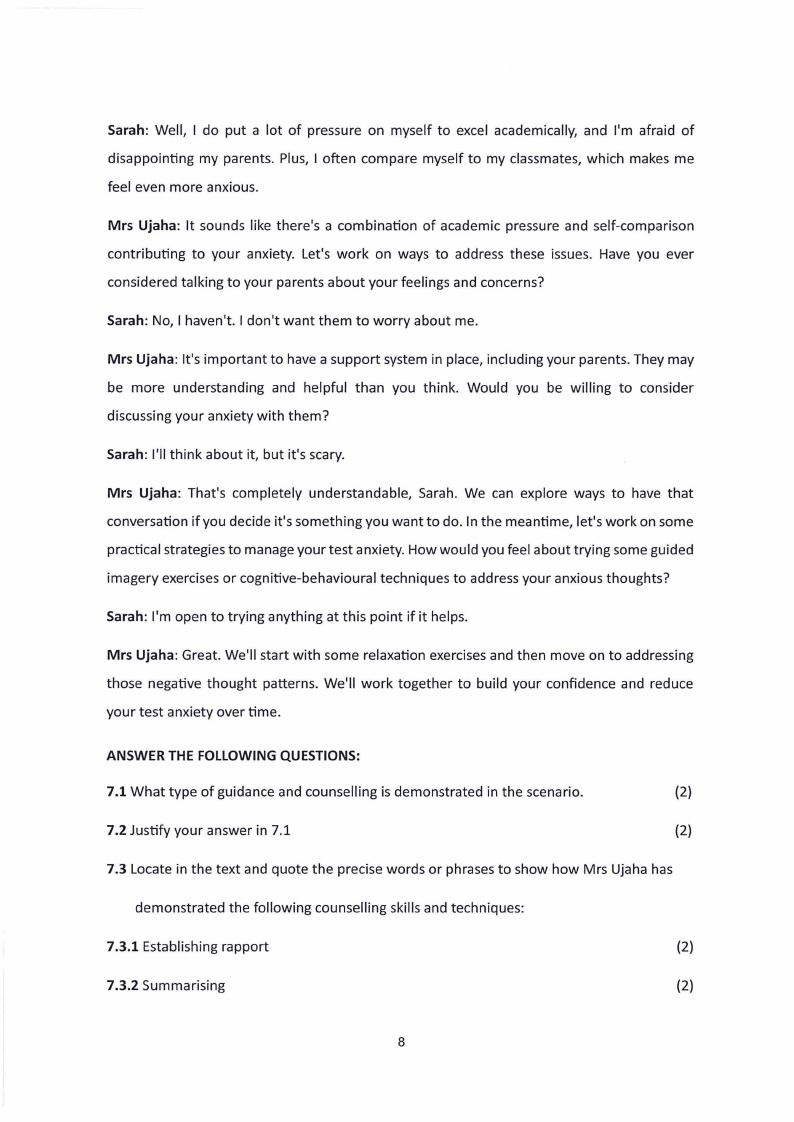
Sarah: Well, I do put a lot of pressure on myself to excel academically, and I'm afraid of
disappointing my parents. Plus, I often compare myself to my classmates, which makes me
feel even more anxious.
Mrs Ujaha: It sounds like there's a combination of academic pressure and self-comparison
contributing to your anxiety. Let's work on ways to address these issues. Have you ever
considered talking to your parents about your feelings and concerns?
Sarah: No, I haven't. I don't want them to worry about me.
Mrs Ujaha: It's important to have a support system in place, including your parents. They may
be more understanding and helpful than you think. Would you be willing to consider
discussing your anxiety with them?
Sarah: I'll think about it, but it's scary.
Mrs Ujaha: That's completely understandable, Sarah. We can explore ways to have that
conversation if you decide it's something you want to do. In the meantime, let's work on some
practical strategies to manage your test anxiety. How would you feel about trying some guided
imagery exercises or cognitive-behavioural techniques to address your anxious thoughts?
Sarah: I'm open to trying anything at this point if it helps.
Mrs Ujaha: Great. We'll start with some relaxation exercises and then move on to addressing
those negative thought patterns. We'll work together to build your confidence and reduce
your test anxiety over time.
ANSWER THE FOLLOWING QUESTIONS:
7.1 What type of guidance and counselling is demonstrated in the scenario.
(2)
7.2 Justify your answer in 7.1
(2)
7.3 Locate in the text and quote the precise words or phrases to show how Mrs Ujaha has
demonstrated the following counselling skills and techniques:
7.3.1 Establishing rapport
(2)
7.3.2 Summarising
(2)
8

9 Page 9

▲back to top


7.3.3 Questioning
(2)
7.3.4 Unconditional positive regard
(2)
7.4 Mrs Ujaha tried to apply the holistic approach.
7.4.1 Which two (2) dimensions or components of a human being were explored in this
scenario according to the holistic approach?
(4)
7.4.2 Justify your answer in 7.4.1 by quoting exact words or phrases from the scenario that
talk to the two (2) dimensions.
(4)
TOTAL MARKS [100)
THE END
9