


 |
BAC511C-BUSINESS ACCOUNTING 1A-2ND OPP- NOV 2025 |
|
|
1 Page 1 |
▲back to top |
nAmlBIA
Un IVERS ITY
OF SCIEnCE AnD
TECHnOLOGY
HP-GSB~
HAROLD PUPKEWITZ
Graduate School of Business
FACULTY OF COMMERCE, HUMAN SCIENCES AND EDUCATION
HAROLD PUPKEWITZ GRADUATE SCHOOL OF BUSINESS
QUALIFICATION: DIPLOMA IN BUSINESS PROCESS MANAGEMENT
QUALIFICATION CODE: 06DBPM LEVEL: 6
COURSE CODE : BACSllC
COURSE NAME: BUSINESS ACCOUNTING 1A
SESSION: DECEMBER 2025
PAPER: THEORY AND CALCULATIONS (PAPER 2)
DURATION: 3 HOURS
MARKS: 100
SECOND OPPORTUNITY EXAMINATION QUESTION PAPER
EXAMINER
Gerhardt Sheehama
MODERATOR Lameck Odada
INSTRUCTIONS
1. This question paper is made up of four (4) questions.
2. Answer ALL the questions in blue or black ink only. NO pencil
3. Start each question on a new page in your answer booklet and show all workings.
4. Round off only final answers to two (2) decimal places unless otherwise stated .
5. Questions relating to this examination may be raised in the initial 30 minutes after the
start of the paper. Thereafter, candidates must use their initiative to deal with any
perceived error or ambiguities & any assumption made by the candidate should be
clearly st~t_e_d_._ _ _ __ _ _ _ _ _ _ _ _ _ _ _ _ _ _ _ _ _ _ _ ___J
PERMISSIBLE MATERIALS
Silent, non-programmable calculators
THIS QUESTION PAPER CONSISTS OF 8 PAGES (including this front page)
|
|
2 Page 2 |
▲back to top |
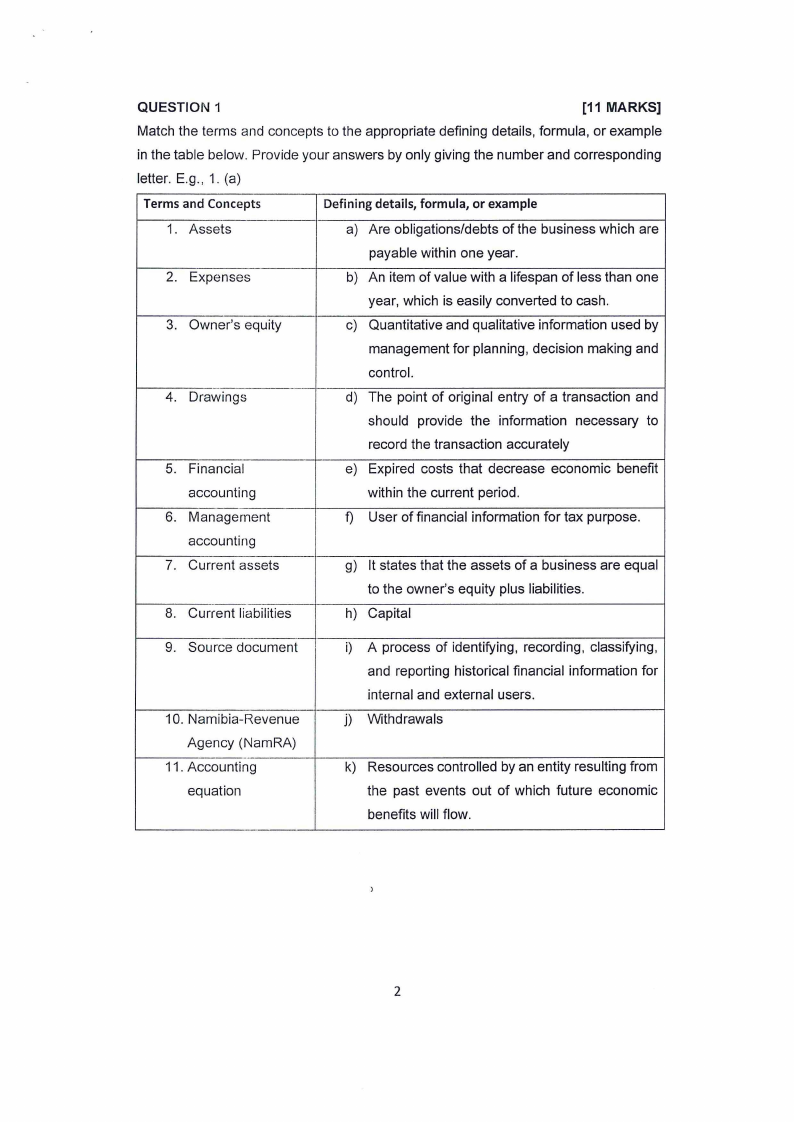
QUESTION 1
[11 MARKS]
Match the terms and concepts to the appropriate defining details, formula, or example
in the table below . Provide your answers by only giving the number and corresponding
letter. E.g. , 1. (a)
Terms and Concepts
Defining details, formula, or example
1. Assets
a) Are obligations/debts of the business which are
payable within one year.
2. Expenses
3. Owner's equity
b) An item of value with a lifespan of less than one
year, which is easily converted to cash.
c) Quantitative and qualitative information used by
management for planning, decision making and
4. Drawings
control.
d) The point of original entry of a transaction and
should provide the information necessary to
record the transaction accurately
5. Financial
accounting
e) Expired costs that decrease economic benefit
within the current period .
6. Management
accounting
f) User of financial information for tax purpose.
7. Current assets
g) It states that the assets of a business are equal
to the owner's equity plus liabilities.
8. Current liabilities
h) Capital
9. Source document
10. Namibia-Revenue
Agency (NamRA)
11. Accounting
equation
i) A process of identifying, recording , classifying,
and reporting historical financial information for
internal and external users.
j) Withdrawals
k) Resources controlled by an entity resulting from
the past events out of which future economic
benefits will flow.
2
|
|
3 Page 3 |
▲back to top |
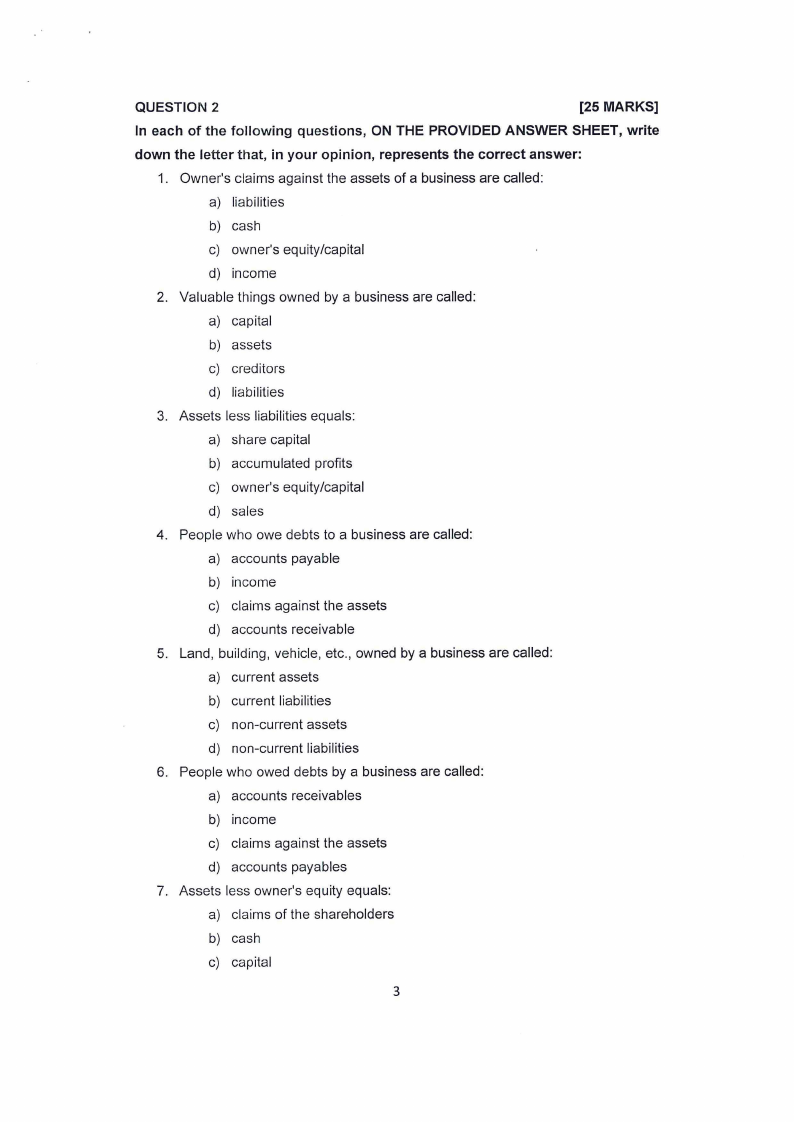
QUESTION 2
[25 MARKS]
In each of the following questions, ON THE PROVIDED ANSWER SHEET, write
down the letter that, in your opinion, represents the correct answer:
1. Owner's claims against the assets of a business are called:
a) liabilities
b) cash
c) owner's equity/capital
d) income
2. Valuable things owned by a business are called:
a) capital
b) assets
c) creditors
d) liabilities
3. Assets less liabilities equals:
a) share capital
b) accumulated profits
c) owner's equity/capital
d) sales
4. People who owe debts to a business are called:
a) accounts payable
b) income
c) claims against the assets
d) accounts receivable
5. Land, building, vehicle, etc., owned by a business are called :
a) current assets
b) current liabilities
c) non-current assets
d) non-current liabilities
6. People who owed debts by a business are called:
a) accounts receivables
b) income
c) claims against the assets
d) accounts payables
7. Assets less owner's equity equals:
a) claims of the shareholders
b) cash
c) capital
3
|
|
4 Page 4 |
▲back to top |
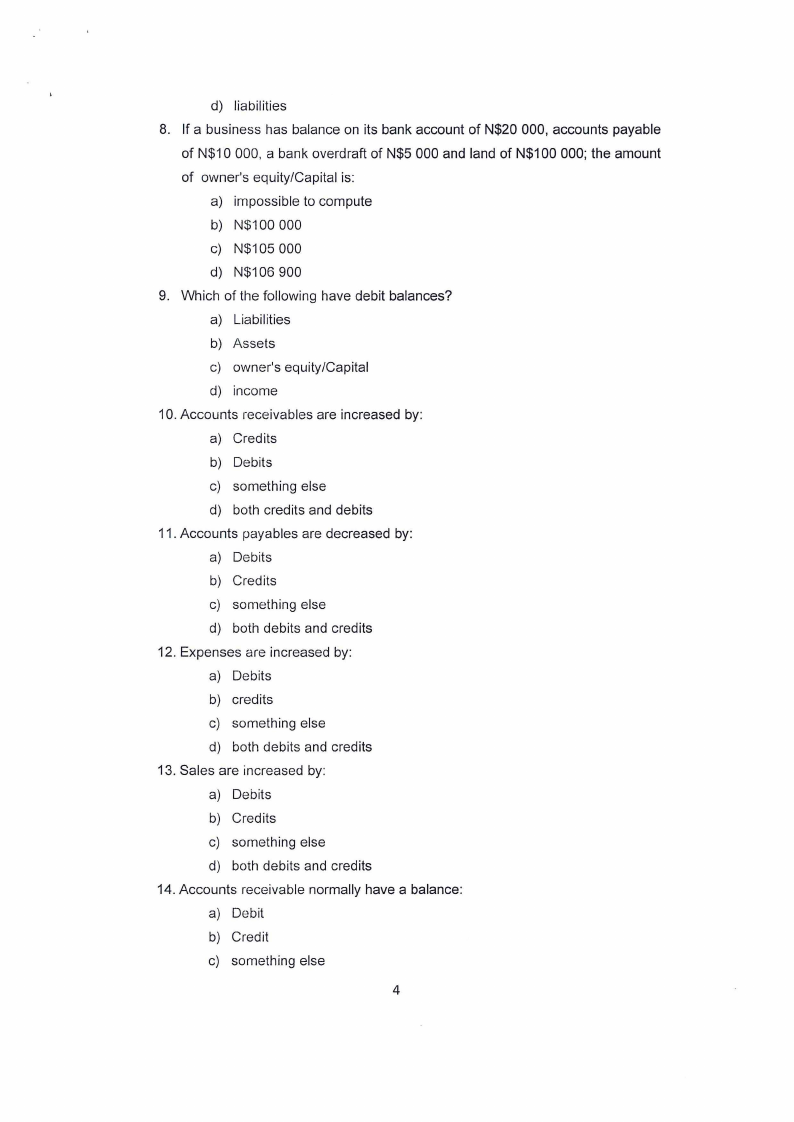
d) liabilities
8. If a business has balance on its bank account of N$20 000, accounts payable
of N$10 000 , a bank overdraft of N$5 000 and land of N$100 000; the amount
of owner's equity/Capital is:
a) impossible to compute
b) N$100000
c) N$105 000
d) N$106 900
9. Which of the following have debit balances?
a) Liabilities
b) Assets
c) owner's equity/Capital
d) income
10. Accounts receivables are increased by:
a) Credits
b) Debits
c) something else
d) both credits and debits
11 . Accounts payables are decreased by:
a) Debits
b) Credits
c) something else
d) both debits and credits
12. Expenses are increased by:
a) Debits
b) credits
c) something else
d) both debits and credits
13. Sales are increased by:
a) Debits
b) Credits
c) something else
d) both debits and credits
14. Accounts receivable normally have a balance:
a) Debit
b) Credit
c) something else
4
|
|
5 Page 5 |
▲back to top |
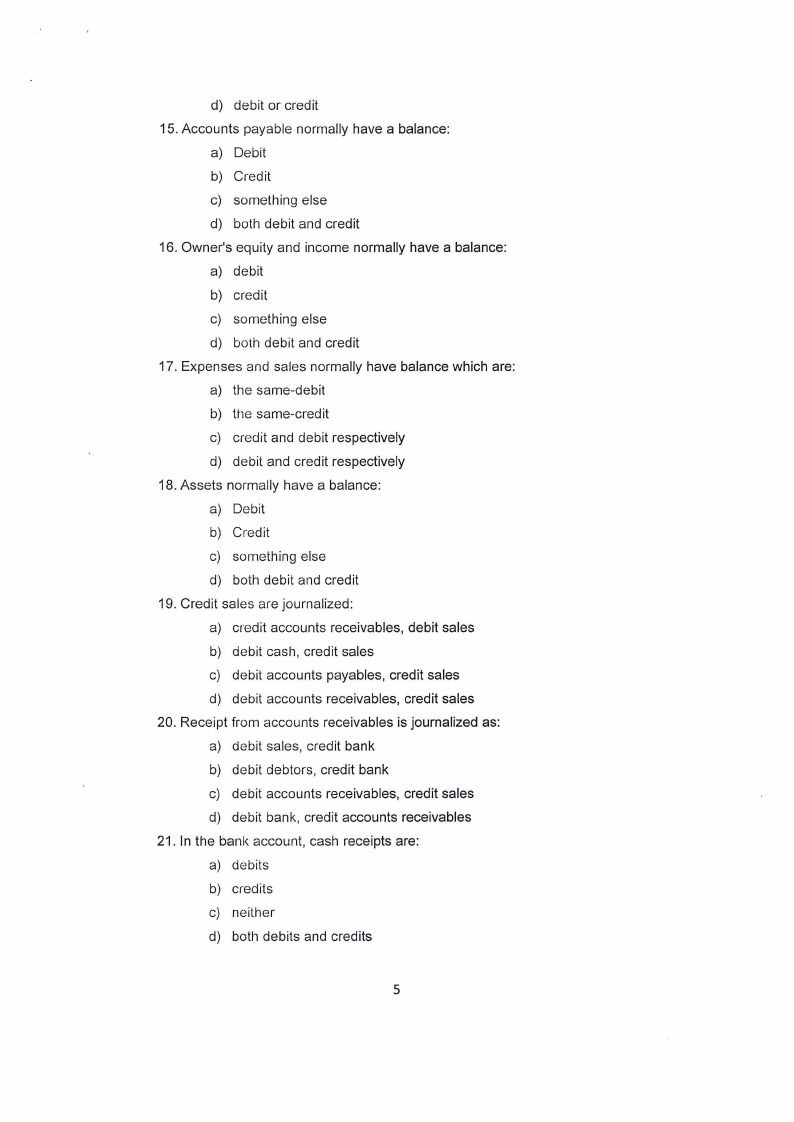
d) debit or credit
15. Accounts payable normally have a balance:
a) Debit
b) Credit
c) something else
d) both debit and credit
16. Owner's equity and income normally have a balance:
a) debit
b) credit
c) something else
d) both debit and credit
17. Expenses and sales normally have balance which are:
a) the same-debit
b) the same-credit
c) credit and debit respectively
d) debit and credit respectively
18. Assets normally have a balance:
a) Debit
b) Credit
c) something else
d) both debit and credit
19. Credit sales are journalized:
a) credit accounts receivables, debit sales
b) debit cash, credit sales
c) debit accounts payables, credit sales
d) debit accounts receivables, credit sales
20 . Receipt from accounts receivables is journalized as:
a) debit sales, credit bank
b) debit debtors, credit bank
c) debit accounts receivables, credit sales
d) debit bank, credit accounts receivables
21. In the bani< account, cash receipts are:
a) debits
b) credits
c) neither
d) both debits and credits
5
|
|
6 Page 6 |
▲back to top |
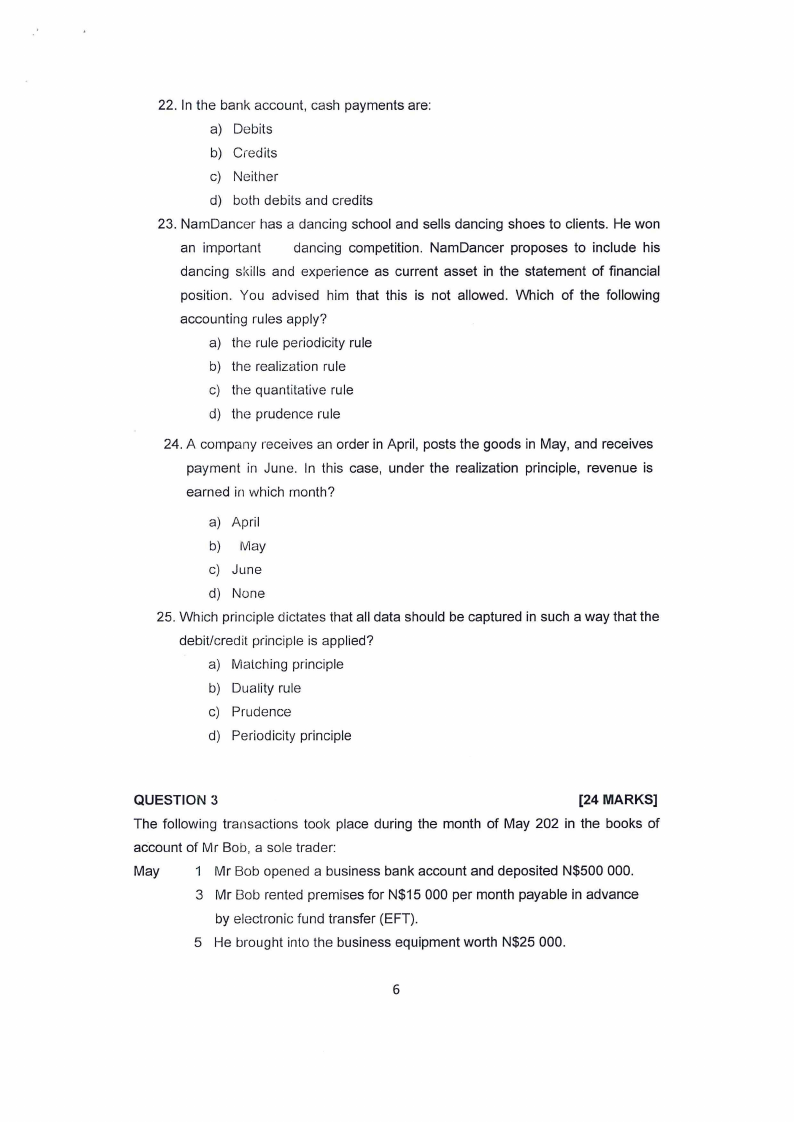
22. In the bank account, cash payments are:
a) Debits
b) Credits
c) Neither
d) both debits and credits
23. NamDancer has a dancing school and sells dancing shoes to clients. He won
an important dancing competition . NamDancer proposes to include his
dancing skills and experience as current asset in the statement of financial
position. You advised him that this is not allowed. Which of the following
accounting rules apply?
a) th e rule periodicity rule
b) th e realization rule
c) the quantitative rule
d) th e prudence rule
24. A company receives an order in April, posts the goods in May, and receives
payment in June. In this case, under the realization principle, revenue is
earned in which month?
a) April
b) May
c) June
d) None
25. Which principle dictates that all data should be captured in such a way that the
debit/credit principle is applied?
a) Matching principle
b) Duality rule
c) Prudence
d) Periodicity principle
QUESTION 3
[24 MARKS]
The following tra nsactions took place during the month of May 202 in the books of
account of Mr Bob, a sole trader:
May
1 Mr Bob opened a business bank account and deposited N$500 000.
3 Mr Bob rented premises for N$15 000 per month payable in advance
by electronic fund transfer (EFT).
5 He brought into the business equipment worth N$25 000.
6
|
|
7 Page 7 |
▲back to top |
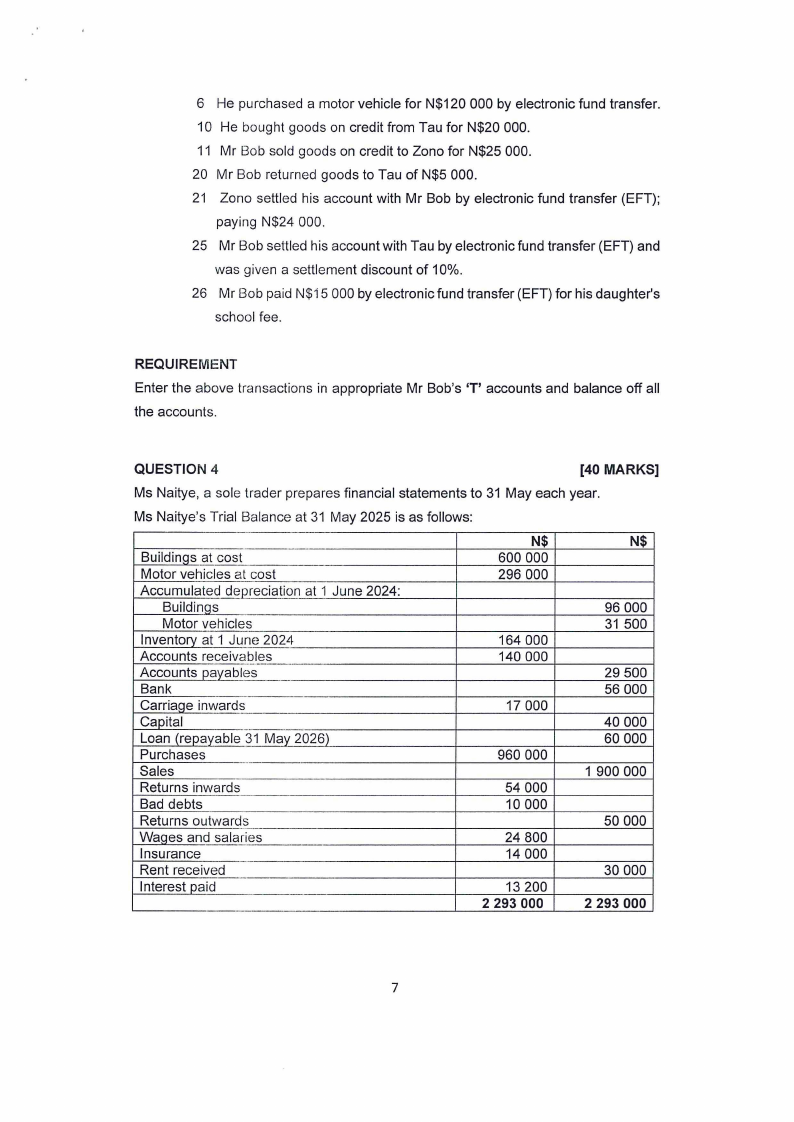
6 He purchased a motor vehicle for N$120 000 by electronic fund transfer.
10 He bought goods on credit from Tau for N$20 000.
11 Mr Bob sold goods on credit to Zona for N$25 000.
20 Mr Bob returned goods to Tau of N$5 000.
21 Zona settled his account with Mr Bob by electronic fund transfer (EFT);
paying N$24 000.
25 Mr Bob settled his account with Tau by electronic fund transfer (EFT) and
was given a settlement discount of 10%.
26 Mr Bob paid N$15 000 by electronic fund transfer (EFT) for his daughter's
school fee.
REQUIREMENT
Enter the above transactions in appropriate Mr Bob's 'T' accounts and balance off all
the accounts.
QUESTION 4
[40 MARKS]
Ms Naitye, a sole trader prepares financial statements to 31 May each year.
Ms Naitye's Trial Balance at 31 May 2025 is as follows:
Buildings at cost
Motor vehicles at cost
Accumulated depreciation at 1 June 2024:
Buildings
Motor vehicles
Inventory at 1 June 2024
Accounts receivables
Accounts payables
Bank
Carriaqe inwards
Capital
Loan (repayable 31 May 2026)
Purchases
Sales
Returns inwards
Bad debts
Returns outwards
Waqes and salaries
Insurance
Rent received
Interest paid
N$
600 000
296 000
164 000
140 000
17 000
960 000
54 000
10 000
24 800
14 000
13 200
2 293 000
N$
96 000
31 500
29 500
56 000
40 000
60 000
1 900 000
50 000
30 000
2 293 000
7
|
|
8 Page 8 |
▲back to top |
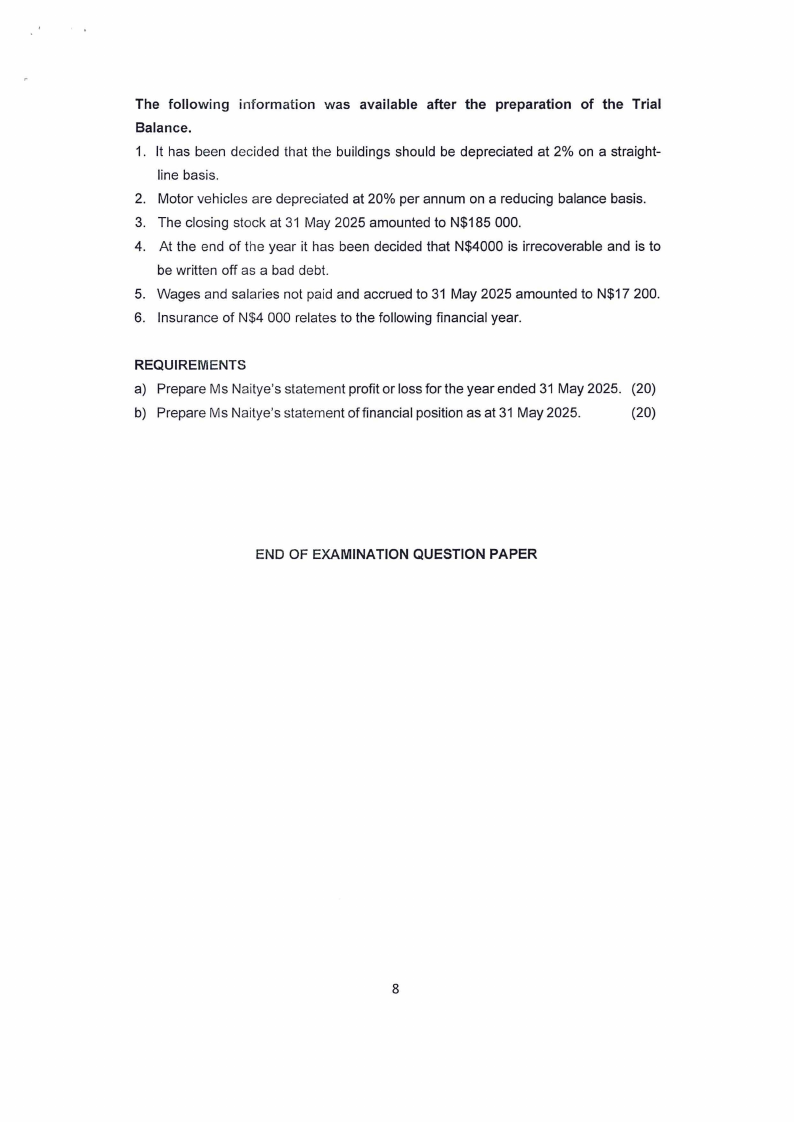
The following information was available after the preparation of the Trial
Balance.
1. It has been decided that the buildings should be depreciated at 2% on a straight-
line basis.
2. Motor vehicles are depreciated at 20% per annum on a reducing balance basis.
3. The closing stock at 31 May 2025 amounted to N$185 000.
4. At the end of the year it has been decided that N$4000 is irrecoverable and is to
be written off as a bad debt.
5. Wages and salaries not paid and accrued to 31 May 2025 amounted to N$17 200.
6. Insurance of N$4 000 relates to the following financial year.
REQUIREMENTS
a) Prepare Ms Naitye's statement profit or loss for the year ended 31 May 2025. (20)
b) Prepare Ms Naitye's statement offinancial position as at 31 May 2025.
(20)
END OF EXAMINATION QUESTION PAPER
8