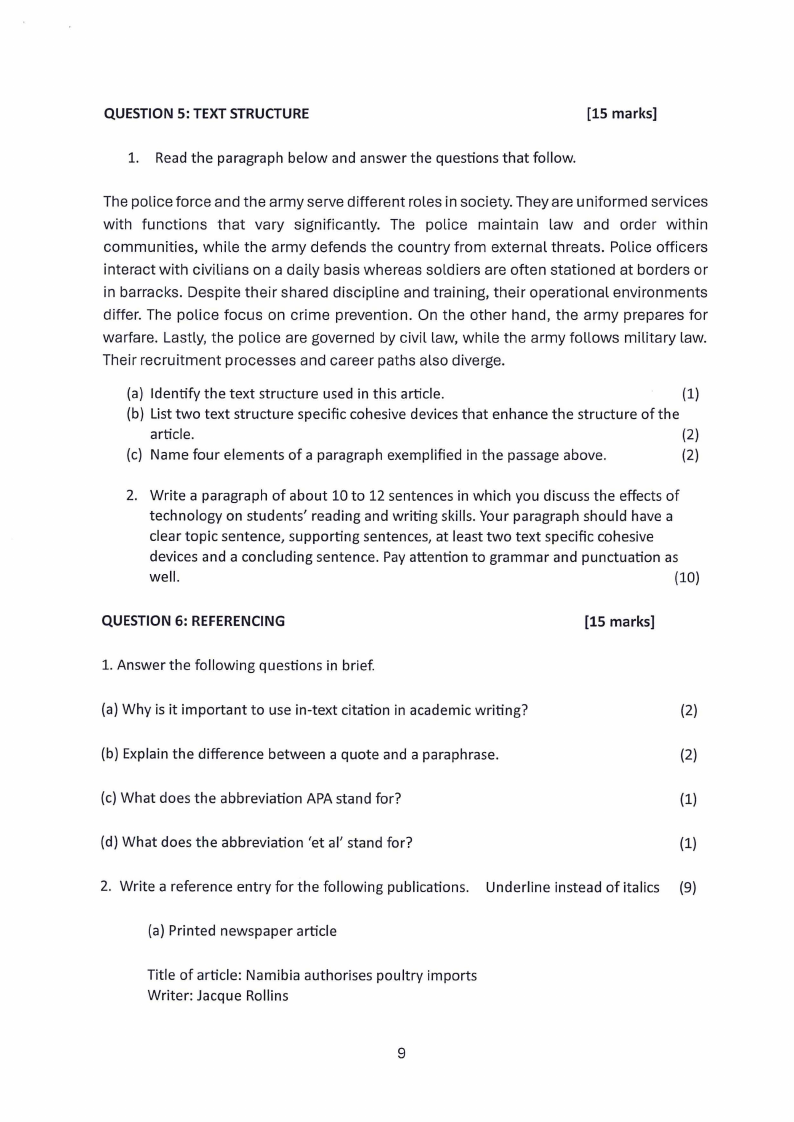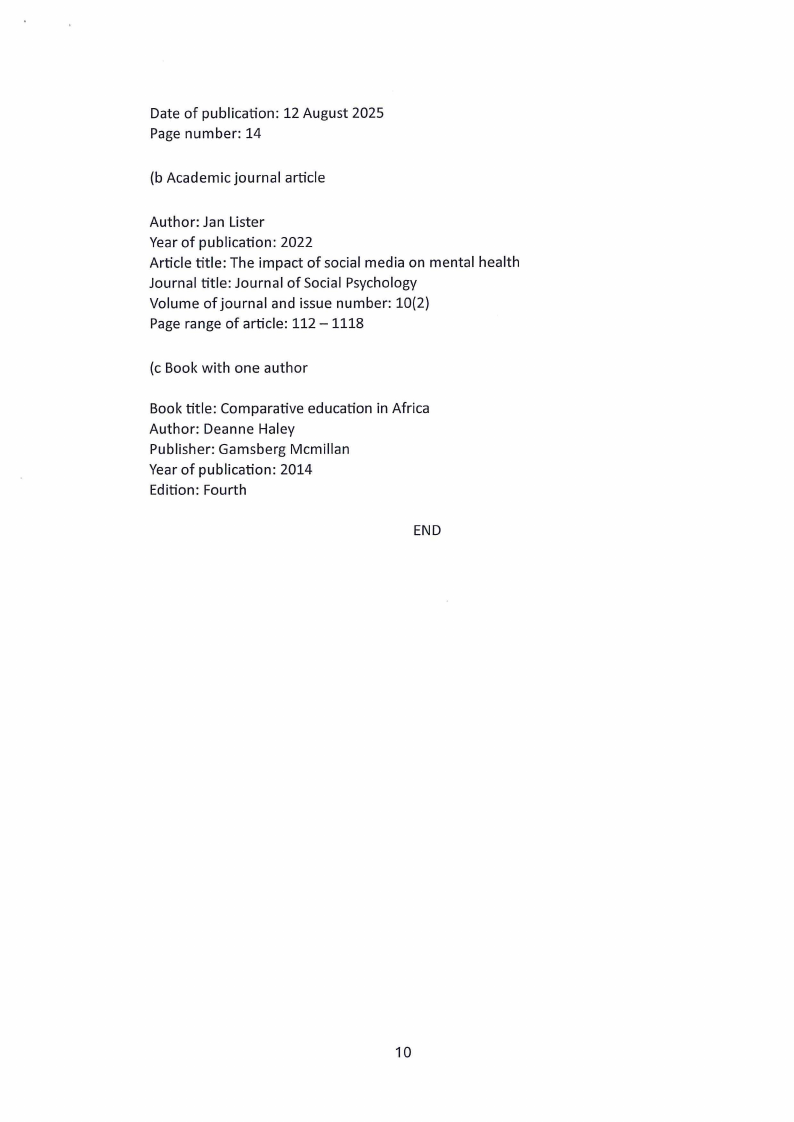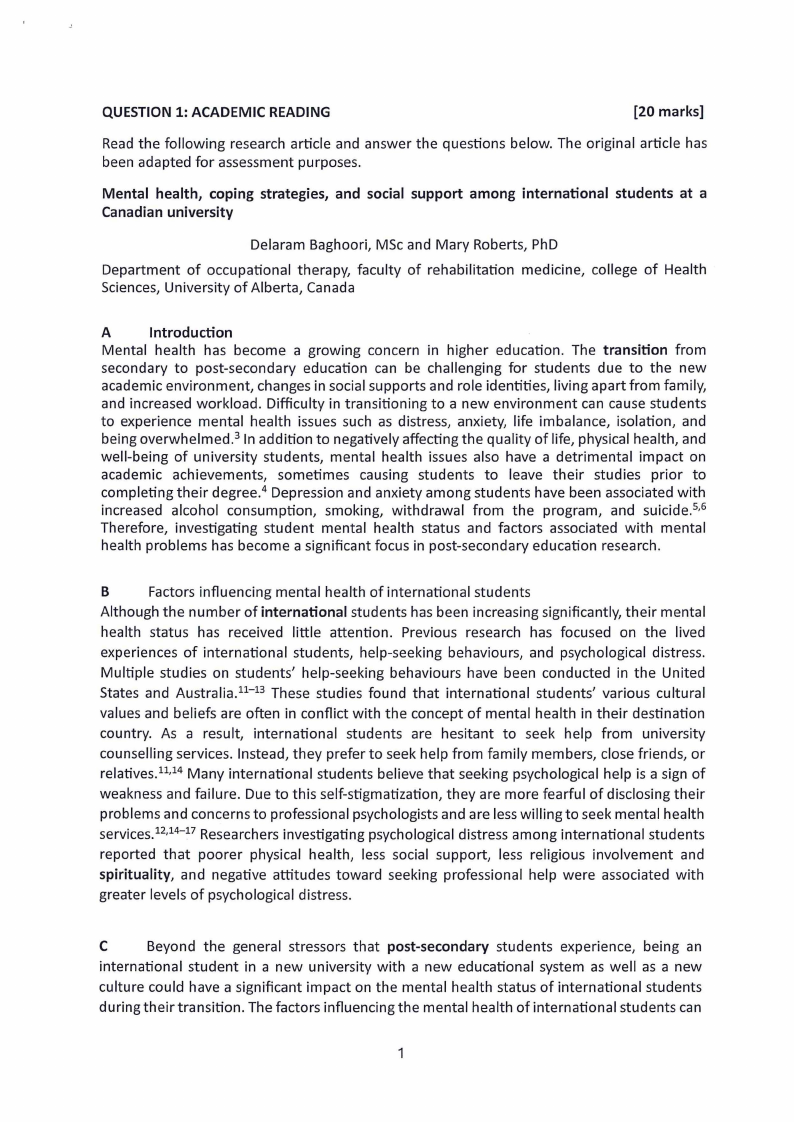
QUESTION 1: ACADEMIC READING
[20 marks]
Read the following research article and answer the questions below. The original article has
been adapted for assessment purposes.
Mental health, coping strategies, and social support among international students at a
Canadian university
Delaram Baghoori, MSc and Mary Roberts, PhD
Department of occupational therapy, faculty of rehabilitation medicine, college of Health
Sciences, University of Alberta, Canada
A
Introduction
Mental health has become a growing concern in higher education. The transition from
secondary to post-secondary education can be challenging for students due to the new
academic environment, changes in social supports and role identities, living apart from family,
and increased workload . Difficulty in transitioning to a new environment can cause students
to experience mental health issues such as distress, anxiety, life imbalance, isolation, and
being overwhelmed. 3 In addition to negatively affecting the quality of life, physical health, and
well-being of university students, mental health issues also have a detrimental impact on
academic achievements, sometimes causing students to leave their studies prior to
completing their degree.4 Depression and anxiety among students have been associated with
increased alcohol consumption, smoking, withdrawal from the program, and suicide.5•6
Therefore, investigating student mental health status and factors associated with mental
health problems has become a significant focus in post-secondary education research.
B
Factors influencing mental health of international students
Although the number of international students has been increasing significantly, their mental
health status has received little attention. Previous research has focused on the lived
experiences of international students, help-seeking behaviours, and psychological distress.
Multiple studies on students' help-seeking behaviours have been conducted in the United
States and Australia. 11- 13 These studies found that international students' various cultural
values and beliefs are often in conflict with the concept of mental health in their destination
country. As a result, international students are hesitant to seek help from university
counselling services. Instead, they prefer to seek help from family members, close friends, or
relatives. 11•14 Many international students believe that seeking psychological help is a sign of
weakness and failure. Due to this self-stigmatization, they are more fearful of disclosing their
problems and concerns to professional psychologists and are less willing to seek mental health
services. 12,14- 17 Researchers investigating psychological distress among international students
reported that poorer physical health, less social support, less religious involvement and
spirituality, and negative attitudes toward seeking professional help were associated with
greater levels of psychological distress.
C
Beyond the general stressors that post-secondary students experience, being an
international student in a new university with a new educational system as well as a new
culture could have a significant impact on the mental health status of international students
during their transition. The factors influencing the mental health of international students can
1