PQS721S - PRINCIPLES OF QUANTITY SURVEYING - 1ST OPP - JUNE 2025


PQS721S - PRINCIPLES OF QUANTITY SURVEYING - 1ST OPP - JUNE 2025


1 Pages 1-10

▲back to top


1.1 Page 1

▲back to top


nAm I BIA un IVE RSITY
OF SCIEnCE Ano TECHnOLOGY
FACULTY OF ENGINEERING AND THE BUILT ENVIRONMENT
DEPARTMENT OF LAND AND SPATIALSCIENCES
QUALIFICATION(S): BACHELOROF PROPERTYSTUDIES
QUALIFICATION(S)CODE: 08BOPS NQF LEVEL: 7
COURSECODE: PQS721S
COURSENAME: PRINCIPLESOF QUANTITYSURVEYING
EXAMS SESSION:JUNE2025
PAPER:
THEORY
DURATION:
2 HOURS
MARl<S:
100
EXAMINER:
FIRSTOPPORTUNITY EXAMINATION QUESTION PAPER
MR AMIN ISSA
MODERATOR: MS ELINATEODOL
INSTRUCTIONS
1. Read the entire question paper before answering the Questions.
2. Please write clearly and legibly!
3. The question paper contains a total of 5 questions.
4. You must answer ALL QUESTIONS.
5. Make sure your Student Number is on the ANSWERSHEET(S).
PERMISSIBLEMATERIALS
1. Non-programmable Scientific Calculator
THIS QUESTION PAPERCONSISTSOF 11 PAGES(Including this front-page including Appendices 1 & 2)

1.2 Page 2

▲back to top


Principles of Quantity Surveying
PQS721S
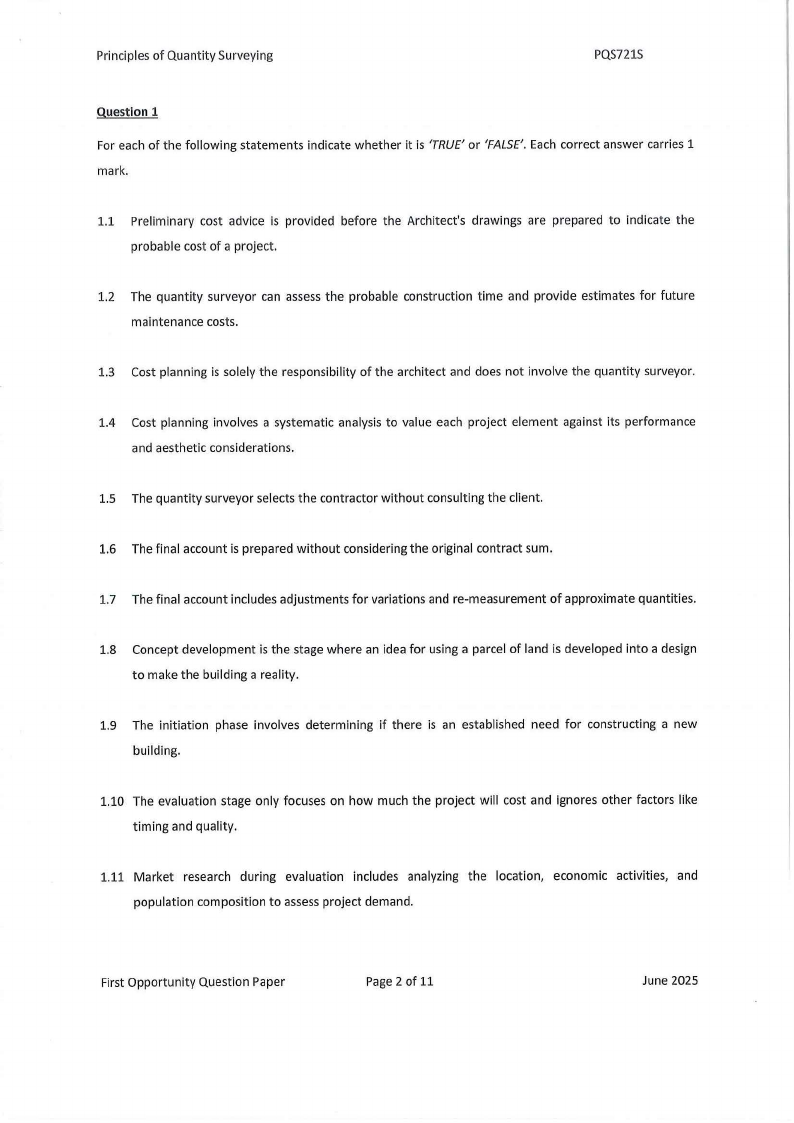
Question 1
For each of the following statements indicate whether it is 'TRUE'or 'FALSE'.Eachcorrect answer carries 1
mark.
1.1 Preliminary cost advice is provided before the Architect's drawings are prepared to indicate the
probable cost of a project.
1.2 The quantity surveyor can assessthe probable construction time and provide estimates for future
maintenance costs.
1.3 Cost planning is solely the responsibility of the architect and does not involve the quantity surveyor.
1.4 Cost planning involves a systematic analysis to value each project element against its performance
and aesthetic considerations.
1.5 The quantity surveyor selects the contractor without consulting the client.
1.6 The final account is prepared without considering the original contract sum.
1.7 The final account includes adjustments for variations and re-measurement of approximate quantities.
1.8 Concept development is the stage where an idea for using a parcel of land is developed into a design
to make the building a reality.
1.9 The initiation phase involves determining if there is an established need for constructing a new
building.
1.10 The evaluation stage only focuses on how much the project will cost and ignores other factors like
timing and quality.
1.11 Market research during evaluation includes analyzing the location, economic activities, and
population composition to assessproject demand.
First Opportunity Question Paper
Page2 of 11
June 2025

1.3 Page 3

▲back to top


Principles of Quantity Surveying
PQS721S
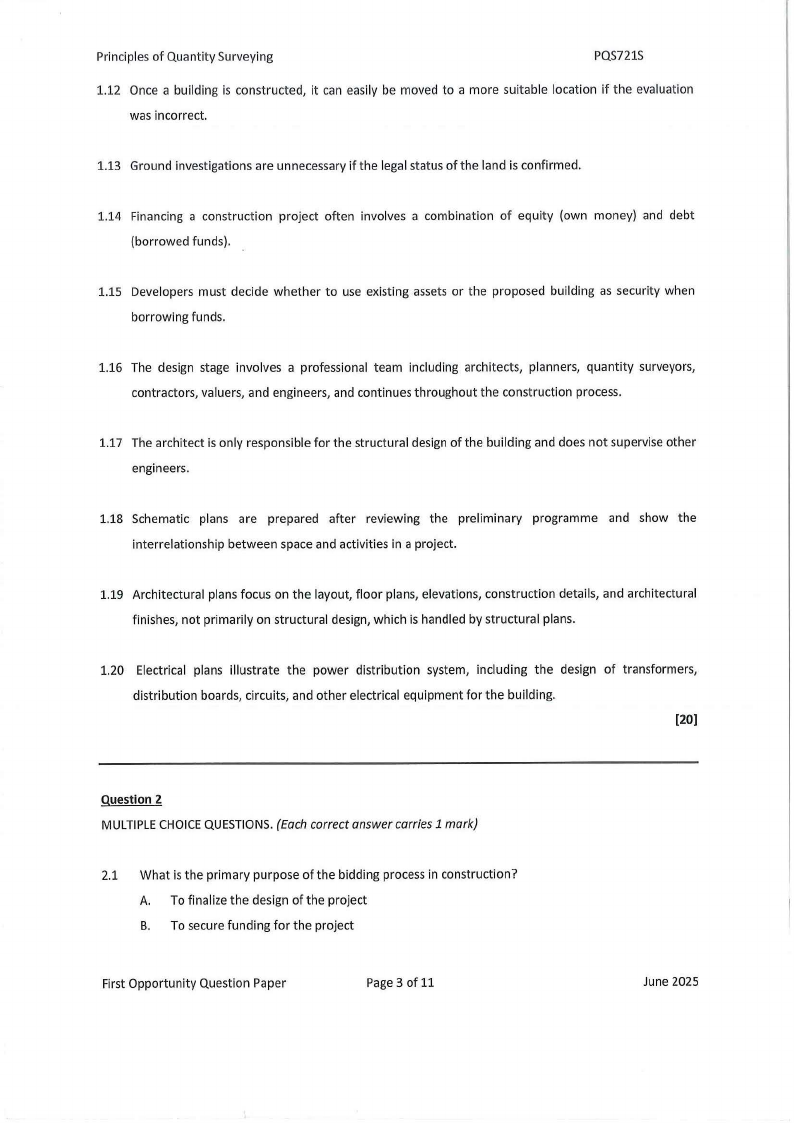
1.12 Once a building is constructed, it can easily be moved to a more suitable location if the evaluation
was incorrect.
1.13 Ground investigations are unnecessary if the legal status of the land is confirmed.
1.14 Financing a construction project often involves a combination of equity (own money) and debt
(borrowed funds).
1.15 Developers must decide whether to use existing assets or the proposed building as security when
borrowing funds.
1.16 The design stage involves a professional team including architects, planners, quantity surveyors,
contractors, valuers, and engineers, and continues throughout the construction process.
1.17 The architect is only responsible for the structural design of the building and does not supervise other
engineers.
1.18 Schematic plans are prepared after reviewing the preliminary programme and show the
interrelationship between space and activities in a project.
1.19 Architectural plans focus on the layout, floor plans, elevations, construction details, and architectural
finishes, not primarily on structural design, which is handled by structural plans.
1.20 Electrical plans illustrate the power distribution system, including the design of transformers,
distribution boards, circuits, and other electrical equipment for the building.
(20]
Question2
MULTIPLECHOICEQUESTIONS(.Each correct answer carries 1 mark)
2.1 What is the primary purpose of the bidding process in construction?
A. To finalize the design of the project
B. To secure funding for the project
First Opportunity Question Paper
Page3 of 11
June 2025

1.4 Page 4

▲back to top


Principles of Quantity Surveying
C. Selecting a contractor to carry out the construction
D. To obtain building permits from local authorities
PQS721S
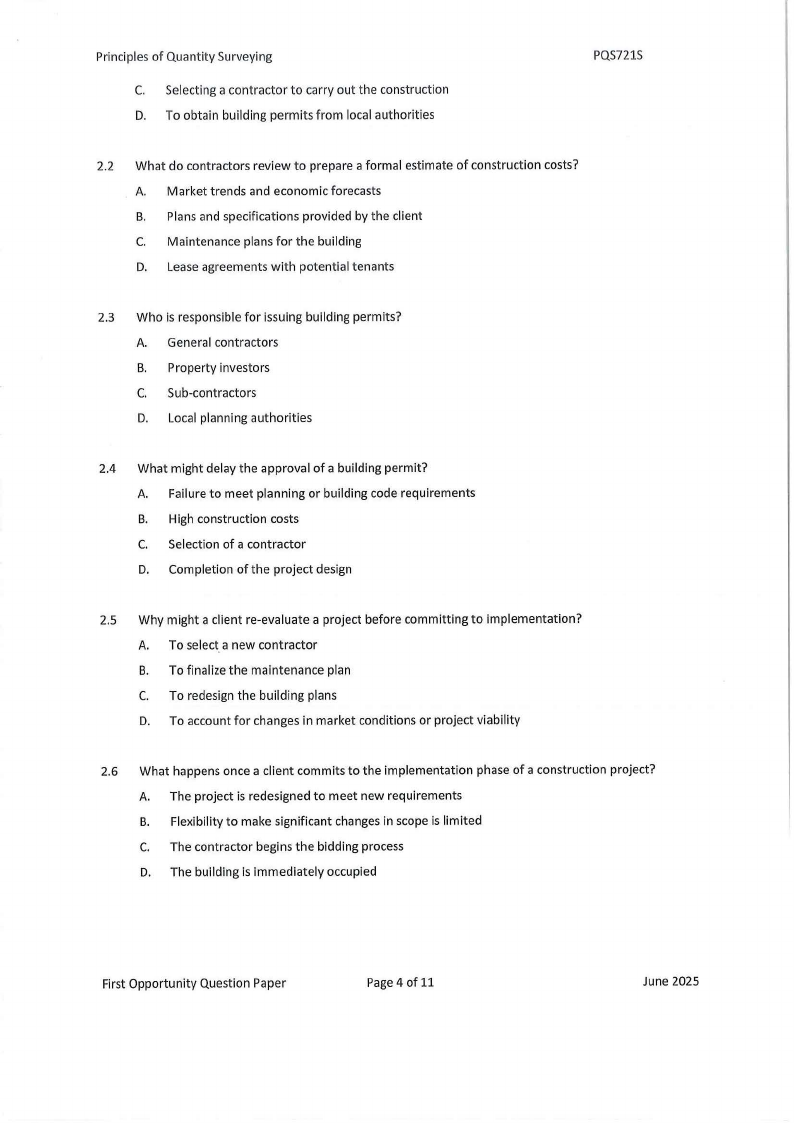
2.2 What do contractors review to prepare a formal estimate of construction costs?
A. Market trends and economic forecasts
B. Plans and specifications provided by the client
C. Maintenance plans for the building
D. Leaseagreements with potential tenants
2.3 Who is responsible for issuing building permits?
A. General contractors
B. Property investors
C. Sub-contractors
D. Local planning authorities
2.4 What might delay the approval of a building permit?
A. Failure to meet planning or building code requirements
B. High construction costs
C. Selection of a contractor
D. Completion of the project design
2.5 Why might a client re-evaluate a project before committing to implementation?
A. To select a new contractor
B. To finalize the maintenance plan
C. To redesign the building plans
D. To account for changes in market conditions or project viability
2.6 What happens once a client commits to the implementation phase of a construction project?
A. The project is redesigned to meet new requirements
B. Flexibility to make significant changes in scope is limited
C. The contractor begins the bidding process
D. The building is immediately occupied
First Opportunity Question Paper
Page4 of 11
June 2025

1.5 Page 5

▲back to top


Principles of Quantity Surveying
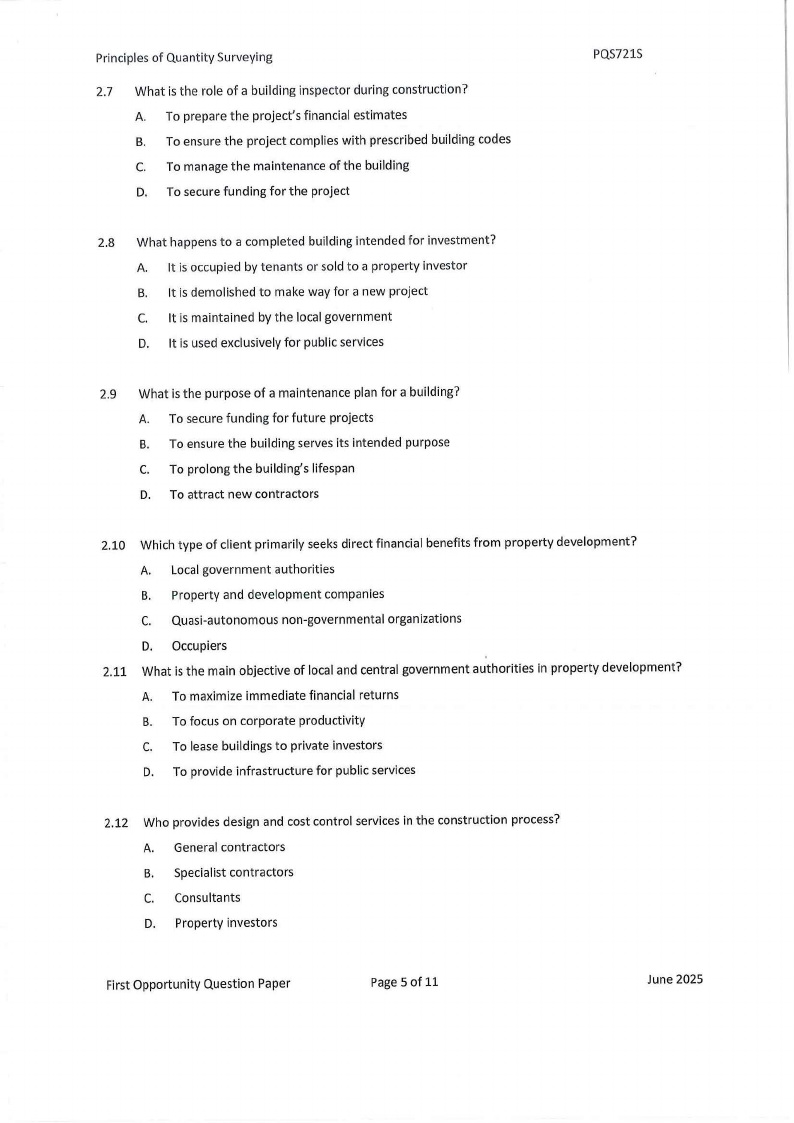
2.7 What is the role of a building inspector during construction?
A. To prepare the project's financial estimates
B. To ensure the project complies with prescribed building codes
C. To manage the maintenance of the building
D. To secure funding for the project
PQS721S
2.8 What happens to a completed building intended for investment?
A. It is occupied by tenants or sold to a property investor
B. It is demolished to make way for a new project
C. It is maintained by the local government
D. It is used exclusively for public services
2.9 What is the purpose of a maintenance plan for a building?
A. To secure funding for future projects
B. To ensure the building serves its intended purpose
C. To prolong the building's lifespan
D. To attract new contractors
2.10 Which type of client primarily seeksdirect financial benefits from property development?
A. Localgovernment authorities
8. Property and development companies
C. Quasi-autonomous non-governmental organizations
D. Occupiers
2.11 What is the main objective of local and central government authorities in property development?
A. To maximize immediate financial returns
8. To focus on corporate productivity
C. To lease buildings to private investors
D. To provide infrastructure for public services
2.12 Who provides design and cost control services in the construction process?
A. General contractors
8. Specialist contractors
C. Consultants
D. Property investors
First Opportunity Question Paper
Page5 of 11
June 2025

1.6 Page 6

▲back to top


Principles of Quantity Surveying
PQS721S
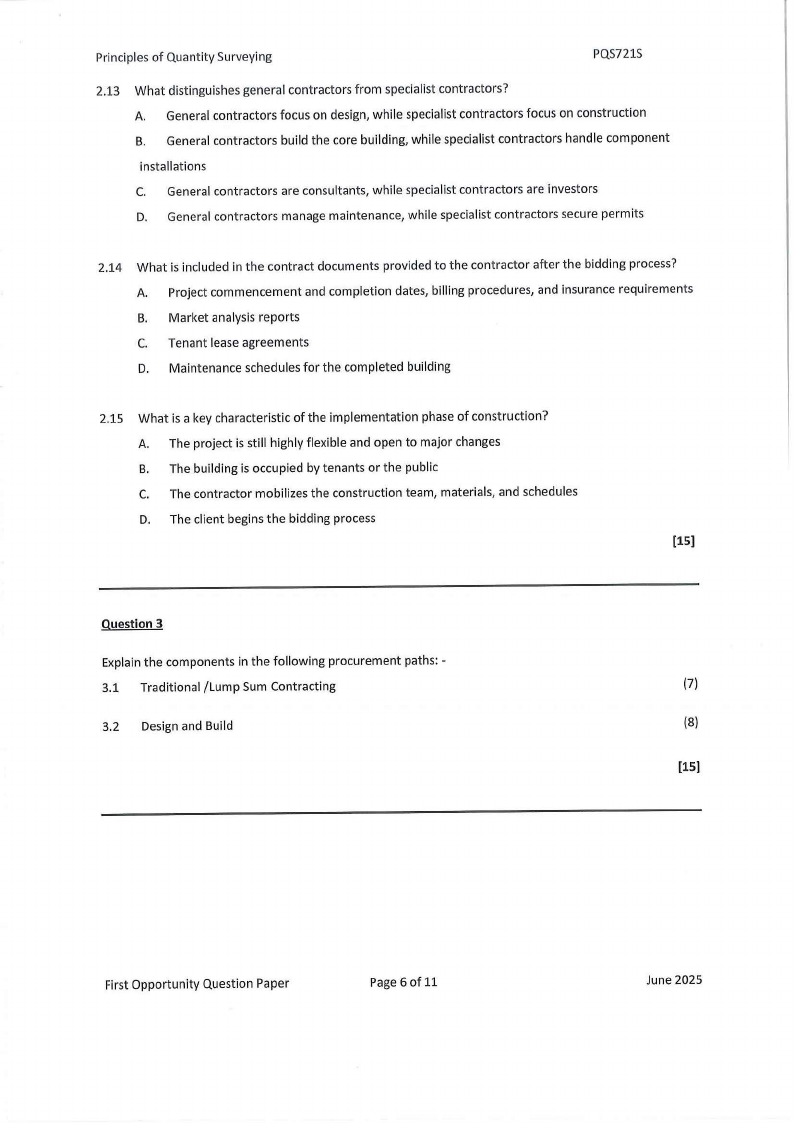
2.13 What distinguishes general contractors from specialist contractors?
A. General contractors focus on design, while specialist contractors focus on construction
B. General contractors build the core building, while specialist contractors handle component
installations
C. General contractors are consultants, while specialist contractors are investors
D. General contractors manage maintenance, while specialist contractors secure permits
2.14 What is included in the contract documents provided to the contractor after the bidding process?
A. Project commencement and completion dates, billing procedures, and insurance requirements
B. Market analysis reports
C. Tenant lease agreements
D. Maintenance schedules for the completed building
2.15 What is a key characteristic of the implementation phase of construction?
A. The project is still highly flexible and open to major changes
B. The building is occupied by tenants or the public
C. The contractor mobilizes the construction team, materials, and schedules
D. The client begins the bidding process
(15]
Question 3
Explain the components in the following procurement paths: -
3.1 Traditional /Lump Sum Contracting
(7)
3.2 Design and Build
(8)
(15]
First Opportunity Question Paper
Page6 of 11
June 2025

1.7 Page 7

▲back to top


Principles of Quantity Surveying
PQS721S
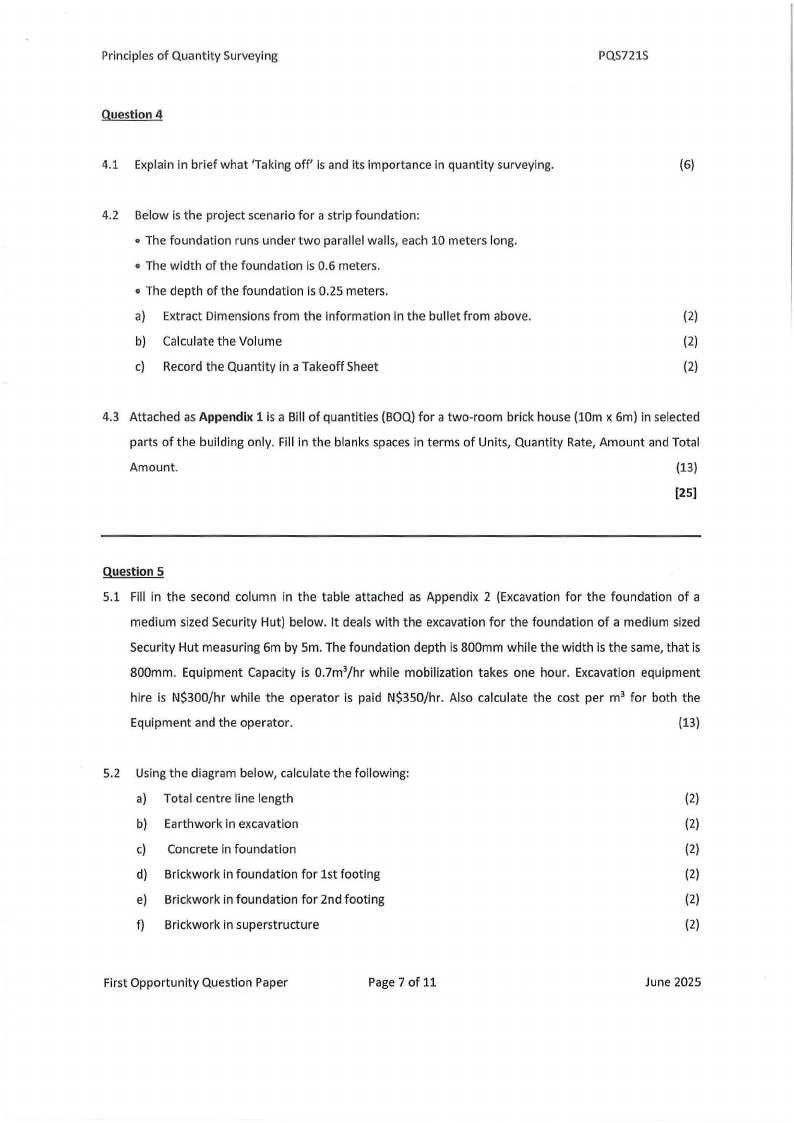
Question4
4.1 Explain in brief what 'Taking off' is and its importance in quantity surveying.
(6)
4.2 Below is the project scenario for a strip foundation:
• The foundation runs under two parallel walls, each 10 meters long.
• The width of the foundation is 0.6 meters.
• The depth of the foundation is 0.25 meters.
a) Extract Dimensions from the information in the bullet from above.
(2)
b) Calculate the Volume
(2)
c) Record the Quantity in a Takeoff Sheet
(2)
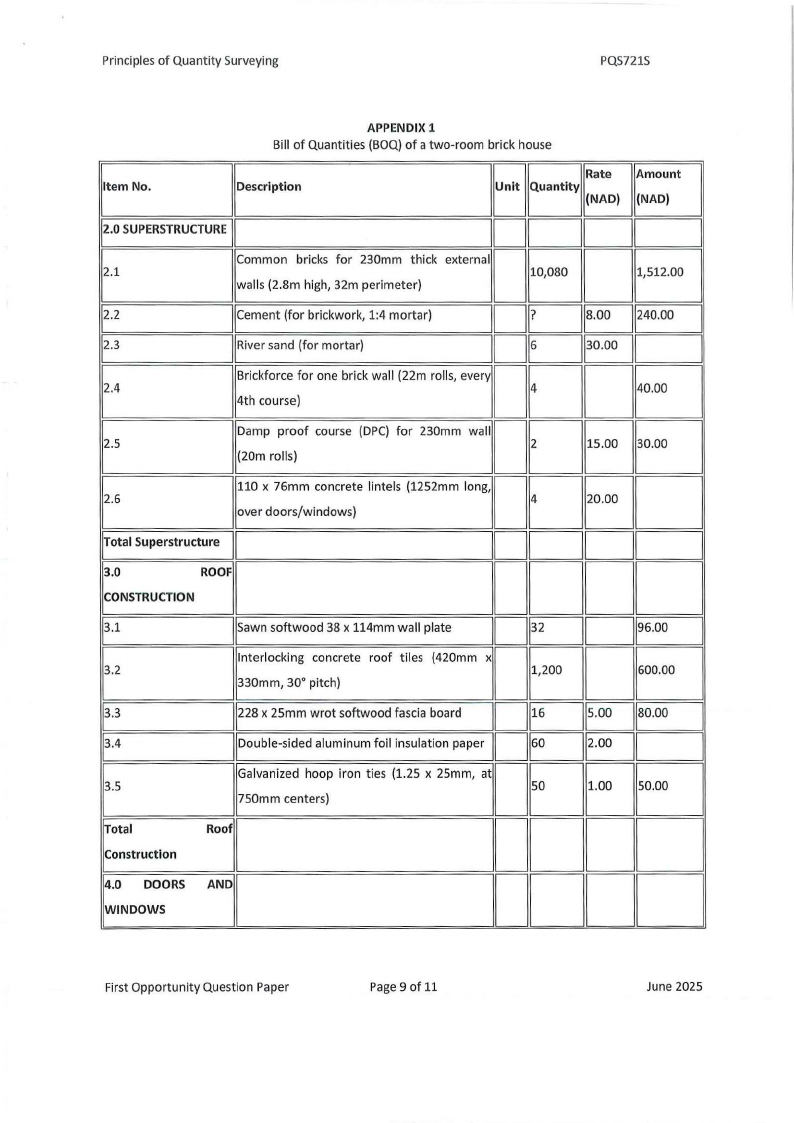
4.3 Attached as Appendix1 is a Bill of quantities (BOQ)for a two-room brick house (10m x 6m) in selected
parts of the building only. Fill in the blanks spaces in terms of Units, Quantity Rate, Amount and Total
Amount.
(13)
[25)
Question5
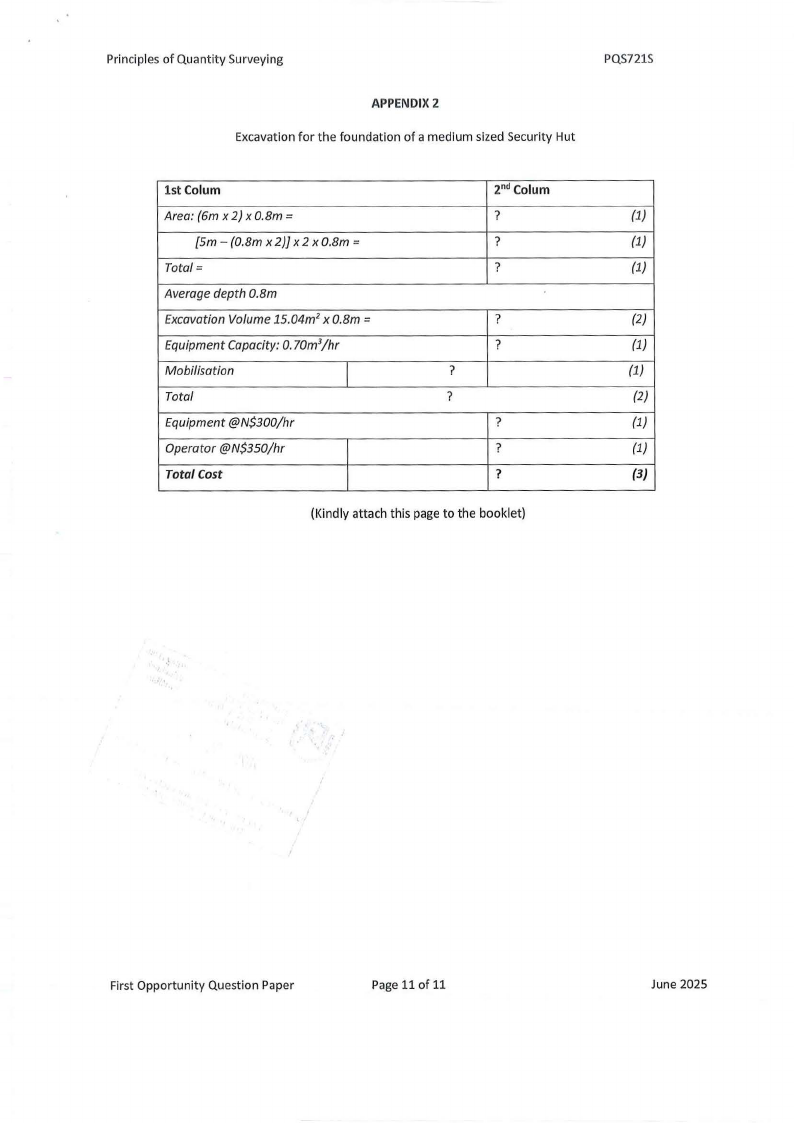
5.1 Fill in the second column in the table attached as Appendix 2 (Excavation for the foundation of a
medium sized Security Hut) below. It deals with the excavation for the foundation of a medium sized
Security Hut measuring 6m by Sm. The foundation depth is 800mm while the width is the same, that is
800mm. Equipment Capacity is 0.7m3/hr while mobilization takes one hour. Excavation equipment
hire is N$300/hr while the operator is paid N$350/hr. Also calculate the cost per m3 for both the
Equipment and the operator.
(13)
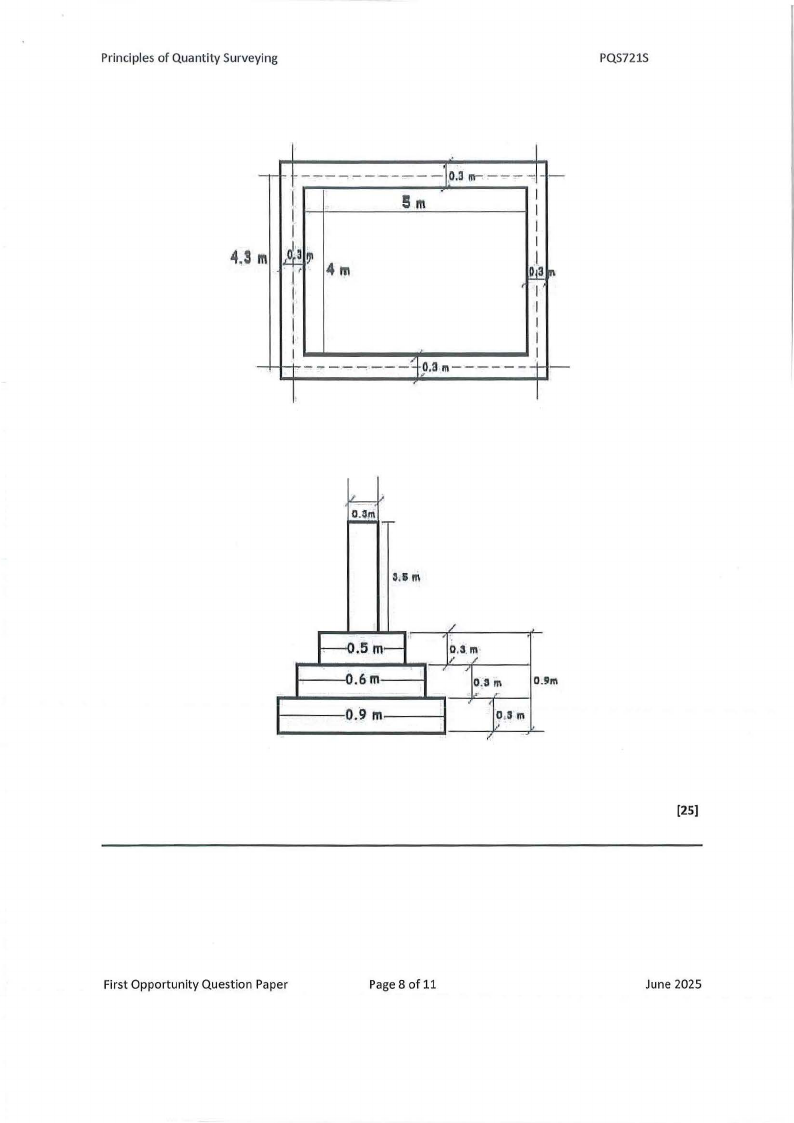
5.2 Using the diagram below, calculate the following:
a) Total centre line length
(2)
b) Earthwork in excavation
(2)
c) Concrete in foundation
(2)
d) Brickwork in foundation for 1st footing
(2)
e) Brickwork in foundation for 2nd footing
(2)
f) Brickwork in superstructure
(2)
First Opportunity Question Paper
Page7 of 11
June 2025

1.8 Page 8

▲back to top


Principles of Quantity Surveying
PQS721S
---- -------
' _D.3in----
.
I1---------------S1m
I
I
I
4.S m d'3!)I
I
I
I' 4m
oa
I
I
I
I
I
--t--t-t-,.. ----
I
I
I
I
.---
o.am------ I
O.S/11
1----0.9
m----1
O,S.m
I'
o.s m
0.9m
[25)
First Opportunity Question Paper
Page 8 of 11
June 2025

1.9 Page 9

▲back to top


Principles of Quantity Surveying
PQS721S
APPENDIX1
Bill of Quantities (BOQ) of a two-room brick house
[Item No.
[[Description
I 12.0SUPERSTRUCTURE
ICommon bricks for 230mm thick external
[21
: walls(2.8mhigh,32m perimeter)
Rate Amount
(NAD) (NAD)
I
12,2
IICement (for brickwork, 1:4 mortar)
II~DEJl240.00
I
12.3
River sand (for mortar)
II~C II I 30 00
11 ·
Brickforce for one brick wall (22m rolls, every
[2•
4th course)
Damp proof course (DPC} for 230mm wall
125
(20m rolls)
126
110 x 76mm concretelintels(1252mmlong,
4
over doors/windows)
20.00
Total Superstructure
I
3.0
ROOFI
CONSTRUCTION
13.1
IIIsawn softwood 38 x 114mm wall plate
lnterlocklng concrete roof tiles (420mm
I
1,.2
330mm, 30° pitch)
,3.3
13.4
11228x 25mm wrot softwood fascia board
ll~D~l80.00
IDouble-sided aluminum foll insulation paper
IGalvani,ed hoop Iron ties (1.25 x 25mm, at
I
I
1,,
Total
750mm centers)
IRoof
Construction
ANDI 4.0 DOORS
WINDOWS
First Opportunity Question Paper
Page 9 of 11
June 2025

1.10 Page 10

▲back to top


Principles of Quantity Surveying
4.1
11
42
External solid wooden door (813 x 2030mm,
2
I:::~ oak veneer, polyurethane finish)
I
mahogany 200 x 50mm rebated
1:=======~
14:==_3========:I
~:::,ongery
100mm pressed steel butt
1
4 _4
I P~epa.reand apply two undercoats, one gloss
.
. oil paint to door surfaces
1
(Kindly attach this page to the booklet)
PQS721S
300.00 600.00
First Opportunity Question Paper
Page 10 of 11
June 2025

2 Pages 11-20

▲back to top


2.1 Page 11

▲back to top


Principles of Quantity Surveying
PQS721S
APPENDIX2
Excavation for the foundation of a medium sized Security Hut
1st Colum
2nd Colum
Area: (6m x 2) x 0.8m =
?
(1)
[Sm - (0.8m x 2}} x 2 x 0.8m =
?
(1)
Total=
?
(1)
Average depth 0.8m
Excavation Volume 15.04m 2 x 0.Bm =
?
(2)
Equipment Capacity: 0.70m 3/hr
?
(1)
Mobilisation
?
(1)
Total
?
(2)
Equipment @N$300/hr
?
(1)
Operator @N$350/hr
?
(1)
Total Cost
?
(3)
(Kindly attach this page to the booklet)
First Opportunity Question Paper
Page 11 of 11
June 2025