


 |
PQS721S - PRINCIPLES OF QUANTITY SURVEYING - 2ND OPP - JULY 2025 |
|
|
1 Page 1 |
▲back to top |

nAm I BI A un IVERS ITY
OF SCIEnCE Ano TECHnOLOGY
FACULTY OF ENGINEERING AND THE BUILT ENVIRONMENT
DEPARTMENT OF LAND AND SPATIALSCIENCES
QUALIFICATION{S):
BACHELOROF PROPERTYSTUDIES
QUALIFICATION(S)CODE: 08BOPS NQF LEVEL: 7
COURSECODE: PQS721S
COURSENAME: PRINCIPLESOF QUANTITYSURVEYING
EXAMS SESSION:JULY2025
PAPER:
THEORY
DURATION: 2 HOURS
MARl<S:
100
SECOND OPPORTUNITY/SUPPLEMENTARY EXAMINATION QUESTION PAPER
EXAMINER:
MR AMIN ISSA
MODERATOR: MS ELINATEODOL
INSTRUCTIONS
1. Read the entire question paper before answering the Questions.
2. Please write clearly and legibly!
3. The question paper contains a total of 5 questions.
4. You must answer ALL QUESTIONS.
5. Make sure your Student Number is on the ANSWERSHEET(S).
PERMISSIBLEMATERIALS
1. Non-programmable Scientific Calculator
THIS QUESTION PAPERCONSISTSOF 8 PAGES(Including this front page and appendices 1 & 2)
|
|
2 Page 2 |
▲back to top |
Principles of Quantity Surveying
PQS721S
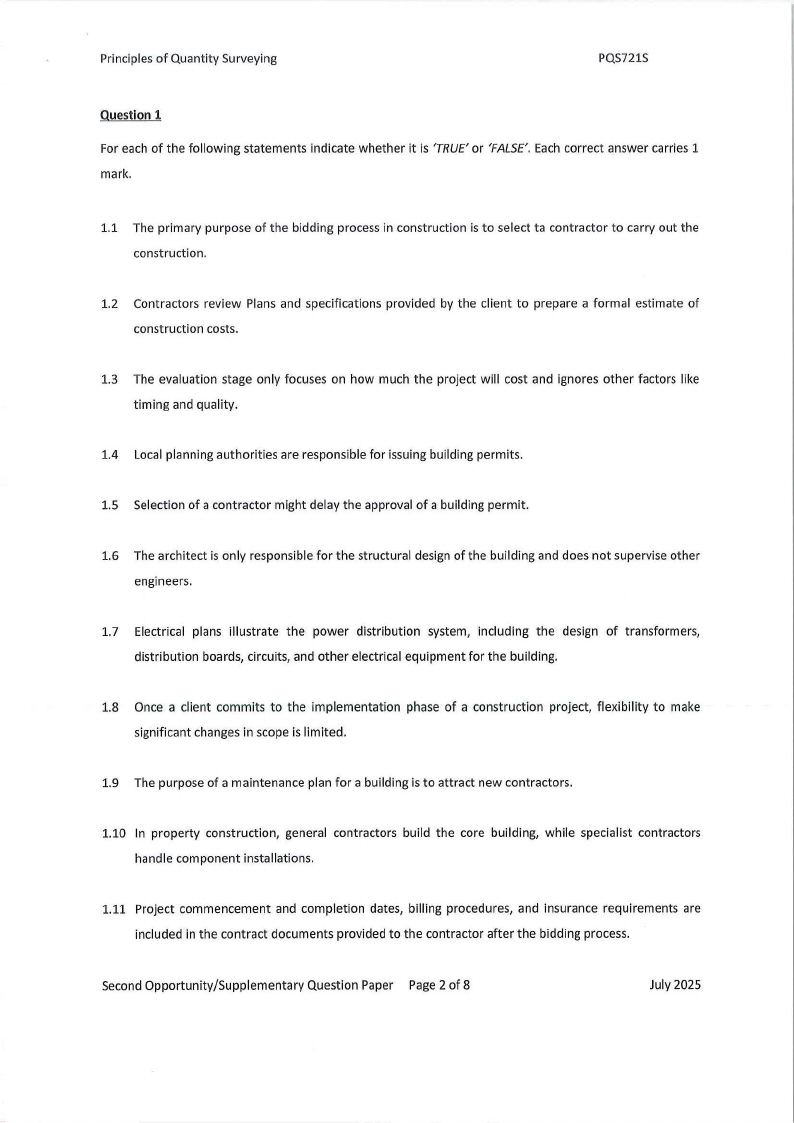
Question l
For each of the following statements indicate whether it is 'TRUE'or 'FALSE'.Eachcorrect answer carries 1
mark.
1.1 The primary purpose of the bidding process in construction is to select ta contractor to carry out the
construction.
1.2 Contractors review Plans and specifications provided by the client to prepare a formal estimate of
construction costs.
1.3 The evaluation stage only focuses on how much the project will cost and ignores other factors like
timing and quality.
1.4 Local planning authorities are responsible for issuing building permits.
1.5 Selection of a contractor might delay the approval of a building permit.
1.6 The architect is only responsible for the structural design of the building and does not supervise other
engineers.
1.7 Electrical plans illustrate the power distribution system, including the design of transformers,
distribution boards, circuits, and other electrical equipment for the building.
1.8 Once a client commits to the implementation phase of a construction project, flexibility to make
significant changes in scope is limited.
1.9 The purpose of a maintenance plan for a building is to attract new contractors.
1.10 In property construction, general contractors build the core building, while specialist contractors
handle component installations.
1.11 Project commencement and completion dates, billing procedures, and insurance requirements are
included in the contract documents provided to the contractor after the bidding process.
SecondOpportunity/Supplementary Question Paper Page2 of 8
July 2025
|
|
3 Page 3 |
▲back to top |
Principles of Quantity Surveying
PQS721S
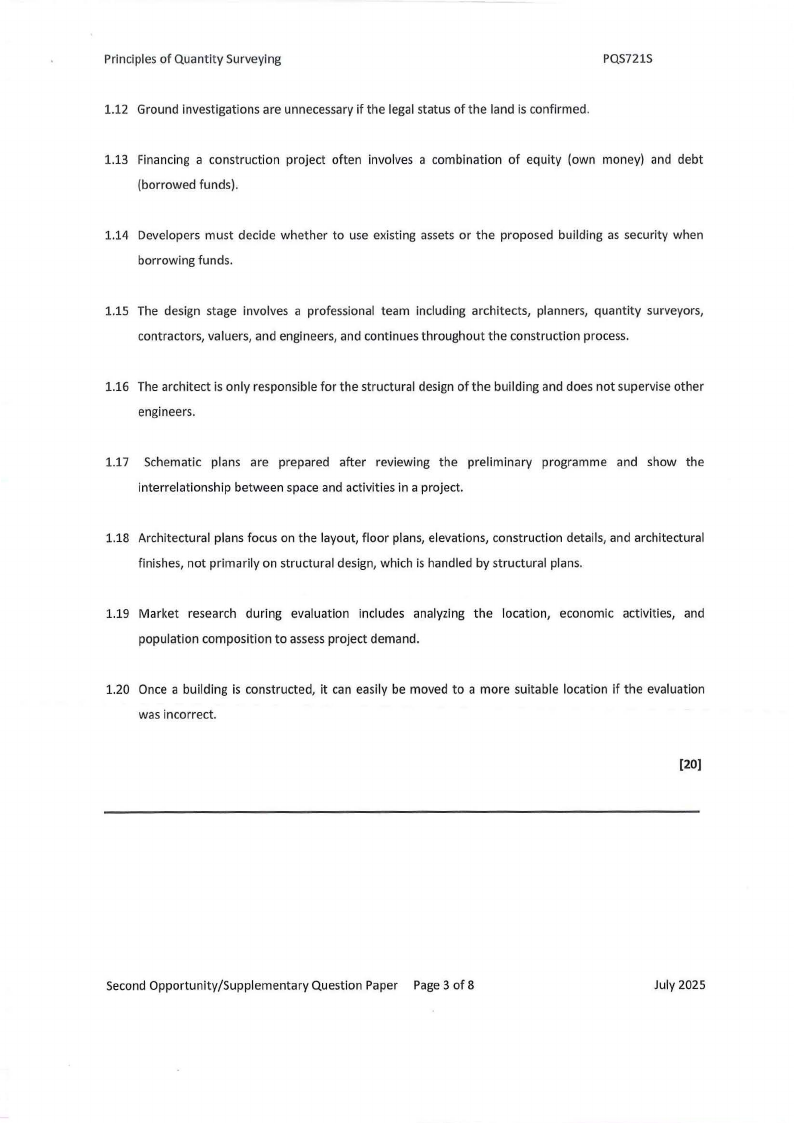
1.12 Ground investigations are unnecessary if the legal status of the land is confirmed.
1.13 Financing a construction project often involves a combination of equity (own money) and debt
(borrowed funds).
1.14 Developers must decide whether to use existing assets or the proposed building as security when
borrowing funds.
1.15 The design stage involves a professional team including architects, planners, quantity surveyors,
contractors, valuers, and engineers, and continues throughout the construction process.
1.16 The architect is only responsible for the structural design of the building and does not supervise other
engineers.
1.17 Schematic plans are prepared after reviewing the preliminary programme and show the
interrelationship between space and activities in a project.
1.18 Architectural plans focus on the layout, floor plans, elevations, construction details, and architectural
finishes, not primarily on structural design, which is handled by structural plans.
1.19 Market research during evaluation includes analyzing the location, economic activities, and
population composition to assessproject demand.
1.20 Once a building is constructed, it can easily be moved to a more suitable location if the evaluation
was incorrect.
[20)
SecondOpportunity/Supplementary Question Paper Page3 of 8
July 2025
|
|
4 Page 4 |
▲back to top |
Principles of Quantity Surveying
PQS721S
Question 2
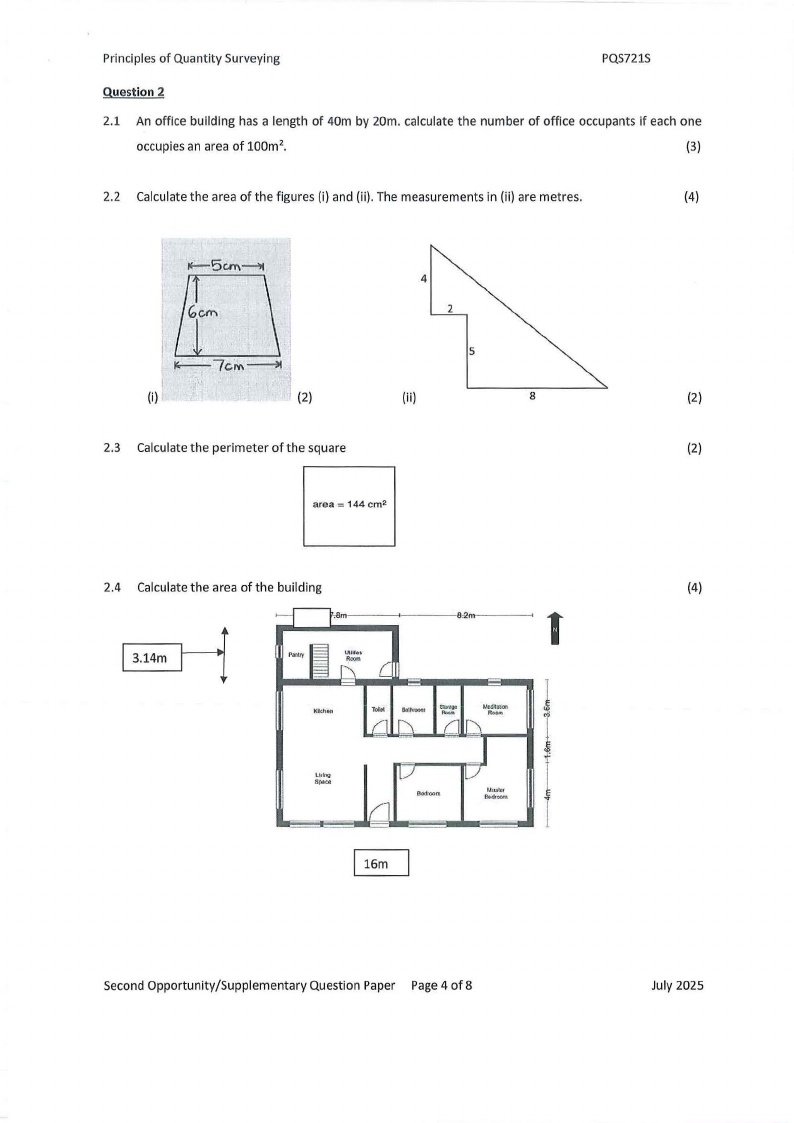
2.1 An office building has a length of 40m by 20m. calculate the number of office occupants if each one
occupies an area of 100m2•
(3)
2.2 Calculatethe area of the figures (i) and (ii).The measurements in (ii) are metres.
(4)
4
2
5
i'-------- 7 GM
(i)
I (2)
(ii)
8
(2)
2.3 Calculate the perimeter of the square
(2)
area = 144 cm2
2.4 Calculate the area of the building
f;&ri--------t----ils2m-----<
(4)
l
l
1
r
Oocfroon,
i
16m
SecondOpportunity/Supplementary Question Paper Page4 of 8
July 2025
|
|
5 Page 5 |
▲back to top |
Principles of Quantity Surveying
PQS721S
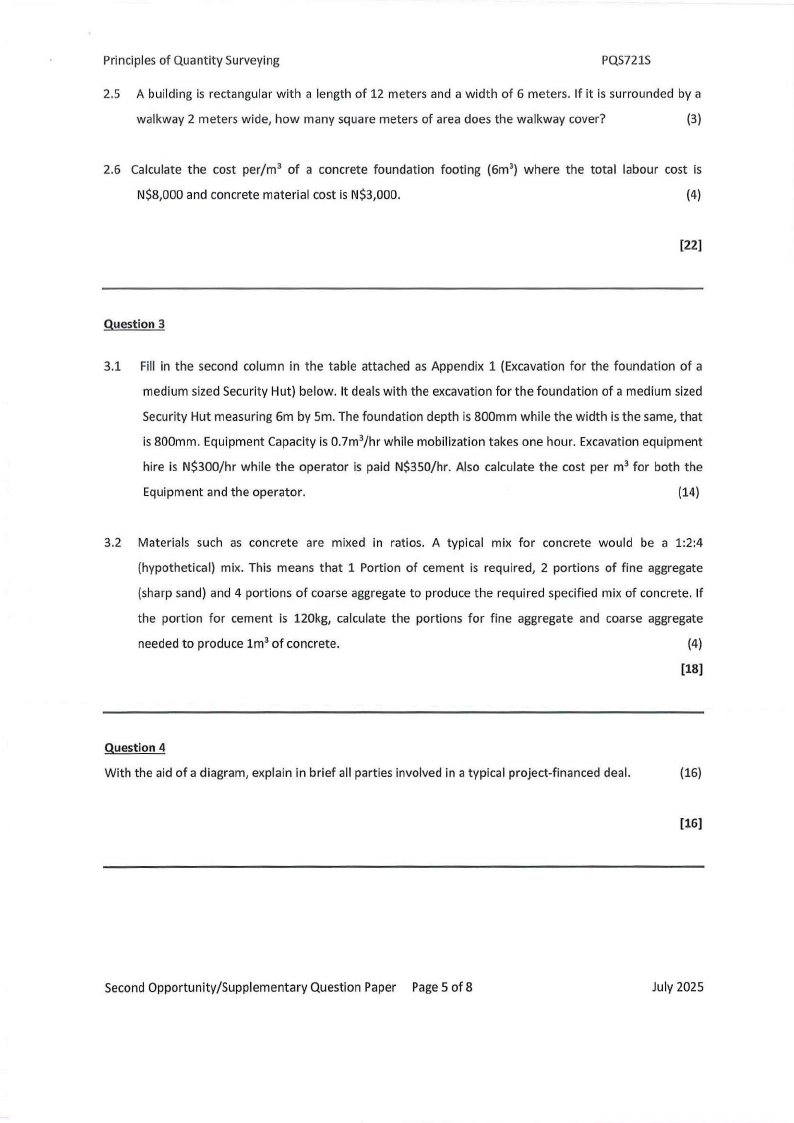
2.5 A building is rectangular with a length of 12 meters and a width of 6 meters. If it is surrounded by a
walkway 2 meters wide, how many square meters of area does the walkway cover?
(3)
2.6 Calculate the cost per/m 3 of a concrete foundation footing (6m3) where the total labour cost is
N$8,000 and concrete material cost is N$3,000.
(4)
[22)
Question 3
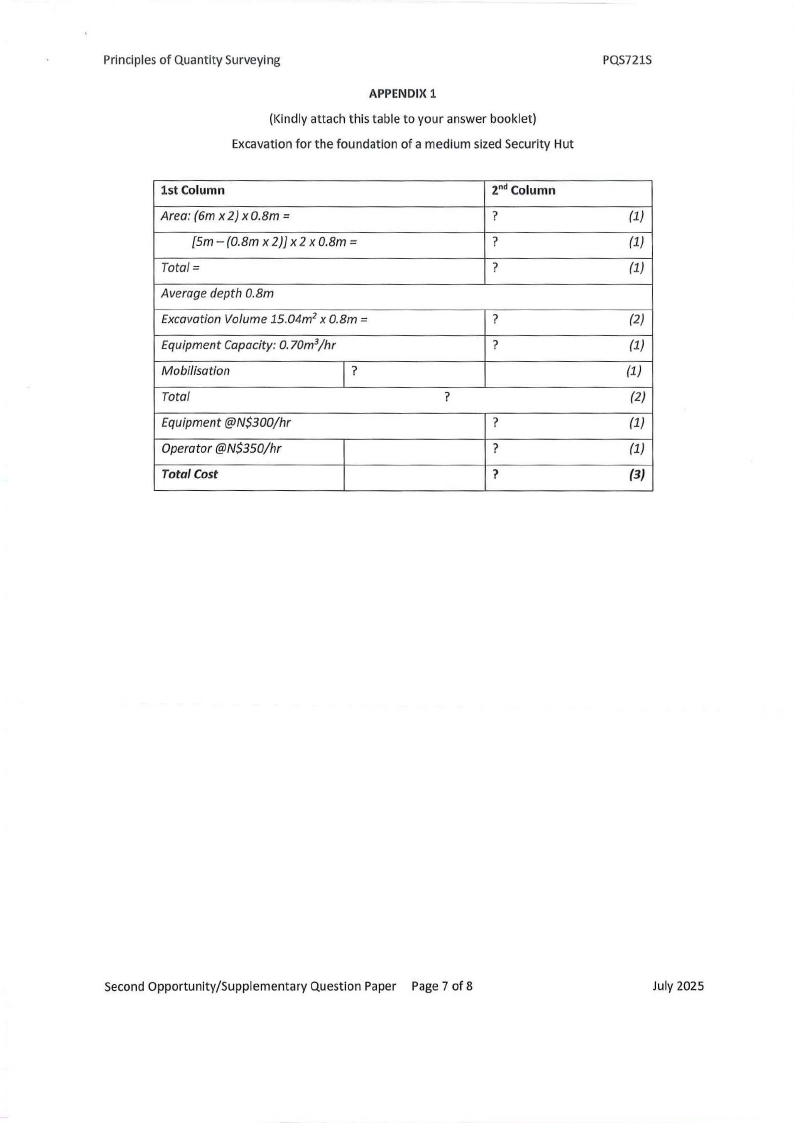
3.1 Fill in the second column in the table attached as Appendix 1 (Excavation for the foundation of a
medium sized Security Hut) below. It deals with the excavation for the foundation of a medium sized
Security Hut measuring 6m by Sm. The foundation depth is 800mm while the width is the same, that
is 800mm. Equipment Capacity is 0.7m3/hr while mobilization takes one hour. Excavation equipment
hire is N$300/hr while the operator is paid N$350/hr. Also calculate the cost per m3 for both the
Equipment and the operator.
(14)
3.2 Materials such as concrete are mixed in ratios. A typical mix for concrete would be a 1:2:4
(hypothetical) mix. This means that 1 Portion of cement is required, 2 portions of fine aggregate
(sharp sand) and 4 portions of coarse aggregate to produce the required specified mix of concrete. If
the portion for cement is 120kg, calculate the portions for fine aggregate and coarse aggregate
needed to produce 1m3 of concrete.
(4)
[18)
Question 4
With the aid of a diagram, explain in brief all parties involved in a typical project-financed deal.
(16)
[16)
SecondOpportunity/Supplementary Question Paper Page5 of 8
July 2025
|
|
6 Page 6 |
▲back to top |
Principles of Quantity Surveying
Question 5
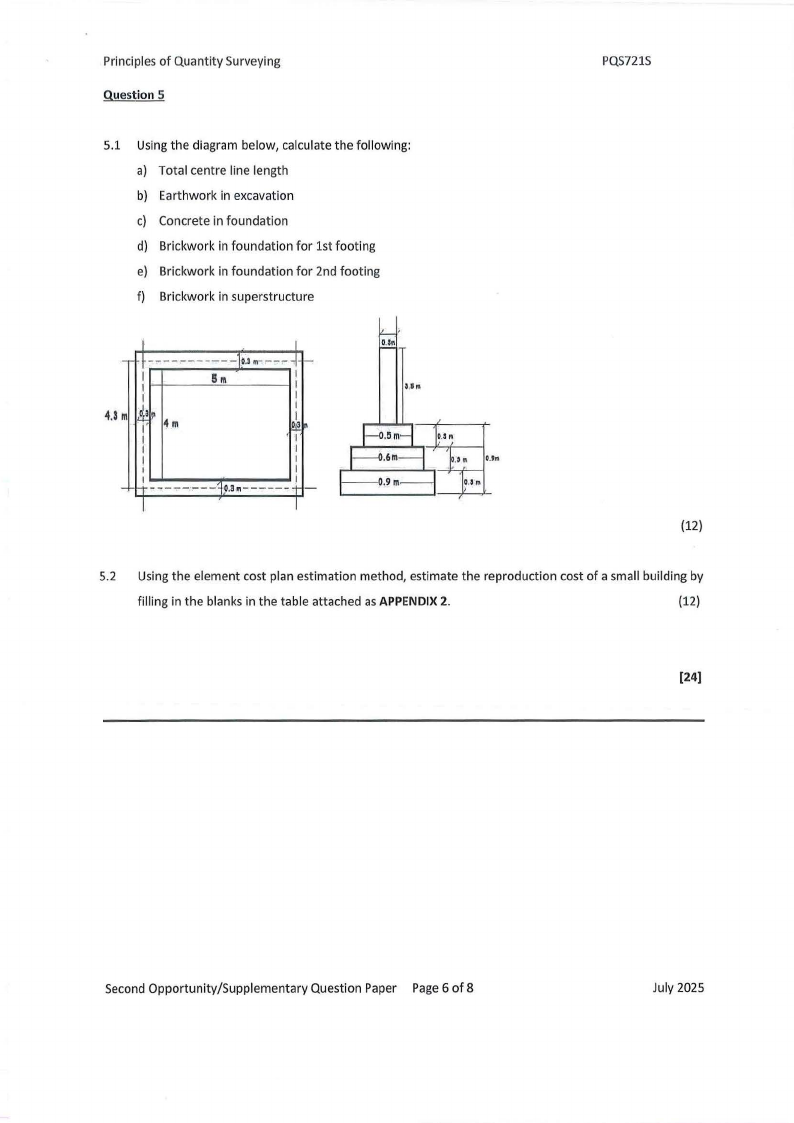
5.1 Using the diagram below, calculate the following:
a) Total centre line length
b) Earthwork in excavation
c) Concrete in foundation
d) Brickwork in foundation for 1st footing
e) Brickwork in foundation for 2nd footing
f) Brickwork in superstructure
--- --- --- - .0.3m---
Sm
4m
PQS721S
(12)
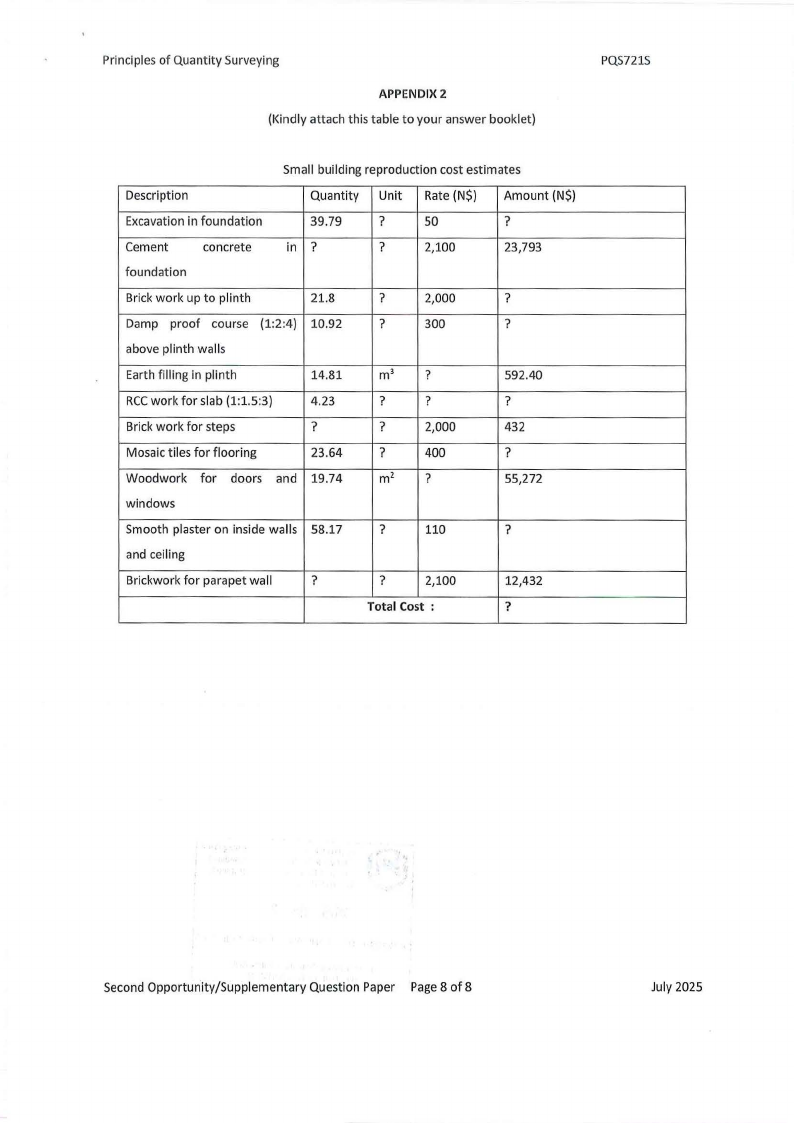
5.2 Using the element cost plan estimation method, estimate the reproduction cost of a small building by
filling in the blanks in the table attached asAPPENDIX2.
(12)
(24)
SecondOpportunity/Supplementary Question Paper Page6 of 8
July 2025
|
|
7 Page 7 |
▲back to top |
Principles of Quantity Surveying
APPENDIX1
(Kindly attach this table to your answer booklet)
Excavation for the foundation of a medium sized Security Hut
PQS721S
1st Column
Area: {6m x 2) x 0.Bm =
{Sm - {0.Bm x 2}} x 2 x 0.Bm =
Total=
Average depth 0.Bm
Excavation Volume 15.04m 2 x 0.Bm =
Equipment Capacity: 0.70m 3/hr
Mobilisation
?
Total
Equipment @N$300/hr
Operator @N$350/hr
Total Cost
2nd Column
?
(1)
?
(1)
?
(1)
?
(2)
?
(1)
(1)
?
(2)
?
(1)
?
(1)
?
{3}
Second Opportunity/Supplementary Question Paper Page 7 of 8
July 2025
|
|
8 Page 8 |
▲back to top |
Principles of Quantity Surveying
APPENDIX 2
(Kindly attach this table to your answer booklet)
PQS721S
Small building reproduction cost estimates
Description
Quantity Unit Rate (N$) Amount (N$)
Excavation in foundation
39.79
?
50
?
Cement
concrete
in ?
?
2,100
23,793
foundation
Brick work up to plinth
21.8
?
2,000
?
Damp proof course (1:2:4) 10.92
?
300
?
above plinth walls
Earth filling in plinth
14.81
m3 ?
592.40
RCCwork for slab (1:1.5:3)
4.23
?
?
?
Brick work for steps
?
?
2,000
432
Mosaic tiles for flooring
23.64
Woodwork for doors and 19.74
?
400
m2 ?
?
55,272
windows
Smooth plaster on inside walls 58.17
?
110
?
and ceiling
Brickwork for parapet wall
?
?
2,100
12,432
Total Cost :
?
Second Opportunity/Supplementary Question Paper Page 8 of 8
July 2025