


 |
LTS520S - LAND TENURE SYSTEMS - 1ST OPP - NOV 2025 |
|
|
1 Page 1 |
▲back to top |
n Am I BI A u n IVER s I TY
OF SCIEnCE Ano TECHnOLOGY
FACULTY OF ENGINEERING AND THE BUILT ENVIRONMENT
DEPARTMENT OF LAND AND SPATIAL SCIENCES
QUALIFICATION(S): BACHELOR/DIPLOMA- PROPERTY STUDIES, LAND ADMINISTRATION,
GEOMATICS, AND TOWN AND REGIONAL PLANNING
QUALIFICATION(S) CODE: 08BOPS, 06DIPS,
07BLAM, 06DGEO, 06DGEM, NQF LEVEL: 5
07BGEO,07BGEM,07BTAR
COURSE CODE: LTS520S
COURSE NAME: LAND TENURE SYSTEMS
EXAMS SESSION: NOVEMBER 2025
PAPER:
THEORY
DURATION: 3 HOURS
MARKS:
100
EXAMINER(S)
FIRST OPPORTUNITY EXAMINATION QUESTION PAPER
PROF UCHENDU E. CHIGBU
MODERATOR: MR AMIN ISSA
INSTRUCTIONS
1. Read the entire question paper before answering the Questions.
2. Please write clearly and legibly!
3. The question paper contains a total of 4 questions.
4. You must answer ALL QUESTIONS.
5. Make sure your Student Number is on the EXAMINATION BOOK(S}.
PERMISSIBLE MATERIALS
1. None
THIS QUESTION PAPER CONSISTS OF 6 PAGES (Including this front page)
|
|
2 Page 2 |
▲back to top |
Land Tenure Systems
LTS520S
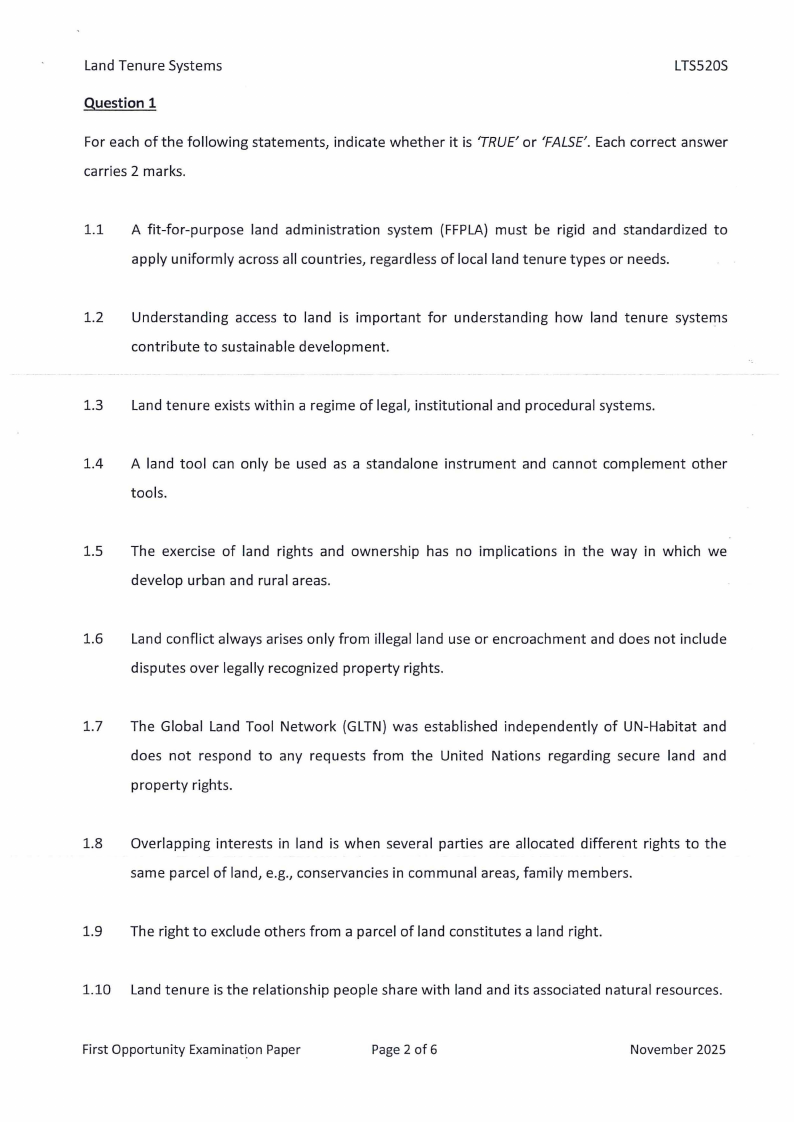
Question 1
For each of the following statements, indicate whether it is 'TRUE' or 'FALSE'. Each correct answer
carries 2 marks.
1.1 A fit-for-purpose land administration system (FFPLA} must be rigid and standardized to
apply uniformly across all countries, regardless of local land tenure types or needs.
1.2 Understanding access to land is important for understanding how land tenure systems
contribute to sustainable development.
1.3 Land tenure exists within a regime of legal, institutional and procedural systems.
1.4 A land tool can only be used as a standalone instrument and cannot complement other
tools.
1.5 The exercise of land rights and ownership has no implications in the way in which we
develop urban and rural areas.
1.6 Land conflict always arises only from illegal land use or encroachment and does not include
disputes over legally recognized property rights.
1.7 The Global Land Tool Network (GLTN} was established independently of UN-Habitat and
does not respond to any requests from the United Nations regarding secure land and
property rights.
1.8 Overlapping interests in land is when several parties are allocated different rights to the
same parcel of land, e.g., conservancies in communal areas, family members.
1.9 The right to exclude others from a parcel of land constitutes a land right.
1.10 Land tenure is the relationship people share with land and its associated natural resources.
First Opportunity Examinati_on Paper
Page 2 of 6
November 2025
|
|
3 Page 3 |
▲back to top |
Land Tenure Systems
LTS5205
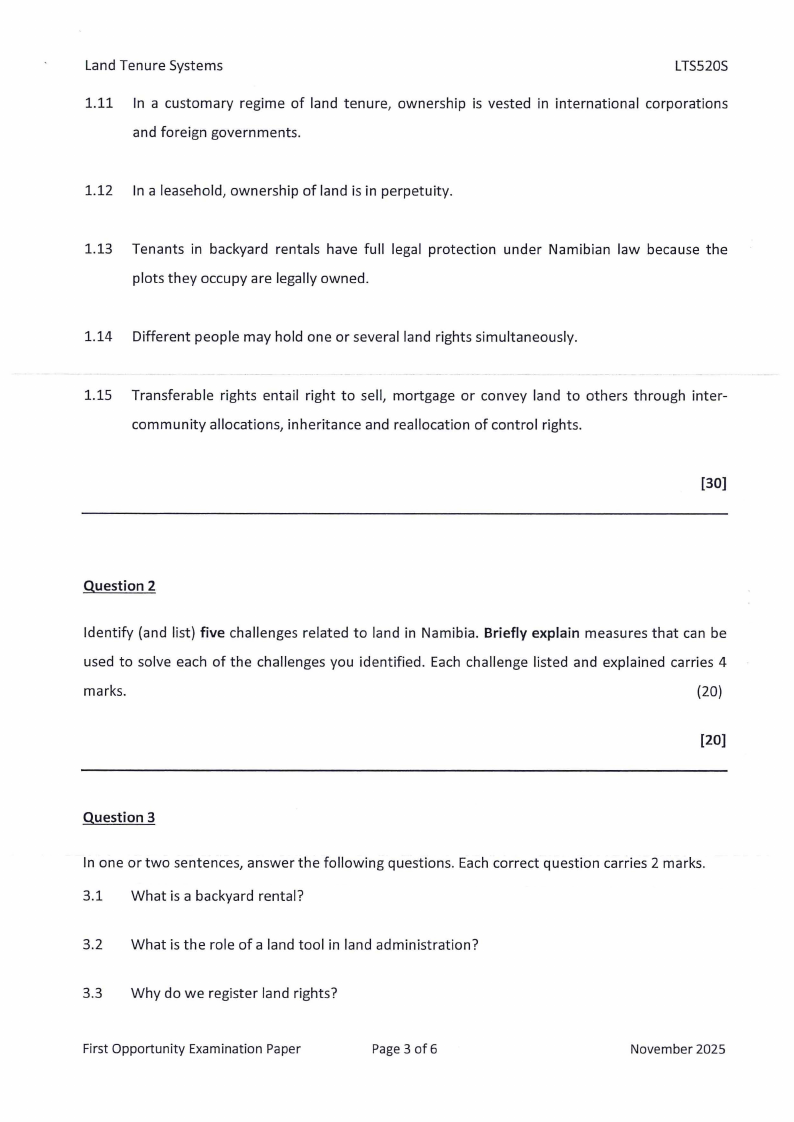
1.11 In a customary regime of land tenure, ownership is vested in international corporations
and foreign governments.
1.12 In a leasehold, ownership of land is in perpetu ity.
1.13 Tenants in backyard rentals have full legal protection under Namibian law because the
plots they occupy are legally owned.
1.14 Different people may hold one or several land rights simultaneously.
1.15 Transferable rights entail right to sell, mortgage or convey land to others through inter-
community allocations, inheritance and reallocation of control rights.
[30]
Question 2
Identify (and list) five challenges related to land in Namibia. Briefly explain measures that can be
used to solve each of the challenges you identified. Each challenge listed and explained carries 4
marks.
(20)
[20]
Question 3
In one or two sentences, answer the following questions. Each correct question carries 2 marks.
3.1 What is a backyard rental?
3.2 What is the role of a land tool in land administration?
3.3 Why do we register land rights?
First Opportunity Examination Paper
Page 3 of 6
November 2025
|
|
4 Page 4 |
▲back to top |
Land Tenure Systems
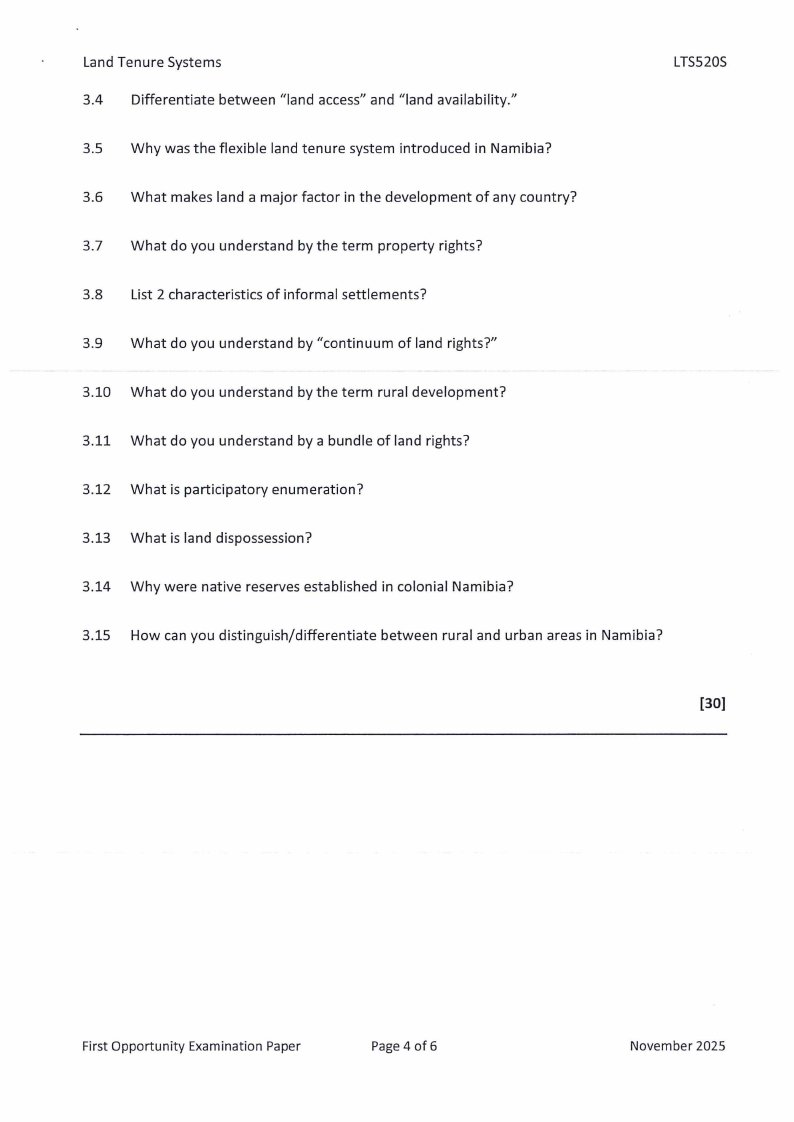
3.4 Differentiate between "land access" and "land availability."
LTS5205
3.5 Why was the flexible land tenure system introduced in Namibia?
3.6 What makes land a major factor in the development of any country?
3.7 What do you understand by the term property rights?
3.8 List 2 characteristics of informal settlements?
3.9 What do you understand by "continuum of land rights?"
3.10 What do you understand by the term rural development?
3.11 What do you understand by a bundle of land rights?
3.12 What is participatory enumeration?
3.13 What is land dispossession?
3.14 Why were native reserves established in colonial Namibia?
3.15 How can you distinguish/differentiate between rural and urban areas in Namibia?
[30]
First Opportunity Examination Paper
Page 4 of 6
November 2025
|
|
5 Page 5 |
▲back to top |
Land Tenure Systems
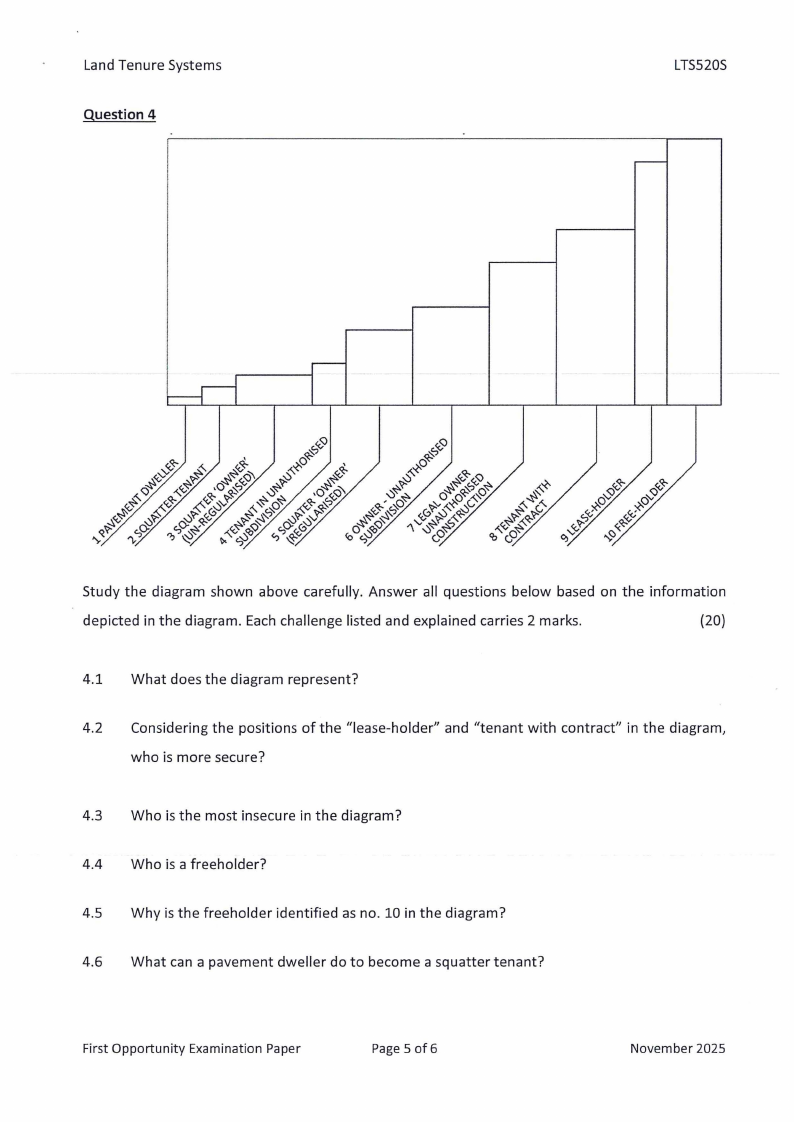
Question 4
LTS520S
Study the diagram shown above carefully. Answer all questions below based on the information
depicted in the diagram . Each challenge listed and explained carries 2 marks.
{20}
4.1 What does the diagram represent?
4.2 Considering the positions of the "lease-holder" and "tenant with contract" in the diagram,
who is more secure?
4.3 Who is the most insecure in the diagram?
4.4 Who is a freeholder?
4.5 Why is the freeholder identified as no. 10 in the diagram?
4.6 What can a pavement dweller do to become a squatter tenant?
First Opportunity Examination Paper
Page 5 of 6
November 2025
|
|
6 Page 6 |
▲back to top |
Land Tenure Systems
4.7 What is the difference between a lease-holder and a free-holder?
LTS520S
4.8 Considering the positions of the "tenant with contract" and "tenant in unauthorized
subdivision" in the diagram, who is more insecure?
4.9 Who is the most secure in the diagram?
4.10 What do the bars in the diagram represent in the context of land tenure?
[20]
First Opportunity Examination Paper
Page 6 of 6
November 2025