


 |
SML620S - STRATEGIC MANAGEMENT AND LEADERSHIP B - 2ND OPP - DECEMBER 2025 |
|
|
1 Page 1 |
▲back to top |
r
nAmlBIA unlVERSITY
OF SCIEnCE Ano TECHnOLOGY
FACULTY OF COMMERCE, HUMAN SCIENCE AND EDUCATION
DEPARTMENT OF TECHNICAL, VOCATIONAL EDUCATION AND TRAINING
QUALIFICATION: DIPLOMA IN TECHNICAL AND VOCATIONAL EDUCATION AND TRAINING :
MANAGEMENT
QUALIFICATION CODE: 06DTVM
LEVEL: 6
COURSE CODE: SML620S
COURSE NAME: STRATEGIC MANAGEMENT AND
LEADERSHIP B
SESSION: DECEMBER 2025
PAPER: 2
DURATION: 3 HOURS
MARKS: 100
SECOND OPPORTUNITY EXAMINATION QUESTION PAPER
EXAMINER(S) DR INDEPENTIA DE WALDT
MODERATOR: MR BENHARDT U KAUTEZA
INSTRUCTIONS
1. Answer ALL the questions.
2. Read all the questions carefully before answering.
3. Number the answers clearly
THIS EXAMINATION QUESTION PAPER CONSISTS OF 5 PAGES (Including this front page)
Page 1 of 5
|
|
2 Page 2 |
▲back to top |
Question 1
(10 marks)
Read the following statements and indicate true if you agree with the statement and false if
you do not agree.
1.1 Strategic objectives are very precise, time-based, measurable actions that support the
completion of a goal, whereas strategic goals are broad, high-level targets that an
organisation aims to achieve over the long term.
(1 mark)
1.2 The strategic management process is defined as the process by which managers make a
choice of a set of strategies for the organisation that will enable it to achieve better
performance.
(1 mark)
1.3 A vision is a short statement of why an organisation exists, what its overall goal is, and
identifying the goal of its operations: what kind of product or service it provides, its
primary customers or market, and its geographical region of operation, whereas a
mission states the current and future objectives of an organisation.
(1 mark)
1.4 Shared beliefs, norms, symbols, and behaviors that shape how work gets done within a
company or institution define organisational values.
(1 mark)
1.5 Chaos theory is defined as the process by which managers make a choice from a set of
strategies for the organisation that will enable it to achieve better performance.
(1 mark)
1.6 There is no need to conduct an external environmental analysis during the assessment
stage in developing a strategic plan.
(1 mark)
1.7 Preparing for change, managing change, and reinforcing change are common elements
in change management models.
(1 mark)
1.8 Bifurcations, strange attractors and non-linear systems are key components in chaos
theory.
(1 mark)
1.9 Lewi n's change management model consists of three stages: namely, unfreezing,
changing, and refreezing.
(1 mark)
1.10 SMART Key Performance Indicators are broad, high-level targets that an organization
aims to achieve over the long term.
(1 mark)
Page 2 of 5
|
|
3 Page 3 |
▲back to top |
Question 2
(15 marks)
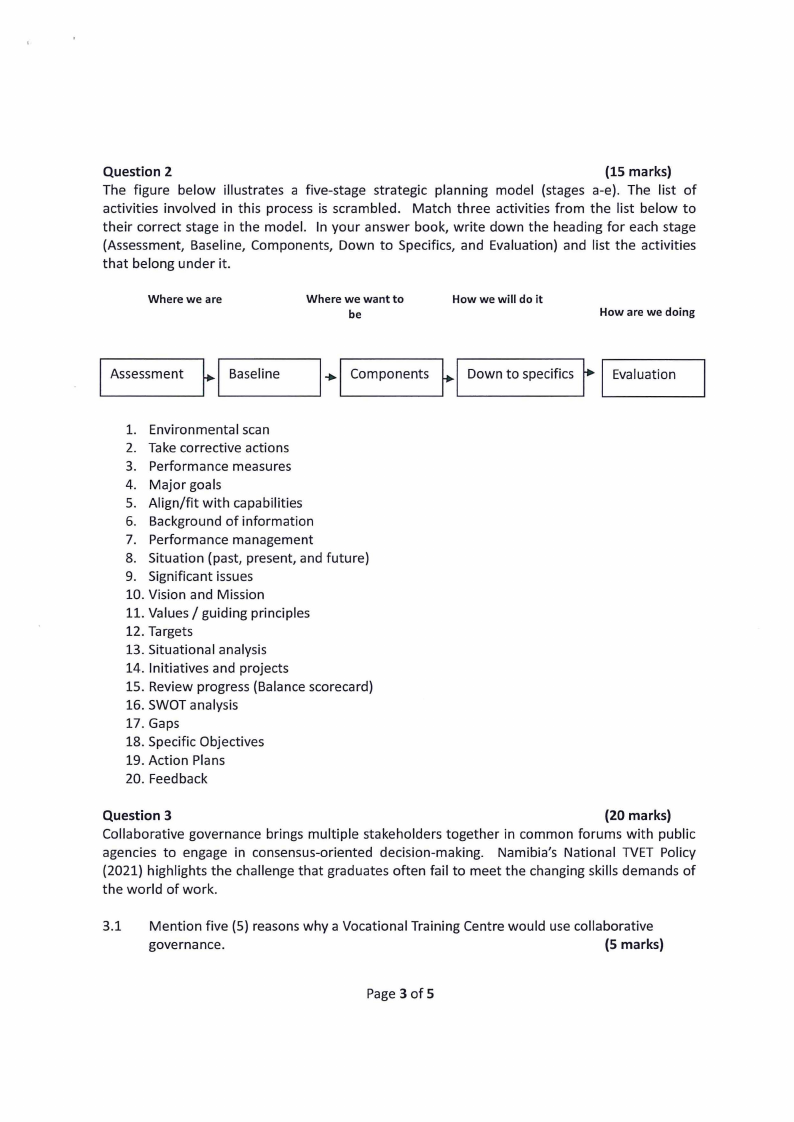
The figure below illustrates a five-stage strategic planning model (stages a-e). The list of
activities involved in this process is scrambled. Match three activities from the list below to
their correct stage in the model. In your answer book, write down the heading for each stage
(Assessment, Baseline, Components, Down to Specifics, and Evaluation) and list the activities
that belong under it.
Where we are
Where we want to
be
How we will do it
How are we doing
~ I Assessment
Baseline
I•I ~ Components
Down to specifics
Evaluation
1. Environmental scan
2. Take corrective actions
3. Performance measures
4. Major goals
5. Align/fit with capabilities
6. Background of information
7. Performance management
8. Situation (past, present, and future)
9. Significant issues
10. Vision and Mission
11. Values/ guiding principles
12. Targets
13. Situational analysis
14. Initiatives and projects
15. Review progress (Balance scorecard)
16. SWOT analysis
17. Gaps
18. Specific Objectives
19. Action Plans
20. Feedback
Question 3
(20 marks)
Collaborative governance brings multiple stakeholders together in common forums with public
agencies to engage in consensus-oriented decision-making. Namibia's National TVET Policy
(2021) highlights the challenge that graduates often fail to meet the changing skills demands of
the world of work.
3.1 Mention five (5) reasons why a Vocational Training Centre would use collaborative
governance.
(S marks)
Page 3 of 5
|
|
4 Page 4 |
▲back to top |
3.2 Explain why a collaborative governance approach for TVET is required to solve this
challenge .
(4 marks)
3.3 Mention at least five {S) stakeholders in the TVET sector who should be involved in
addressing this challenge.
(5 marks)
3.4 Mention the criteria that should be used in using the collaborative governance
approach.
(6 marks)
Question 4
Read through the article below and answer the questions that follow.
(28 marks)
Taskforce Appointed to Transform TVET Centres into Colleges
DEPARTMENT OF CORPORATE ENGAGEMENT AND INTERNATIONALISATION/ 3 MARCH 2025 /
In line with the vision of advancing Namibia's education system, the Minister of Higher
Education, Technology, and Innovation {MHETI), Hon Dr ltah Kandjii-Murangi, has appointed a
taskforce to oversee the transformation of state-owned Vocational Training Centres {VTCs) into
Technical and Vocational Education and Training (TVET) Colleges. The taskforce, chaired by the
Registrar of the Namibia University of Science and Technology {NUST), Prof Sifiso Nyathi, will
collaborate with experts from the Namibia Training Authority, the University of Namibia, various
ministries, and other stakeholders to drive this transformative initiative. This move is designed
to address the limitations of the current Level 3 TVET qualifications, which have hindered
graduates from advancing to higher-skilled, better-paying jobs. Dr Kandjii-Murangi stressed the
need for Namibia to go beyond basic certifications, stating: "It is time for us to transition to
diploma-level training at TVET centres". By introducing Diplomas {Level 4) and Advanced
Diplomas {Levels 5 and 6), the initiative aims to equip graduates with the necessary skills to
engage in high-value production fields, such as furniture manufacturing, going beyond
traditional carpentry. Prof Nyathi expressed his confidence in the collaborative effort, saying,
"Through this alliance, I am confident we will bring this national duty to fruition. As educators,
we hold the responsibility of shaping the future of education and skills development in our
country, to better the life of the Namibian child" . Prof Nyathi is a curricularist, researcher,
linguist and lawyer by training. The engagement will also be in consultation with NUST and
other international institutions that are known for best practices in relevant fields. The taskforce
will assess the current offerings at state-owned VTCs and explore the possibility of introducing
specialised production and manufacturing disciplines at the expanded TVET Colleges. The
evaluation will cover key areas such as governance, funding, infrastructure, staffing, and
curriculum alignment with the nation's skills development priorities. The taskforce's work is set
to span a ten-month period, during which they will provide comprehensive recommendations
for the transformation.
4.1 Define change management.
(2 marks)
4.2 Discuss the types of organisational change that will happen if the public Vocational
Training Centres {VTCs) are transformed into TVET colleges.
(8 marks)
Page 4 of 5
|
|
5 Page 5 |
▲back to top |
4.3 Explain how the ADKAR change model can be applied to manage the above change.
(10 marks)
4.4 Discuss how the Centre Manager can support the organisational changes. (8 marks)
Question 5
(12 marks)
Read the scenario below and answer the questions that follow:
Mr lita joined!Karas Vocational Training Centre, a government-funded institution, in January
2025. The VTC has been in existence for more than 20 years. The VTC offers certificates in
trades like automotive mechanics, welding, bricklaying, plastering, and office administration.
Since joining, Mr lita has been informed by middle management that the VTC faces significant
challenges. Mr lita has decided to do a comprehensive diagnosis of the VTC.
5.1 Explain the purpose of diagnosing the VTC.
(3 marks)
5.2 Mention the steps that will be used in the diagnostic cycle.
(9 marks)
Question 6
Explain how chaos theory can be applied in the TVET field in the following:
6.1 Resource allocation
6.2 Curriculum Development
6.3 Workforce Development
(9 marks)
(3 marks)
(3 marks)
(3 marks)
Question 7
(6 marks)
Mention six (6) enablers needed to successfully implement a strategic plan. (6 marks)
TOTAL = 100 MARKS
-END-
Page 5 of 5