


 |
FSD820S-FINANCING SUSTAINABLE DEVELOPMENT-2ND OPP- DEC 2025 |
|
|
1 Page 1 |
▲back to top |
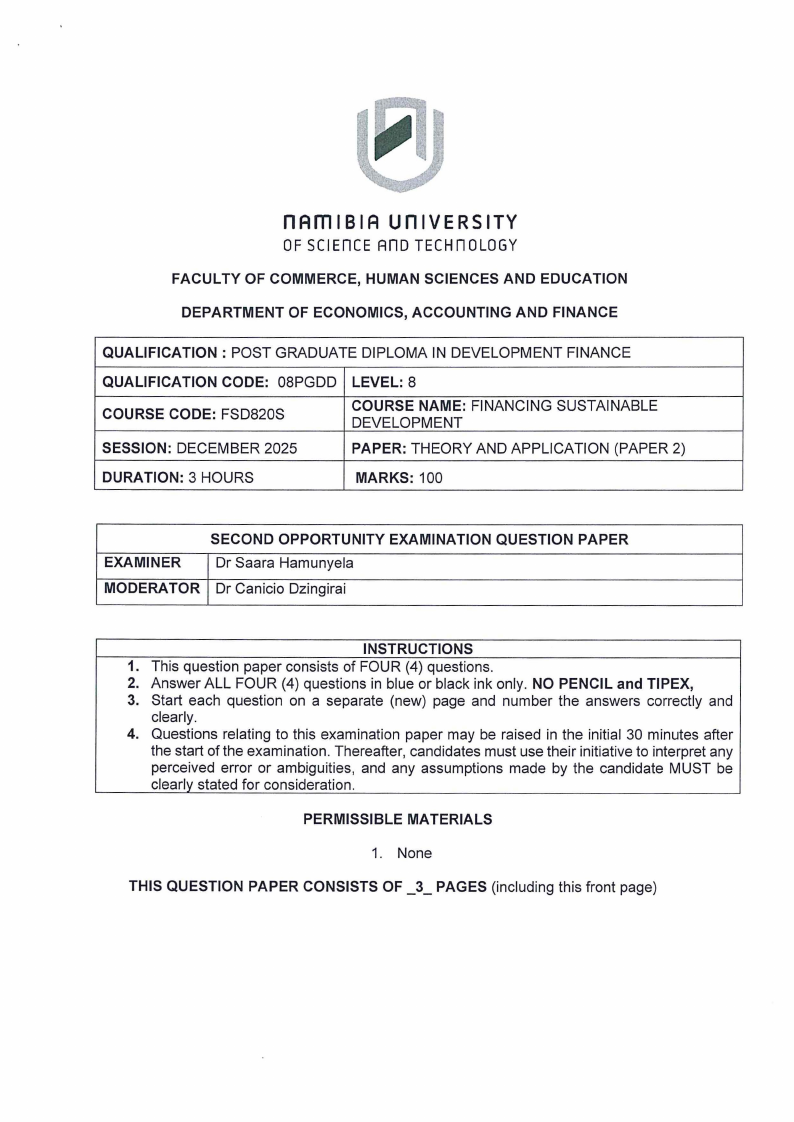
nAmlBIA UnlVERSITY
OF SCIEnCE Ano TECHnDLOGY
FACULTY OF COMMERCE, HUMAN SCIENCES AND EDUCATION
DEPARTMENT OF ECONOMICS, ACCOUNTING AND FINANCE
QUALIFICATION: POST GRADUATE DIPLOMA IN DEVELOPMENT FINANCE
QUALIFICATION CODE: 08PGDD LEVEL:8
COURSE CODE: FSD820S
COURSE NAME: FINANCING SUSTAINABLE
DEVELOPMENT
SESSION: DECEMBER 2025
PAPER: THEORY AND APPLICATION (PAPER 2)
DURATION: 3 HOURS
MARKS: 100
SECOND OPPORTUNITY EXAMINATION QUESTION PAPER
EXAMINER Dr Saara Hamunyela
MODERATOR Dr Canicio Dzingirai
INSTRUCTIONS
1. This question paper consists of FOUR (4) questions.
2. Answer ALL FOUR (4) questions in blue or black ink only. NO PENCIL and TIPEX,
3. Start each question on a separate (new) page and number the answers correctly and
clearly .
4. Questions relating to this examination paper may be raised in the initial 30 minutes after
the start of the examination . Thereafter, candidates must use their initiative to interpret any
perceived error or ambiguities, and any assumptions made by the candidate MUST be
clearly stated for consideration.
PERMISSIBLE MATERIALS
1. None
THIS QUESTION PAPER CONSISTS OF _3_ PAGES (including this front page)
|
|
2 Page 2 |
▲back to top |
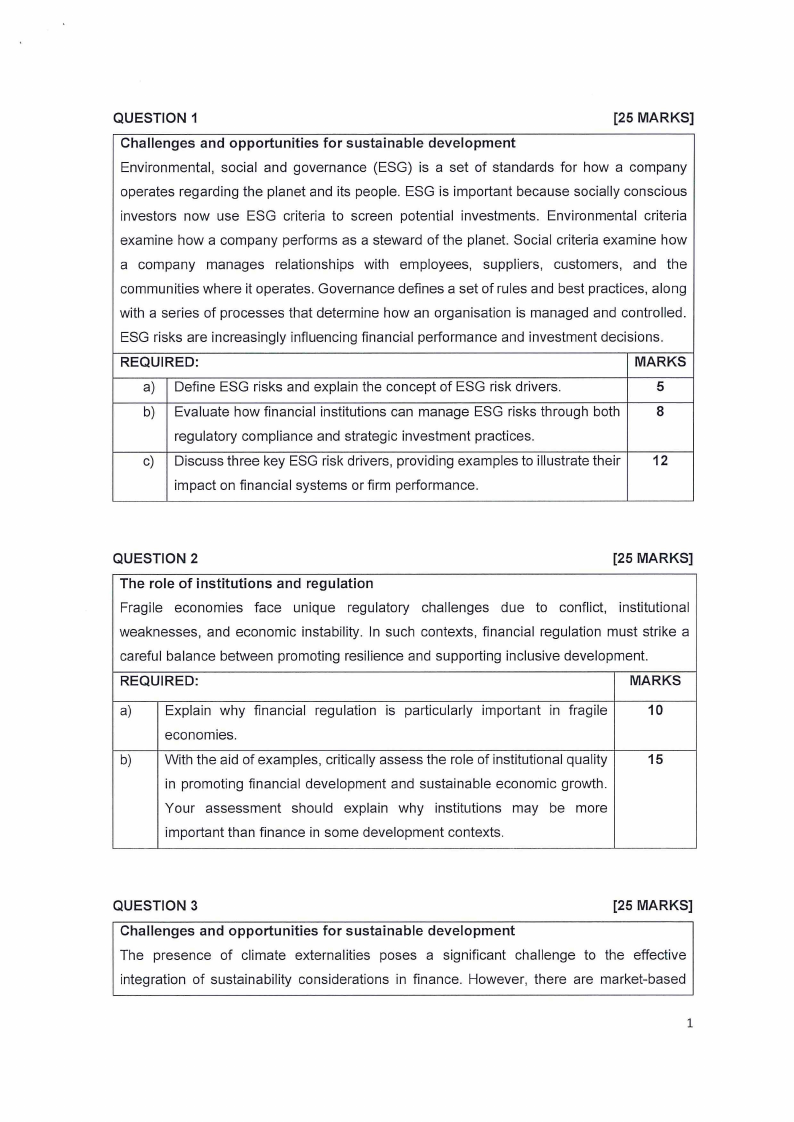
QUESTION 1
[25 MARKS]
Challenges and opportunities for sustainable development
Environmental, social and governance (ESG) is a set of standards for how a company
operates regarding the planet and its people . ESG is important because socially conscious
investors now use ESG criteria to screen potential investments. Environmental criteria
examine how a company performs as a steward of the planet. Social criteria examine how
a company manages relationships with employees, suppliers, customers, and the
communities where it operates . Governance defines a set of rules and best practices, along
with a series of processes that determine how an organisation is managed and controlled.
ESG risks are increasingly influencing financial performance and investment decisions.
REQUIRED:
MARKS
a) Define ESG risks and explain the concept of ESG risk drivers.
5
b) Evaluate how financial institutions can manage ESG risks through both
8
regulatory compliance and strategic investment practices.
c) Discuss three key ESG risk drivers, provid ing examples to illustrate their 12
impact on financial systems or firm performance.
QUESTION 2
[25 MARKS]
The role of institutions and regulation
Fragile economies face unique regulatory challenges due to conflict, institutional
weaknesses, and economic instability. In such contexts , financial regulation must strike a
careful balance between promoting resilience and supporting inclusive development.
REQUIRED:
MARKS
a) Explain why financial regulation is particularly important in fragile
10
economies.
b) With the aid of examples , critically assess the role of institutional quality
15
in promoting financial development and sustainable economic growth .
Your assessment should explain why institutions may be more
important than finance in some development contexts.
QUESTION 3
[25 MARKS]
Challenges and opportunities for sustainable development
The presence of climate externalities poses a significant challenge to the effective
integration of sustainability considerations in finance. However, there are market-based
1
|
|
3 Page 3 |
▲back to top |
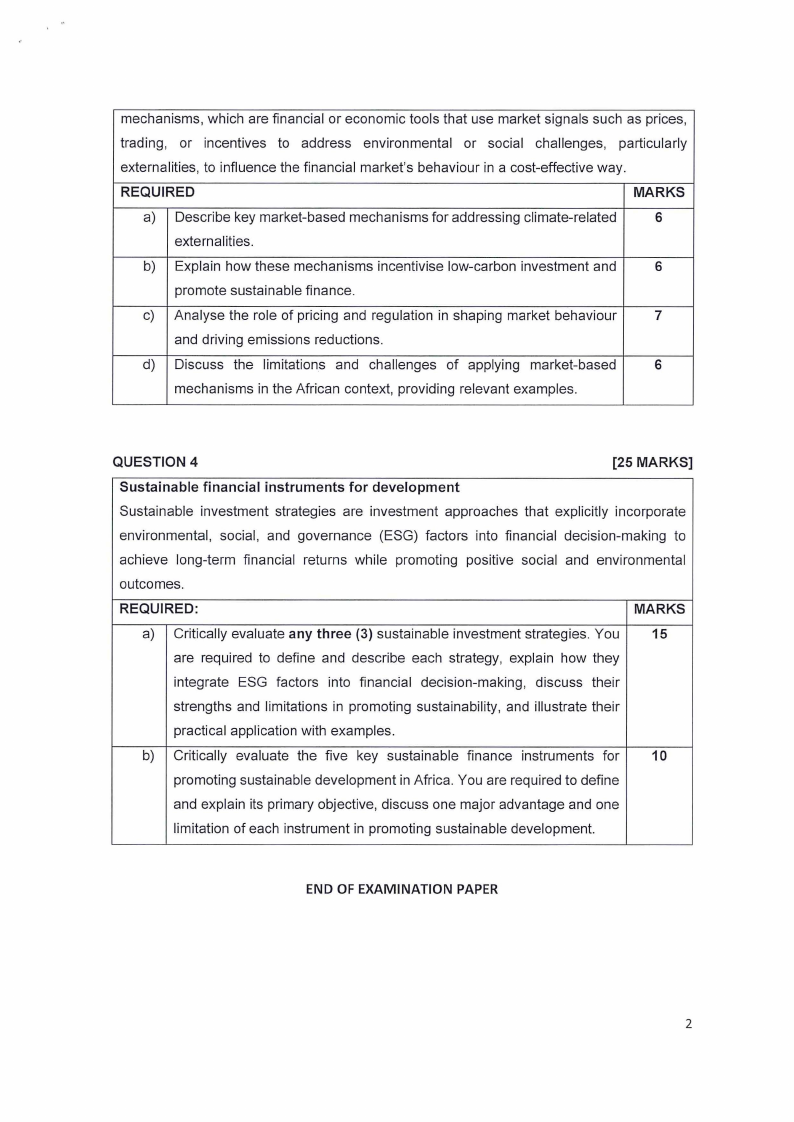
mechanisms , which are financial or economic tools that use market signals such as prices,
trading, or incentives to address environmental or social challenges, particularly
externalities, to influence the financial market's behaviour in a cost-effective way.
REQUIRED
MARKS
a) Describe key market-based mechanisms for addressing climate-related
6
externalities.
b) Explain how these mechanisms incentivise low-carbon investment and
6
promote sustainable finance .
c) Analyse the role of pricing and regulation in shaping market behaviour
7
and driving emissions reductions.
d) Discuss the limitations and challenges of applying market-based
6
mechanisms in the African context, providing relevant examples.
QUESTION 4
[25 MARKS]
Sustainable financial instruments for development
Sustainable investment strategies are investment approaches that explicitly incorporate
environmental , social , and governance (ESG) factors into financial decision-making to
achieve long-term financial returns wh ile promoting positive social and environmental
outcomes.
REQUIRED:
MARKS
a) Critically evaluate any three (3) sustainable investment strategies. You 15
are required to define and describe each strategy, explain how they
integrate ESG factors into financial decision-making , discuss their
strengths and limitations in promoting sustainability, and illustrate their
practical application with examples.
b) Critically evaluate the five key sustainable finance instruments for 10
promoting sustainable development in Africa . You are required to define
and explain its primary objective, discuss one major advantage and one
limitation of each instrument in promoting sustainable development.
END OF EXAMINATION PAPER
2