


 |
CAC610S - COMPARATIVE AFRICAN CITIES - 1ST OPP - JUNE 2025 |
|
|
1 Page 1 |
▲back to top |
nAmlBIA un1VERSITY
OF SCIEnCE Ano TECHnOLOGY
FACULTYOF ENGINEERINGAND THE BUILTENVIRONMENT
DEPARTMENTOF ARCHITECTUREP, LANNINGAND CONSTRUCTION
QUALIFICATION:
BACHELOR OF TOWN AND REGIONAL PLANNING
QUALIFICATIONCODE: BTAR07
NQF LEVEL:
6
COURSECODE:
CAC610S
COURSENAME: COMPARATIVE AFRICAN CITIES
DATE:
JUNE 2025
PAPER:
THEORY
DURATION:
3 HOURS
MARKS:
100
LECTURER:
FIRSTOPPORTUNITYEXAMINATION QUESTIONPAPER
Ms D Brand
MODERATOR: Ms N Korrubel
INSTRUCTIONS
1. Answer ALL the questions.
2. Read all the questions carefully before answering.
3. Number the answers clearly and legibly
THIS EXAM PAPERCONSISTSOF 4 PAGES(Including this front page)
|
|
2 Page 2 |
▲back to top |
Comparative African Cities
CAC610S
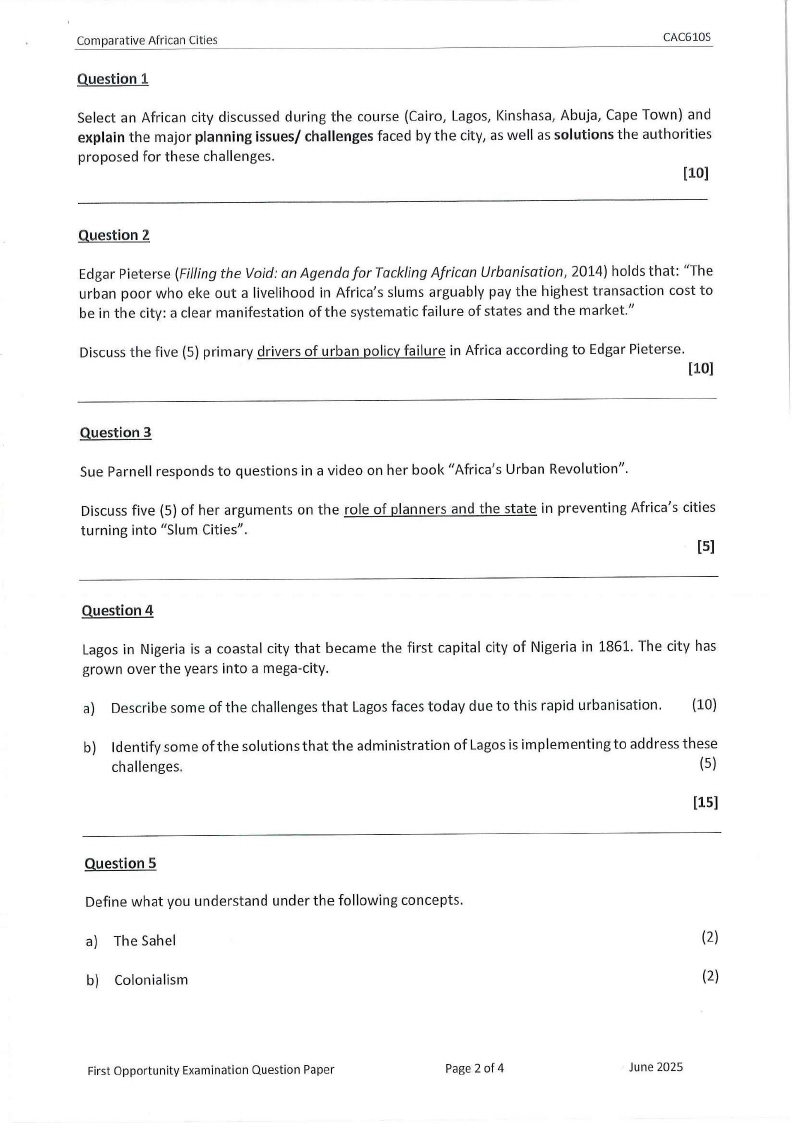
Question 1
Select an African city discussed during the course {Cairo, Lagos, Kinshasa, Abuja, Cape Town) and
explain the major planning issues/ challenges faced by the city, as well as solutions the authorities
proposed for these challenges.
(10]
Question 2
Edgar Pieterse (Fillingthe Void:an Agenda for TacklingAfrican Urbanisation, 2014) holds that: "The
urban poor who eke out a livelihood in Africa's slums arguably pay the highest transaction cost to
be in the city: a clear manifestation of the systematic failure of states and the market."
Discussthe five (5) primary drivers of urban policy failure in Africa according to Edgar Pieterse.
[10]
Question 3
Sue Parnell responds to questions in a video on her book "Africa's Urban Revolution".
Discuss five (5) of her arguments on the role of planners and the state in preventing Africa's cities
turning into "Slum Cities".
[5]
Question 4
Lagos in Nigeria is a coastal city that became the first capital city of Nigeria in 1861. The city has
grown over the years into a mega-city.
a) Describe some of the challenges that Lagosfaces today due to this rapid urbanisation. (10)
b) Identify some of the solutions that the administration of Lagosis implementing to address these
challenges.
(5)
[15]
Question 5
Define what you understand under the following concepts.
a) The Sahel
(2)
b) Colonialism
(2)
First Opportunity Examination Question Paper
Page 2 of 4
June 2025
|
|
3 Page 3 |
▲back to top |
Comparative African Cities
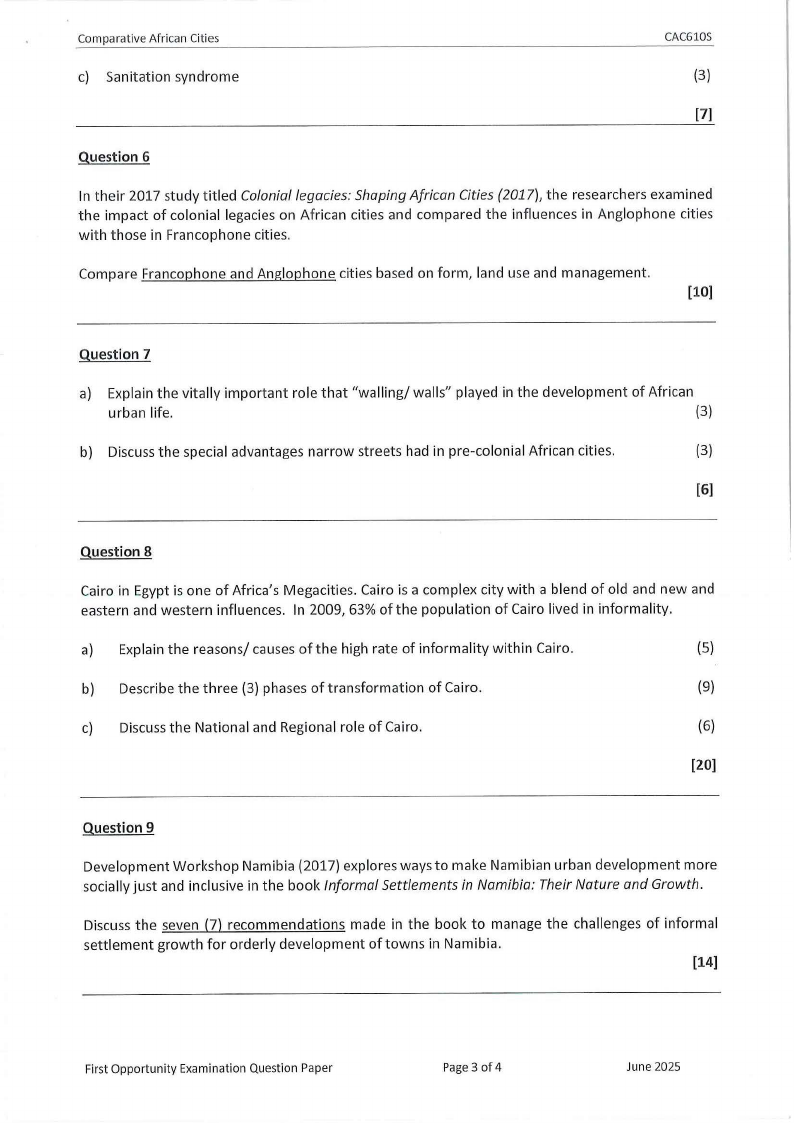
c) Sanitation syndrome
CAC610S
(3)
[7]
Question 6
In their 2017 study titled Colonial legacies: Shaping African Cities {2017), the researchers examined
the impact of colonial legacies on African cities and compared the influences in Anglophone cities
with those in Francophone cities.
Compare Francophone and Anglophone cities based on form, land use and management.
[10]
Question 7
a) Explain the vitally important role that "walling/ walls" played in the development of African
urban life.
(3)
b) Discussthe special advantages narrow streets had in pre-colonial African cities.
(3)
[6]
Question 8
Cairo in Egypt is one of Africa's Megacities. Cairo is a complex city with a blend of old and new and
eastern and western influences. In 2009, 63% of the population of Cairo lived in informality.
a) Explain the reasons/ causes of the high rate of informality within Cairo.
(5)
b) Describe the three (3) phases of transformation of Cairo.
(9)
c) Discuss the National and Regional role of Cairo.
(6)
[20]
Question 9
Development Workshop Namibia (2017) explores ways to make Namibian urban development more
socially just and inclusive in the book Informal Settlements in Namibia: Their Nature and Growth.
Discuss the seven (7) recommendations made in the book to manage the challenges of informal
settlement growth for orderly development of towns in Namibia.
[14]
First Opportunity Examination Question Paper
Page 3 of 4
June 2025
|
|
4 Page 4 |
▲back to top |

Comparative African Cities
CAC610S
Question 10
As a whole Africa is urbanising rapidly, but the pace and shape of the trend differs very much
between countries.
Name the three (3) indicators, used by the African Development Bank, the Organisation for
Economic Co-operation and Development, and the United Nations Development Programme, to
categorise countries to better display the varying contexts of urbanisation.
(3]
TOTALMARKS
THE END
(100)
First Opportunity Examination Question Paper
Page 4 of 4
June 2025