LAL111S - LABOUR LAW 1A - 2ND OPP - JULY 2025


LAL111S - LABOUR LAW 1A - 2ND OPP - JULY 2025


1 Page 1

▲back to top


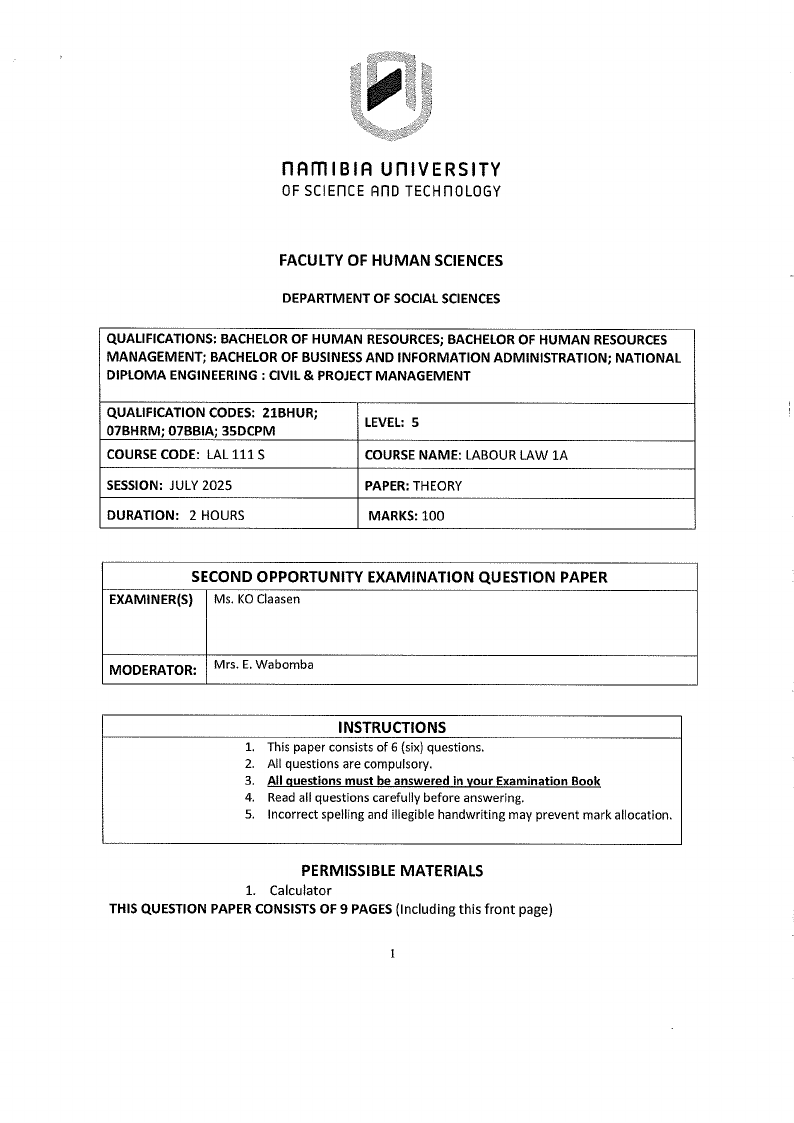
nAmlBIA unlVERSITY
OF SCIEnCE Ano TECHnOLOGY
FACULTYOF HUMANSCIENCES
DEPARTMENTOF SOCIALSCIENCES
QUALIFICATIONS: BACHELOR OF HUMAN RESOURCES;BACHELOR OF HUMAN RESOURCES
MANAGEMENT; BACHELOR OF BUSINESS AND INFORMATION ADMINISTRATION; NATIONAL
DIPLOMA ENGINEERING : CIVIL & PROJECTMANAGEMENT
QUALIFICATION CODES: 21BHUR;
07BHRM; 07BBIA; 35DCPM
COURSE CODE: LAL 111 S
SESSION: JULY 2025
DURATION: 2 HOURS
LEVEL: 5
COURSE NAME: LABOUR LAW 1A
PAPER: THEORY
MARKS: 100
SECOND OPPORTUNITY EXAMINATION QUESTION PAPER
EXAMINER(S) Ms. KO Claasen
MODERATOR: Mrs. E.Wabomba
INSTRUCTIONS
1. This paper consists of 6 (six) questions.
2. All questions are compulsory.
3. All questions must be answered in your Examination Book
4. Readall questions carefully before answering.
5. Incorrect spelling and illegible handwriting may prevent mark allocation.
PERMISSIBLE MATERIALS
1. Calculator
THIS QUESTION PAPER CONSISTS OF 9 PAGES (Including this front page)

2 Page 2

▲back to top


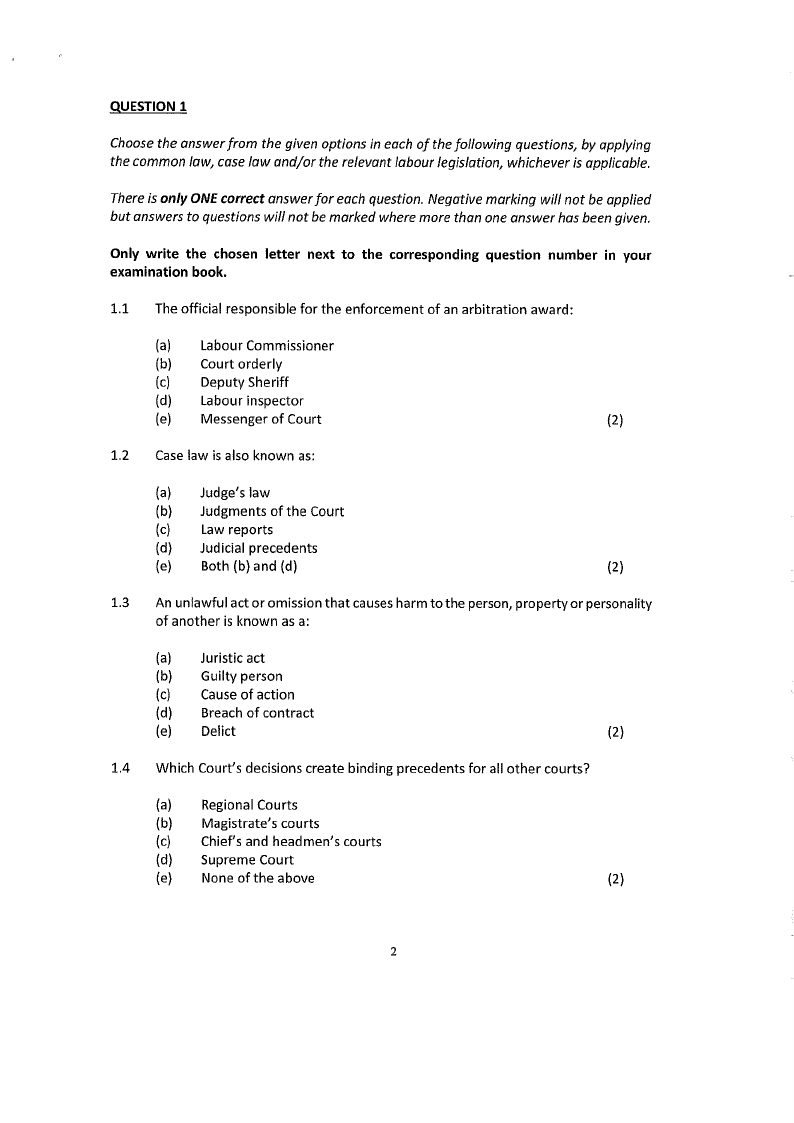
QUESTION1
Choose the answer from the given options in each of the following questions, by applying
the common law, case law and/or the relevant labour legislation, whichever is applicable.
There is only ONE correct answer for each question. Negative marking will not be applied
but answers to questions will not be marked where more than one answer has been given.
Only write the chosen letter next to the corresponding question number in your
examination book.
1.1 The official responsible for the enforcement of an arbitration award:
(a) Labour Commissioner
(b) Court orderly
(c) Deputy Sheriff
(d) Labour inspector
(e) Messenger of Court
(2)
1.2 Caselaw is also known as:
(a) Judge's law
(b) Judgments of the Court
(c) Law reports
(d) Judicial precedents
(e) Both (b) and (d)
(2)
1.3 An unlawful act or omission that causesharm to the person, property or personality
of another is known as a:
(a) Juristic act
(b) Guilty person
(c) Causeof action
(d) Breach of contract
(e) Delict
(2)
1.4 Which Court's decisions create binding precedents for all other courts?
(a) Regional Courts
(b) Magistrate's courts
(c) Chief's and headmen's courts
(d) Supreme Court
(e) None of the above
(2)
2

3 Page 3

▲back to top


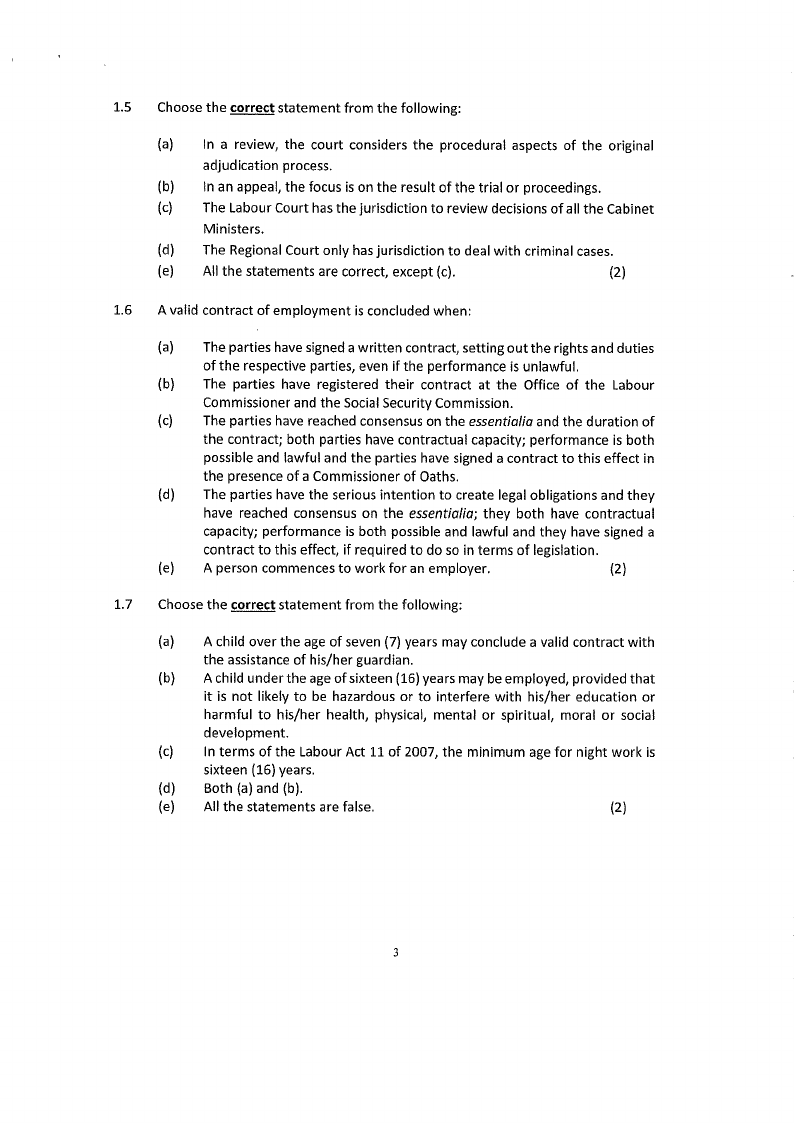
1.5 Choosethe correct statement from the following:
(a) In a review, the court considers the procedural aspects of the original
adjudication process.
(b) In an appeal, the focus is on the result of the trial or proceedings.
(c) The Labour Court has the jurisdiction to review decisions of all the Cabinet
Ministers.
(d) The Regional Court only has jurisdiction to deal with criminal cases.
(e) All the statements are correct, except (c).
(2)
1.6 A valid contract of employment is concluded when:
(a) The parties have signed a written contract, setting out the rights and duties
of the respective parties, even if the performance is unlawful.
(b) The parties have registered their contract at the Office of the Labour
Commissioner and the Social Security Commission.
(c) The parties have reached consensuson the essentia/iaand the duration of
the contract; both parties have contractual capacity; performance is both
possible and lawful and the parties have signed a contract to this effect in
the presence of a Commissioner of Oaths.
(d) The parties have the serious intention to create legal obligations and they
have reached consensus on the essentialia; they both have contractual
capacity; performance is both possible and lawful and they have signed a
contract to this effect, if required to do so in terms of legislation.
(e) A person commences to work for an employer.
(2)
1.7 Choose the correct statement from the following:
(a) A child over the age of seven (7) years may conclude a valid contract with
the assistanceof his/her guardian.
(b) A child under the age of sixteen (16) years may be employed, provided that
it is not likely to be hazardous or to interfere with his/her education or
harmful to his/her health, physical, mental or spiritual, moral or social
development.
(c) In terms of the Labour Act 11 of 2007, the minimum age for night work is
sixteen (16) years.
(d) Both (a) and (b).
(e) All the statements are false.
(2)
3

4 Page 4

▲back to top


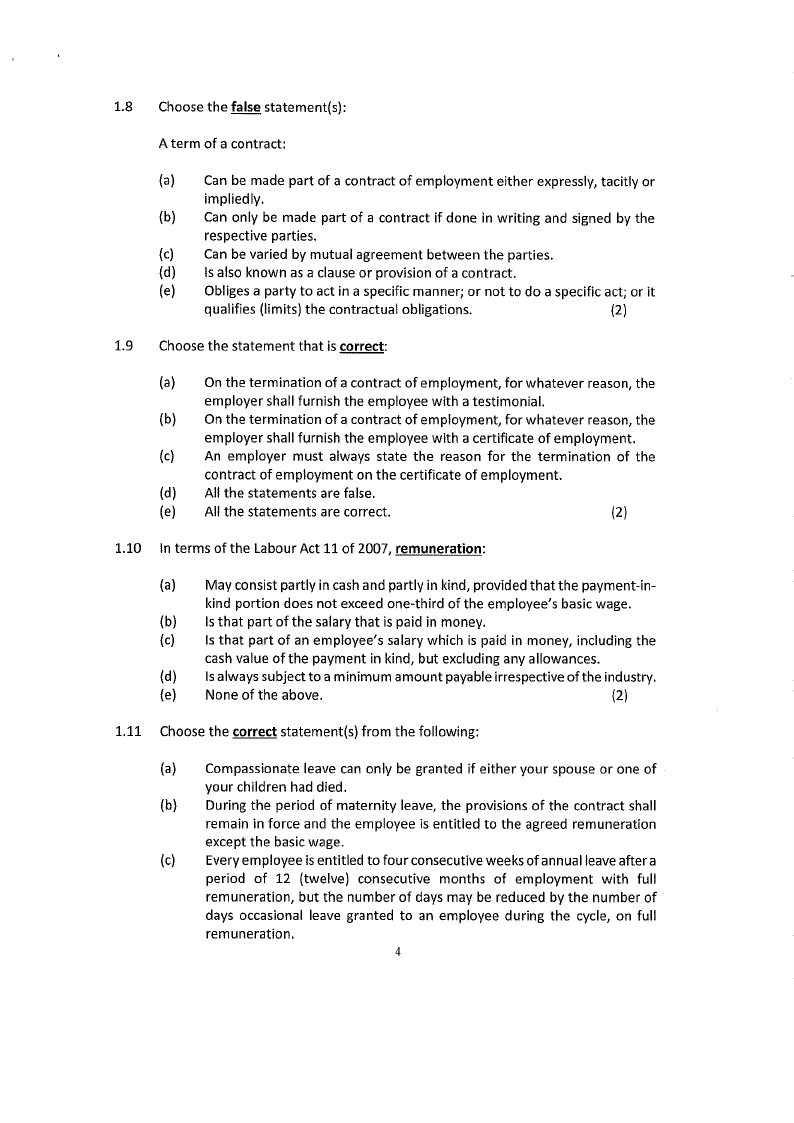
1.8 Choose the false statement(s):
A term of a contract:
(a) Can be made part of a contract of employment either expressly, tacitly or
impliedly.
(b) Can only be made part of a contract if done in writing and signed by the
respective parties.
(c) Can be varied by mutual agreement between the parties.
(d) Is also known as a clause or provision of a contract.
(e) Obliges a party to act in a specific manner; or not to do a specific act; or it
qualifies (limits) the contractual obligations.
(2)
1.9 Choose the statement that is correct:
(a) On the termination of a contract of employment, for whatever reason, the
employer shall furnish the employee with a testimonial.
(b) On the termination of a contract of employment, for whatever reason, the
employer shall furnish the employee with a certificate of employment.
(c) An employer must always state the reason for the termination of the
contract of employment on the certificate of employment.
(d) All the statements are false.
(e) All the statements are correct.
(2)
1.10 In terms of the Labour Act 11 of 2007, remuneration:
(a) May consist partly in cash and partly in kind, provided that the payment-in-
kind portion does not exceed one-third of the employee's basic wage.
(b) Is that part of the salary that is paid in money.
(c) Is that part of an employee's salary which is paid in money, including the
cash value of the payment in kind, but excluding any allowances.
(d) Isalways subject to a minimum amount payableirrespective of the industry.
(e) None of the above.
(2)
1.11 Choose the correct statement(s) from the following:
(a) Compassionate leave can only be granted if either your spouse or one of
your children had died.
(b) During the period of maternity leave, the provisions of the contract shall
remain in force and the employee is entitled to the agreed remuneration
except the basic wage.
(c) Everyemployee is entitled to four consecutive weeks of annual leaveafter a
period of 12 (twelve) consecutive months of employment with full
remuneration, but the number of days may be reduced by the number of
days occasional leave granted to an employee during the cycle, on full
remuneration.
4

5 Page 5

▲back to top


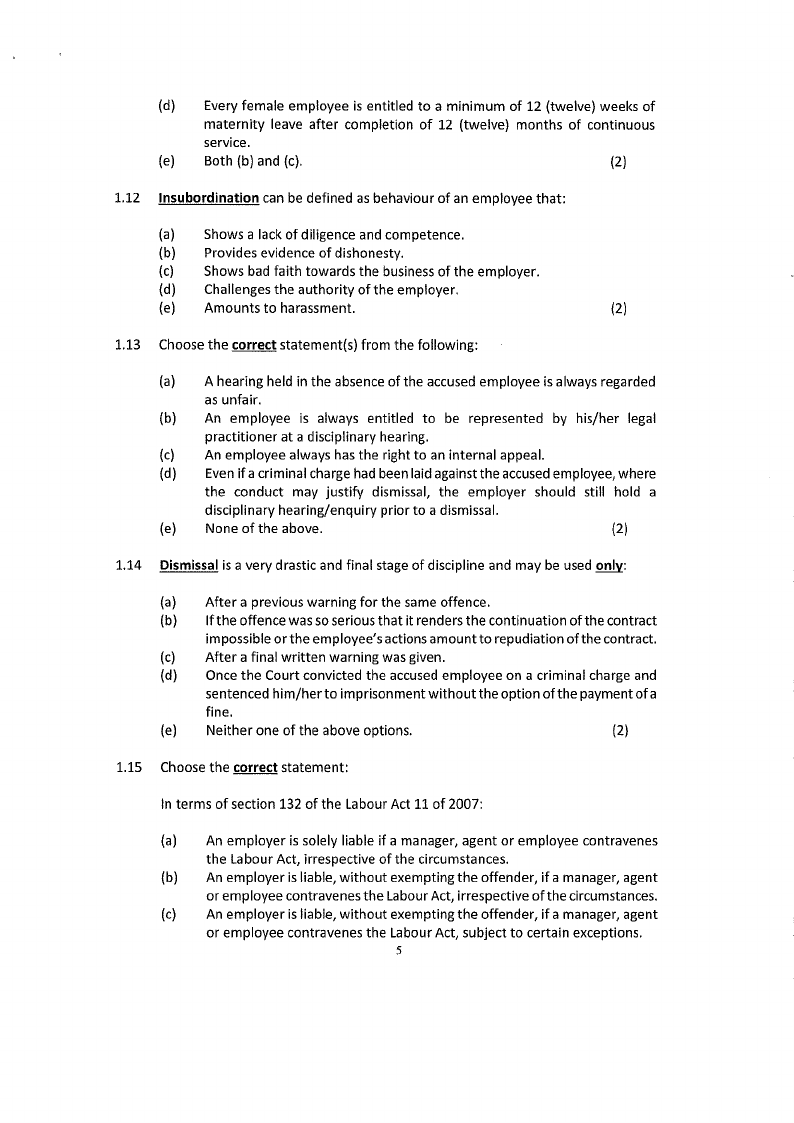
(d) Every female employee is entitled to a minimum of 12 (twelve) weeks of
maternity leave after completion of 12 (twelve) months of continuous
service.
(e) Both (b) and (c).
(2)
1.12 Insubordination can be defined as behaviour of an employee that:
(a) Shows a lack of diligence and competence.
(b) Provides evidence of dishonesty.
(c) Shows bad faith towards the businessof the employer.
(d) Challengesthe authority of the employer.
(e) Amounts to harassment.
(2)
1.13 Choose the correct statement(s) from the following:
(a) A hearing held in the absence of the accused employee is always regarded
as unfair.
(b) An employee is always entitled to be represented by his/her legal
practitioner at a disciplinary hearing.
(c) An employee always has the right to an internal appeal.
(d) Evenif a criminal charge had been laid againstthe accusedemployee, where
the conduct may justify dismissal, the employer should still hold a
disciplinary hearing/enquiry prior to a dismissal.
(e) None of the above.
(2)
1.14 Dismissalis a very drastic and final stage of discipline and may be used only:
(a) After a previous warning for the same offence.
(b) If the offence was so serious that it renders the continuation of the contract
impossible or the employee's actions amount to repudiation of the contract.
(c) After a final written warning was given.
(d) Once the Court convicted the accusedemployee on a criminal charge and
sentenced him/her to imprisonment without the option of the payment of a
fine.
(e) Neither one of the above options.
(2)
1.15 Choose the correct statement:
In terms of section 132 of the Labour Act 11 of 2007:
(a) An employer is solely liable if a manager, agent or employee contravenes
the Labour Act, irrespective of the circumstances.
(b) An employer is liable, without exempting the offender, if a manager, agent
or employee contravenes the LabourAct, irrespective of the circumstances.
(c) An employer is liable, without exempting the offender, if a manager, agent
or employee contravenes the Labour Act, subject to certain exceptions.
5

6 Page 6

▲back to top


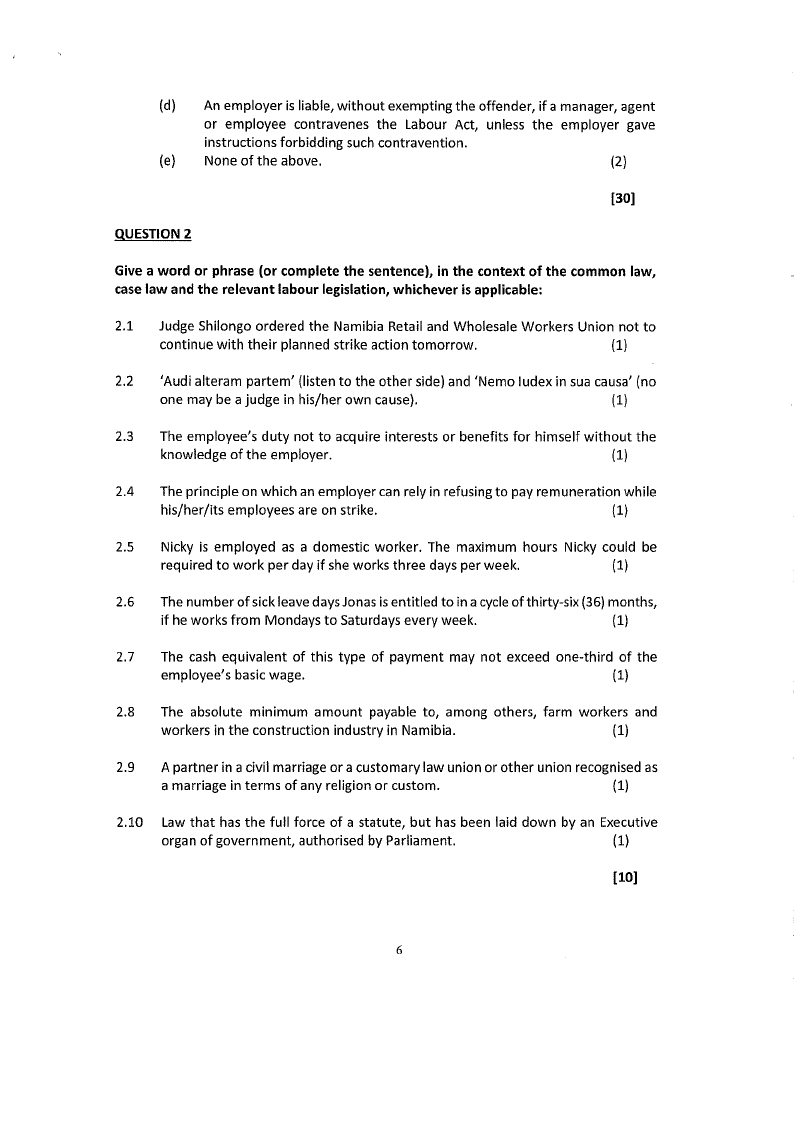
(d) An employer is liable, without exempting the offender, if a manager, agent
or employee contravenes the Labour Act, unless the employer gave
instructions forbidding such contravention.
(e) None of the above.
(2)
(30]
QUESTION 2
Give a word or phrase (or complete the sentence), in the context of the common law,
case law and the relevant labour legislation, whichever is applicable:
2.1 Judge Shilongo ordered the Namibia Retail and Wholesale Workers Union not to
continue with their planned strike action tomorrow.
(1)
2.2 'Audi alteram partem' (listen to the other side) and 'Nemo ludex in sua causa' (no
one may be a judge in his/her own cause).
(1)
2.3 The employee's duty not to acquire interests or benefits for himself without the
knowledge of the employer.
(1)
2.4 The principle on which an employer can rely in refusing to pay remuneration while
his/her/its employees are on strike.
(1)
2.5 Nicky is employed as a domestic worker. The maximum hours Nicky could be
required to work per day if she works three days per week.
(1)
2.6 The number of sick leave daysJonasis entitled to in a cycleof thirty-six (36) months,
if he works from Mondays to Saturdays every week.
(1)
2.7 The cash equivalent of this type of payment may not exceed one-third of the
employee's basic wage.
(1)
2.8 The absolute minimum amount payable to, among others, farm workers and
workers in the construction industry in Namibia.
(1)
2.9 A partner in a civil marriage or a customary law union or other union recognised as
a marriage in terms of any religion or custom.
(1)
2.10 Law that has the full force of a statute, but has been laid down by an Executive
organ of government, authorised by Parliament.
(1)
(10]
6

7 Page 7

▲back to top


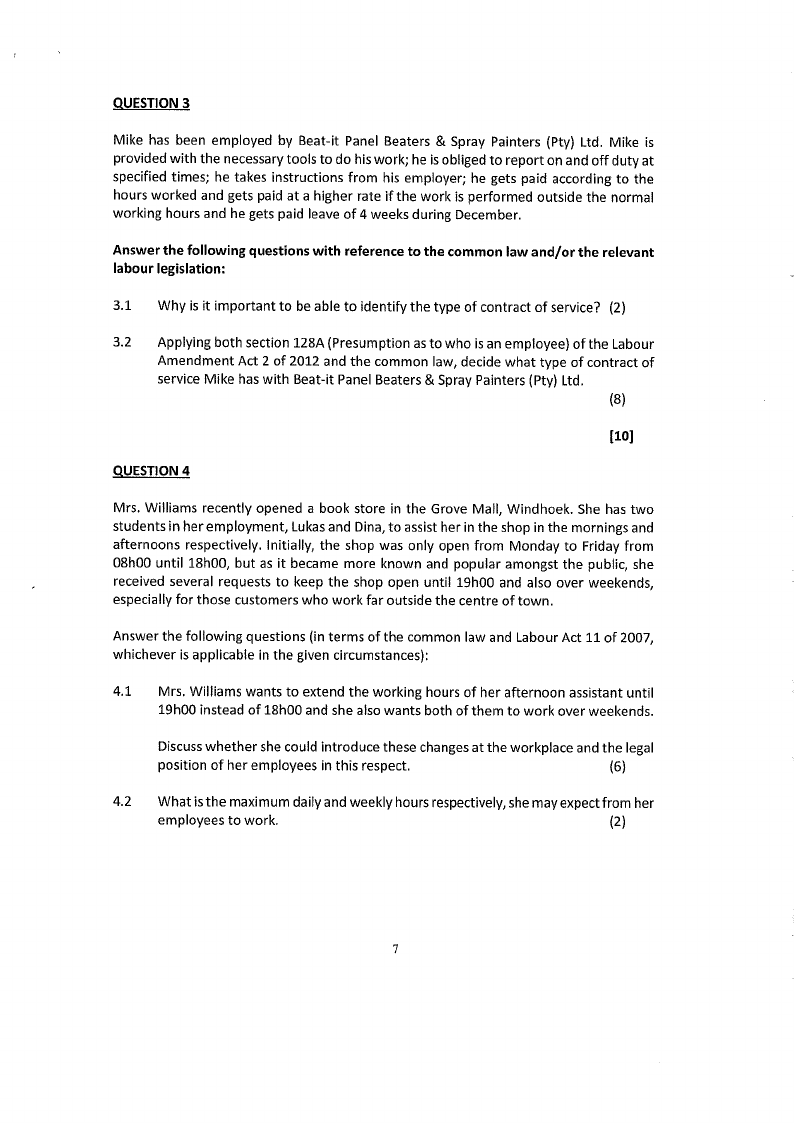
QUESTION 3
Mike has been employed by Beat-it Panel Beaters & Spray Painters (Pty) Ltd. Mike is
provided with the necessary tools to do his work; he is obliged to report on and off duty at
specified times; he takes instructions from his employer; he gets paid according to the
hours worked and gets paid at a higher rate if the work is performed outside the normal
working hours and he gets paid leave of 4 weeks during December.
Answer the following questions with reference to the common law and/or the relevant
labour legislation:
3.1 Why is it important to be able to identify the type of contract of service? (2)
3.2 Applying both section 128A (Presumption as to who is an employee) of the Labour
Amendment Act 2 of 2012 and the common law, decide what type of contract of
service Mike has with Beat-it Panel Beaters & Spray Painters (Pty) Ltd.
(8)
(10]
QUESTION 4
Mrs. Williams recently opened a book store in the Grove Mall, Windhoek. She has two
students in her employment, Lukasand Dina, to assist her in the shop in the mornings and
afternoons respectively. Initially, the shop was only open from Monday to Friday from
08h00 until 18h00, but as it became more known and popular amongst the public, she
received several requests to keep the shop open until 19h00 and also over weekends,
especially for those customers who work far outside the centre of town.
Answer the following questions (in terms of the common law and Labour Act 11 of 2007,
whichever is applicable in the given circumstances):
4.1 Mrs. Williams wants to extend the working hours of her afternoon assistant until
19h00 instead of 18h00 and she also wants both of them to work over weekends.
Discusswhether she could introduce these changesat the workplace and the legal
position of her employees in this respect.
(6)
4.2 What is the maximum daily and weekly hours respectively, she may expect from her
employees to work.
(2)
7

8 Page 8

▲back to top


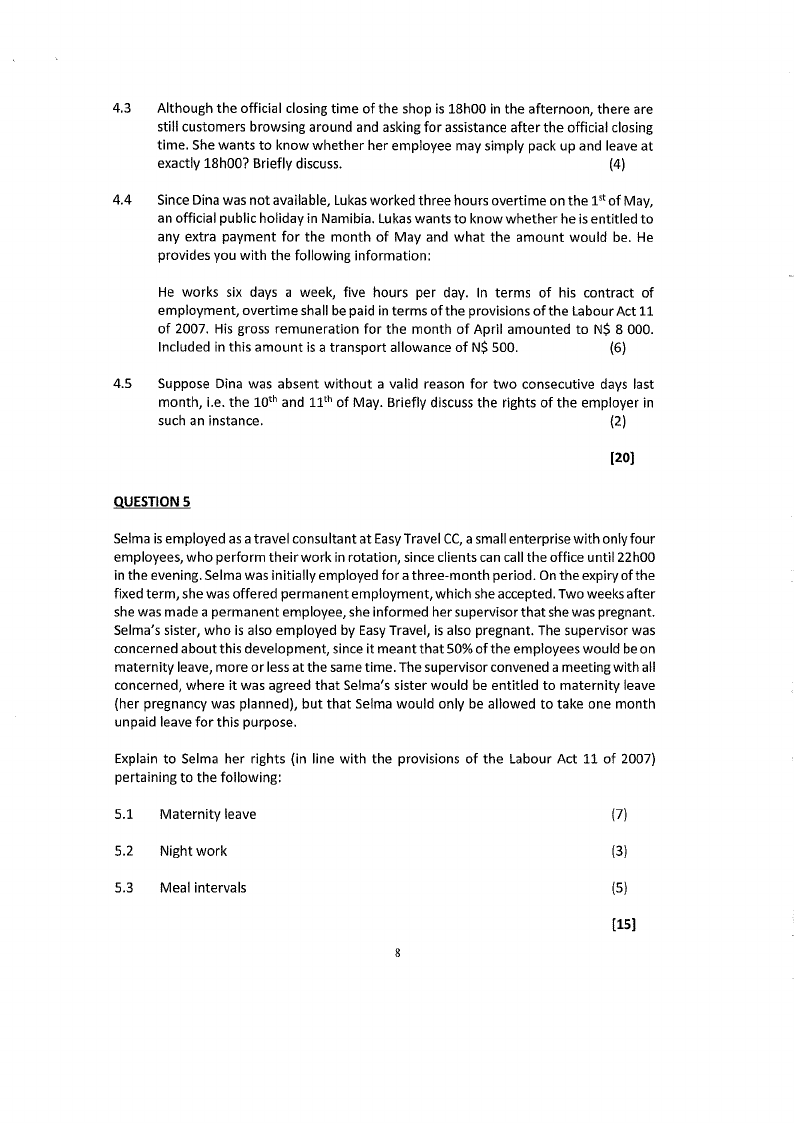
4.3 Although the official closing time of the shop is 18h00 in the afternoon, there are
still customers browsing around and asking for assistance after the official closing
time. She wants to know whether her employee may simply pack up and leave at
exactly 18h00? Briefly discuss.
(4)
4.4 Since Dina was not available, Lukasworked three hours overtime on the 1st of May,
an official public holiday in Namibia. Lukaswants to know whether he is entitled to
any extra payment for the month of May and what the amount would be. He
provides you with the following information:
He works six days a week, five hours per day. In terms of his contract of
employment, overtime shall be paid in terms of the provisions of the Labour Act 11
of 2007. His gross remuneration for the month of April amounted to N$ 8 000.
Included in this amount is a transport allowance of N$ 500.
(6)
4.5 Suppose Dina was absent without a valid reason for two consecutive days last
month, i.e. the 10th and 11th of May. Briefly discuss the rights of the employer in
such an instance.
(2)
(20)
QUESTION 5
Selma isemployed as a travel consultant at EasyTravel CC,a small enterprise with only four
employees, who perform their work in rotation, since clients can call the office until 22h00
in the evening. Selma was initially employed for a three-month period. On the expiry of the
fixed term, she was offered permanent employment, which she accepted. Two weeks after
she was made a permanent employee, she informed her supervisor that she was pregnant.
Selma's sister, who is also employed by EasyTravel, is also pregnant. The supervisor was
concerned about this development, since it meant that 50% of the employees would be on
maternity leave, more or less at the same time. The supervisor convened a meeting with all
concerned, where it was agreed that Selma's sister would be entitled to maternity leave
(her pregnancy was planned), but that Selma would only be allowed to take one month
unpaid leave for this purpose.
Explain to Selma her rights (in line with the provisions of the Labour Act 11 of 2007)
pertaining to the following:
5.1 Maternity leave
(7)
5.2 Night work
(3)
5.3 Meal intervals
(5)
(15)
8

9 Page 9

▲back to top


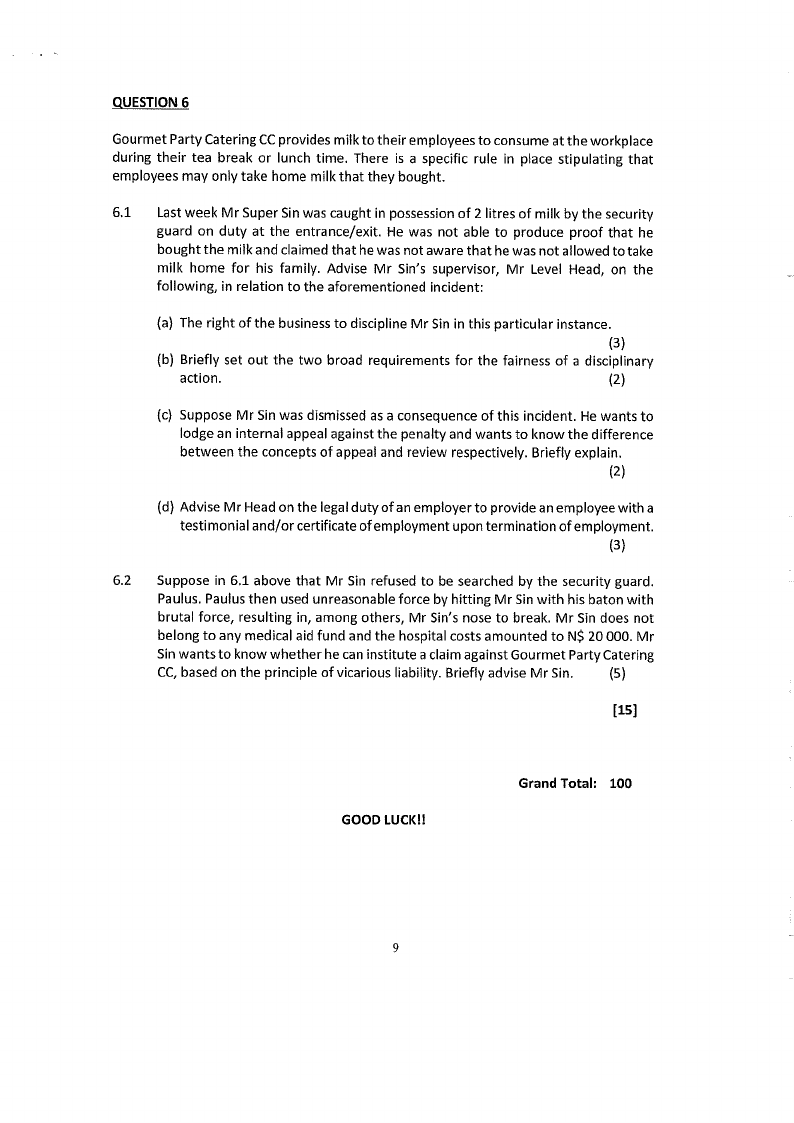
QUESTION 6
Gourmet Party Catering CCprovides milk to their employees to consume at the workplace
during their tea break or lunch time. There is a specific rule in place stipulating that
employees may only take home milk that they bought.
6.1 Last week Mr Super Sin was caught in possessionof 2 litres of milk by the security
guard on duty at the entrance/exit. He was not able to produce proof that he
bought the milk and claimed that he was not aware that he was not allowed to take
milk home for his family. Advise Mr Sin's supervisor, Mr Level Head, on the
following, in relation to the aforementioned incident:
(a) The right of the business to discipline Mr Sin in this particular instance.
(3)
(b) Briefly set out the two broad requirements for the fairness of a disciplinary
action.
(2)
(c) Suppose Mr Sin was dismissed as a consequence of this incident. He wants to
lodge an internal appeal against the penalty and wants to know the difference
between the concepts of appeal and review respectively. Briefly explain.
(2)
(d) Advise Mr Head on the legal duty of an employer to provide an employee with a
testimonial and/or certificate of employment upon termination of employment.
(3)
6.2 Suppose in 6.1 above that Mr Sin refused to be searched by the security guard.
Paulus. Paulus then used unreasonable force by hitting Mr Sin with his baton with
brutal force, resulting in, among others, Mr Sin's nose to break. Mr Sin does not
belong to any medical aid fund and the hospital costs amounted to N$ 20 000. Mr
Sin wants to know whether he can institute a claim against Gourmet Party Catering
CC,based on the principle of vicarious liability. Briefly advise Mr Sin.
(5)
[15]
GOOD LUCK!!
Grand Total: 100
9