EAP511S - ENGLISH FOR ACADEMIC PURPOSES FM - 1ST OPP - JUNE 2025


EAP511S - ENGLISH FOR ACADEMIC PURPOSES FM - 1ST OPP - JUNE 2025


1 Pages 1-10

▲back to top


1.1 Page 1

▲back to top


n Am I BI A u n IVER s I TY
OF SCIEnCE
TECHnOLOGY
FACULTY OF COMMERCE, HUMAN SCIENCES AND EDUCATION
DEPARTMENTOF COMMUNICATION AND LANGUAGES
COURSE CODE: EAP511S
COURSE NAME: ENGLISH FOR ACADEMIC PURPOSES
DATE:
JUNE 2025
MODE:
FM, PM, DI
DURATION:
3 HOURS
MARKS:
100
FIRST OPPORTUNITY EXAMINATION QUESTION PAPER
EXAMINER(S):
Ms T. l<anime
Mr C. Gwasira
Ms Y. Lyamine
Mr E. Shilemba
Ms R. Ndengu
Ms M. Simon
Ms M. Hashoongo
Dr P. Midzi
Mr V. Enkali
Ms E. Limwena
MODERATOR: Prof N. Mlambo
INSTRUCTIONS
1. Answer all questions.
2. Write clearly and neatly.
3. Number the answers clearly.
4. Follow instructions for each question carefully.
THIS EXAMINATION QUESTION PAPER CONSISTS OF 12 PAGES (Including this front
page).
1

1.2 Page 2

▲back to top


QUESTION 1: ACADEMIC READING
[20 marks]
Read the following research article and answer the questions below. The original article has
been adapted for assessment purposes.
Perceptions of EFLStudents toward Academic Reading
Oktay Akarsu
Ataturk University
Leyla Harputlu
Dokuz Eylul University
INTRODUCTION
A
Reading is a complex information processing skill in which the readers interact with the
text in order to create meaningful discourse not just from the words and sentences but
also from the ideas, memories, and knowledge aroused by those words and sentences
(Cziko, Greenleaf, Hurwitz, & Schoenbach, 2000}.
B
Three basic definitions of reading skill have driven literacy programs in the United States
(Foertsch, 1998}. According to the first definition, learning to read means learning to
pronounce words. According to the second definition, learning to read means learning to
identify words and get their meaning. According to the third definition, learning to read
means learning to bring meaning to a text in order to get meaning from it. The definitions
of reading are more than just word recognition and mastery of phonemic decoding.
Contemporary definitions include-or can be replaced by-the dynamic, reciprocal
interactions among reader, text, and the context of the reader's prior literacy schema
(Ulmer, Timothy, Bercaw, Gilbert, Holleman, & Hunting, 2002). Reading is the process
through which the dynamic interaction of the reader's background knowledge, the
information inferred by the written language, and the reading situation context are
constructing meaning (Dutcher, 1990).
C
Successful reading comprehension is a complete grasp of meaning in a text in which
dynamic and growing appreciation of interrelationships in the text is required (Yang,
2002}. Furthermore, reading comprehension depends on factors such as the levels of
readers' proficiency, types of texts and task demands (Anderson, 1991}. With regard to
the successful reading comprehension, Learning and Information Service (2013, p. 1, 2),
2

1.3 Page 3

▲back to top


at the University of Wolverhampton, states that "By reading effectively you will learn to
question and survey the text you are reading to gain a better understanding of your
subject. By improving your reading skills you can reduce unnecessary reading time and
this will enable you to read in a more focused manner."
{Methods and results sections of the article are omitted.)
SUMMARY OF MAJOR FINDINGS AND DISCUSSION
D
The purpose of this study was to investigate and determine Turkish graduate-level EFL
learners' perceptions towards effective reading strategies. This study also aimed to
explore other factors such as gender, age, and academic discipline that might affect
learners' reading strategies. The data were collected through a questionnaire completed
by 144 Turkish graduate-level EFL learners of the School of Foreign Languages of AtatUrk
University. The results of the study suggest that Turkish graduate-level EFL learners are
experienced readers.
E
Reading is a crucial phenomenon for the graduate learners of EFL. An effective grasp of
academic texts requires an essential effort by the reader. A considerable amount of
research has been performed to investigate the processes that contribute to reading
comprehension. Researchers have focused on nearly all aspects of reading such as reading
comprehension, reading anxiety, reading problems, reading strategies, and so on
throughout the world. Alsamadani (2009) conducted a research called "The relationship
between Saudi EFLcollege-level students' use of reading strategies and their EFLreading
comprehension." Alsamadani (2009) found out that EFL learners in Saudi Arabia used
more planning strategies than attending strategies and evaluating strategies. Alsamadani
also pointed out that the environment affected the learners' reading comprehension, but
there was no significant relationship between the learners' comprehension level and their
use of reading strategies. Reading in academic education is regarded as the most needed
skill for EFL learners as their inability to read L2 texts may impede academic and
professional development of those whose academic programs require information from
the target language (Alderson, 1984). It is, therefore, important for graduate EFLprograms
in Turkey to design reading courses for their students to improve their reading ability.
PEDAGOGICAL IMPLICATIONS
F
This study has pedagogical implications for teaching reading to Turkish graduate level EFL
learners in Turkey. Firstly, these findings can be helpful for teachers to guide learners to
3

1.4 Page 4

▲back to top


the reading strategies that suit them individually. This study shows that graduate EFL
learners have different approaches to reading. In other words, reading strategies change
from person to person. Although they know almost all the reading strategies, they just
use the ones they think essential. This is why learners should be considered with regard
to their individual approaches to reading. Teachers should take the learners' individual
experiences and approaches into account while teaching reading.
G
Secondly, the implications of this study are useful for students who seek to increase their
perception of reading strategies. Instruction in this regard can help all learners become
more active readers. Additionally, the findings revealed differences among reading
strategy selections according to gender, age, and academic discipline. In other words,
gender may affect learners' perceptions toward effective reading strategies and,
accordingly, gender should be taken into consideration when teaching reading and other
language skills.
Age was also shown to be a factor in the selection of reading habits. As such, reading
instructors should also pay attention to the age factor. Learners may be classified
according to their ages during classes and also during the implementation of related
research.
J
Academic discipline is also an important factor that affects learners' selection of reading
strategies. In this study, the variable regarding area of study is significant, as the
participants are all graduate students and thus must read for academic purposes. The
results regarding the differences in reading strategies among disciplines have implications
for education. For example, scheduling for English preparatory classes should be prepared
according to discipline. Students of the Social Sciences, for example, can deal with social
issues, whereas the other students can be taught according to their own disciplines.
K
In conclusion, it would be beneficial for EFLlearners, whether proficient in reading the
target language or not, to be aware of the strategies that proficient readers have.
Accordingly, three concrete recommendations can be made here:
1. Turkish graduate-level learners should practice other reading strategies to improve
their reading strategies.
2. Teachers should know how to instruct reading.
3. Teachers should also take certain variables (age, gender, academic discipline, etc.)
into account when teaching reading.
4

1.5 Page 5

▲back to top


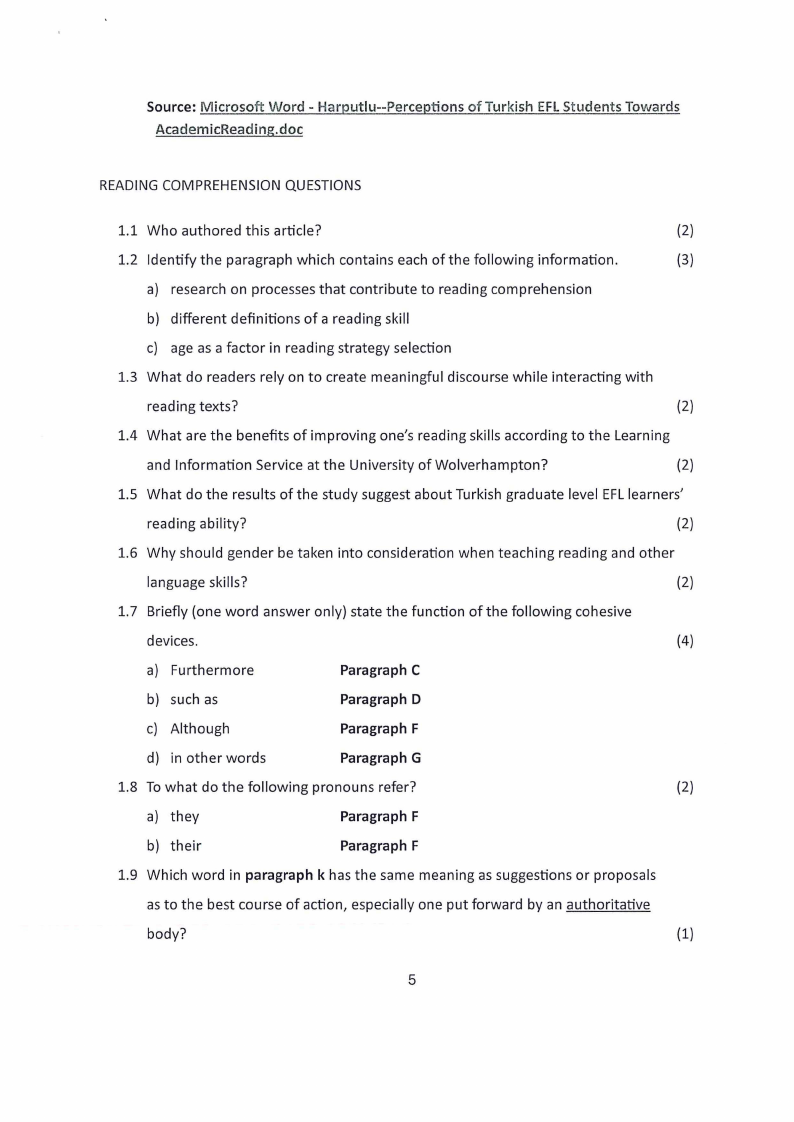
Source: Microsoft Word - Harputlu--Perceptions of Turkish EFLStudents Towards
AcademicReading.doc
READINGCOMPREHENSIONQUESTIONS
1.1 Who authored this article?
(2)
1.2 Identify the paragraph which contains each of the following information.
(3)
a) research on processes that contribute to reading comprehension
b) different definitions of a reading skill
c) age as a factor in reading strategy selection
1.3 What do readers rely on to create meaningful discourse while interacting with
reading texts?
(2)
1.4 What are the benefits of improving one's reading skills according to the Learning
and Information Service at the University of Wolverhampton?
(2)
1.5 What do the results of the study suggest about Turkish graduate level EFLlearners'
reading ability?
(2)
1.6 Why should gender be taken into consideration when teaching reading and other
language skills?
(2)
1.7 Briefly (one word answer only) state the function of the following cohesive
devices.
(4)
a) Furthermore
Paragraph C
b) such as
Paragraph D
c) Although
Paragraph F
d) in other words
Paragraph G
1.8 To what do the following pronouns refer?
(2)
a) they
Paragraph F
b) their
Paragraph F
1.9 Which word in paragraph k has the same meaning as suggestions or proposals
as to the best course of action, especially one put forward by an authoritative
body?
(1)
5

1.6 Page 6

▲back to top


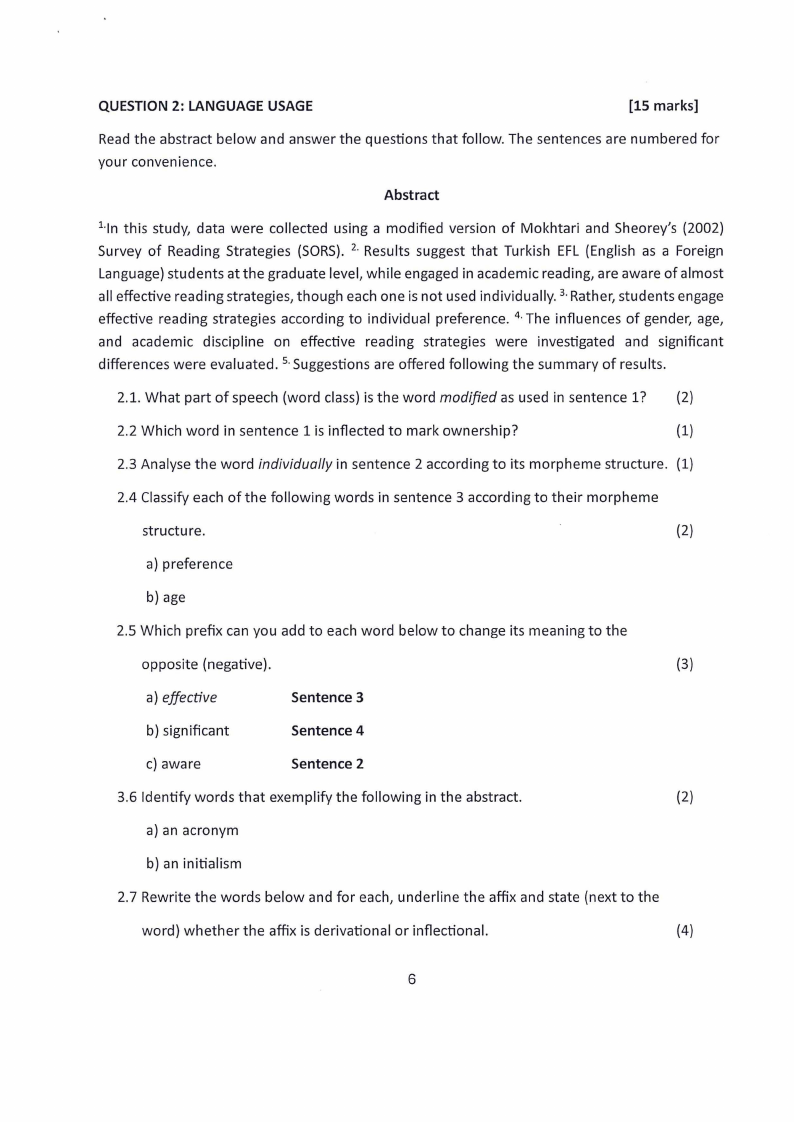
QUESTION 2: LANGUAGE USAGE
[15 marks]
Read the abstract below and answer the questions that follow. The sentences are numbered for
your convenience.
Abstract
1.In this study, data were collected using a modified version of Mokhtari and Sheorey's (2002)
Survey of Reading Strategies {SORS).Results suggest that Turkish EFL {English as a Foreign
Language) students at the graduate level, while engaged in academic reading, are aware of almost
all effective reading strategies, though each one is not used individually. 3 · Rather, students engage
effective reading strategies according to individual preference. The influences of gender, age,
and academic discipline on effective reading strategies were investigated and significant
differences were evaluated. Suggestions are offered following the summary of results.
2.1. What part of speech (word class) is the word modified as used in sentence 1? (2)
2.2 Which word in sentence 1 is inflected to mark ownership?
(1)
2.3 Analyse the word individually in sentence 2 according to its morpheme structure. (1)
2.4 Classify each of the following words in sentence 3 according to their morpheme
structure.
(2)
a) preference
b)age
2.5 Which prefix can you add to each word below to change its meaning to the
opposite (negative).
{3)
a) effective
Sentence 3
b) significant
Sentence 4
c) aware
Sentence 2
3.6 Identify words that exemplify the following in the abstract.
(2)
a) an acronym
b) an initialism
2.7 Rewrite the words below and for each, underline the affix and state (next to the
word) whether the affix is derivational or inflectional.
(4)
6

1.7 Page 7

▲back to top


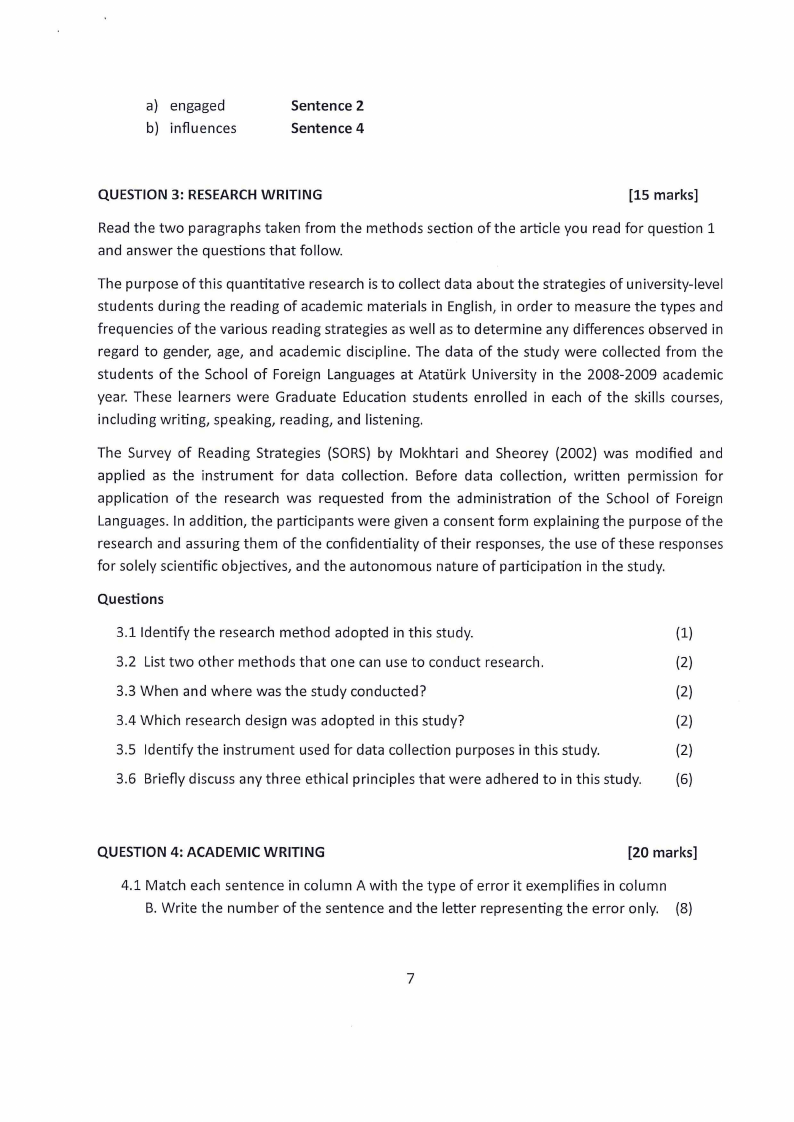
a) engaged
b) influences
Sentence 2
Sentence 4
QUESTION 3: RESEARCHWRITING
[15 marks]
Read the two paragraphs taken from the methods section of the article you read for question 1
and answer the questions that follow.
The purpose of this quantitative research is to collect data about the strategies of university-level
students during the reading of academic materials in English, in order to measure the types and
frequencies of the various reading strategies as well as to determine any differences observed in
regard to gender, age, and academic discipline. The data of the study were collected from the
students of the School of Foreign Languages at Ataturk University in the 2008-2009 academic
year. These learners were Graduate Education students enrolled in each of the skills courses,
including writing, speaking, reading, and listening.
The Survey of Reading Strategies (SORS) by Mokhtari and Sheorey (2002) was modified and
applied as the instrument for data collection. Before data collection, written permission for
application of the research was requested from the administration of the School of Foreign
Languages. In addition, the participants were given a consent form explaining the purpose of the
research and assuring them of the confidentiality of their responses, the use of these responses
for solely scientific objectives, and the autonomous nature of participation in the study.
Questions
3.1 Identify the research method adopted in this study.
(1)
3.2 List two other methods that one can use to conduct research.
(2)
3.3 When and where was the study conducted?
(2)
3.4 Which research design was adopted in this study?
(2)
3.5 Identify the instrument used for data collection purposes in this study.
(2)
3.6 Briefly discuss any three ethical principles that were adhered to in this study.
(6)
QUESTION 4: ACADEMIC WRITING
[20 marks]
4.1 Match each sentence in column A with the type of error it exemplifies in column
B. Write the number of the sentence and the letter representing the error only. (8)
7

1.8 Page 8

▲back to top


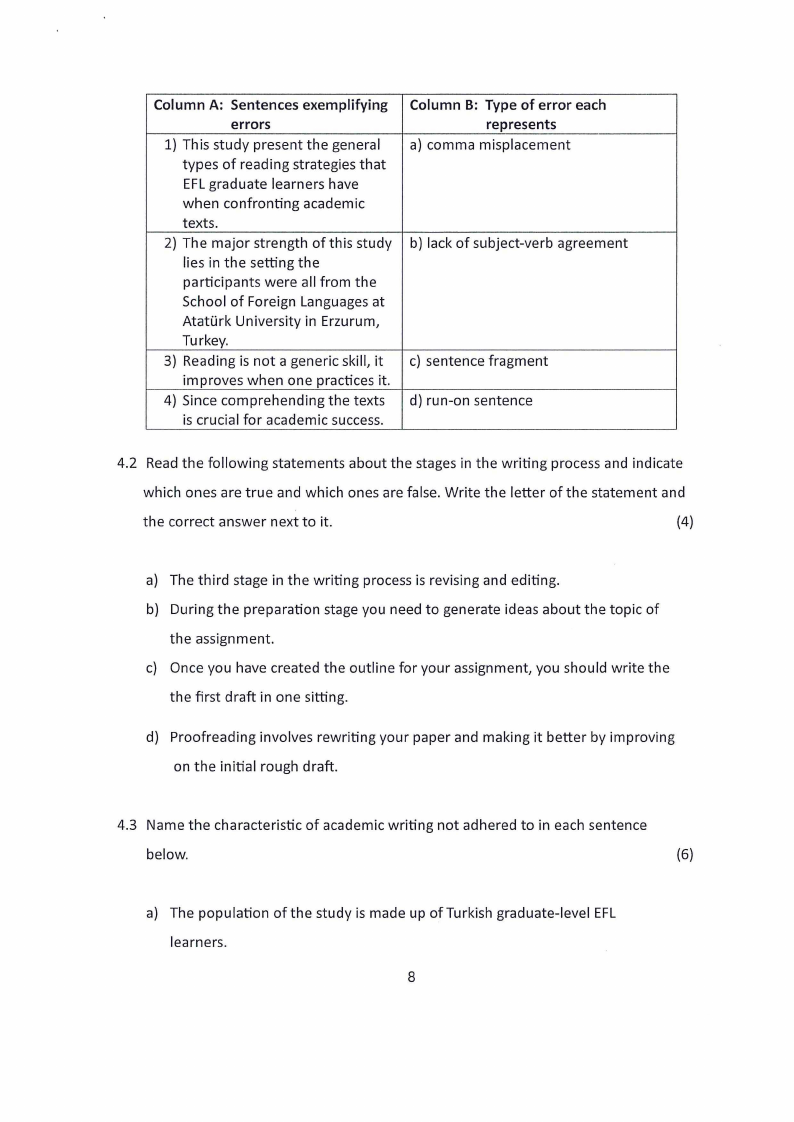
Column A: Sentences exemplifying
errors
1) This study present the general
types of reading strategies that
EFLgraduate learners have
when confronting academic
texts.
2) The major strength of this study
lies in the setting the
participants were all from the
School of Foreign Languages at
Ataturk University in Erzurum,
Turkey.
3) Reading is not a generic skill, it
improves when one practices it.
4) Since comprehending the texts
is crucial for academic success.
Column B: Type of error each
represents
a) comma misplacement
b) lack of subject-verb agreement
c) sentence fragment
d) run-on sentence
4.2 Read the following statements about the stages in the writing process and indicate
which ones are true and which ones are false. Write the letter of the statement and
the correct answer next to it.
(4)
a) The third stage in the writing process is revising and editing.
b) During the preparation stage you need to generate ideas about the topic of
the assignment.
c) Once you have created the outline for your assignment, you should write the
the first draft in one sitting.
d) Proofreading involves rewriting your paper and making it better by improving
on the initial rough draft.
4.3 Name the characteristic of academic writing not adhered to in each sentence
below.
(6)
a) The population of the study is made up of Turkish graduate-level EFL
learners.
8

1.9 Page 9

▲back to top


b) In this study we give a picture of the graduate learners' strategies.
c) In the future, graduate-level EFLlearners' perceptions toward effective
reading strategies must be investigated through different research designs
and data collection procedures and instruments, and with the inclusion of
more participants.
4.4 Read paragraph C of the article in question 1 and identify two methods of
incorporating other scholars' ideas used by the authors.
(2)
QUESTION 5: TEXT STRUCTURE
[15 marks]
5.1 Read the paragraph below and answer the questions that follow after it.
There are numerous reasons why students may develop poor reading
comprehension ability. Firstly, poor comprehension ability may be as a result of
lack of motivation. Secondly, poor comprehension ability may occur due to low
prior knowledge. Students may also develop poor comprehension ability on
account of poor English vocabulary. To avert the negative consequences
associated with poor comprehension ability among students, it is important to
address the factors the lead to poor reading ability among students.
a) Identify the pattern of organisation used in this paragraph.
(1)
b) List two text structure specific cohesive devices that signal the pattern
of organisation.
(2)
c) Name four elements of a body paragraph exemplified in the paragraph.
(2)
5.2 Use the information in the table below to construct a (one) paragraph of
not more than ten (10) sentences using an appropriate pattern of
organisation.
(10)
Your paragraph should
begin with a topic sentence
have three main supporting sentences
have at least two minor supporting sentences
have at least three text structure specific cohesive devices
closing sentence
9

1.10 Page 10

▲back to top


Proficient Readers (Good Readers)
Ineffective Readers (Poor Readers)
. . Before Reading
Build up their background knowledge on the
Start reading without thinking about the
.. subject before they begin to read.
Know their purpose for reading.
Focus their complete attention on reading
. subject
Do not know why they are reading.
. . Dul'ing Reading
Give their complete attention to the reading
Do not know whether they understand or do
. task.
Keep a constant check on their own
. understanding.
Monitor their reading comprehension and do
not understand.
. Do not monitor their own comprehension.
. Seldom use any of the fix-up strategies.
. it so otlen it becomes automatic.
Stop only to use a fix-up strategy when they
do not understand.
After Reading
. . Decide if they have achieved their goal for
Do not know what they have read .
. reading.
Do not follow reading with comprehension
. Evaluate comprehension of what was read.
self-check .
. Summarize the major ideas .
. Seek additional information from ouL,idc
sources.
QUESTION 6: REFERENCING
[15 marks]
Study the list of sources below and answer the questions based on it.
[1] Alderson, J. C. {1984). Reading in a foreign language: A reading problem or a
language problem. In J. C. Alderson & A. H. Urquhart (Eds.),Reading
in a foreign language (pp. 1-27). Longman.
[2] Andriani, E., & Mbato, C. L. (2021). Male and female Indonesian EFL
undergraduate program students' metacognitive strategies in
academic reading: planning, monitoring and evaluation strategies.
Journal on English as a Foreign Language, 11(2), 275-296.
https://doi.org/10.23971/jefl.vlli2.3006
[3]
Baum, J., Framer, R., & Rahman, R. A. (n.d.). Emotions and cognitive effort -
but not source credibility- determine news-based social
judgments. Preprint, 1-25.
[4] Conrady, K. (2015). Modeling Metacognition: Making Thinking Visible in a
Content Course for Teachers. Journal of Research in Mathematics
Education, 4(2), 132. https://doi.org/10.17583/redimat.2015.1422
[5] Mayring, P.{2014). Qualitative content analysis: theoretical foundation, basic
procedures and software solution. Klagenfurt. Retrieved from
https://www.ssoar.info/
6.1 Use the list of references to insert in-text citations as appropriate to complete
each of the sentences below. Use page 20 if you need to use a page number. (8)
10

2 Pages 11-20

▲back to top


2.1 Page 11

▲back to top


i) ______
[Source 3] frankly acknowledge that the successful identification of
specific reading strengths and weaknesses will fully strengthen EFL learners'
metacognitive reading learning strategies they are going to implement in their
reading learning processes.
ii) "University EFL learners have to be able to thoroughly evaluate the academic
reading processes to progressively elevate their higher order thinking, problem-
solving, decision-making, planning, and monitoring skills" ______
[Source
4].
iii) ______
[Source 2] strongly prompt Indonesian EFL teachers to provide
clearer metacognitive strategies guidance for learners to fully reap more fruitful
reading learning outcomes in future events.
iv) An issue that has received a fair amount of attention in EFL reading is if there is a
threshold of L2 proficiency (or linguistic knowledge; that is, a language factor) that
needs to be passed for the transfer of Ll reading (that is, a reading matter) to occur
______
[Source 1].
6.2 What is represented by the following information?
(3)
i)
the abbreviation Eds. (in bold) in source 1
a) editions
b) editorials
c) editors
ii)
the number 2 (in bold) in source 2
a) volume number
b) issue number
c) edition
iii) the abbreviation n.d. (in bold) in source 3
a) variant of and or end
b) no damage
c) no date
6.3 Use the list of sources below and decide what type of source is represented
11

2.2 Page 12

▲back to top


by each of the following entries in the reference list. Write only the question
number and the letter of the correct answer.
(2)
List of sources:
a) journal article b) book chapter c) newspaper article d)book
i)
Source 1
ii) Source 5
6.4 Indicate whether the following tips for writing a reference list are true or
false.
(2)
i)
Arrange the reference list in alphabetical order according to the first
name of the first named author.
ii)
Number or 'bullet' the reference entries.
THE END
12