


 |
PTD712S - PRINCIPLES OF TRAINING AND DEVELOPMENT - 1ST OPP - NOV 2025 |
|
|
1 Page 1 |
▲back to top |
nAmlBIA unlVERSITY
OF SCI En CE Ano TECH n OLOGY
FACULTY OF COMMERCE, HUMAN SCIENCES AND EDUCATION
DEPARTMENT OF GOVERNANCE AND MANAGEMENT SCIENCES
QUALIFICATION : BACHELOR OF HUMAN RESOURCES MANAGEMENT DEGREE
QUALIFICATION CODE: 07HRM
LEVEL: 7
COURSE CODE: PTD712S
COURSE NAME: PRINCIPLES OF TRAINING AND
DEVELOPMENT
DATE: NOVEMBER 2025
PAPER:1
DURATION: 3 HOURS
MARKS: 100
,
,
EXAMINER{S)
MODERATOR:
FIRST OPPORTUNITY QUESTION PAPER
Ms. Fiina Shimaneni
Ms. llenimutale N. Haiduwa
INSTRUCTIONS
1. Write clearly and neatly.
2. ALL questions are compulsory
THIS QUESTION PAPER CONSISTS OF 5 PAGES {Including this front page).
1
|
|
2 Page 2 |
▲back to top |
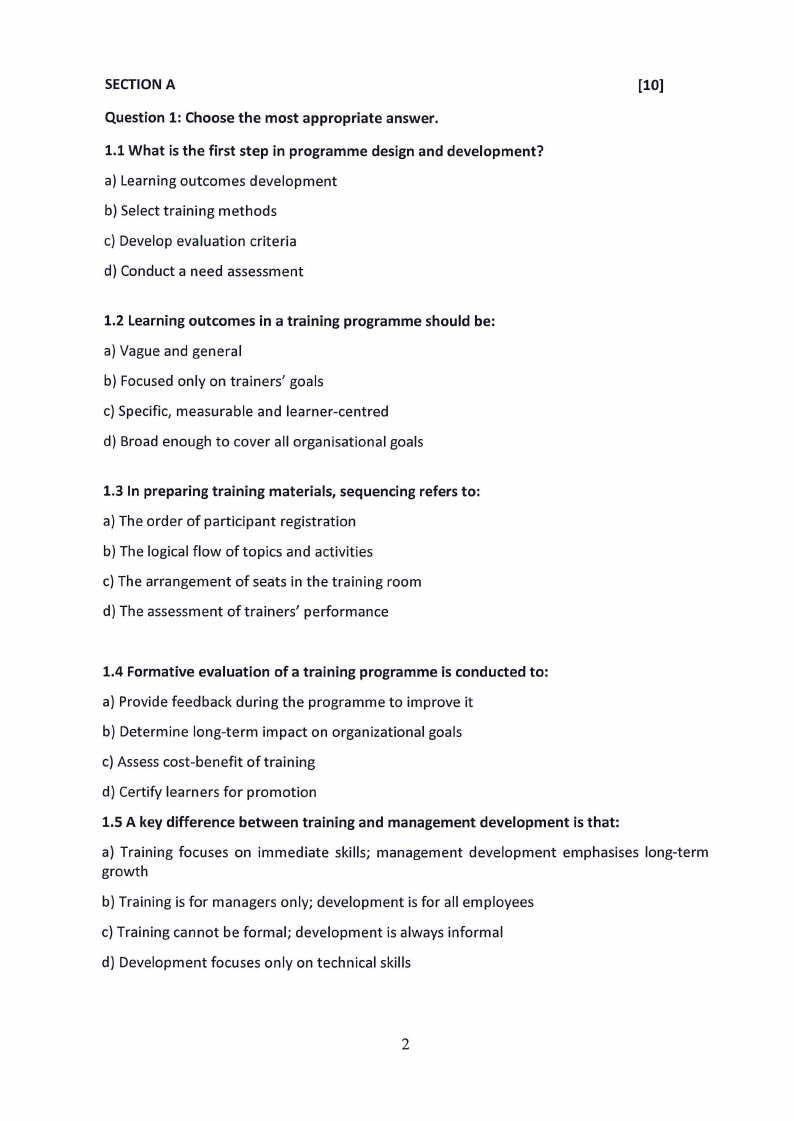
SECTION A
[10]
Question 1: Choose the most appropriate answer.
1.1 What is the first step in programme design and development?
a) Learning outcomes development
b) Select training methods
c) Develop evaluation criteria
d) Conduct a need assessment
1.2 Learning outcomes in a training programme should be:
a) Vague and general
b) Focused only on trainers' goals
c) Specific, measurable and learner-centred
d) Broad enough to cover all organisational goals
1.3 In preparing training materials, sequencing refers to:
a) The order of participant registration
b) The logical flow of topics and activities
c) The arrangement of seats in the training room
d) The assessment of trainers' performance
1.4 Formative evaluation of a training programme is conducted to:
a) Provide feedback during the programme to improve it
b) Determine long-term impact on organizational goals
c) Assess cost-benefit of training
d) Certify learners for promotion
1.5 A key difference between training and management development is that:
a) Training focuses on immediate skills; management development emphasises long-term
growth
b) Training is for managers only; development is for all employees
c) Training cannot be formal; development is always informal
d) Development focuses only on technical skills
2
|
|
3 Page 3 |
▲back to top |
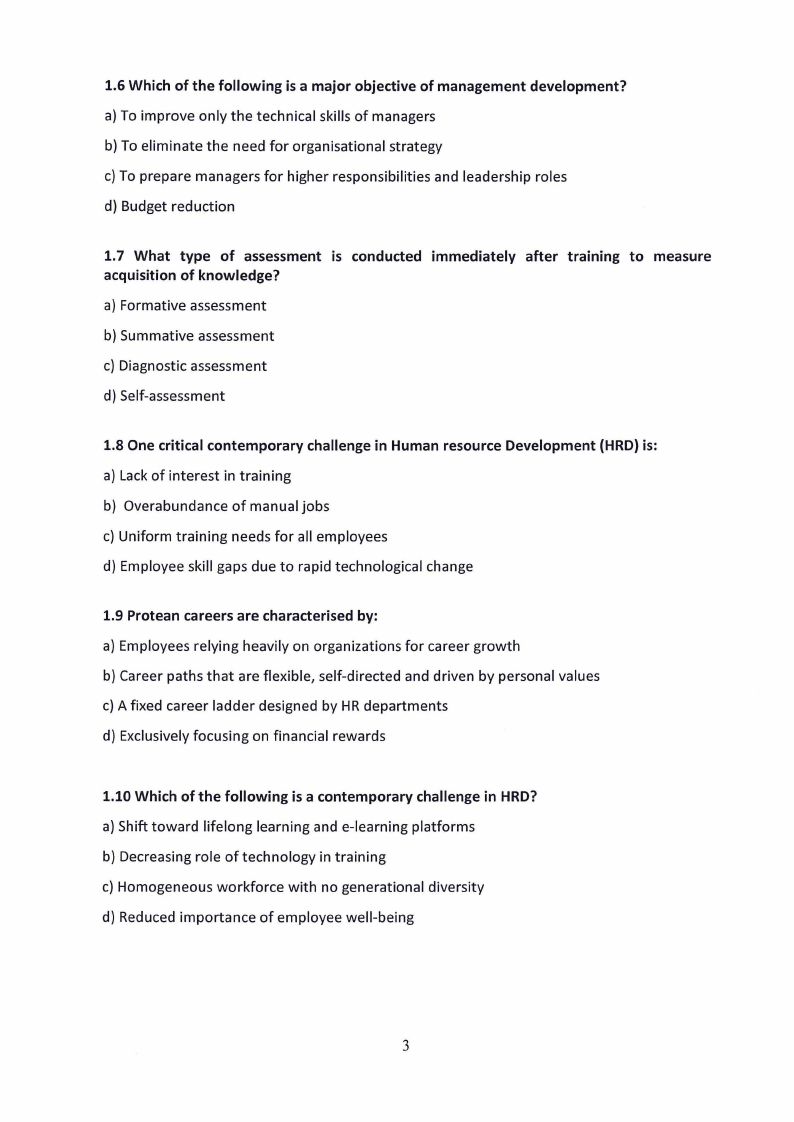
1.6 Which of the following is a major objective of management development?
a) To improve only the technical skills of managers
b) To eliminate the need for organisational strategy
c) To prepare managers for higher responsibilities and leadership roles
d) Budget reduction
1.7 What type of assessment is conducted immediately after training to measure
acquisition of knowledge?
a) Formative assessment
b) Summative assessment
c) Diagnostic assessment
d) Self-assessment
1.8 One critical contemporary challenge in Human resource Development (HRD) is:
a) Lack of interest in training
b) Overabundance of manual jobs
c) Uniform training needs for all employees
d) Employee skill gaps due to rapid technological change
1.9 Protean careers are characterised by:
a) Employees relying heavily on organizations for career growth
b) Career paths that are flexible, self-directed and driven by personal values
c) A fixed career ladder designed by HR departments
d) Exclusively focusing on financial rewards
1.10 Which of the following is a contemporary challenge in HRD?
a) Shift toward lifelong learning and e-learning platforms
b) Decreasing role of technology in training
c) Homogeneous workforce with no generational diversity
d) Reduced importance of employee well-being
3
|
|
4 Page 4 |
▲back to top |
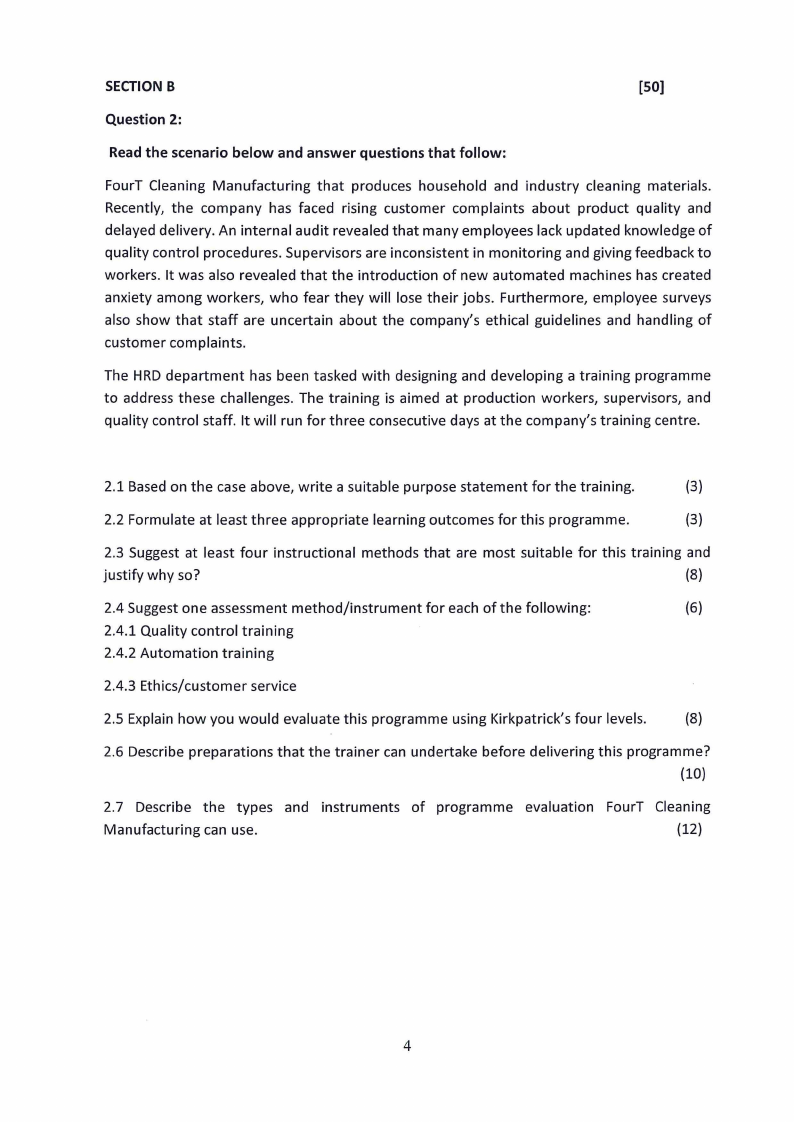
SECTION B
[50]
Question 2:
Read the scenario below and answer questions that follow:
FourT Cleaning Manufacturing that produces household and industry cleaning materials.
Recently, the company has faced rising customer complaints about product quality and
delayed delivery. An internal audit revealed that many employees lack updated knowledge of
quality control procedures. Supervisors are inconsistent in monitoring and giving feedback to
workers. It was also revealed that the introduction of new automated machines has created
anxiety among workers, who fear they will lose their jobs. Furthermore, employee surveys
also show that staff are uncertain about the company's ethical guidelines and handling of
customer complaints.
The HRD department has been tasked with designing and developing a training programme
to address these challenges. The training is aimed at production workers, supervisors, and
quality control staff. It will run for three consecutive days at the company's training centre.
2.1 Based on the case above, write a suitable purpose statement for the training.
(3}
2.2 Formulate at least three appropriate learning outcomes for this programme.
(3}
2.3 Suggest at least four instructional methods that are most suitable for this training and
justify why so?
(8)
2.4 Suggest one assessment method/instrument for each of the following:
(6}
2.4.1 Quality control training
2.4.2 Automation training
2.4.3 Ethics/customer service
2.5 Explain how you would evaluate this programme using Kirkpatrick's four levels.
(8}
2.6 Describe preparations that the trainer can undertake before delivering this programme?
(10}
2.7 Describe the types and instruments of programme evaluation FourT Cleaning
Manufacturing can use.
(12}
4
|
|
5 Page 5 |
▲back to top |

SECTION C
Question 3: Long and structured questions.
[40]
3.1 Organisations increasingly recognise that effective management is critical for achieving
strategic objectives. Discuss the concept of Management Development and its importance in
modern organisations. In addition, outline the various methods commonly used in
management development programs.
(15)
3.2 Competency-Based Training (CBT) is widely used to align employees with organisational
needs. Critically discuss the concept of CBT, its key characteristics and its significance in
Human Resource Development.
(15)
3.3 Effective presentation skills are critical for trainers in ensuring knowledge transfer,
engagement and influence. Explain the key components of effective presentation skills and
discuss how these skills can impact the success of a training session.
(10)
Good luck!
5