


 |
FMH810S- FINANCIAL MANAGEMENT FOR HOSPITALITY AND TOURISM- 1ST OPP-JUNE 2025 |
|
|
1 Page 1 |
▲back to top |
nAmlBIA UnlVERSITY
OF SCIEnCE Ano TECHnDLOGY
FACULTYOFCOMMERCEH, UMANSCIENCEAS ND EDUCATION
DEPARTMENT OF ECONOMICS, ACCOUNTING & FINANCE
QUALIFICATION: BACHELOR OF HOSPITALITY AND
TOURISM MANAGEMENT HONOURS
QUALIFICATION CODE: 08BHTH
LEVEL: 8
COURSE CODE: FMH810S
COURSE NAME: FINANCIAL MANAGEMENT FOR
HOSPITALITY AND TOURISM
SESSION: JUNE 2025
DURATION: 3 HOURS
PAPER: THEORY AND APPLICATION
MARKS: 100
FIRST OPPORTUNITY EXAMINATION QUESTION PAPER
EXAMINERS:
Kuhepa Tjondu
MODERATOR: Mr. A Okafor
INSTRUCTIONS
• This question paper is made up of FOUR(4) questions.
• Start each question on a new page.
• Answer All the questions and in blue or black ink.
• You are advised to pay due attention to expression and presentation. Failure to do so will
cost you marks.
• Start each question on a new page in your answer booklet and show all your workings.
• Questions relating to this paper may be raised in the initial 30 minutes after the start of
the paper. Thereafter, candidates must use their initiative to deal with any perceived error
or ambiguities and any assumption made by the candidate should be clearly stated.
PERMISSIBLE MATERIALS
Non-programmable calculator/financial calculator
THIS QUESTION PAPER CONSISTS OF 7 PAGES (Including this front page)
1
|
|
2 Page 2 |
▲back to top |
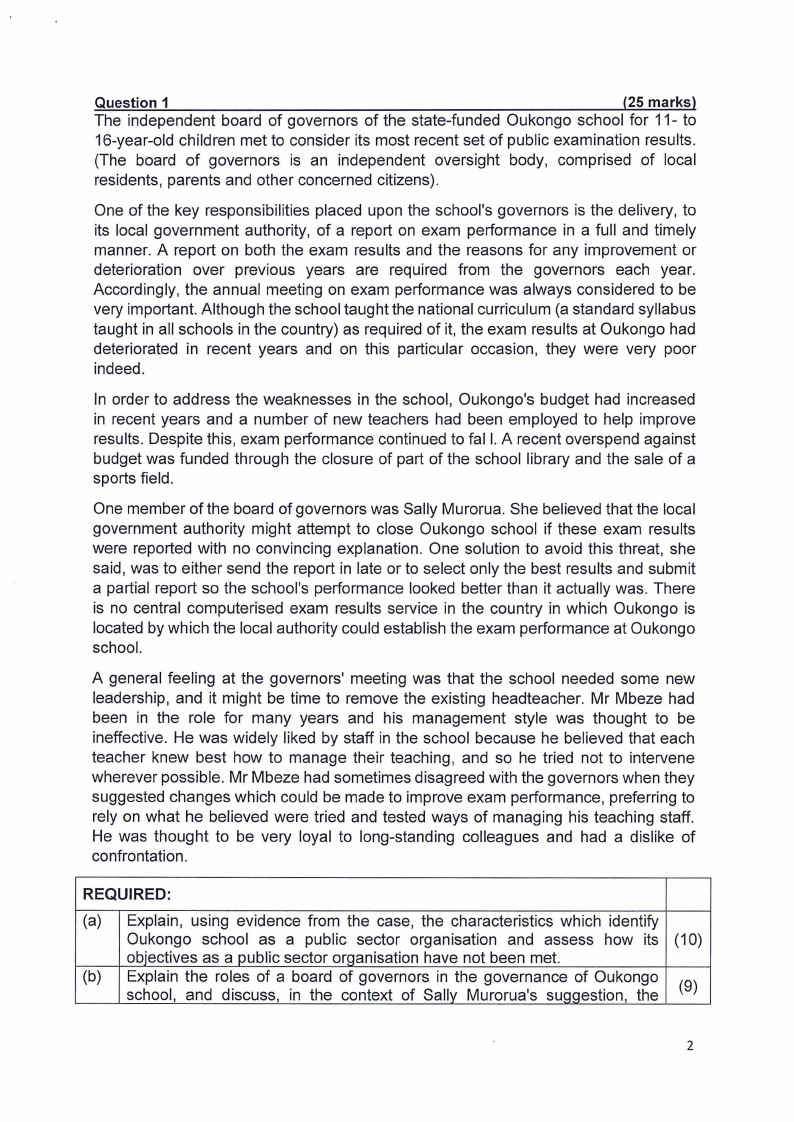
Question 1
(25 marks)
The independent board of governors of the state-funded Oukongo school for 11- to
16-year-old children met to consider its most recent set of public examination results.
(The board of governors is an independent oversight body, comprised of local
residents, parents and other concerned citizens).
One of the key responsibilities placed upon the school's governors is the delivery, to
its local government authority, of a report on exam performance in a full and timely
manner. A report on both the exam results and the reasons for any improvement or
deterioration over previous years are required from the governors each year.
Accordingly, the annual meeting on exam performance was always considered to be
very important. Although the school taught the national curriculum (a standard syllabus
taught in all schools in the country) as required of it, the exam results at Oukongo had
deteriorated in recent years and on this particular occasion, they were very poor
indeed.
In order to address the weaknesses in the school, Oukongo's budget had increased
in recent years and a number of new teachers had been employed to help improve
results. Despite this, exam performance continued to fal I. A recent overspend against
budget was funded through the closure of part of the school library and the sale of a
sports field.
One member of the board of governors was Sally Murorua. She believed that the local
government authority might attempt to close Oukongo school if these exam results
were reported with no convincing explanation. One solution to avoid this threat, she
said, was to either send the report in late or to select only the best results and submit
a partial report so the school's performance looked better than it actually was. There
is no central computerised exam results service in the country in which Oukongo is
located by which the local authority could establish the exam performance at Oukongo
school.
A general feeling at the governors' meeting was that the school needed some new
leadership, and it might be time to remove the existing headteacher. Mr Mbeze had
been in the role for many years and his management style was thought to be
ineffective. He was widely liked by staff in the school because he believed that each
teacher knew best how to manage their teaching, and so he tried not to intervene
wherever possible. Mr Mbeze had sometimes disagreed with the governors when they
suggested changes which could be made to improve exam performance, preferring to
rely on what he believed were tried and tested ways of managing his teaching staff.
He was thought to be very loyal to long-standing colleagues and had a dislike of
confrontation.
REQUIRED:
(a) Explain, using evidence from the case, the characteristics which identify
Oukongo school as a public sector organisation and assess how its (10)
objectives as a public sector orQanisation have not been met.
(b)
Explain the roles of a board of governors in the governance of Oukongo
school, and discuss, in the context of Sally Murorua's suaaestion, the
(9)
2
|
|
3 Page 3 |
▲back to top |
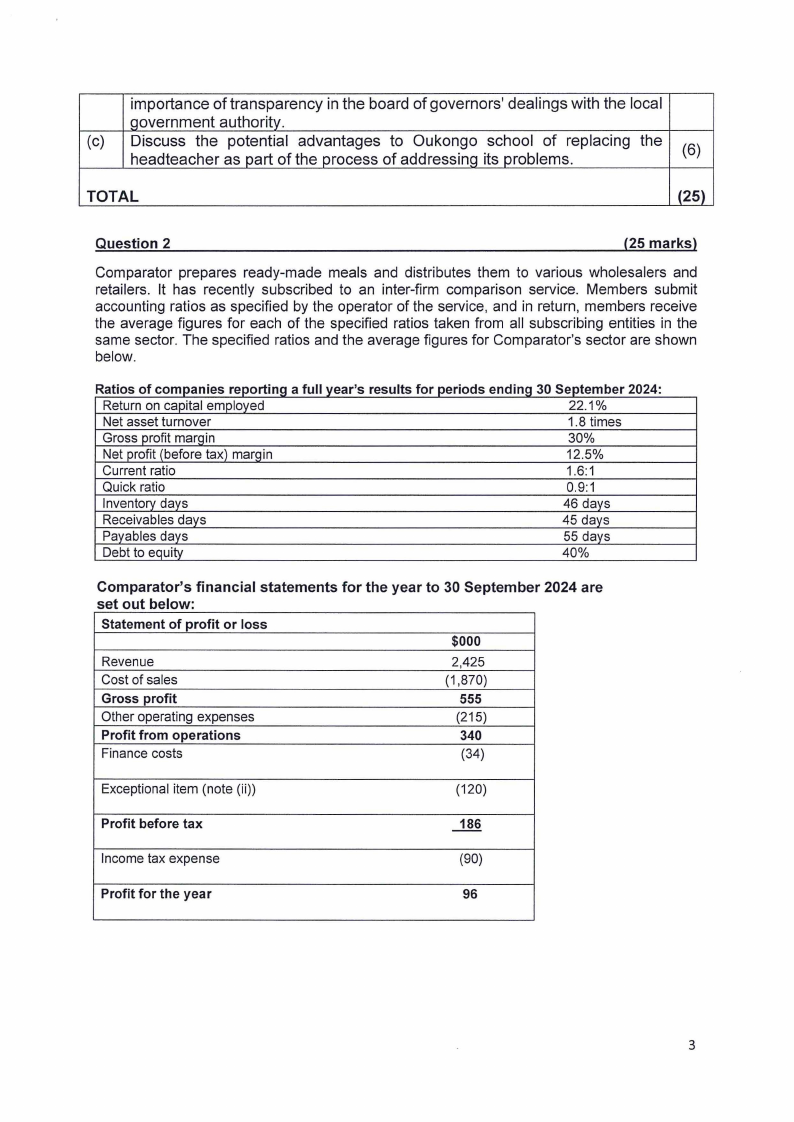
importance of transparency in the board of governors' dealings with the local
Qovernment authority.
(c)
Discuss the potential advantages to Oukongo school of replacing the
headteacher as part of the process of addressinQ its problems.
(6)
TOTAL
(25)
Question 2
(25 marks)
Comparator prepares ready-made meals and distributes them to various wholesalers and
retailers. It has recently subscribed to an inter-firm comparison service. Members submit
accounting ratios as specified by the operator of the service, and in return, members receive
the average figures for each of the specified ratios taken from all subscribing entities in the
same sector. The specified ratios and the average figures for Comparator's sector are shown
below.
Rat1. os of companies reporting a fuII year s resu Its for peri.o ds end.mg 30 Septem ber 2024
Return on capital employed
22.1%
Net asset turnover
1.8 times
Gross profit marqin
30%
Net profit (before tax) marqin
12.5%
Current ratio
1.6:1
Quick ratio
0.9:1
Inventory days
46 days
Receivables days
45 days
Payables days
55 days
Debt to equity
40%
Comparator's financial statements for the year to 30 September 2024 are
set out below:
Statement of profit or loss
$000
Revenue
2,425
Cost of sales
(1,870)
Gross profit
555
Other operating expenses
(215)
Profit from operations
340
Finance costs
(34)
Exceptional item (note (ii))
(120)
Profit before tax
186
Income tax expense
(90)
Profit for the year
96
3
|
|
4 Page 4 |
▲back to top |
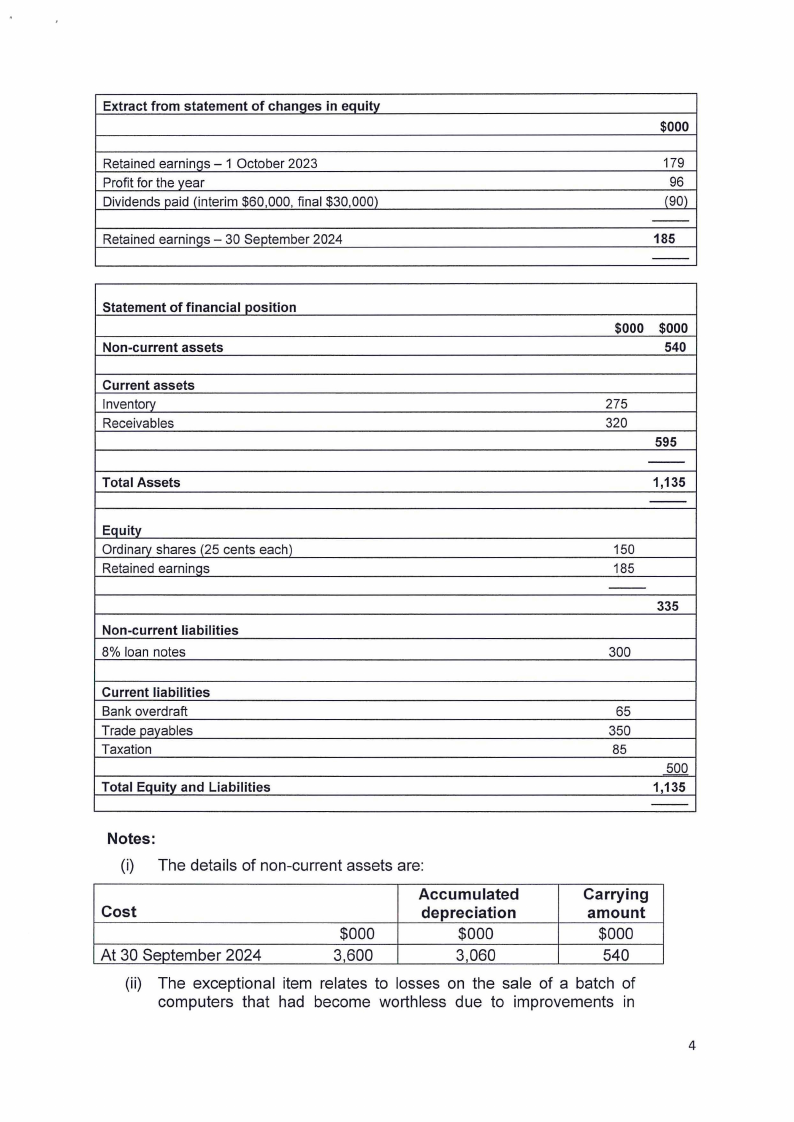
Extract from statement of changes in equity
Retained earnings - 1 October 2023
Profit for the year
Dividends paid (interim $60,000, final $30,000)
Retained earnings - 30 September 2024
$000
179
96
(90)
--
185
--
Statement of financial position
Non-current assets
$000 $000
540
Current assets
Inventory
Receivables
Total Assets
EQuitv
Ordinary shares (25 cents each)
Retained earnings
Non-current liabilities
8% loan notes
275
320
595
--
1,135
--
150
185
--
335
300
Current liabilities
Bank overdraft
Trade payables
Taxation
Total Equity and Liabilities
65
350
85
500
1,135
--
Notes:
(i) The details of non-current assets are:
Cost
At 30 September 2024
$000
3,600
Accumulated
depreciation
$000
3,060
Carrying
amount
$000
540
(ii) The exceptional item relates to losses on the sale of a batch of
computers that had become worthless due to improvements in
4
|
|
5 Page 5 |
▲back to top |
microchip design.
(iii) The market price of Comparator's shares throughout the year
averaged $6 each.
REQUIRED:
(a)
Calculate the ratios for Comparator which are equivalent to those provided
by the comparison service.
(20)
(b) Define value for money and briefly explain the 3Es of Values for Money.
(5)
TOTAL
(25)
Question 3
(25 marks)
Budget (Pty) Ltd was established two years ago and has been struggling to break-
even. However, the benefit of an aggressive marketing strategy in the last six months
is now starting to pay off and the company is anticipating an upsurge demand for its
product.
Management has asked you to assist in preparing a budget for the next month. The
company uses a standard variable costing system. The following information is
relevant:
1. Standard selling price and standard prime cost per unit:
Selling price
N$1 000
Raw materials
15 kg at N$25 per kg
Direct labour (variable) 5 hours at N$50 per hour
2. Expected monthly sales units. The company believes that the following
targets are realistic and attainable:
Month 1
9000 units
3. The company currently has an opening stock of finished goods of 3 000 units,
which management is of the opinion is far too high. The intention is to reduce
the closing inventory to 2 000 units per month.
4. The company is in the process of implementing a Just-in-Time (JIT) system and
hence all raw material requirements will be purchased in the month of
production to save costs. Stock holding will therefore be minimal. Nevertheless,
the company will hold a closing stock of 5 000 kgs of raw materials at the end
of every month. Currently, it has 30 000 kgs in stock.
5
|
|
6 Page 6 |
▲back to top |
REQUIRED:
(a) Prepare the following functional budgets for Months 1:
(i) Sales Budget (units and value)
(3)
(ii) Production Budget
(4)
(iii) Material usage and purchases Budget (units and value)
(8)
(iv) Direct labour Budget (hours and value)
(5)
(b) Name and briefly explain FIVE (5) uses or purposes of budgeting
(5)
TOTAL
(25)
Question 4
(25 marks)
Ms. Elaine is a businesswoman who is running a successful hospitality and tourism
company in Namibia. Ms. Elaine believes that the organization must embrace
emerging technology if it is to compete in the highly competitive Tourism Sector of
Namibia. She attended a workshop last week where she learned that "Big data is a
term for a collection of data which is so large that it becomes difficult to store and
process using traditional databases and data processing applications". Big data often
also includes more than simply financial information and can involve other
organizational data (both internal and external) which is often unstructured.
Her business partner Ms. Abbi agreed that the organization must embrace technology
but it is important to understand the advantages and possible disadvantages of any
emerging technology by it can be adopted by the organization.
REQUIRED:
(a)
Name and explain the characteristics of big data which are also known as
the 5Vs.
(10)
(b) Explain the possible disadvantages and/or risks of Big Data?
(8)
(c) List Seven (7) benefits of using Big Data?
(7)
TOTAL
(25)
6
|
|
7 Page 7 |
▲back to top |
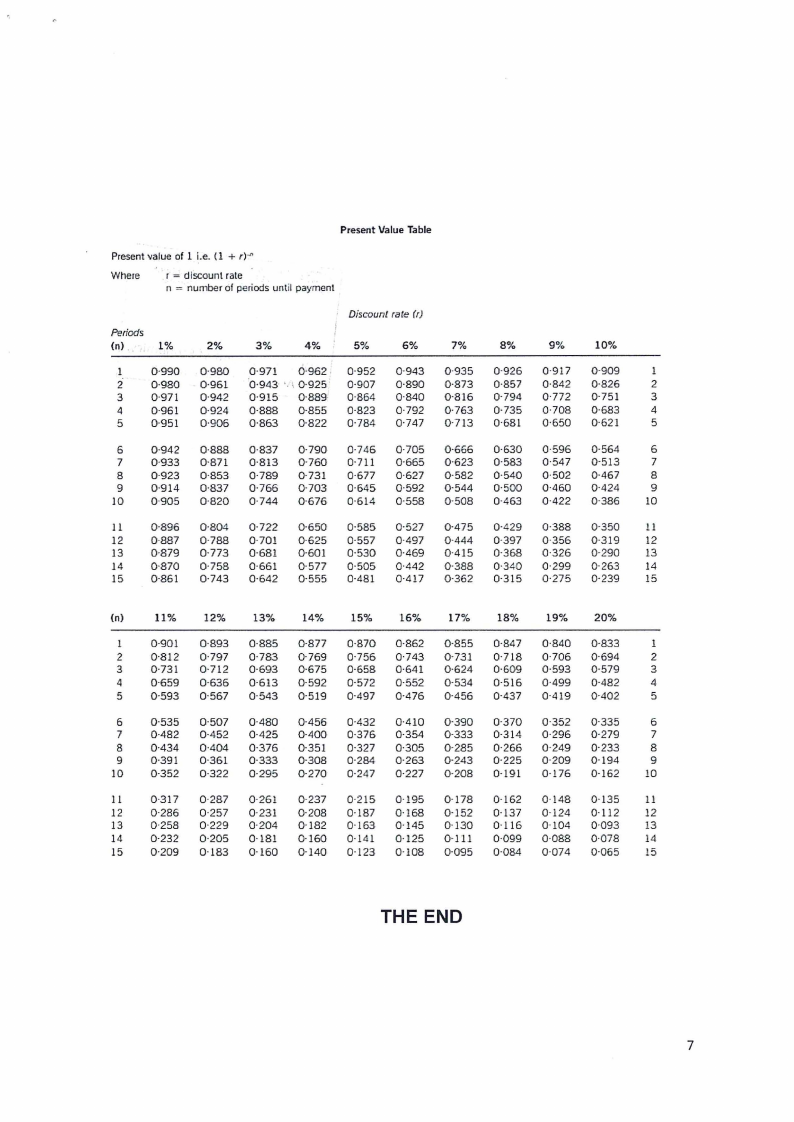
Present Value Table
Present value of 1 i.e. (1 + r)-"
Where
r = discount rate
n = number of periods until payment
Discount rate (rJ
Periods
(n) ..
1%
2%
3%
4%
5%
6%
7%
8%
9%
10%
1
0·990 0·980 0·971 0·962 0·952 0·943 0·935 0·926 0·917 0·909
1
2
0·980 0·961 ·o-943· ·. \\ 0-925 0·907 0·890 0·873 0·857 0·842 0·826
2
3
0·971 0·942 0·915 0·889 0·864 0·840 0·816 0·794 0·772 0·751
3
4
0·961 0·924 0·888 0·855 0·823 0·792 0·763 0·735 0·708 0·683
4
5
0·951 0·906 0·863 0·822 0·784 0·747 0·713 0·681 0·650 0·621
5
6
0·942 0·888 0·837 0·790 0·746 0·705 0·666 0·630 0·596 0·564
6
7
0·933 0·871 0·813 0·760 0·711 0·665 0·623 0·583 0·547 0·513
7
8
0·923 0·853 0·789 0·731 0·677 0·627 0·582 0·540 0·502 0·467
8
9
0·914 0·837 0·766 0·703 0·645 0·592 0·544 0·500 0·460 0·424
9
10
0·905 0·820 0·744 0·676 0·614 0·558 0·508 0·463 0·422 0·386
10
Il
0·896 0·804 0·722 0·650 0·585 0·527 0·475 0·429 0·388 0·350
11
12
0·887 0·788 0·70! 0·625 0·557 0·497 0·444 0·397 0·356 0·319
12
13
0·879 0·773 0·681 0·601 0·530 0-469 0·415 0·368 0·326 0·290
13
14
0·870 0·758 0·661 0·577 0·505 0·442 0·388 0·340 0·299 0·263
14
15
0·861 0·743 0·642 0·555 0·481 0-417 0·362 0·315 0·275 0·239
15
(n)
11%
12%
13%
14%
15%
16%
17%
18%
19%
20%
1 0·901 0·893 0·885 0·877 0·870 0·862 0·855 0·847 0·840 0·833
I
2
0·812 0·797 0·783 0·769 0·756 0·743 0·731 0·718 0·706 0·694
2
3
0·731 0·712 0·693 0·675 0·658 0·641 0·624 0·609 0·593 0·579
3
4
0·659 0·636 0·613 0·592 0·572 0·552 0·534 0·516 0-499 0·482
4
5
0·593 0·567 0·543 0·519 0·497 0·476 0·456 0·437 0·419 0·402
5
6
0·535 0·507 0·480 0·456 0·432 0-410 0·390 0·370 0352
0·335
6
7
0-482 0·452 0·425 0·400 0·376 0·354 0·333 0·314 0·296 0·279
7
8
0·434 0·404 0·376 0·351 0·327 0·305 0·285 0·266 0·249 0·233
8
9
0·391 0·361 0·333 0·308 0·284 0·263 0·243 0·225 0·209 0·194
9
10
0·352 0·322 0·295 0·270 0·247 0·227 0·208 0·191 0·176 0·162
!O
II
0·317 0·287 0·261 0·237 0·215 0·195 0·178 0·162 0·!48 0·135
l!
12
0·286 0·257 0·231 0·208 0·187 0·168 0·152 0·137 0·124 0·112
12
13
0·258 0·229 0·204 0·182 0·163 0·145 0·130 0· 116 0·104 0·093
13
14
0·232 0·205 0· 18! 0·160 0· 141 0·125 0·111 0·099 0·088 0·078
14
15
0·209 0·183 0·!60 0·140 0·123 0·108 0·095 0·084 0·074 0·065
15
THE END
7