ISM520S - INTRODUCTION TO MAPPING - 1ST OPP - NOV 2025


ISM520S - INTRODUCTION TO MAPPING - 1ST OPP - NOV 2025


1 Pages 1-10

▲back to top


1.1 Page 1

▲back to top


e
nAmlBIA UnlVERSITY
OF SCI En CE Ano TECH n OLOGY
FACULTY OF ENGINEERING AND THE BUILT ENVIRONMENT
DEPARTMENT OF LAND AND SPATIAL SCIENCES
QUALIFICATION: BACHELOR OF QUANTITY SURVEYING, BACHELOR OF GEOINFORMATION TECHNOLOGY,
BACHELOR OF LAND ADMINISTRATION, BACHELOR OF ARCHITECTURE, BACHELOR OF REG IONAL AND
URBAN PLANNING, BACHELOR OF REGIONAL AND RURAL DEVELOPMENT
QUALIFICATION CODE: 07BQOS, 07BGEI, LEVEL: 5
07BLAM, 07BARC, 07BURP, 07BROR
COURSE:
INTRODUCTION TO
SURVEY AND MAPPING
COURSE CODE: ISM520S
SESSION: NOVEMBER 2025
PAPER:
THEORY
DURATION: 3 HOURS
MARKS:
100
FIRST OPPORTUNITY EXAMINATION QUESTION PAPER
EXAMINERS: Ms D. Husselmann and Mr D. Varges
MODERATOR: Mr F. Louw
THIS QUESTION PAPER CONSISTS OF 11 PAGES (Including this front page)
INSTRUCTIONS
1. Answer ALL the questions.
2. Write clearly and neatly.
3. Number the answers clearly.
4 . Answers to calculations must be rounded off to three decimal places, excluding
answers to co-ordinate conve~sions
PERMISSIBLE MATERIALS
1. Calculators and other drawing equipment

1.2 Page 2

▲back to top


Introduction to Survey and Mapping
Question 1
ISM520S
Answer the following questions by selecting the correct statement for each:
(10)
1.1. The position of a point may be determined by a variety of methods. Which of these
methods uses angles to determine the position of a point?
a. Triangulation
b. Trilateration
c. Polar
d. Traverses
1.2. Which of the following instruments are used to determine they and x position of a
point accurately?
a. Level
b. Measuring tape
c. Theodolite
d. Total station
1.3. Which of these levels read a bar-coded staff using electronic laser methods?
a. Dumpy level
b. Automatic level
c. Tilting level
d. Digital level
1.4.
Projection panels for the Namibian LO co-ordinate system is _ _ __ wide.
a. 1 degrees
b. 2 degrees
c. 3 degrees
d. 4 degrees
1.5.
One of these corrections are applied to both electronic measured and taped
distances:
a. Slope Corrections
b. Standard Tension
c. Converstion to German legal Meter
d. Standard Temperature
First Opportunity Question Paper
Page 2 of 11
November 2025

1.3 Page 3

▲back to top


Introduction to Survey and Mapping
ISM520S
1.6. Which of these is a method used to determine the horizontal distance and direction?
a. Polar
b. Join
c. Traverses
d. Trilateration
1.7. A traverse that starts and ends at the same known point is known as a:
a. Link traverse
b. Loop traverse
c. Open traverse
d. Normal traverse
1.8. Which of these describes setting out?
a. Transferring positional values from plans to the ground
b. Transferring positional values from ground to plans
c. Determining positional values using survey software
d. Comparing measured and calculated values
1.9. GNSS stands for:
a. Global Navigation Space Satellites
b. Global Navigation Space Systems
c. Geographic Navigation Satellite Systems
d. Global Navigation Satellite Systems
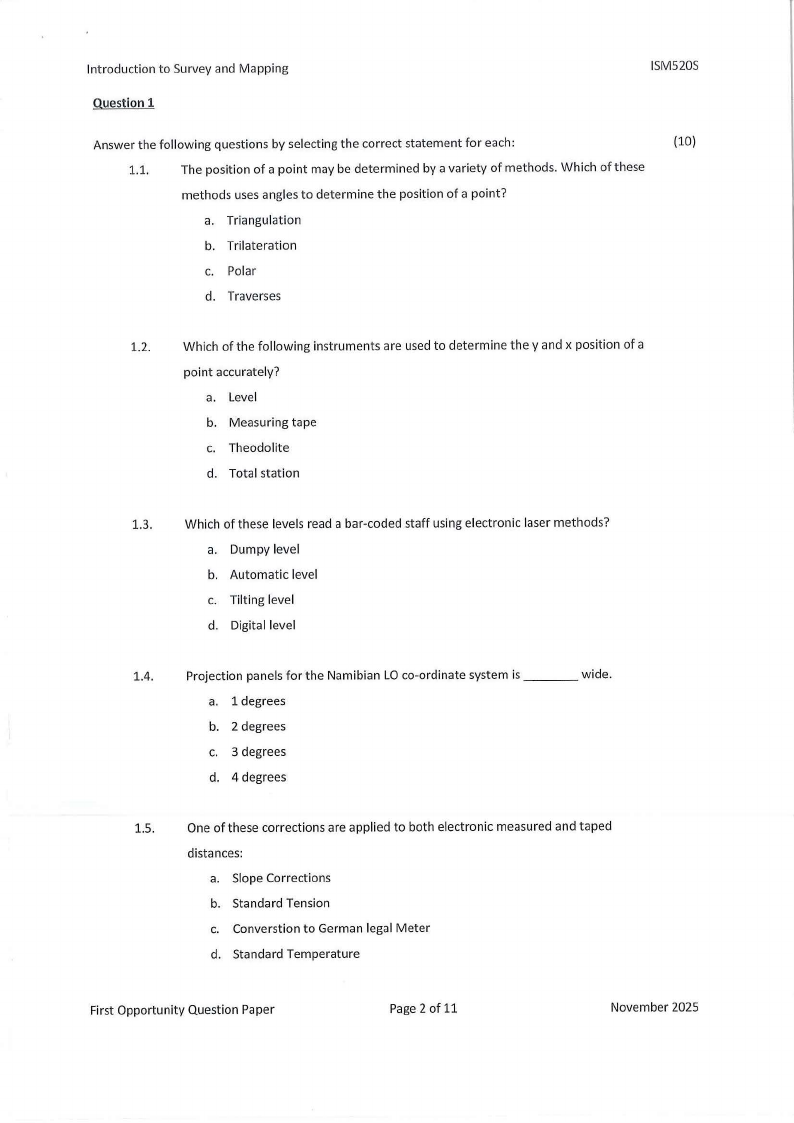
1.10. The picture below represents which natural feature?
~
First Opportunity Question Paper
Page 3 of 11
November 2025

1.4 Page 4

▲back to top


Introduction to Survey and Mapping
a. Ridge
b. Valley
c. Vertical cliff
d. Pond
Question 2
2.1. What do the following acronyms stand for?
ISM520S
(10]
(3)
a. RTK
b. MSL
c. EDM
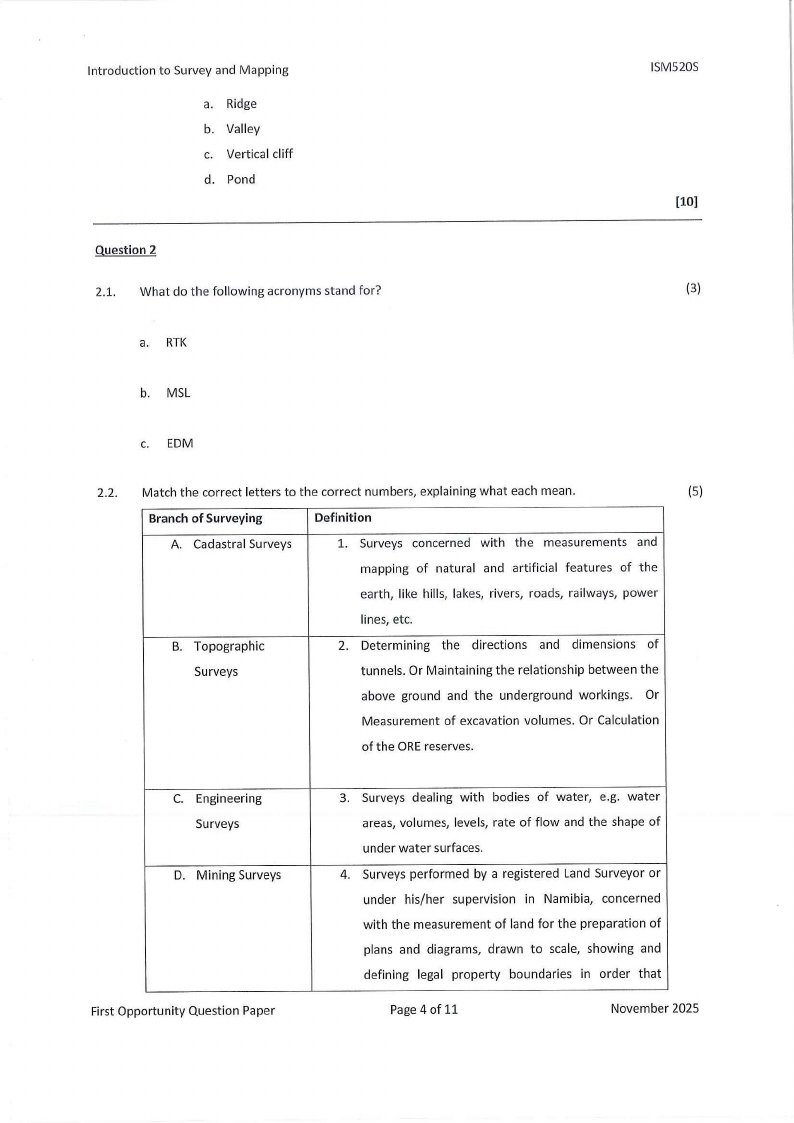
2.2. Match the correct letters to the correct numbers, explaining what each mean.
(5)
Branch of Surveying
Definition
A. Cadastral Surveys
1. Surveys concerned with the measurements and
mapping of natural and artificial features of the
earth, like hills, lakes, rivers, roads, railways, power
lines, etc.
B. Topographic
2. Determining the directions and dimensions of
Surveys
tunnels. Or Maintaining the relationship between the
above ground and the underground workings. Or
Measurement of excavation volumes. Or Calculation
of the ORE reserves.
C. Engineering
Surveys
D. Mining Surveys
First Opportunity Question Paper
3. Surveys dealing with bodies of water, e.g. water
areas, volumes, levels, rate of flow and the shape of
under water surfaces.
4. Surveys performed by a registered Land Surveyor or
under his/her supervision in Namibia, concerned
with the measurement of land for the preparation of
plans and diagrams, drawn to scale, showing and
defining legal property boundaries in order that
Page 4 of 11
November 2025

1.5 Page 5

▲back to top


Introduction to Survey and Mapping
E. Hydrographical
Surveys
ISM520S
ownership may be registered in the Deeds Office.
5. Surveys concerned with the planning, design and
placing of pegs in the field of engineering works, such
as roads, railways, dams, canals, tunnels, services in
townships, etc.
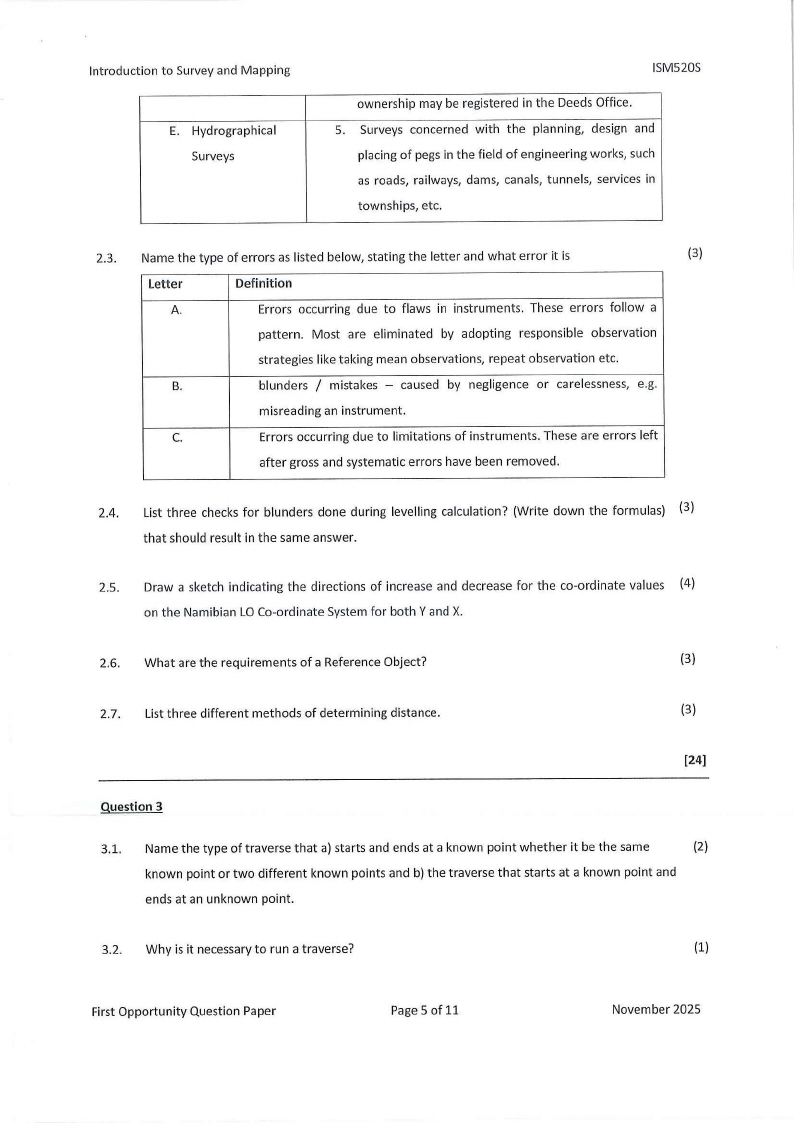
2.3. Name the type of errors as listed below, stating the letter and what error it is
(3)
Letter
Definition
A.
Errors occurring due to flaws in instruments. These errors follow a
pattern. Most are eliminated by adopting responsible observation
strategies like taking mean observations, repeat observation etc.
B.
blunders / mistakes - caused by negligence or carelessness, e.g.
misreading an instrument.
C.
Errors occurring due to limitations of instruments. These are errors left
after gross and systematic errors have been removed.
2.4. List three checks for blunders done during levelling calculation? (Write down the formulas) (3)
that should result in the same answer.
2.5. Draw a sketch indicating the directions of increase and decrease for the co-ordinate values (4)
on the Namibian LO Co-ordinate System for both Y and X.
2.6. What are the requirements of a Reference Object?
(3)
2.7. List three different methods of determining distance.
(3)
[24)
Question 3
3.1. Name the type of traverse that a) starts and ends at a known point whether it be the same
(2)
known point or two different known points and b) the traverse that starts at a known point and
ends at an unknown point.
3.2. Why is it necessary to run a traverse?
(1)
First Opportunity Question Paper
Page 5 of 11
November 2025

1.6 Page 6

▲back to top


Introduction to Survey and Mapping
ISM520S
3.3. Complete the sentence: To check the accuracy of your traverse, you need to end your traverse (1)
at a ____ point.
3.4. Draw a table to differentiate between horizontal setting out and vertical setting out.
(2)
3.5. What is the most accurate method for vertical setting out?
(1)
3.6. List two advantages and two disadvantages of using a GNSS.
(4)
(5)
3.7. Briefly describe ANY FIVE characteristics of Contours.
[16)
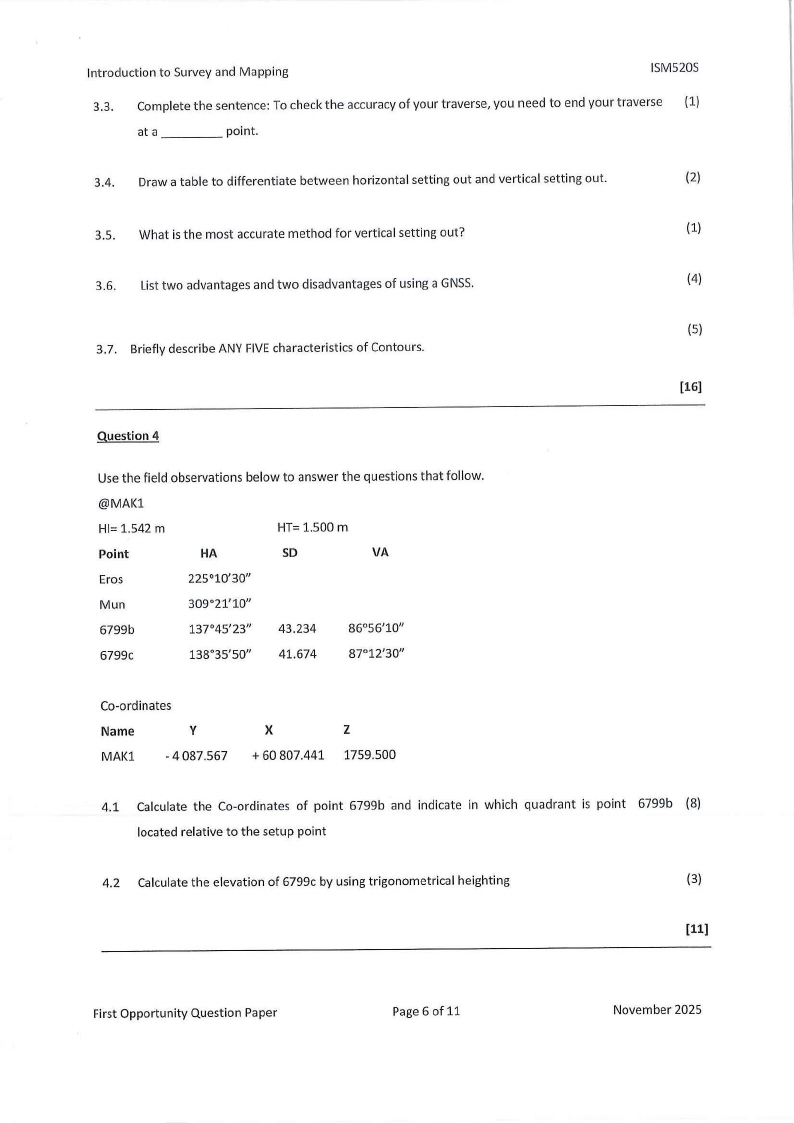
Question 4
Use the field observations below to answer the questions that follow.
@MAKl
HI= 1.542 m
HT= 1.500 m
Point
HA
SD
VA
Eros
225°10'30"
Mun
309°21'10"
6799b
137°45'23" 43.234
86°56'10"
6799c
138°35'50" 41.674
87°12'30"
Co-ordinates
Name
V
MAKl -4 087.567
X
Z
+ 60 807.441 1759.500
4.1 Calculate the Co-ordinates of point 6799b and indicate in which quadrant is point 6799b (8)
located relative to the setup point
4.2 Calculate the elevation of 6799c by using trigonometrical heighting
(3)
[11)
First Opportunity Question Paper
Page 6 of 11
November 2025

1.7 Page 7

▲back to top


Introduction to Survey and Mapping
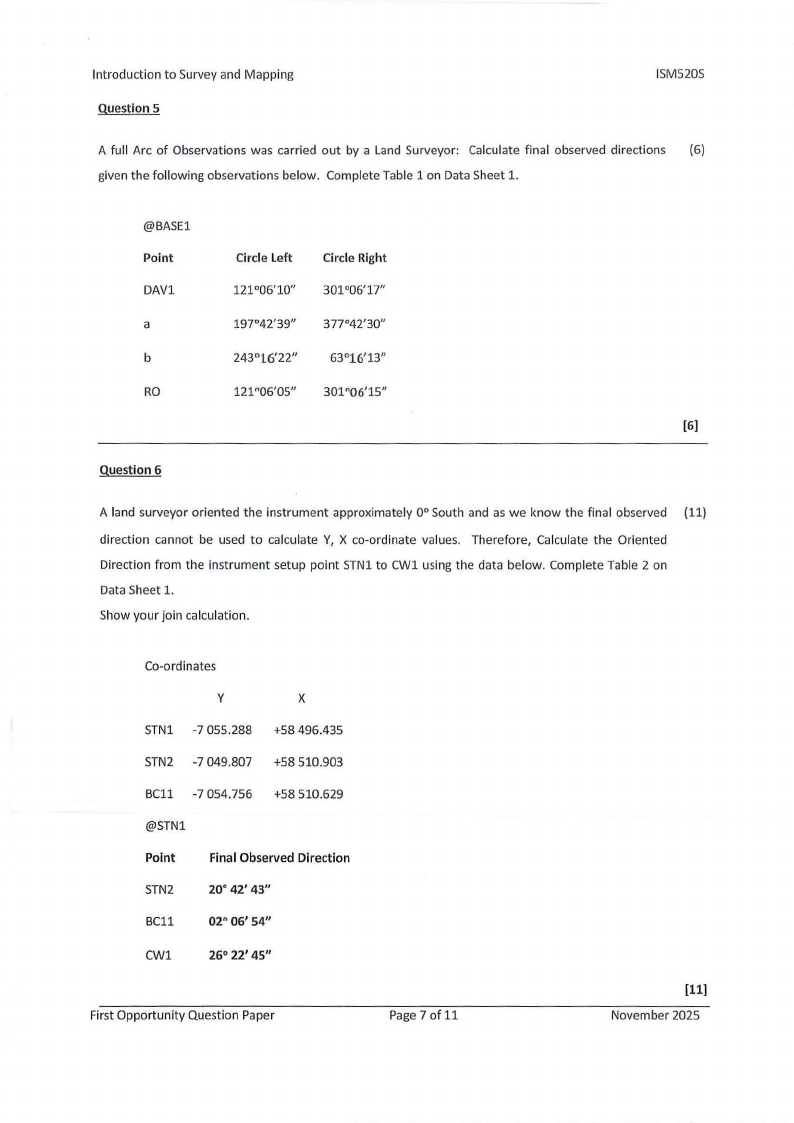
Question 5
ISM520S
A full Arc of Observations was carried out by a Land Surveyor: Calculate fina l observed directions (6)
given th e following observations below. Complete Table 1 on Data Sheet 1.
@BASEl
Point
DAVl
Circle Left
121°06'10"
Circle Right
301 °06'17"
a
197°42'39" 377°42'30"
b
243°16'22"
63°16'13"
RO
121"06'05" 301"06'15"
(6)
Question 6
A land surveyor oriented the instrument approximately South and as we know the fin al observed (11)
direction ca nnot be used to calculate Y, X co-ordinate values. Therefore, Calculate the Oriented
Direction from the instrument setup point STNl to CWl using t he data below. Complete Table 2 on
Data Sheet 1.
Show your join calculation.
Co-ordinates
y
X
STNl -7 055.288 +58 496.435
STN2 -7 049.807 +58 510.903
BC11 -7 054.756 +58 510.629
@STNl
Point
Final Observed Direction
STN2
20° 42' 43"
BC11
02" 06' 54"
CWl
26° 22' 45"
First Opportunity Question Paper
Page 7 of 11
(11)
November 2025

1.8 Page 8

▲back to top


Introduction to Survey and M apping
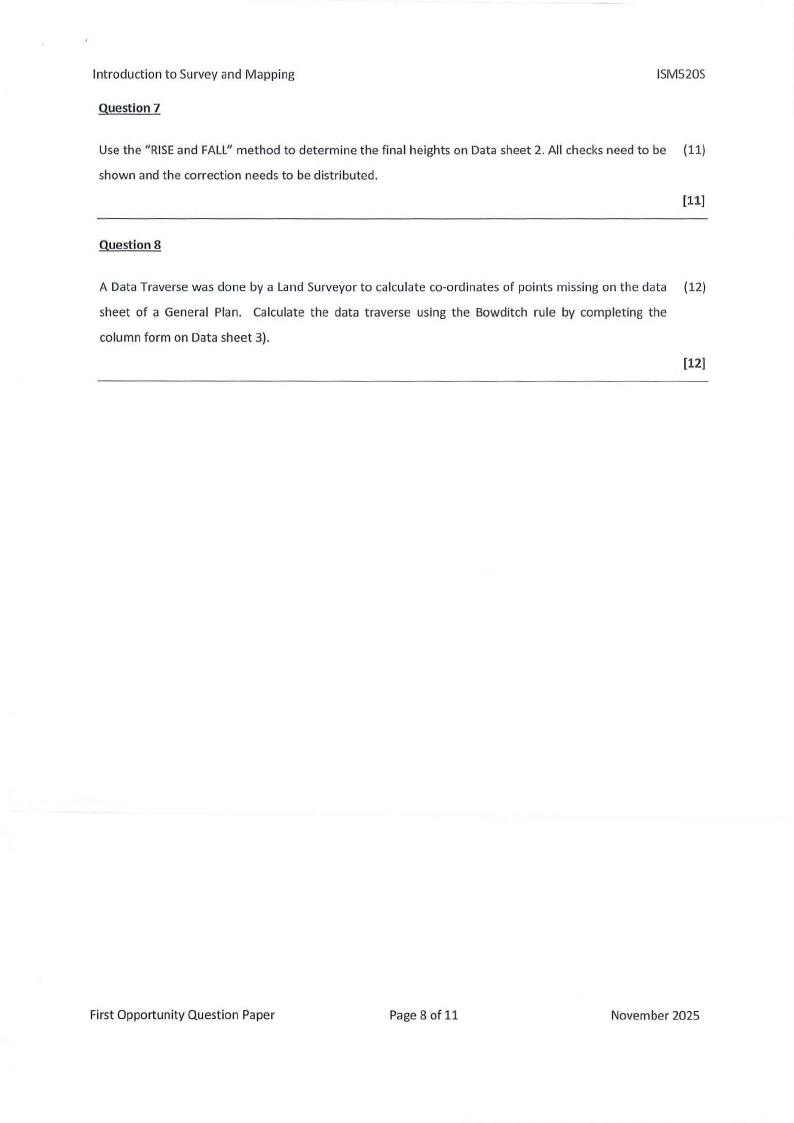
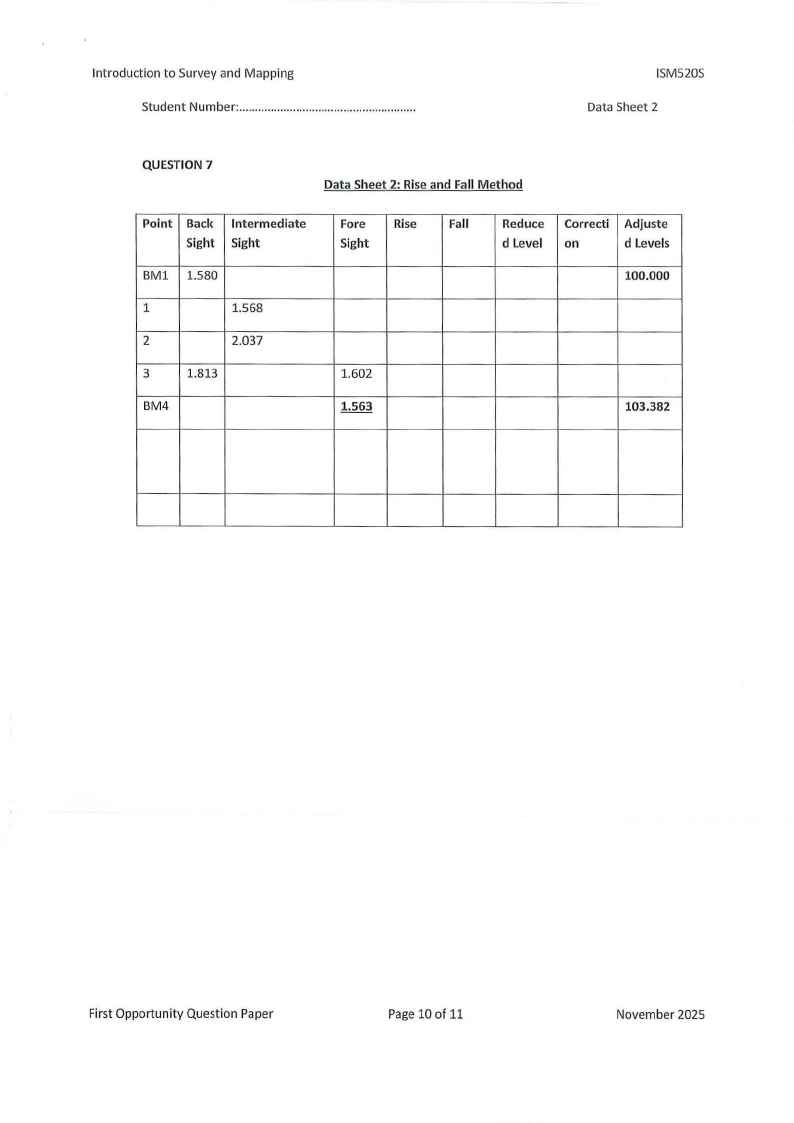
Question 7
ISMS20S
Use the " RISE and FALL" method to determine the final heights on Data sheet 2. All checks need to be (11)
shown and the correction needs to be distributed.
[11]
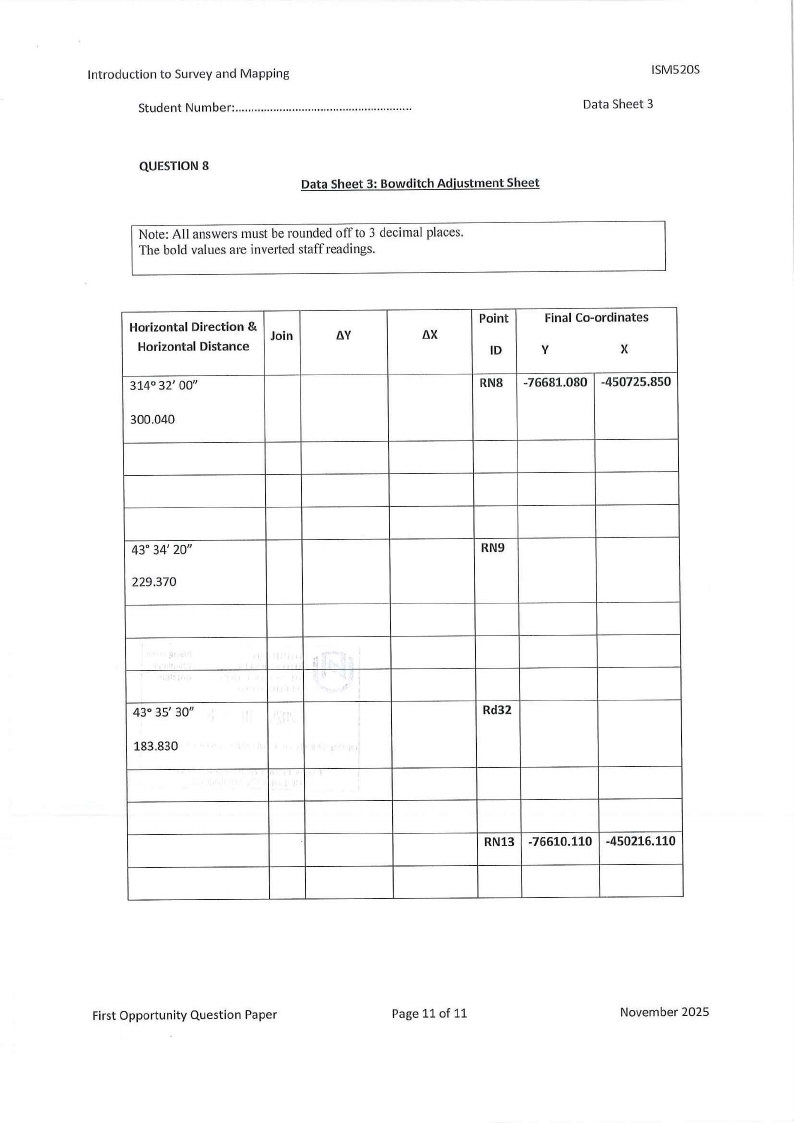
Question 8
A Data Traverse was done by a Land Surveyor to calculate co-ordinates of points missing on th e data (12)
sheet of a General Plan. Calculate the data traverse using the Bowditch rule by completing the
column form on Data sheet 3).
[12]
First Opportunity Question Paper
Page 8 of 11
November 2025

1.9 Page 9

▲back to top


Introduction to Survey and Mapping
Student Number:........................................................
ISM520S
Datasheetl
QUESTION 5
@BASEl
Point Circle Left
Table 1: Final Observed Direction
Circle Right
Mean
Correction
Final Observed
Direction
DAVl 121"06'10" 301°06'17"
a
197"42'39" 377"42'30"
b
243°16'22" 63°16'13"
RO
121°06'05" 301°06"15"
QUESTION 6
Point
STN2
BCll
CWl
Table 2: Oriented Direction
Final Observed
Direction
Join
20° 42' 43"
02° 06' 30"
26~ 22' 45"
Difference /
Correction
Oriented
Direction
First Opportunity Question Paper
Page 9 of 11
November 2025

1.10 Page 10

▲back to top


Introduction to Survey and M apping
Student Number: ........................................................
ISM520S
Dat a Sheet 2
QUESTION 7
Data Sheet 2: Rise and Fall Method
Point Back Intermediate
Fore Rise
Fall
Reduce Correcti Adjuste
Sight Sight
Sight
d Level on
d Levels
BMl 1.580
100.000
1
1.568
2
2.037
3
1.813
1.602
BM4
1.563
103.382
First Opportunity Question Paper
Page 10 of 11
November 2025

2 Pages 11-20

▲back to top


2.1 Page 11

▲back to top


Introduction to Survey and Mapping
Student Number: ........................................................
ISM520S
Data Sheet 3
QUESTION 8
Data Sheet 3 : Bowditch Adjustment Sheet
Note: All answers must be rounded off to 3 decimal places.
The bold values are inverted staff readings.
Horizontal Direction &
Join
6V
Horizontal Distance
314° 32' 00"
300.040
Point
Final Co-ordinates
6X
ID
y
X
RN8 -76681.080 -450725.850
43° 34' 20"
RN9
229 .370
43° 35' 30"
183.830
Rd32
RN13 -76610.110 -450216.110
First Opportunity Question Paper
Page 11 of 11
November 2025