


 |
IPP521S - INTRODUCTION TO PHONETICS AND PHONOLOGY - 2ND OPP - DECEMBER 2025 |
|
|
1 Page 1 |
▲back to top |
nAmlBIA unlVERSITY
OF SCIEnCE Ano TECHnOLOGY
FACULTY OF COMMERCE, HUMAN SCIENCES AND EDUCATION
DEPARTMENT OF COMMUNICATION AND LANGUAGES
QUALIFICATION: BACHELOR OF ENGLISH AND LINGUISTICS
QUALIFICATION CODE: (07BENL)
LEVEL: 5
COURSE CODE: IPP521S
COURSE NAME: Introduction to Phonetics and Phonology
SESSION: DECEMBER 2025
TIME :
3 HOURS
PAPER : THEORY
MARKS: 100
EXAMINER(S)
SECOND OPPORTUNITY EXAMINATION PAPER
Dr Sylvia N lthindi
Dr Hambeleleni Hamunyela
MODERATOR: Dr Anneli Nghikembua
INSTRUCTIONS
1. Answer ALL the questions.
2. Read all the questions carefully before answering.
3. Number the answers clearly
THIS QUESTION PAPER CONSISTS OF 4 PAGES, INCLUDING THE COVER PAGE
1
|
|
2 Page 2 |
▲back to top |
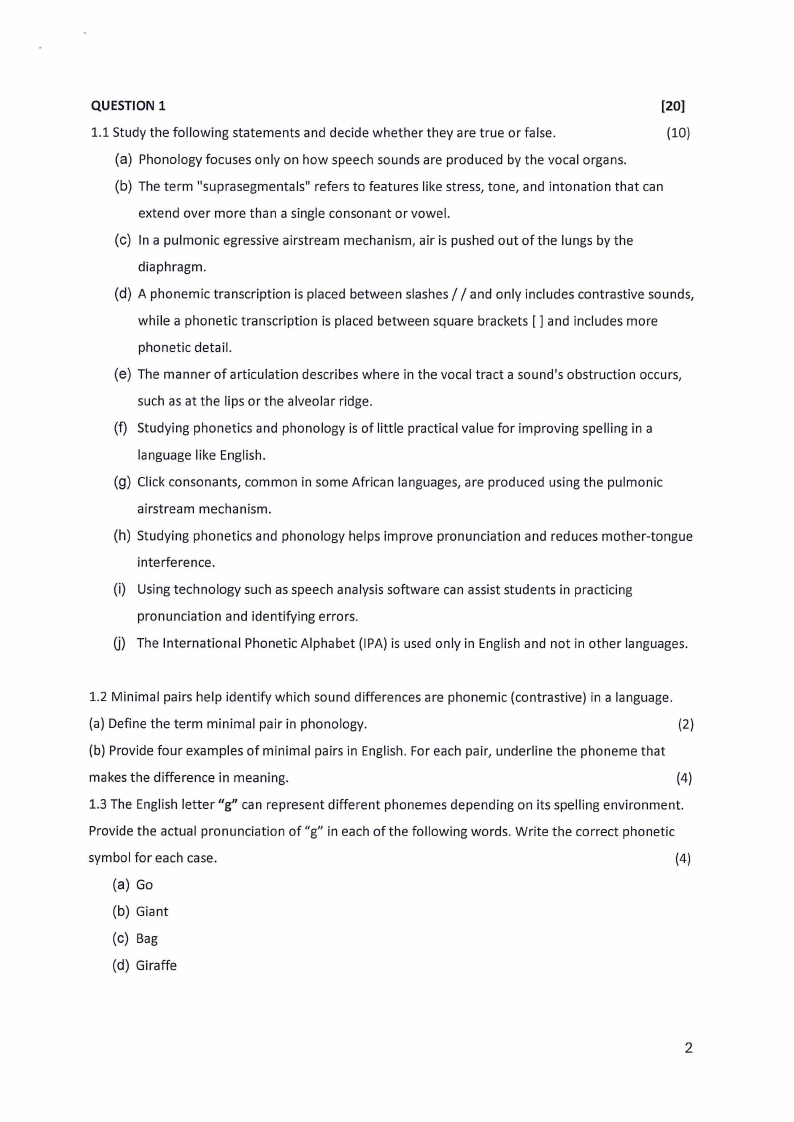
QUESTION 1
[20]
1.1 Study the following statements and decide whether they are true or false.
(10)
(a) Phonology focuses only on how speech sounds are produced by the vocal organs.
(b) The term "suprasegmentals" refers to features like stress, tone, and intonation that can
extend over more than a single consonant or vowel.
(c) In a pulmonic egressive airstream mechanism, air is pushed out of the lungs by the
diaphragm.
(d) A phonemic transcription is placed between slashes// and only includes contrastive sounds,
while a phonetic transcription is placed between square brackets [] and includes more
phonetic detail.
(e) The manner of articulation describes where in the vocal tract a sound's obstruction occurs,
such as at the lips or the alveolar ridge.
(f) Studying phonetics and phonology is of little practical value for improving spelling in a
language like English.
(g) Click consonants, common in some African languages, are produced using the pulmonic
airstream mechanism.
(h) Studying phonetics and phonology helps improve pronunciation and reduces mother-tongue
interference .
(i) Using technology such as speech analysis software can assist students in practicing
pronunciation and identifying errors.
U) The International Phonetic Alphabet (IPA) is used only in English and not in other languages.
1.2 Minimal pairs help identify which sound differences are phonemic (contrastive) in a language .
(a) Define the term minimal pair in phonology.
(2)
(b) Provide four examples of minimal pairs in English . For each pair, underline the phoneme that
makes the difference in meaning.
(4)
1.3 The English letter "g" can represent different phonemes depending on its spelling environment.
Provide the actual pronunciation of "g" in each of the following words. Write the correct phonetic
symbol for each case.
(4)
(a) Go
(b) Giant
(c) Bag
(d) Giraffe
2
|
|
3 Page 3 |
▲back to top |
r
QUESTION 2
[20]
2.1 The fields of Phonetics and Phonology are very significant both to the study and acquisition of
various languages. Discuss how phonetics and phonology can be used by people as discussed in this
course.
(10)
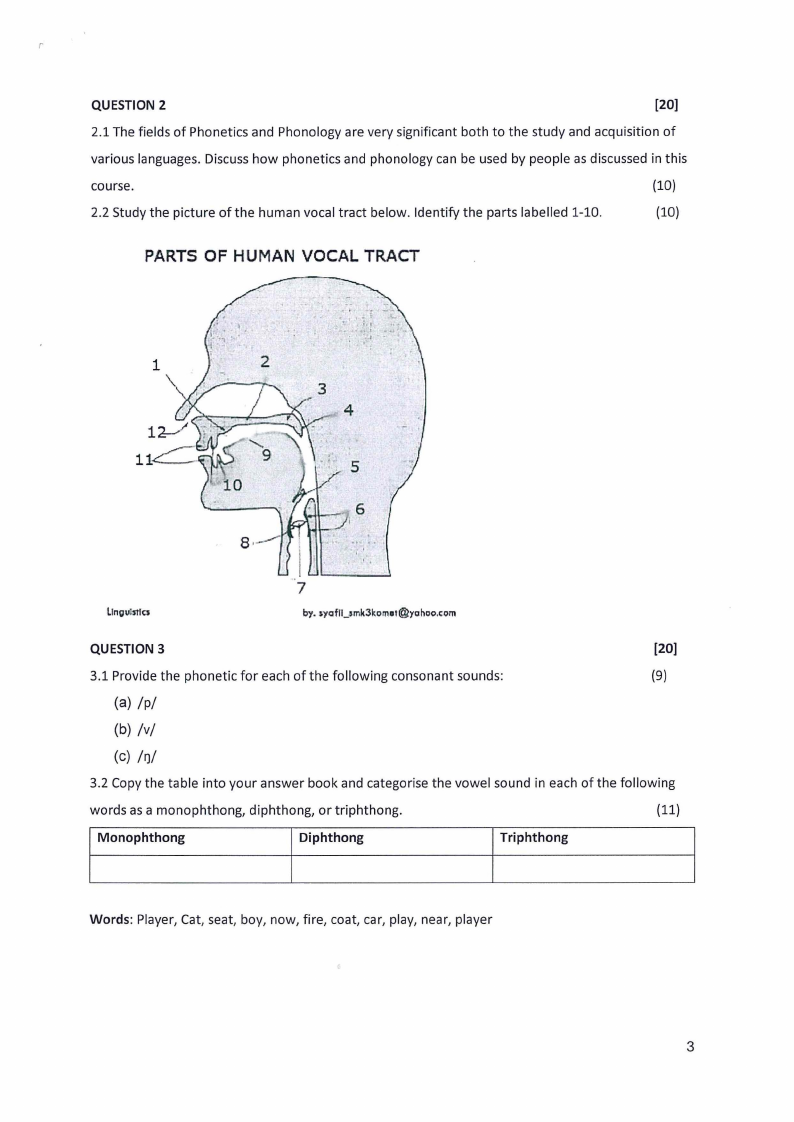
2.2 Study the picture of the human vocal tract below. Identify the parts labelled 1-10.
(10)
PARTS OF HUMAN VOCAL TRACT
lingvmfg
7
by. $yafnJmk3k.o m.•1@yohoo.~orn
QUESTION 3
[20]
3.1 Provide the phonetic for each of the following consonant sounds:
(9)
(a) /p/
(b) /v/
(c) /rJ/
3.2 Copy the table into your answer book and categorise the vowel sound in each of the following
words as a monophthong, diphthong, or triphthong.
(11)
I Monophthong
I Diphthong
I Triphthong
Words: Player, Cat, seat, boy, now, fire, coat, car, play, near, player
3
|
|
4 Page 4 |
▲back to top |
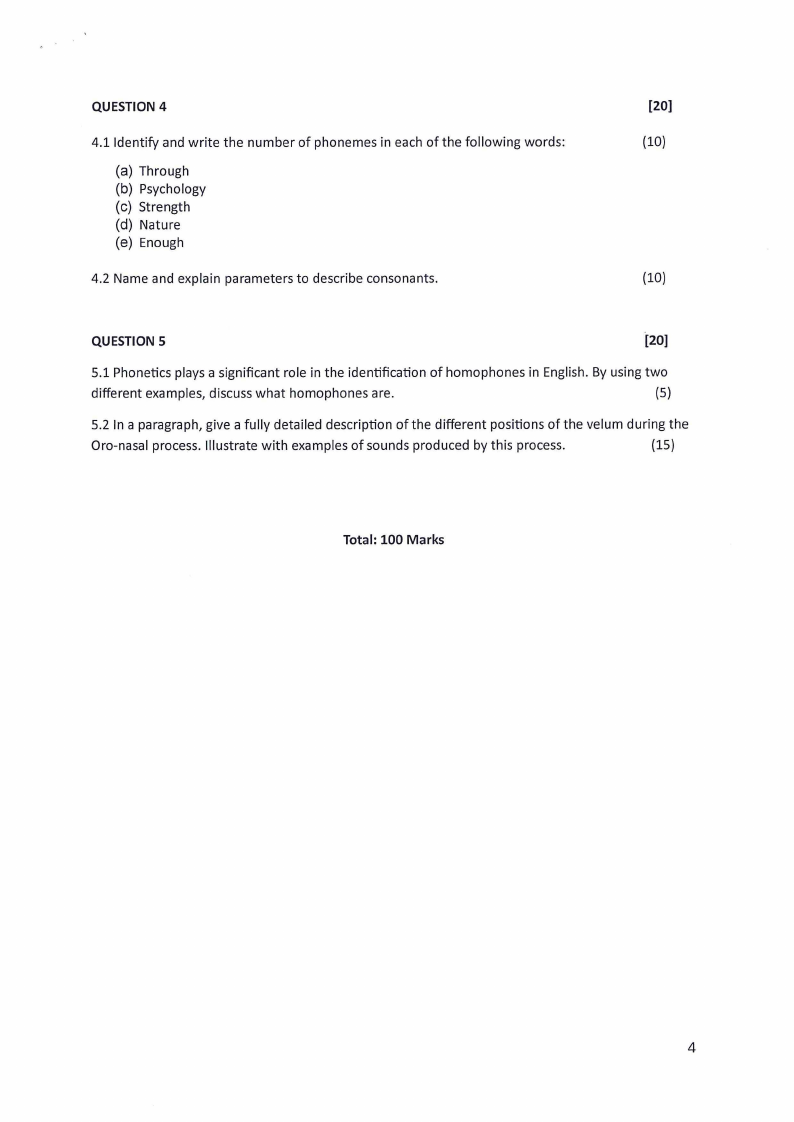
QUESTION 4
4.1 Identify and write the number of phonemes in each of the following words:
(a) Through
(b) Psychology
(c) Strength
(d) Nature
(e) Enough
4.2 Name and explain parameters to describe consonants.
[20]
(10)
(10)
QUESTION 5
[20]
5.1 Phonetics plays a significant role in the identification of homophones in English. By using two
different examples, discuss what homophones are.
(5)
5.2 In a paragraph, give a fully detailed description of the different positions of the velum during the
Oro-nasal process. Illustrate with examples of sounds produced by this process.
(15)
Total: 100 Marks
4