


 |
PLF621S - Policies And legal Framework For Public Procurement Management - 1st Opp - Nov 2025 |
|
|
1 Page 1 |
▲back to top |
n Am I BI A u n I VE Rs ITY
OF SCIEnCE Ano TECHnOLOGY
FACULTY OF COMMERCE, HUMAN SCIENCES AND EDUCATION
DEPARTMENT OF MARKETING, LOGISTICS AND SPORTS MANAGEMENT
QUALIFICATION: BACHELOR OF PROCUREMENT & SUPPLY CHAIN MANAGEMENT
QUALIFICATION CODE: 07BPSM
COURSE CODE: PLF621S
LEVEL: 6
COURSE NAME: POLICIES AND LEGAL FRAMEWORK
FOR PUBLIC PROCUREMENT MANAGEMENT
SESSION: NOVEMBER 2025
PAPER: THEORY
DURATION: 3 HOURS
MARKS: 100
FIRST OPPORTUNITY EXAMINATION QUESTION PAPER
EXAMINER(S)
MODERATOR:
MS. SELMA KAM BONDE (FT)
MS. PAULINA SHINANA (FT/PM)
MR. TANGI NEPOLO (DI)
MR. PUIS SHIFETA (EF/ED)
MR. HILMA NUUYANDJA
INSTRUCTIONS
1. Answer ALL the questions.
2. Write clearly and neatly.
3. Number the answers.
4. Pay attention to the mark allocation when formulating your answers.
THIS EXAMINATION QUESTION PAPER CONSISTS OF 5 PAGES (Including this front page)
1
|
|
2 Page 2 |
▲back to top |
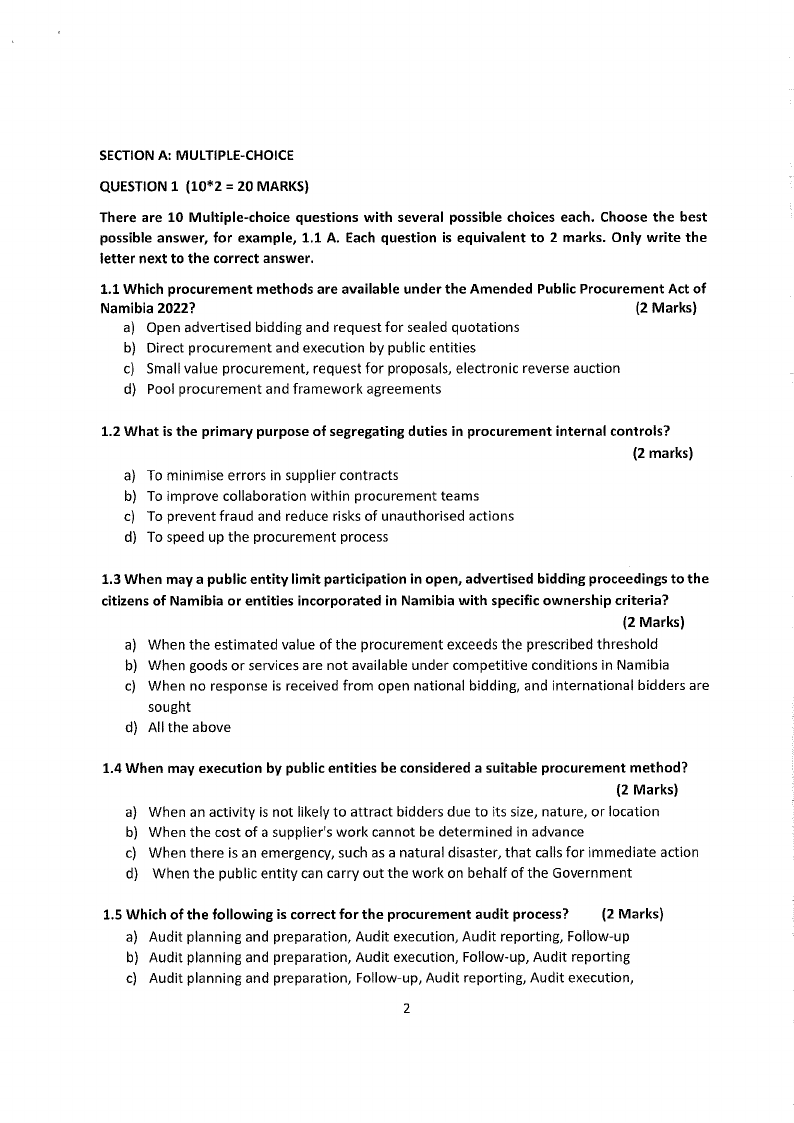
SECTION A: MULTIPLE-CHOICE
QUESTION 1 (10*2 = 20 MARKS)
There are 10 Multiple-choice questions with several possible choices each. Choose the best
possible answer, for example, 1.1 A. Each question is equivalent to 2 marks. Only write the
letter next to the correct answer.
1.1 Which procurement methods are available under the Amended Public Procurement Act of
Namibia 2022?
(2 Marks)
a) Open advertised bidding and request for sealed quotations
b) Direct procurement and execution by public entities
c) Small value procurement, request for proposals, electronic reverse auction
d) Pool procurement and framework agreements
1.2 What is the primary purpose of segregating duties in procurement internal controls?
(2 marks)
a) To minimise errors in supplier contracts
b) To improve collaboration within procurement teams
c) To prevent fraud and reduce risks of unauthorised actions
d) To speed up the procurement process
1.3 When may a public entity limit participation in open, advertised bidding proceedings to the
citizens of Namibia or entities incorporated in Namibia with specific ownership criteria?
(2 Marks)
a) When the estimated value of the procurement exceeds the prescribed threshold
b) When goods or services are not available under competitive conditions in Namibia
c) When no response is received from open national bidding, and international bidders are
sought
d) All the above
1.4 When may execution by public entities be considered a suitable procurement method?
(2 Marks)
a) When an activity is not likely to attract bidders due to its size, nature, or location
b) When the cost of a supplier's work cannot be determined in advance
c) When there is an emergency, such as a natural disaster, that calls for immediate action
d) When the public entity can carry out the work on behalf of the Government
1.5 Which of the following is correct for the procurement audit process? (2 Marks)
a) Audit planning and preparation, Audit execution, Audit reporting, Follow-up
b) Audit planning and preparation, Audit execution, Follow-up, Audit reporting
c) Audit planning and preparation, Follow-up, Audit reporting, Audit execution,
2
|
|
3 Page 3 |
▲back to top |
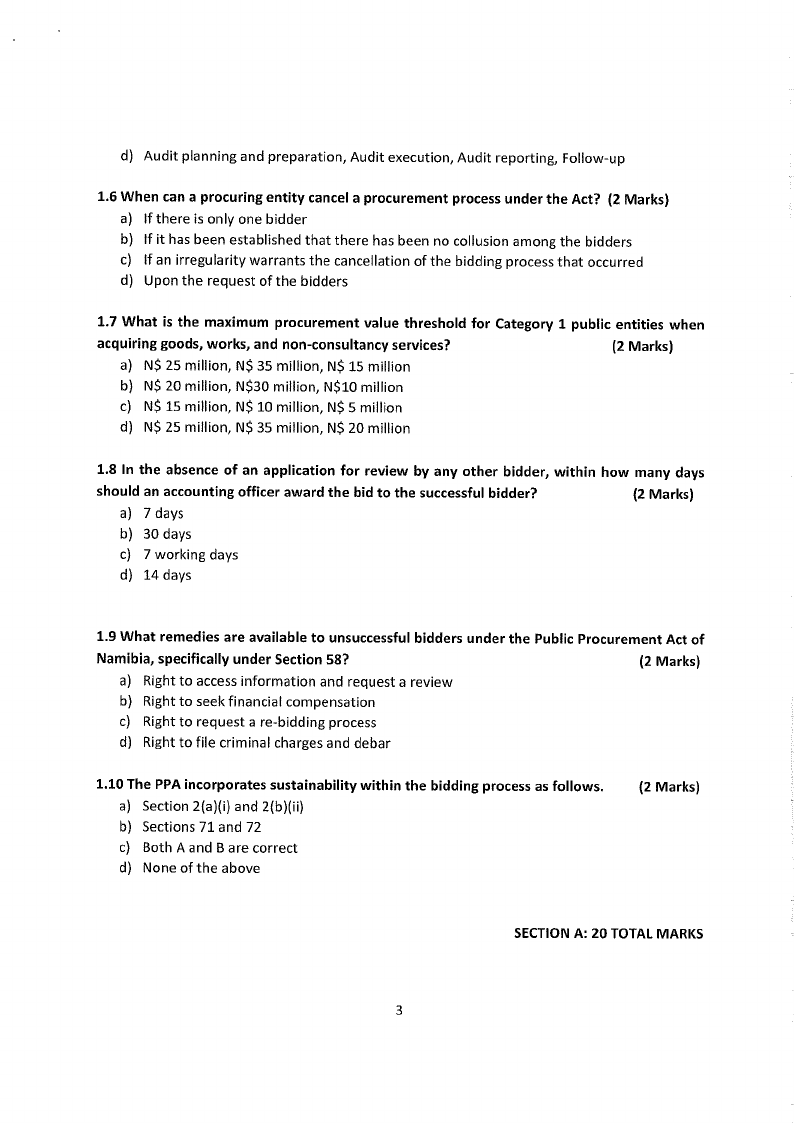
d) Audit planning and preparation, Audit execution, Audit reporting, Follow-up
1.6 When can a procuring entity cancel a procurement process under the Act? (2 Marks)
a) If there is only one bidder
b) If it has been established that there has been no collusion among the bidders
c) If an irregularity warrants the cancellation of the bidding process that occurred
d) Upon the request of the bidders
1.7 What is the maximum procurement value threshold for Category 1 public entities when
acquiring goods, works, and non-consultancy services?
(2 Marks)
a) N$ 25 million, N$ 35 million, N$ 15 million
b) N$ 20 million, N$30 million, N$10 million
c) N$ 15 million, N$ 10 million, N$ 5 million
d) N$ 25 million, N$ 35 million, N$ 20 million
1.8 In the absence of an application for review by any other bidder, within how many days
should an accounting officer award the bid to the successful bidder?
(2 Marks)
a) 7 days
b) 30 days
c) 7 working days
d) 14 days
1.9 What remedies are available to unsuccessful bidders under the Public Procurement Act of
Namibia, specifically under Section S8?
(2 Marks)
a) Right to access information and request a review
b) Right to seek financial compensation
c) Right to request a re-bidding process
d) Right to file criminal charges and debar
1.10 The PPA incorporates sustainability within the bidding process as follows.
a) Section 2(a)(i) and 2(b)(ii)
b) Sections 71 and 72
c) Both A and Bare correct
d) None of the above
(2 Marks)
SECTION A: 20 TOTAL MARKS
3
|
|
4 Page 4 |
▲back to top |
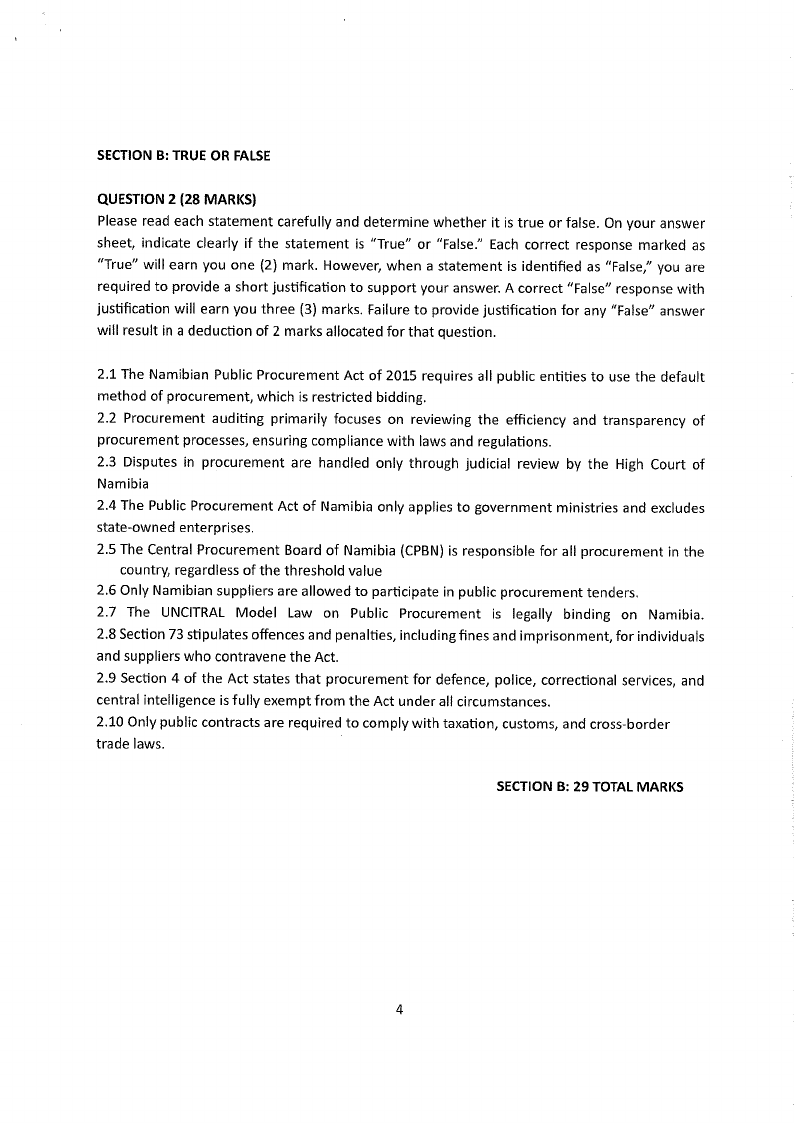
SECTION B: TRUE OR FALSE
QUESTION 2 (28 MARKS)
Please read each statement carefully and determine whether it is true or false. On your answer
sheet, indicate clearly if the statement is "True" or "False." Each correct response marked as
"True" will earn you one (2) mark. However, when a statement is identified as "False," you are
required to provide a short justification to support your answer. A correct "False" response with
justification will earn you three (3) marks. Failure to provide justification for any "False" answer
will result in a deduction of 2 marks allocated for that question.
2.1 The Namibian Public Procurement Act of 2015 requires all public entities to use the default
method of procurement, which is restricted bidding.
2.2 Procurement auditing primarily focuses on reviewing the efficiency and transparency of
procurement processes, ensuring compliance with laws and regulations.
2.3 Disputes in procurement are handled only through judicial review by the High Court of
Namibia
2.4 The Public Procurement Act of Namibia only applies to government ministries and excludes
state-owned enterprises.
2.5 The Central Procurement Board of Namibia (CPBN) is responsible for all procurement in the
country, regardless of the threshold value
2.6 Only Namibian suppliers are allowed to participate in public procurement tenders.
2.7 The UNCITRAL Model Law on Public Procurement is legally binding on Namibia.
2.8 Section 73 stipulates offences and penalties, including fines and imprisonment, for individuals
and suppliers who contravene the Act.
2.9 Section 4 of the Act states that procurement for defence, police, correctional services, and
central intelligence is fully exempt from the Act under all circumstances.
2.10 Only public contracts are required to comply with taxation, customs, and cross-border
trade laws.
SECTION B: 29 TOTAL MARKS
4
|
|
5 Page 5 |
▲back to top |
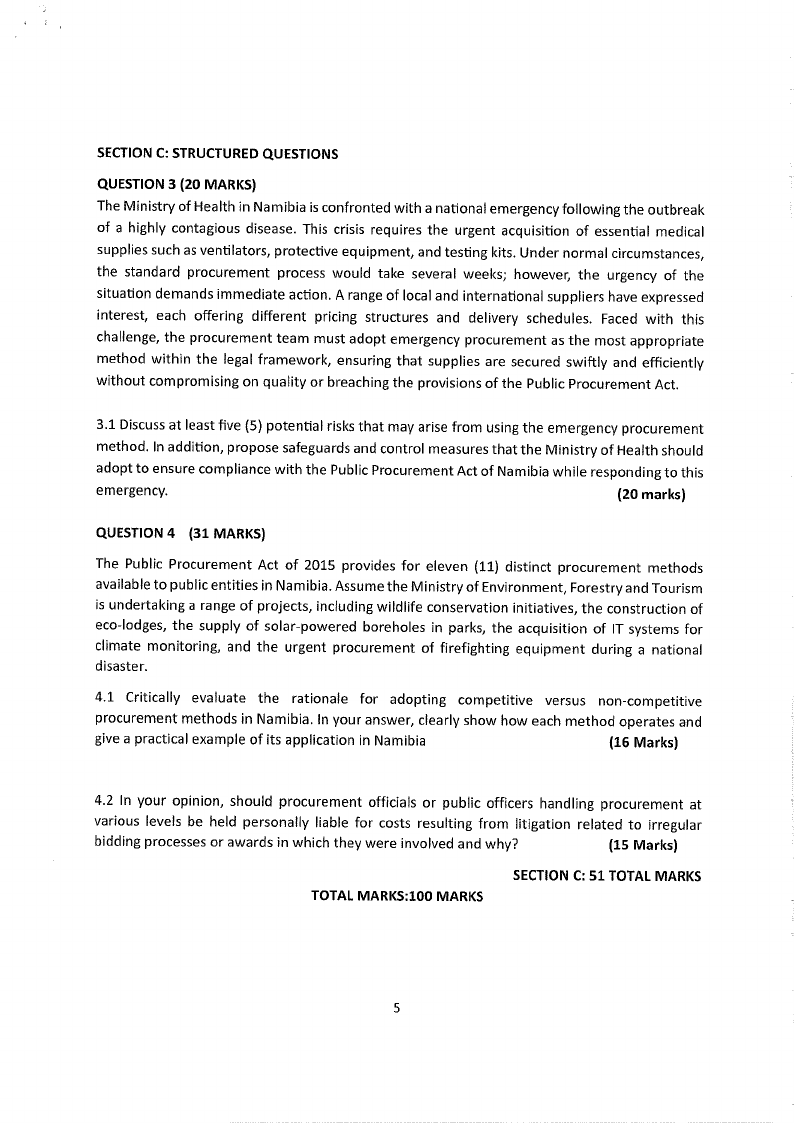
SECTION C: STRUCTURED QUESTIONS
QUESTION 3 (20 MARKS)
The Ministry of Health in Namibia is confronted with a national emergency following the outbreak
of a highly contagious disease. This crisis requires the urgent acquisition of essential medical
supplies such as ventilators, protective equipment, and testing kits. Under normal circumstances,
the standard procurement process would take several weeks; however, the urgency of the
situation demands immediate action. A range of local and international suppliers have expressed
interest, each offering different pricing structures and delivery schedules. Faced with this
challenge, the procurement team must adopt emergency procurement as the most appropriate
method within the legal framework, ensuring that supplies are secured swiftly and efficiently
without compromising on quality or breaching the provisions of the Public Procurement Act.
3.1 Discuss at least five (5) potential risks that may arise from using the emergency procurement
method. In addition, propose safeguards and control measures that the Ministry of Health should
adopt to ensure compliance with the Public Procurement Act of Namibia while responding to this
emergency.
(20 marks)
QUESTION 4 (31 MARKS)
The Public Procurement Act of 2015 provides for eleven (11) distinct procurement methods
available to public entities in Namibia. Assume the Ministry of Environment, Forestry and Tourism
is undertaking a range of projects, including wildlife conservation initiatives, the construction of
eco-lodges, the supply of solar-powered boreholes in parks, the acquisition of IT systems for
climate monitoring, and the urgent procurement of firefighting equipment during a national
disaster.
4.1 Critically evaluate the rationale for adopting competitive versus non-competitive
procurement methods in Namibia. In your answer, clearly show how each method operates and
give a practical example of its application in Namibia
(16 Marks)
4.2 In your opinion, should procurement officials or public officers handling procurement at
various levels be held personally liable for costs resulting from litigation related to irregular
bidding processes or awards in which they were involved and why?
(15 Marks)
TOTAL MARKS:100 MARKS
SECTION C: 51 TOTAL MARKS
5