


 |
BNS511S-BIOLOGY FOR NATURAL SCIENCES-1ST OPP- JUNE 2025 |
|
|
1 Page 1 |
▲back to top |
nAmlBIA unlVERSITY
OF SCIEnCE Ano TECHnOLOGY
FACULTYOF HEALTH,NATURALRESOURCESAND APPLIEDSCIENCES
DEPARTMENTOF NATURALRESOURCESCIENCES
QUALIFICATION: BACHELOROF NATURALRESOURCEMANAGEMENT
QUALIFICATION CODE: 07BNRS
LEVEL: 7
COURSECODE: BNSSllS
COURSENAME: Biology for Natural Sciences
SESSION:JUNE 2025
DURATION: 3 HOURS
PAPER:THEORY(PAPER1)
MARKS: 120
FIRSTOPPORTUNITYEXAMINATION QUESTION PAPER
EXAMINER(S) Mrs. G.L. THERON
MODERATOR: Mr. H TJIKURUNDA
INSTRUCTIONS
1. Answer ALL the questions.
2. Read all the questions carefully before answering.
3. Number the answers clearly
THIS QUESTION PAPERCONSISTSOF _5_ PAGES(Including this front page)
1
|
|
2 Page 2 |
▲back to top |
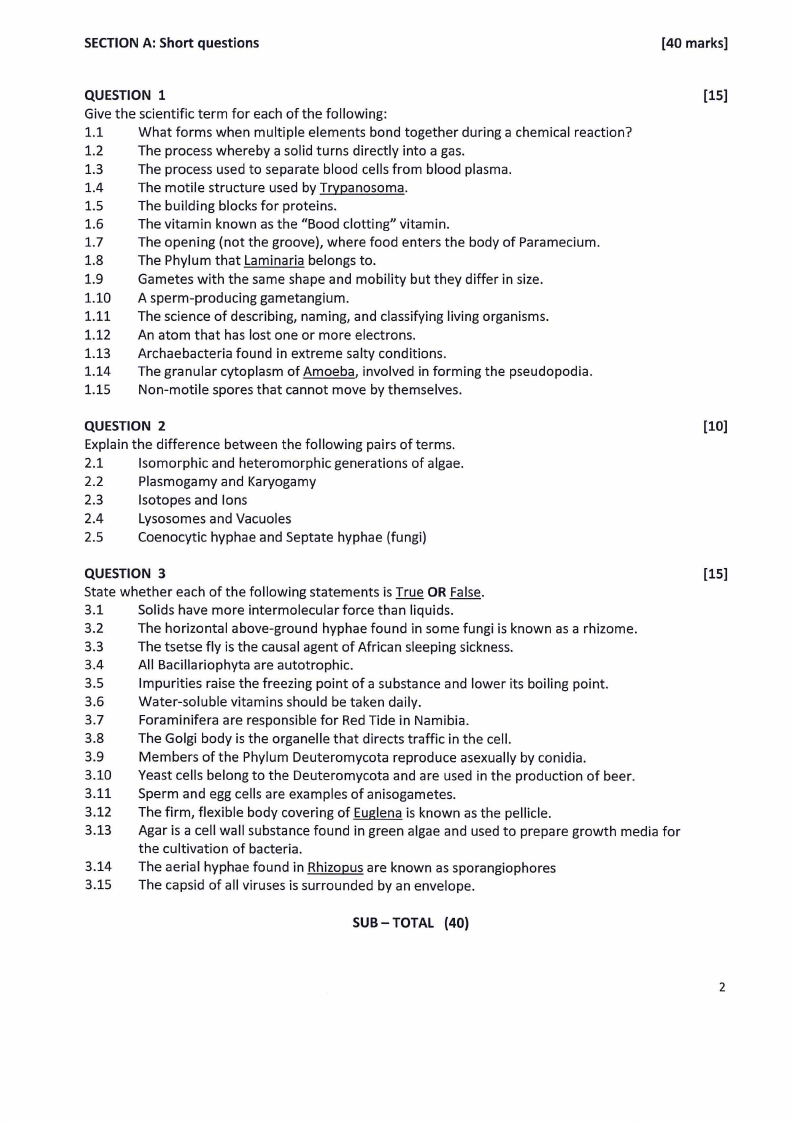
SECTION A: Short questions
[40 marks]
QUESTION 1
[15]
Give the scientific term for each of the following:
1.1
What forms when multiple elements bond together during a chemical reaction?
1.2
The process whereby a solid turns directly into a gas.
1.3
The process used to separate blood cells from blood plasma.
1.4
The motile structure used by Trypanosoma.
1.5
The building blocks for proteins.
1.6
The vitamin known as the "Sood clotting" vitamin.
1.7
The opening (not the groove), where food enters the body of Paramecium.
1.8
The Phylum that Laminaria belongs to.
1.9
Gametes with the same shape and mobility but they differ in size.
1.10 A sperm-producing gametangium.
1.11 The science of describing, naming, and classifying living organisms.
1.12 An atom that has lost one or more electrons.
1.13 Archaebacteria found in extreme salty conditions.
1.14 The granular cytoplasm of Amoeba, involved in forming the pseudopodia.
1.15 Non-motile spores that cannot move by themselves.
QUESTION 2
[10]
Explain the difference between the following pairs of terms.
2.1
Isomorphic and heteromorphic generations of algae.
2.2
Plasmogamy and Karyogamy
2.3
Isotopes and Ions
2.4
Lysosomes and Vacuoles
2.5
Coenocytic hyphae and Septate hyphae (fungi)
QUESTION 3
[15]
State whether each of the following statements is True OR False.
3.1
Solids have more intermolecular force than liquids.
3.2
The horizontal above-ground hyphae found in some fungi is known as a rhizome.
3.3
The tsetse fly is the causal agent of African sleeping sickness.
3.4
All Bacillariophyta are autotrophic.
3.5
Impurities raise the freezing point of a substance and lower its boiling point.
3.6
Water-soluble vitamins should be taken daily.
3.7
Foraminifera are responsible for Red Tide in Namibia.
3.8
The Golgi body is the organelle that directs traffic in the cell.
3.9
Members of the Phylum Deuteromycota reproduce asexually by conidia.
3.10 Yeast cells belong to the Deuteromycota and are used in the production of beer.
3.11 Sperm and egg cells are examples of anisogametes.
3.12 The firm, flexible body covering of Euglena is known as the pellicle.
3.13 Agar is a cell wall substance found in green algae and used to prepare growth media for
the cultivation of bacteria.
3.14 The aerial hyphae found in Rhizopus are known as sporangiophores
3.15 The capsid of all viruses is surrounded by an envelope.
SUB- TOTAL (40)
2
|
|
3 Page 3 |
▲back to top |

SECTION B: Longer questions
[80 marks]
QUESTION 4
[15]
4.1
For each of the following sentences, choose the correct term from the two options
(underlined) given. Write down ONLY the numbers 4.1.1- 4.1.4 and the correct term
next to each letter. Do NOT re-write the sentences.
(4)
4.1.1 Polyunsaturated fats have multiple double bonds between multiple Oxygens/Carbons in
the molecule.
4.1.2 Simple distillation/Fractional distillation should be used to extract salt from seawater.
4.1.3 A solution containing a lot of solute in a given amount of solvent is known as a
concentrated/saturated solution.
4.1.4 When a banana ripens it is a chemical/physical change that is taking place.
4.2
In what way are elements in the same group on the periodic table similar?
(3)
They have similar chemical properties, have the same number of valence electrons and
will form the same kinds of ions.
4.3
Explain what "Bio-fertilisers" are and provide TWO examples.
(2)
Organisms that enrich the nutrient quality of the soil. Ex. Bacteria, Fungi, Cyanobacteria.
4.4
Explain how we can use our faeces to improve our quality of life. (Biotechnology!)
(4)
Bacteria that naturally occur in the faeces undergo anaerobic fermentation and then
produce Methane gas. The gas can be used in gas stoves to cook our food, it can be
used to produce light for our houses, or used in gas heaters to warm our houses during
winter. (Only how it can be used to improve our quality of life!)
4.5
Explain why you find "holes" in your loaf of bread.
(2)
The yeast in the dough produces carbon dioxide, which makes air pockets in the dough.
The carbon dioxide later escapes from the dough - leaving only the holes behind.
QUESTION 5
[15]
5.1
Provide the correct term for each of the following statements:
(4)
5.1.1 Viruses exist as infectious particles known as .....
5.1.2 Viruses that invade members of the Kingdom Eubacteria.
5.1.3 The group of archaebacteria that live in the deep oceans.
5.1.4 The group of bacteria that feeds by obtaining food from dead organic matter.
5.2
Explain four (4) DIFFERENTways how viruses can be transmitted from one host to
another.
(4)
5.3
Write a report on how bacteria improve/benefit OUR lives. (No ecological benefits!)
(5)
5.4
Bacteria cannot survive in an environment with less than 15-20% moisture. Explain how
we can use this to our advantage.
(2)
QUESTION 6
[10]
6.1
Provide the correct term for each of the following.
(4)
6.1.1 Motile organ(s) of Amoeba.
6.1.2 The infectious stage of members of the Phylum Apicomplexa.
6.1.3 The firm, flexible body covering of Euglena.
6.1.4 The vector for sleeping sickness.
6.2
Compare the "Plankton" Protoctista discussed in class. Re-draw and complete the (6)
following table.
Phylum
Cell-wall component
Unique characteristic
2 flagella
Silica
Foraminifera
3
|
|
4 Page 4 |
▲back to top |
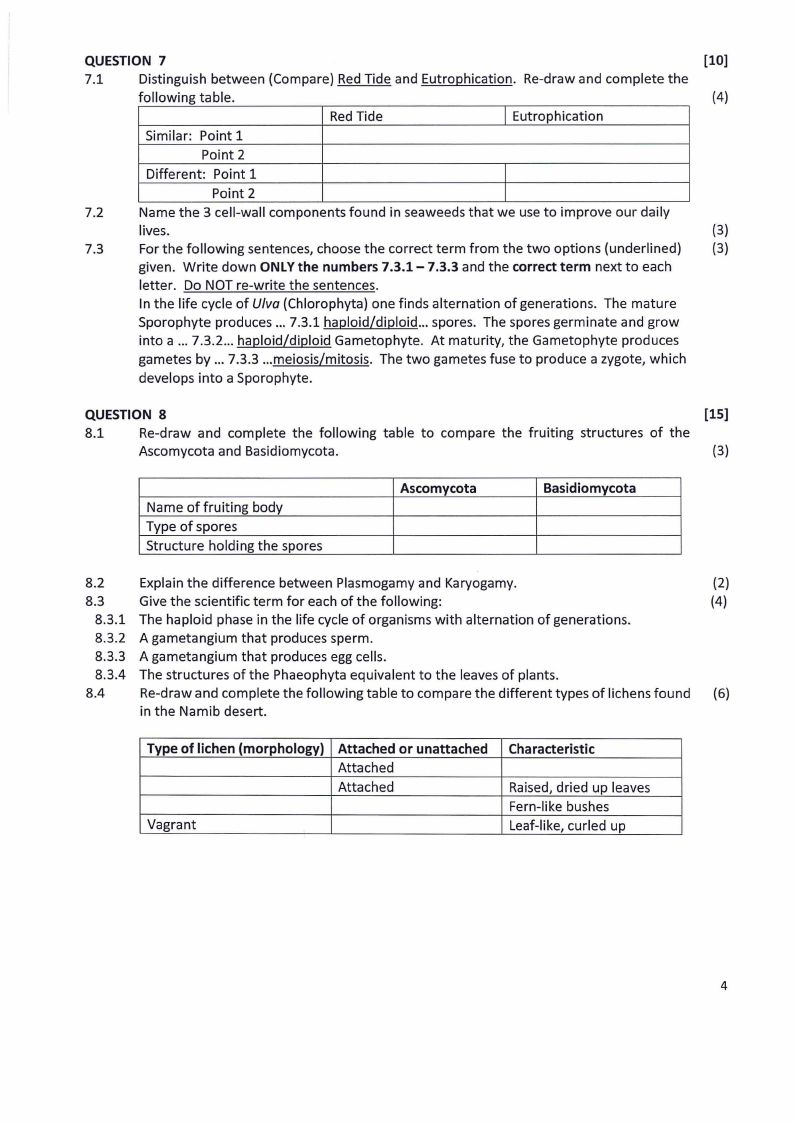
QUESTION 7
(10]
7.1
Distinguish between (Compare) Red Tide and Eutrophication. Re-draw and complete the
following table.
(4)
Red Tide
I Eutrophication
Similar: Point 1
Point 2
Different: Point 1
I
Point 2
I
7.2
Name the 3 cell-wall components found in seaweeds that we use to improve our daily
lives.
(3)
7.3
For the following sentences, choose the correct term from the two options (underlined)
(3)
given. Write down ONLYthe numbers 7.3.1- 7.3.3 and the correct term next to each
letter. Do NOT re-write the sentences.
In the life cycle of Ulva (Chlorophyta) one finds alternation of generations. The mature
Sporophyte produces ... 7.3.1 haploid/diploid ... spores. The spores germinate and grow
into a ... 7.3.2 ... haploid/diploid Gametophyte. At maturity, the Gametophyte produces
gametes by ... 7.3.3 ...meiosis/mitosis. The two gametes fuse to produce a zygote, which
develops into a Sporophyte.
QUESTION 8
(15]
8.1
Re-draw and complete the following table to compare the fruiting structures of the
Ascomycota and Basidiomycota.
(3)
Name of fruiting body
Type of spores
Structure holding the spores
Ascomycota
Basidiomycota
8.2
Explain the difference between Plasmogamy and Karyogamy.
(2)
8.3
Give the scientific term for each of the following:
(4)
8.3.1 The haploid phase in the life cycle of organisms with alternation of generations.
8.3.2 A gametangium that produces sperm.
8.3.3 A gametangium that produces egg cells.
8.3.4 The structures of the Phaeophyta equivalent to the leaves of plants.
8.4
Re-draw and complete the following table to compare the different types of lichens found (6)
in the Namib desert.
Type of lichen (morphology) Attached or unattached
Attached
Attached
Vagrant
Characteristic
Raised, dried up leaves
Fern-like bushes
Leaf-like, curled up
4
|
|
5 Page 5 |
▲back to top |
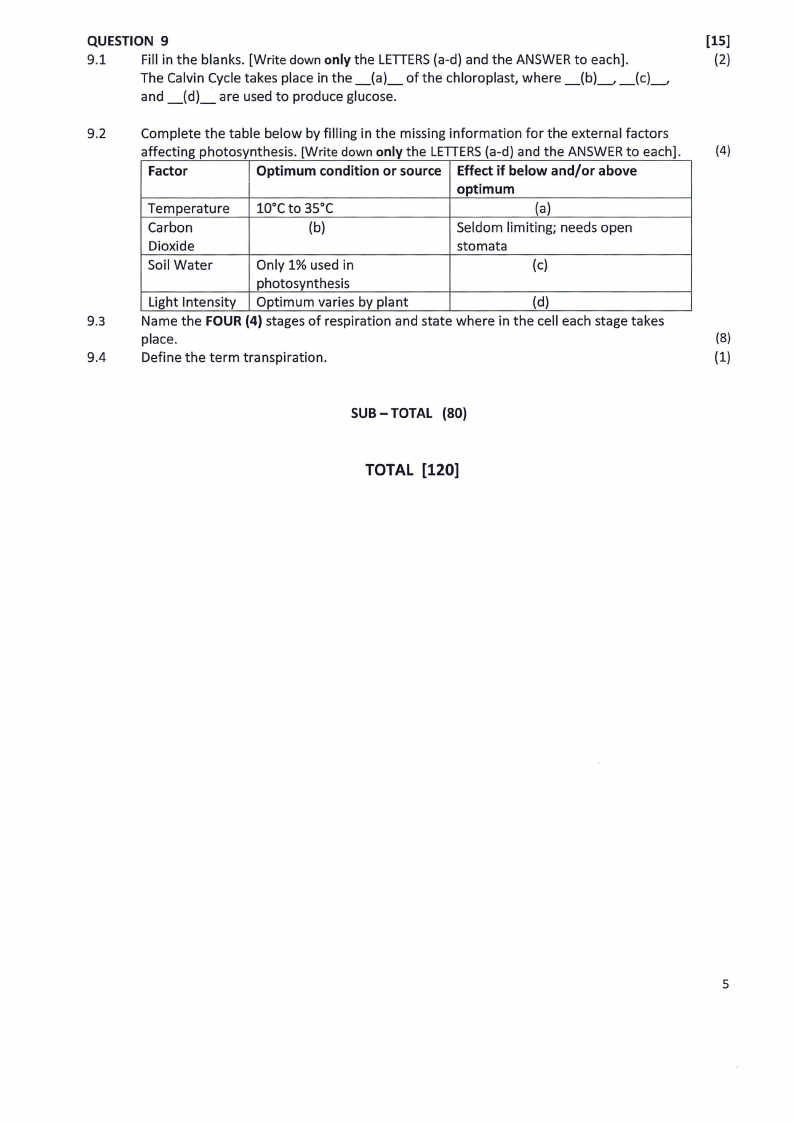
QUESTION 9
[15]
9.1
Fill in the blanks. [Write down only the LETTERS(a-d) and the ANSWERto each].
(2)
The Calvin Cycle takes place in the _(a)_ of the chloroplast, where _(b)_, _(c)_,
and _(d)_ are used to produce glucose.
9.2
Complete the table below by filling in the missing information for the external factors
affecting photosynthesis. [Write down only the LETTERS(a-d) and the ANSWERto each].
(4)
Factor
Optimum condition or source Effect if below and/or above
optimum
Temperature 10°c to 35°C
(a)
Carbon
(b)
Seldom limiting; needs open
Dioxide
stomata
Soil Water
Only 1% used in
(c)
photosynthesis
Light Intensity Optimum varies by plant
(d)
9.3
Name the FOUR (4) stages of respiration and state where in the cell each stage takes
place.
(8)
9.4
Define the term transpiration.
(1)
SUB-TOTAL (80)
TOTAL [120]
5