CHR612S - CONTEMPORARY ISSUES IN HR - 1ST OPP - JUNE 2025


CHR612S - CONTEMPORARY ISSUES IN HR - 1ST OPP - JUNE 2025


1 Pages 1-10

▲back to top


1.1 Page 1

▲back to top


nAmlBIA unlVERSITY
OF SCIEnCE Ano TECHnOLOGY
FACULTY OF COMMERCE, HUMAN SCIENCESAND EDUCATION
DEPARTMENT OF GOVERNANCE AND MANAGEMENT SCIENCES
QUALIFICATION : BACHELOR OF HUMAN RESOURCESMANAGEMENT
QUALIFICATION CODE: 07BHRM
COURSE CODE: CHR612S
DATE: JUNE 2025
LEVEL: 6
COURSE NAME: CONTEMPORARY ISSUES IN HUMAN
RESOURCES
PAPER:1
DURATION: 3 HOURS
MARKS: 100
EXAMINER:
FIRST OPPORTUNITY QUESTION PAPER
Mr. SIMASIKU KAMWI
MODERATOR:
MS. ELAINE ENKALI
INSTRUCTIONS
1. Answer all questions
2. Answer the asked questions
3. Read the case study carefully before attempting questions
4. Write clearly and neatly.
5. Number your answers.
THIS FIRST OPPORTUNITY QUESTION PAPER CONSISTS OF 11 PAGES (Including the cover front
page)

1.2 Page 2

▲back to top


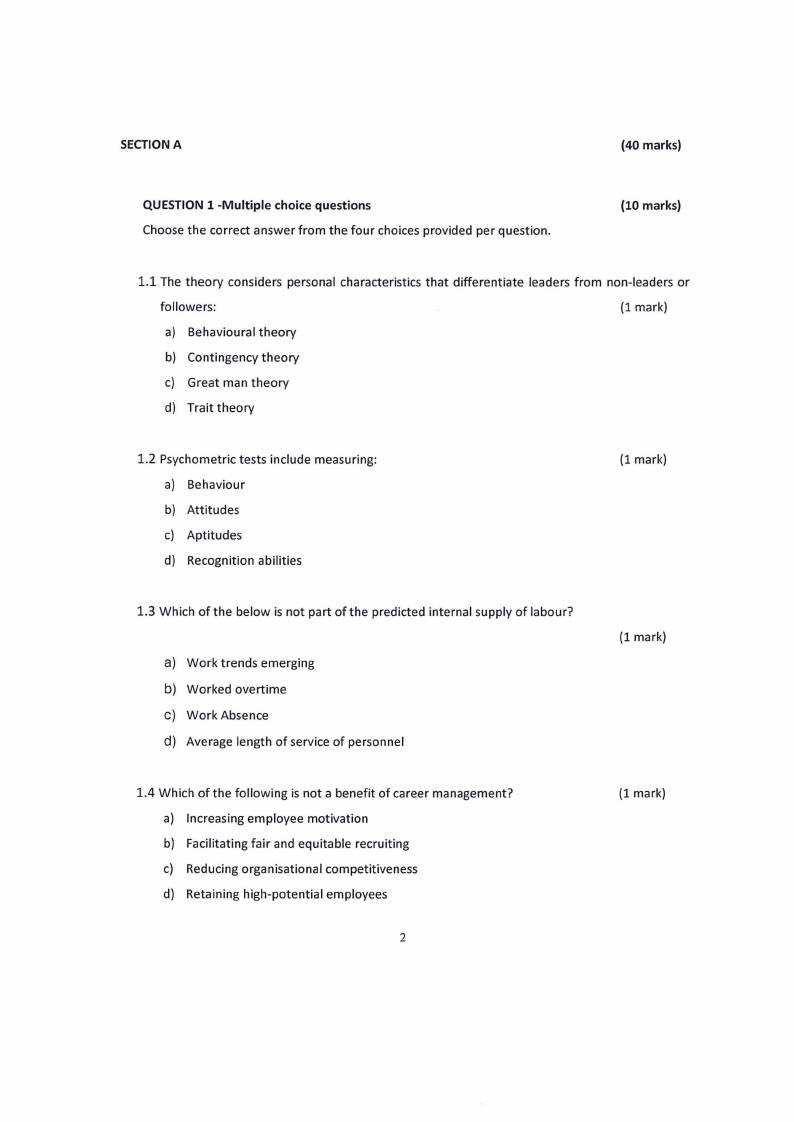
SECTION A
(40 marks)
QUESTION 1 -Multiple choice questions
Choose the correct answer from the four choices provided per question.
(10 marks)
1.1 The theory considers personal characteristics that differentiate leaders from non-leaders or
followers:
(1 mark)
a) Behavioural theory
b) Contingency theory
c) Great man theory
d) Trait theory
1.2 Psychometric tests include measuring:
a) Behaviour
b) Attitudes
c) Aptitudes
d) Recognition abilities
(1 mark)
1.3 Which of the below is not part of the predicted internal supply of labour?
a) Work trends emerging
b) Worked overtime
c) Work Absence
d) Average length of service of personnel
(1 mark)
1.4 Which of the following is not a benefit of career management?
a) Increasing employee motivation
b) Facilitating fair and equitable recruiting
c) Reducing organisational competitiveness
d) Retaining high-potential employees
2
(1 mark)

1.3 Page 3

▲back to top


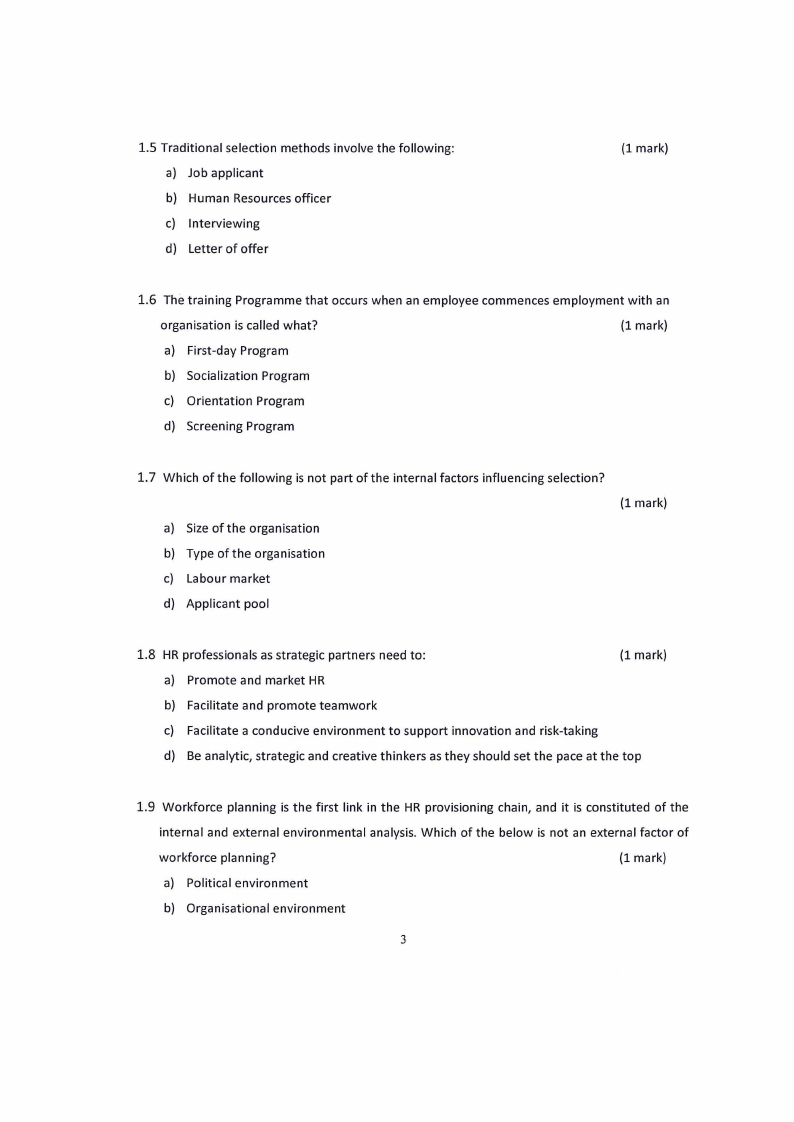
1.5 Traditional selection methods involve the following:
a) Job applicant
b) Human Resources officer
c) Interviewing
d) Letter of offer
(1 mark)
1.6 The training Programme that occurs when an employee commences employment with an
organisation is called what?
(1 mark)
a) First-day Program
b) Socialization Program
c) Orientation Program
d) Screening Program
1.7 Which of the following is not part of the internal factors influencing selection?
a) Size of the organisation
b) Type of the organisation
c) Labour market
d) Applicant pool
(1 mark)
1.8 HR professionals as strategic partners need to:
(1 mark)
a) Promote and market HR
b) Facilitate and promote teamwork
c) Facilitate a conducive environment to support innovation and risk-taking
d) Be analytic, strategic and creative thinkers as they should set the pace at the top
1.9 Workforce planning is the first link in the HR provisioning chain, and it is constituted of the
internal and external environmental analysis. Which of the below is not an external factor of
workforce planning?
(1 mark)
a) Political environment
b) Organisational environment
3

1.4 Page 4

▲back to top


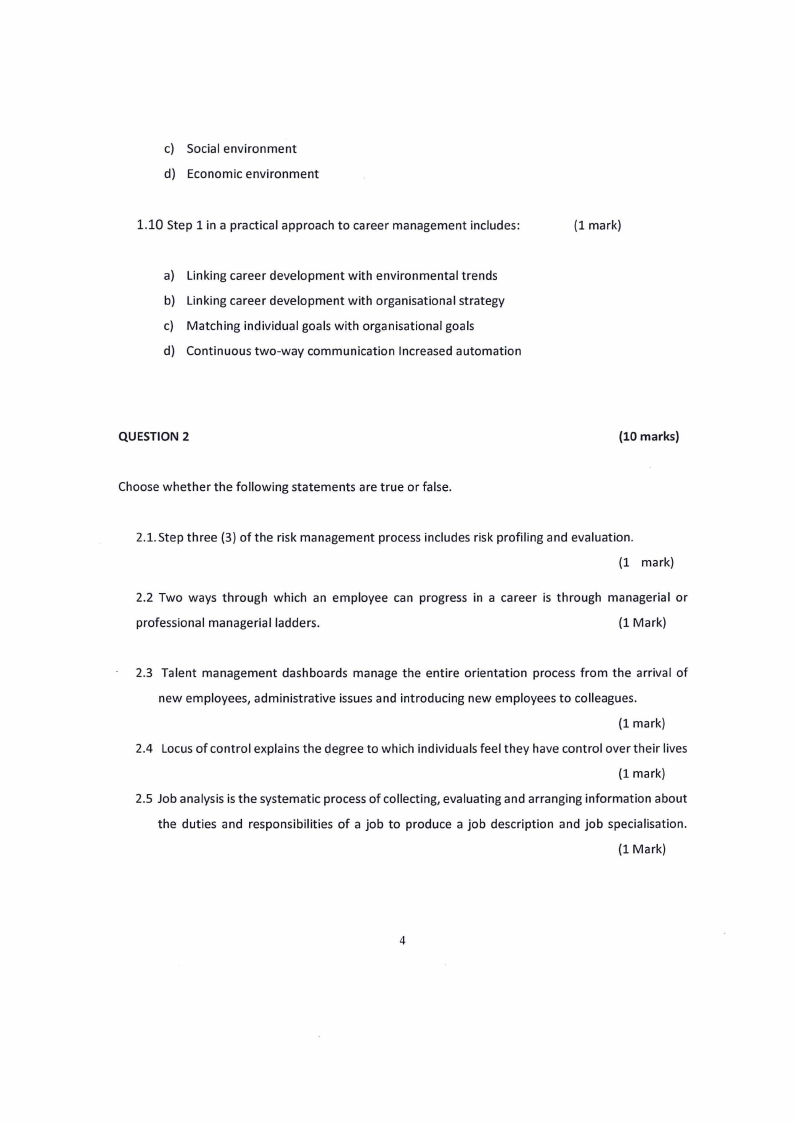
c) Social environment
d) Economic environment
1.10 Step 1 in a practical approach to career management includes:
a) Linking career development with environmental trends
b) Linking career development with organisational strategy
c) Matching individual goals with organisational goals
d) Continuous two-way communication Increased automation
(1 mark)
QUESTION 2
(10 marks)
Choose whether the following statements are true or false.
2.1. Step three (3) of the risk management process includes risk profiling and evaluation.
(1 mark)
2.2 Two ways through which an employee can progress in a career is through managerial or
professional managerial ladders.
(1 Mark)
2.3 Talent management dashboards manage the entire orientation process from the arrival of
new employees, administrative issues and introducing new employees to colleagues.
(1 mark)
2.4 Locus of control explains the degree to which individuals feel they have control over their lives
(1 mark)
2.5 Job analysis is the systematic process of collecting, evaluating and arranging information about
the duties and responsibilities of a job to produce a job description and job specialisation.
(1 Mark)
4

1.5 Page 5

▲back to top


2.6 Artificial Intelligence-mediated HR practices have the potential to significantly impact
employee experience, and one of their positive impacts is the potential for job displacement
for some.
(1 Mark)
2.7 According to the Trait theory, traits are different individual attributes such as personality,
common temperament, common needs, moves and values.
(1 mark)
2.8 Reducing organisational competitiveness is a benefit of career management.
(1 mark)
2.9 Aggressiveness is better reflected in the degree to which managers focus on results or
outcomes rather than on how these outcomes are achieved.
(1 mark)
2.10 Primary elements for implementing career management programmes include the publication
of vacancies.
(1 mark)
QUESTION 3 -Short questions
(20 marks)
3.1 Clarify the difference between a strong and weak organisational culture.
(4 marks)
3.2 Discuss the concept of corporate branding.
(2 marks)
3.3 Explain staffing inventories in the context of human resources.
(2 marks)
3.4 Discuss any two key technologies associated with Industry 4.0.
(2 marks)
3.5 Describe the meaning of the psychological contract concerning talent attraction. (2marks)
3.6 Distinguish the difference between Industry 4.0 and the 4th Industrial Revolution. (2 marks)
3.7 Define workforce planning.
(2 Marks)
5

1.6 Page 6

▲back to top


3.8 Distinguish between HR Metrics and Analytics and explain two examples of HR metrics.
(4 marks)
SECTION B
{60 marks)
QUESTION 4 - Discussion questions
(40 marks)
4.1 Discuss the concept of leadership and separately name and explain the three levels of
leadership.
(8 marks)
4.2 Define talent and specify the four role players in realising talent management. (6 marks)
4.3 There are five reasons why employees stay in an organisation; discuss any four. (8 marks)
4.4 Leaders are faced with both internal and external challenges in the changing world of work.
Outline the five prominent challenges leaders are grappling with in the New World of work.
(10 Marks)
4.5 Identify and explain each of the four (4) pillars of HR professionalism.
(8 marks)
QUESTION 5 - Case study questions
{20 marks)
Read the case study below and answer all the questions that follow.
The Impact of Industry 4.0 On The Human Workforce: Efficiency And Productivity
Article Written by: Ganesh Veerappan
The advent of Industry 4.0 has heralded a new era of unprecedented technological advancements,
promising to reshape industries and economies worldwide. At the heart of this revolution lies the
6

1.7 Page 7

▲back to top


convergence of digital technologies, automation, and artificial intelligence, presenting an intricate
tapestry of opportunities and challenges for the human workforce. As we delve into this
transformative landscape, examining the profound impact of Industry 4.0 on human labor becomes
essential. The way we look at machines and human interaction is changing drastically. Industry 4.0,
the Fourth Industrial Revolution, integrates physical and cyber systems, leading to a new level of
automation and data exchange in manufacturing and other industries. This transition is made possible
by technologies such as the Internet ofThings (lo Tl. Big Data and Analytics, Cloud Computing, Artificial
Intelligence (Al), and advanced Robotics.
The impact of Industry 4.0 on the human workforce is twofold. On the one hand, it leads to higher
efficiency and productivity as machines take on more tasks than humans currently perform. On the
other hand, it leads to a need for new skills and knowledge as the tasks performed by humans change
in nature. This blog explores how this technological revolution is reshaping the nature of work, offering
insights into how businesses and individuals can harness the power of technology to foster a
harmonious collaboration between man and machine while driving unparalleled efficiency and
productivity in the workplace.
What is Industry 4.0?
Industry 4.0 is the term used to describe the fourth industrial revolution. Integrating physical and
cyber systems leads to a new level of automation and data exchange in manufacturing and other
industries. Industry 4.0 was first used in 2011 by a German government initiative to secure Germany's
position as a leading manufacturing nation. The initiative aimed to promote investment in new
technologies and approaches that would increase the productivity and competitiveness of German
manufacturers. However, the term Industry 4.0 has since been adopted by many other countries and
is no longer specific to Germany.
It entails the convergence of technologies like the Internet of Things (loT), artificial intelligence (Al),
robotics, big data analytics, and cyber-physical systems, creating "smart factories" and enabling real-
time data exchange and .autonomous decision-making. Industry 4.0 aims to enhance manufacturing
efficiency, productivity, and flexibility, revolutionizing traditional industries and redefining work
processes to drive economic growth and innovation in the 21st century.
The Technical Advances of Industry 4.0
7

1.8 Page 8

▲back to top


The technical advances that are enabling Industry 4.0 include the following:
The Internet of Things (loT)
loT refers to the network of interconnected physical devices, sensors, and machines that can collect,
exchange, and analyze data. It enables real-time monitoring and control of equipment and processes,
facilitating predictive maintenance, optimizing production, and improving overall efficiency.
Big Data and Analytics
With the vast amount of data generated by loT devices and other sources, big data analytics tools and
techniques are utilized to process and analyze this data. It enables businesses to gain valuable insights,
make data-driven decisions, and optimize processes.
Cloud Computing
Cloud computing provides scalable and on-demand access to computing resources over the internet.
It allows companies to store and process large amounts of data, collaborate remotely, and deploy
complex applications without significant infrastructure investments.
Artificial Intelligence (Al)
Al encompasses various technologies, including machine learning, natural language processing, and
computer vision. Al-powered systems can learn from data, make intelligent decisions, recognize
patterns, and automate complex tasks, enhancing productivity and smarter decision-making.
Advanced Robotics
Robotics is the branch of technology that deals with the design and operation of robots. Advanced
robotics, including industrial and collaborative robots (cobots), are employed in manufacturing and
logistics. They automate repetitive tasks, increase precision, and improve safety by collaboratively
working alongside humans.
Autonomous Vehicles
Autonomous vehicles, such as drones and self-driving cars, use Al and sensors to navigate and operate
without human intervention. They are revolutionizing logistics, transportation, and delivery services
by increasing efficiency and reducing costs.
8

1.9 Page 9

▲back to top


Nanotechnology
Nanotechnology involves manipulating materials at the nanoscale level. It leads to developing
advanced materials with unique properties, such as increased strength, conductivity, and durability,
with applications in diverse industries like electronics, healthcare, and energy.
Augmented Reality (AR) and Virtual Reality (VR)
AR and VR technologies overlay digital information in the real world or create immersive virtual
environments. They find applications in training, maintenance, design, and remote assistance,
improving operational efficiency and reducing errors.
These technical advances of Industry 4.0 are reshaping industries, transforming business processes,
and redefining the relationship between humans and technology in the modern digital era.
How Industry 4.0 is Changing the Workplace?
Industry 4.0 is bringing about significant changes in the workplace, revolutionizing how businesses
operate and how employees carry out their tasks. Here are some of the ways Industry 4.0 is
transforming the workplace:
Automation of Repetitive Tasks
Industry 4.0 introduces advanced robotics and automation, taking over repetitive and mundane tasks
that human workers previously performed. This shift allows employees to focus on more creative and
strategic aspects of their jobs, increasing job satisfaction and higher-value contributions.
Enhanced Efficiency and Productivity
Integrating loT, Al, and data analytics enables real-time monitoring and optimization of production
processes. This results in enhanced efficiency, reduced downtime, and increased overall productivity,
enabling companies to meet market demands effectively.
Customization and Personalization
Industry 4.0 technologies, such as additive manufacturing, enable mass customization of products to
meet individual customer needs and preferences. This level of personalization was not feasible in
traditional manufacturing processes.
9

1.10 Page 10

▲back to top


Upskilling and Reskilling
The adoption of Industry 4.0 technologies demands a workforce with relevant technical skills.
Employees are encouraged to undergo upskilling and reskilling programs to adapt to new
technologies, ensuring they remain relevant and employable in the changing job landscape.
Remote Work and Flexibility
Industry 4.0 technologies, such as cloud computing and collaboration tools, facilitate remote work
arrangements. Employees can work from anywhere, improving work-life balance and access to a
global business talent pool.
Real-Time Decision-Making
With abundant data and advanced analytics, businesses can make data-driven decisions in real time.
This agility helps respond swiftly to market changes and customer demands, staying competitive in
dynamic environments.
Safety and Risk Mitigation
Implementing autonomous systems and robots in hazardous environments reduces the risk to human
workers. This not only improves workplace safety but also lowers the number of workplace accidents.
Human-Robot Collaboration
Industry 4.0 promotes collaboration between humans and robots (cobots). Cobots can work alongside
humans, assisting in tasks and augmenting human capabilities, increasing efficiency and faster
production speed.
5.1 Why are upskilling and reskilling important in the context of Industry 4.0?
(2 marks)
5.2 How does Industry 4.0 enable remote work and flexibility?
(2 marks)
5.3 How does Industry 4.0 affect the nature of human work?
(2 marks)
5.4 Name and explain at least four key technologies driving Industry 4.0.
10
(4 marks)

2 Pages 11-20

▲back to top


2.1 Page 11

▲back to top


5.5 How are Artificial Intelligence (Al) and Big Data transforming decision-making in the workplace?
(2 marks)
5.6 What is the impact of Industry 4.0 on workplace safety?
(2 marks)
5.7 Explain the concept of human-robot collaboration in Industry 4.0.
(2 marks)
5.8 What role does the Internet of Things (loT) play in Industry 4.0?
(2 marks)
5.9 In what ways does Industry 4.0 support customization and personalization in production?
(2marks)
- End of Question Paper -
11