CHR612S - CONTEMPORARY ISSUES IN HR - 2ND OPP - JUNE 2025


CHR612S - CONTEMPORARY ISSUES IN HR - 2ND OPP - JUNE 2025


1 Pages 1-10

▲back to top


1.1 Page 1

▲back to top


nAmlBIA UnlVERSITY
OF SCIEnCE Ano TECHnOLOGY
FACULTY OF COMMERCE, HUMAN SCIENCESAND EDUCATION
DEPARTMENT OF GOVERNANCE AND MANAGEMENT SCIENCES
QUALIFICATION: BACHELOR OF HUMAN RESOURCES MANAGEMENT
QUALIFICATION CODE: 07BHRM
LEVEL: 6
COURSE CODE: CHR612S
COURSE NAME: CONTEMPORARY ISSUES IN HUMAN
RESOURCES
DATE: JULY 2025
PAPER: 2
DURATION: 3 HOURS
MARKS: 100
EXAMINER:
SECOND OPPORTUNITY QUESTION PAPER
MR. SIMASIKU KAMWI
MODERATOR:
MS. ELAINE ENKALI
INSTRUCTIONS
1. Answer all questions
2. Answer the asked questions
3. Read the case study carefully before attempting the questions
4. Write clearly and neatly.
5. Number your answers.
PERMISSIBLE MATERIALS
1. Test paper
2. Test script
THIS SECOND OPPORTUNITY QUESTION PAPER CONSISTS OF 13 PAGES (Incl. the cover front page)

1.2 Page 2

▲back to top


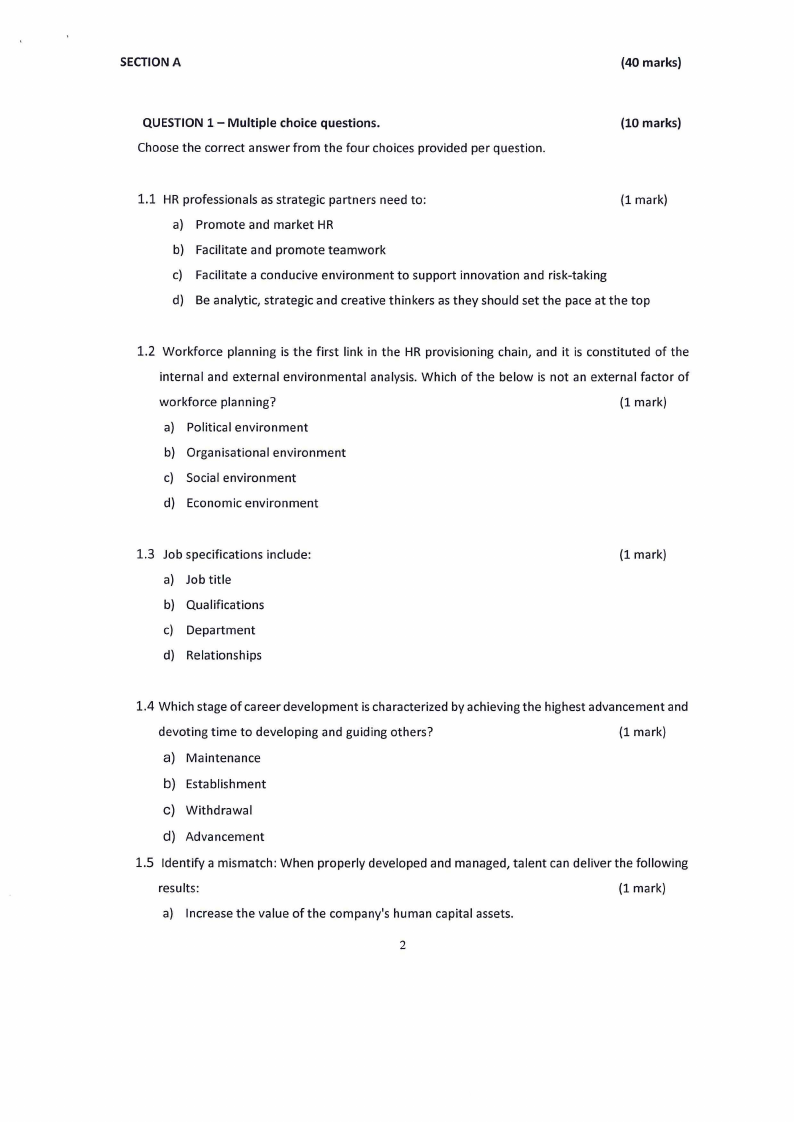
SECTION A
(40 marks)
QUESTION 1- Multiple choice questions.
Choose the correct answer from the four choices provided per question.
(10 marks)
1.1 HR professionals as strategic partners need to:
(1 mark)
a) Promote and market HR
b) Facilitate and promote teamwork
c) Facilitate a conducive environment to support innovation and risk-taking
d) Be analytic, strategic and creative thinkers as they should set the pace at the top
1.2 Workforce planning is the first link in the HR provisioning chain, and it is constituted of the
internal and external environmental analysis. Which of the below is not an external factor of
workforce planning?
(1 mark)
a) Political environment
b) Organisational environment
c) Social environment
d) Economic environment
1.3 Job specifications include:
a) Job title
b) Qualifications
c) Department
d) Relationships
(1 mark)
1.4 Which stage of career development is characterized by achieving the highest advancement and
devoting time to developing and guiding others?
(1 mark)
a) Maintenance
b) Establishment
c) Withdrawal
d) Advancement
1.5 Identify a mismatch: When properly developed and managed, talent can deliver the following
results:
(1 mark)
a) Increase the value of the company's human capital assets.
2

1.3 Page 3

▲back to top


b) Ensure the availability of competent staff to move up the ladder.
c) Create a pool of staff who understand the company and industry and are ready for
leadership.
d) Contribute to ineffective retention
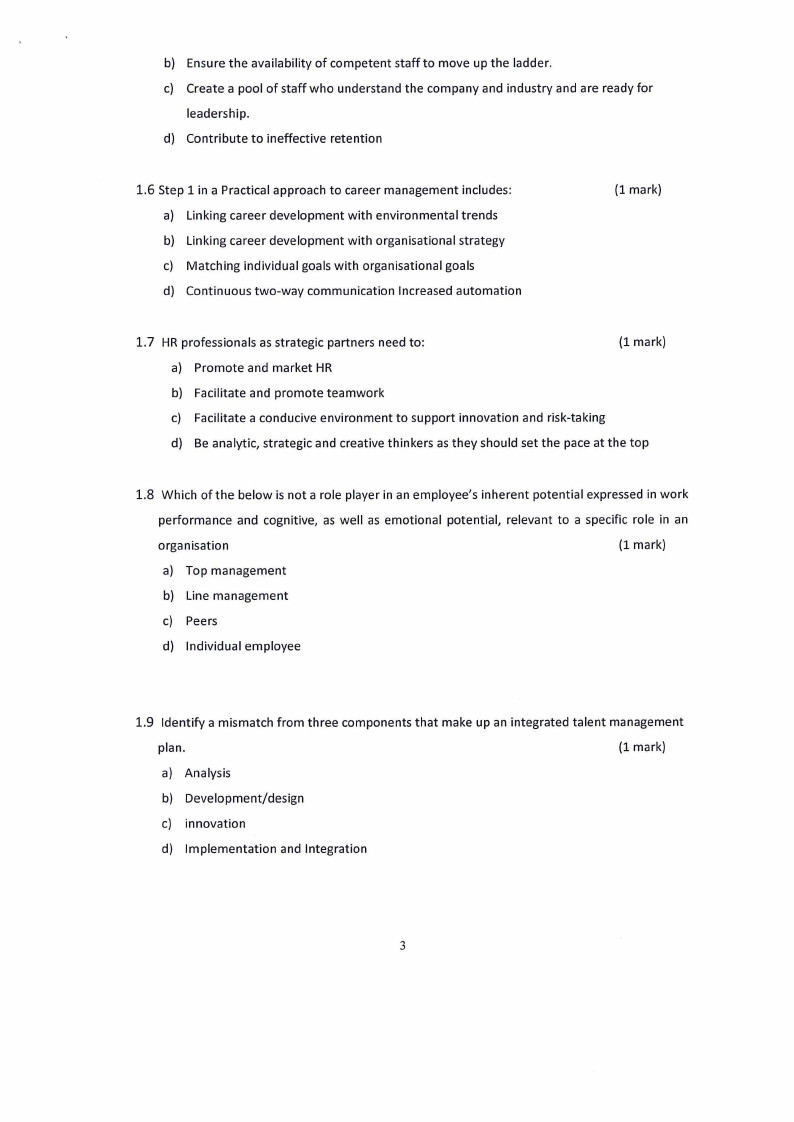
1.6 Step 1 in a Practical approach to career management includes:
a) Linking career development with environmental trends
b) Linking career development with organisational strategy
c) Matching individual goals with organisational goals
d) Continuous two-way communication Increased automation
(1 mark)
1.7 HR professionals as strategic partners need to:
{1 mark)
a) Promote and market HR
b) Facilitate and promote teamwork
c) Facilitate a conducive environment to support innovation and risk-taking
d) Be analytic, strategic and creative thinkers as they should set the pace at the top
1.8 Which of the below is not a role player in an employee's inherent potential expressed in work
performance and cognitive, as well as emotional potential, relevant to a specific role in an
organisation
(1 mark)
a) Top management
b) Line management
c) Peers
d) Individual employee
1.9 Identify a mismatch from three components that make up an integrated talent management
plan.
(1 mark)
a) Analysis
b) Development/design
c) innovation
d) Implementation and Integration
3

1.4 Page 4

▲back to top


1.10 Which of the following is not part of the internal factors influencing selection?
(1 mark)
a) Size of the organisation
b) Type of the organisation
c) Labour market
d} Applicant pool
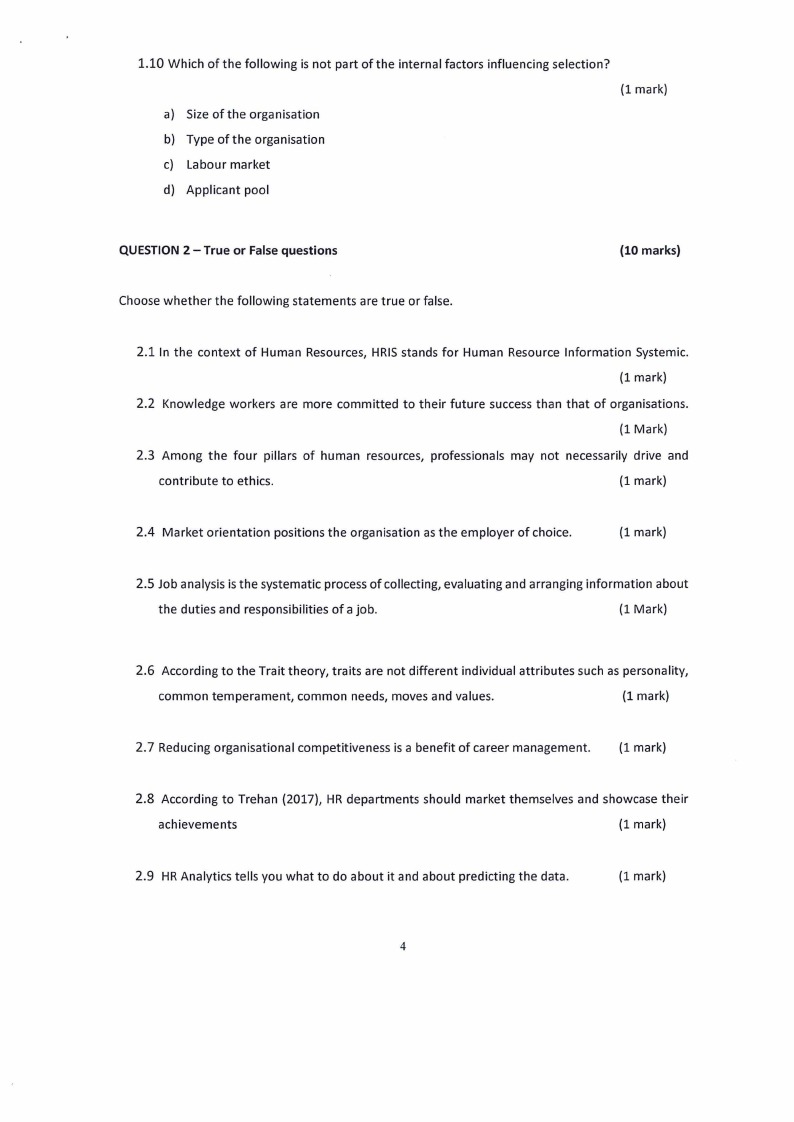
QUESTION 2 - True or False questions
(10 marks)
Choose whether the following statements are true or false.
2.1 In the context of Human Resources, HRISstands for Human Resource Information Systemic.
(1 mark)
2.2 Knowledge workers are more committed to their future success than that of organisations.
(1 Mark)
2.3 Among the four pillars of human resources, professionals may not necessarily drive and
contribute to ethics.
(1 mark)
2.4 Market orientation positions the organisation as the employer of choice.
(1 mark)
2.5 Job analysis is the systematic process of collecting, evaluating and arranging information about
the duties and responsibilities of a job.
(1 Mark)
2.6 According to the Trait theory, traits are not different individual attributes such as personality,
common temperament, common needs, moves and values.
(1 mark)
2.7 Reducing organisational competitiveness is a benefit of career management.
(1 mark)
2.8 According to Trehan (2017), HR departments should market themselves and showcase their
achievements
(1 mark)
2.9 HRAnalytics tells you what to do about it and about predicting the data.
(1 mark)
4

1.5 Page 5

▲back to top


2.10 Contingency Theory Focus on the contextual factors that have an impact on leadership.
(1 Mark)
QUESTION 3 - Short questions
(20 marks)
3.1 Explain the value proposition of "attract suitable human capital".
(2 marks)
3.2 People orientation is a characteristic of organisational culture; define it.
(2 marks)
3.3 HR is now required to play a crucial role as a strategic partner in an organisation. Explain any
three roles that HR strategic partners will need to fulfil in this role.
{6 marks)
3.4 Distinguish the following three levels of leadership: Supervisory, Function and Strategic
(6 marks)
3.5 Define workforce planning.
{2 Marks)
3.6 People orientation is a characteristic of organisational culture; define it.
(2 marks)
SECTION B
[60 marks]
QUESTION 4 - Discussion questions
(40 marks)
4.1 Discuss three important factors concerning Industry 4.0 and talent development. {6 Marks)
4.2 There are a number of popular HR Metrics and formulas. Identify any eight.
{8 Marks)
4.3 Discuss with examples the concepts of digitisation, digitalisation and digital business.
{6 Marks)
5

1.6 Page 6

▲back to top


4.4 Elaborate on the five characteristics of Psychometric tests.
(10 marks)
4.5 Four major forces influence the new world of work. Discuss each of the four.
(4 Marks)
4.6 Discuss the three popular models of contingency theory leadership
(6 Marks)
4.7 Enumerate and discuss the five aspects that are pertinent to developing and managing talent.
(10 Marks)
QUESTION 5 - Case study questions
(20 marks)
Read the case study below and answer all the questions that follow.
The Difference Between HR Metrics and HR Analytics: A Comprehensive Guide
Authored by: CHRMP
Published on: January 10, 2025
HR analytics is a powerful analytical tool used by HR professionals. It is the practice of using data
analysis techniques and tools to extract insights and knowledge from HR data to support data-driven
decision-making that is not intuitive in the human resources function. HRanalytics involves collecting,
organizing, and analyzing large sets of employee-related data to identify patterns, trends, and
correlations that can be used to form HR strategies, policies and tactics. This can include data on
employee performance, workforce demographics, turnover rates, engagement levels, absenteeism,
sabbaticals and more. By leveraging HR analytics, organizations can make data-driven decisions that
optimize the workforce, improve overall business outcomes, and enhance employee experience.
Why Do We Need HR Analytics?
HRanalytics is essential for companies to make informed, data-driven decisions regarding their human
resources function rather than depending upon intuition alone. HR analytics can provide valuable
insights into the workforce, including trends, patterns, and correlations that can help identify
improvement areas and optimisation opportunities. By leveraging HR analytics, organizations can:
1. Improve recruitment and retention: HR analytics can help identify the sources of top talent and
retention issues, enabling organizations to improve recruitment and retention strategies by curbing
turnover rates.
6

1.7 Page 7

▲back to top


2. Enhance employee performance: By analyzing employee performance data, organizations can
identify areas where training and development programs are needed, improve welfare amenities, and
offer competitive compensation specific to the industry to enhance the overall employee experience.
3. Optimize workforce planning: HR analytics can provide insights into the workforce demographics
and trends, patterns and correlations, helping organizations forecast future workforce needs and
optimize workforce productivity.
4. Align HR strategies with business goals: By using HR analytics to identify the drivers of business
success, organizations can align their HR goals, initiatives, drives and strategies with the overall goals
of the organization.
S. Increase efficiency and reduce costs: HR analytics can help identify areas where HR processes can
be streamlined or automated, resulting in increased efficiency and reduced costs to improve financial
metrics like revenue and profits.
What are HR Metrics?
HR metrics are specific measurements used to track and evaluate various aspects of the human
resources function. HR metrics are typically used to assess the performance, efficiency, and
effectiveness of HR processes and practices and to provide insights into workforce trends and
patterns. HR metrics include employee turnover rates, time-to-hire, training and development costs,
absenteeism, skills gap and employee engagement levels. By tracking and analyzing HR metrics,
organizations can identify areas for improvement, make data-driven decisions, and ensure that HR
initiatives, practices and drives are aligned with the business's overall goals.
Why Do We Need HR Metrics?
HR metrics are important for organizations to assess, measure and monitor specific aspects of their
human resources function. By measuring and tracking HR metrics, organizations can identify areas for
improvement, make data-driven decisions, and ensure that their HR initiatives are aligned with their
overall business goals.
Some key reasons why we need HR metrics are:
1. Measure performance: HR metrics provide a way to measure and assess the performance of
specific HR processes and practices, such as recruitment, training, or employee engagement.
2. Identify areas for improvement: By tracking HR metrics, organizations can identify areas where
they are underperforming and take action to improve their HR initiatives.
3. Ensurecompliance: HR metrics can help organizations ensure that they are complying with relevant
7

1.8 Page 8

▲back to top


government. and company laws, by-laws and regulations, such as those related to diversity and
inclusion or equal pay.
4. Evaluate the effectiveness of HR initiatives: HR metrics provide a way to evaluate the effectiveness
of HR initiatives and drives, such as training programs or performance management systems, and
make data-driven decisions about whether to continue, modify, or discontinue them.
5. Benchmark against industry standards: HR metrics enable organizations to benchmark their
performance against industry standards and best practices, providing insight into how they compare
with their peers and competitors.
Top 8 HR Metrics used by Organizations in 2025
Here are 8 commonly used HR metrics that organizations use to measure the effectiveness of their HR
practices:
1. Offer Acceptance Rate:
The offer acceptance rate tracks the percentage of job offers extended to candidates that are
accepted. This metric helps organizations evaluate the attractiveness of their compensation packages,
workplace culture, and recruitment strategies. A low offer acceptance rate could indicate issues such
as uncompetitive salary offers or misaligned job expectations. Improving this rate ensures that top
talent joins the organization, contributing to its overall success.
2. Employee Turnover Rate:
Employee turnover rate measures how many employees leave an organization over a given period,
typically expressed as a percentage of the total workforce. A high turnover rate can indicate problems
with employee retention, job satisfaction, or other factors, while a low turnover rate may suggest a
healthy and engaged workforce.
3. Time-to-Fill:
Time-to-fill is a metric that measures the length of time it takes to fill a vacant position, from the
posting of the job opening to the offer of employment. This metric can help organizations evaluate
their recruitment processes, identify improvement areas, and assess the impact of external factors
such as the availability of qualified candidates.
4. Cost-per-Hire:
Cost-per-hire is a metric that measures the total cost of recruiting and hiring a new employee,
including advertising, recruitment fees, and other expenses. This metric can help organizations to
8

1.9 Page 9

▲back to top


evaluate the efficiency and cost-effectiveness of their recruitment processes and identify areas where
costs can be reduced.
5. Absenteeism Rate:
The absenteeism rate is a measure of the percentage of employees who are absent from work on a
given day or over a given period of time. High rates of absenteeism can indicate problems with
employee morale, engagement, or workplace culture and can hurt productivity and organizational
performance.
6. Employee Engagement:
Employee engagement measures how committed and satisfied employees are with their work and the
organization as a whole. This metric is typically measured through employee surveys or other feedback
mechanisms and can provide valuable insights into areas where the organization can improve its HR
practices and foster a more engaged and productive workforce.
7. Training Effectiveness Rate
Training effectiveness rate measures the impact of training programs on employee performance and
productivity. This metric evaluates whether the learning objectives of a training program have been
achieved and how well employees are able to apply new skills in their roles. It is typically measured
through post-training assessments, employee feedback, and performance evaluations. A high training
effectiveness rate indicates that the organization's training initiatives are well-aligned with business
goals, improving workforce capabilities.
8. Internal Mobility Rate
The internal mobility rate measures the percentage of employees who move to new roles within the
organization, whether through promotions, lateral moves, or cross-functional assignments. This
metric reflects the organization's commitment to employee development and career progression. A
high internal mobility rate often indicates a strong culture of growth and retention, as well as effective
talent management practices that keep top performers engaged.
What's the Difference Between HR Metrics and HR Analytics?
HR metrics and HR analytics are both essential for effective HR management but are different in terms
of their scope, focus, and application. Organizations have to use an integrated approach of HR metrics
and analytics for effective workforce management using these parameters. HR metrics are specific
measurements that track, assess and evaluate various aspects of the human resources function. They
provide insight into specific HR processes and practices, drives and initiatives such as time-to-hire,
9

1.10 Page 10

▲back to top


training costs, or employee turnover rates. HR metrics enable HR professionals to monitor the
effectiveness and efficiency of HR initiatives and identify areas for improvement and implementation
to drive the organization's success to greater heights. In contrast, HR analytics is a broader and more
complex practice that encompasses the collection, analysis, and interpretation of large sets of HR-
related data. HR analytics is not limited to specific metrics but instead focuses on identifying patterns,
trends and relationships between multiple data points and multiple metrics from across the myriad
functions of the organization.
The purpose of HR analytics is to generate insights and knowledge that give relevant information for
strategic data-driven decision-making in the HR function. HR analytics can help organizations identify
workforce trends, extrapolate and forecast future workforce needs, and develop data-driven HR
strategies and practices, doing away with intuitional decisions altogether.
In summary, HR metrics are specific measurements that track and evaluate the performance of
individual HR processes. At the same time, HR analytics is a more comprehensive and integrated
practice that encompasses data collection, data analysis and data interpretation to provide insights
and provide relevant experience information for strategic decision-making in the HR function.
While HR metrics and HR Analytics are essential for effective HR management, HR analytics has a
broader focus. It aims to provide a more holistic bird's eye view of the organizational workforce.
How are HR Metrics and HR Analytics Interconnected?
HR metrics and HR analytics are closely intertwined and support each other in the field of Human
Resources. Here's how they are related:
HR metrics serve as the foundation for HR analytics. Metrics are specific measurements that help HR
professionals track and assess various aspects of their workforce, such as employee turnover,
recruitment effectiveness, training outcomes, performance evaluations, and more. These metrics
provide valuable data points and benchmarks to evaluate the current state of HR practices within an
organization.
HR analytics takes this data a step further by analyzing and interpreting the metrics to uncover
meaningful insights. By applying statistical methods and data visualization techniques, HR analytics
professionals can identify trends, patterns, and correlations within the metrics. This deeper analysis
allows HR teams to gain valuable insights into the factors influencing HR outcomes and make data-
driven decisions. In essence, HR metrics provide the raw data, while HR analytics transforms that data
into actionable insights. By leveraging HR analytics, organizations can better understand the drivers
of their HR metrics, identify areas for improvement, and make strategic decisions to optimize their
10

2 Pages 11-20

▲back to top


2.1 Page 11

▲back to top


human capital management practices.
What is the most important use of HR metrics and analytics in 2025?
• Enable Data-Driven Decision-Making: HR metrics and analytics provide insights to make
informed decisions rather than relying on intuition.
• Optimize Workforce Management: They help identify trends in employee performance,
engagement, and retention for better workforce planning.
• Identify Patterns and Trends: These tools reveal valuable correlations, such as reasons behind
high turnover rates or employee disengagement.
• Predict Future Workforce Needs: Analytics enables forecasting for recruitment, training, and
organizational growth.
• Align HR Strategies with Business Goals: Metrics and analytics ensure that HR initiatives
directly contribute to organizational success.
• Facilitate Targeted Solutions: Insights help implement focused interventions, such as training
programs or cultural enhancements, to address specific challenges.
• Improve Efficiency and Reduce Costs: They streamline HR processes, leading to cost savings
and better resource allocation.
• Enhance Employee Experience: By addressing issues proactively, they contribute to higher job
satisfaction and engagement.
5.1 What is the primary difference between HR metrics and HR analytics?
5.2 How do HR analytics support strategic decision-making in organizations?
(4 marks)
(2 marks)
5.3 List three key benefits of using HR analytics in an organization.
(6 marks)
5.4 How are HR metrics and HR analytics interconnected?
(2 marks)
5.5 What is the overarching goal of integrating HR metrics and HR analytics in 2025? (2 marks)
11

2.2 Page 12

▲back to top


5.6 What is the significance of the "Offer Acceptance Rate" metric?
5.7 Why is the "Time-to-Fill" metric important in HR?
(2marks)
(2 marks)
- End of Question Paper -
12