


 |
DTA621S - DATA ANALYTICS - 1ST OPP - NOV 2025 |
|
|
1 Page 1 |
▲back to top |
n Am I BI A u n IVE Rs ITY
OF SC IEn CE Ano TEC HnOLOGY
FACULTY OF CO MPUTING AN D INFORMATICS
DEPARTM ENT OF INFORM ATICS
QUALIFICATIONS: Bachelor of Informatics
QUALIFICATION CODE: 06BENT/06BAIF LEVEL: 6
COURSE CODE: DTA621S
COURSE: Data Analyti cs
DATE: October 2025
DURATION: 3 Hours
SESSION: 1
MARKS: 100
FIRST OPPORTUNITY EXAMINATION QUESTION PAPER
EXAMIN ERS:
Dr Clopas Kwenda
M ODE RATOR(S):
Professor St ephen Fashoto
THIS EXAMINATION PAPER CONSISTS OF 7 PAGES
(INCLUDING THIS FRONT PAG E)
INSTRUCTIONS FOR THE CANDIDATE
1. Answer ALL QUESTIONS.
2. When writing, take into account: The style should inform than impress, it should be
formal, in third person, paragraphs set out according to ideas or issues, and the
paragraphs flowing in a logical order.
3. Information should be brief and accurate.
Please ensure that your writing is legible, neat and presentable
|
|
2 Page 2 |
▲back to top |
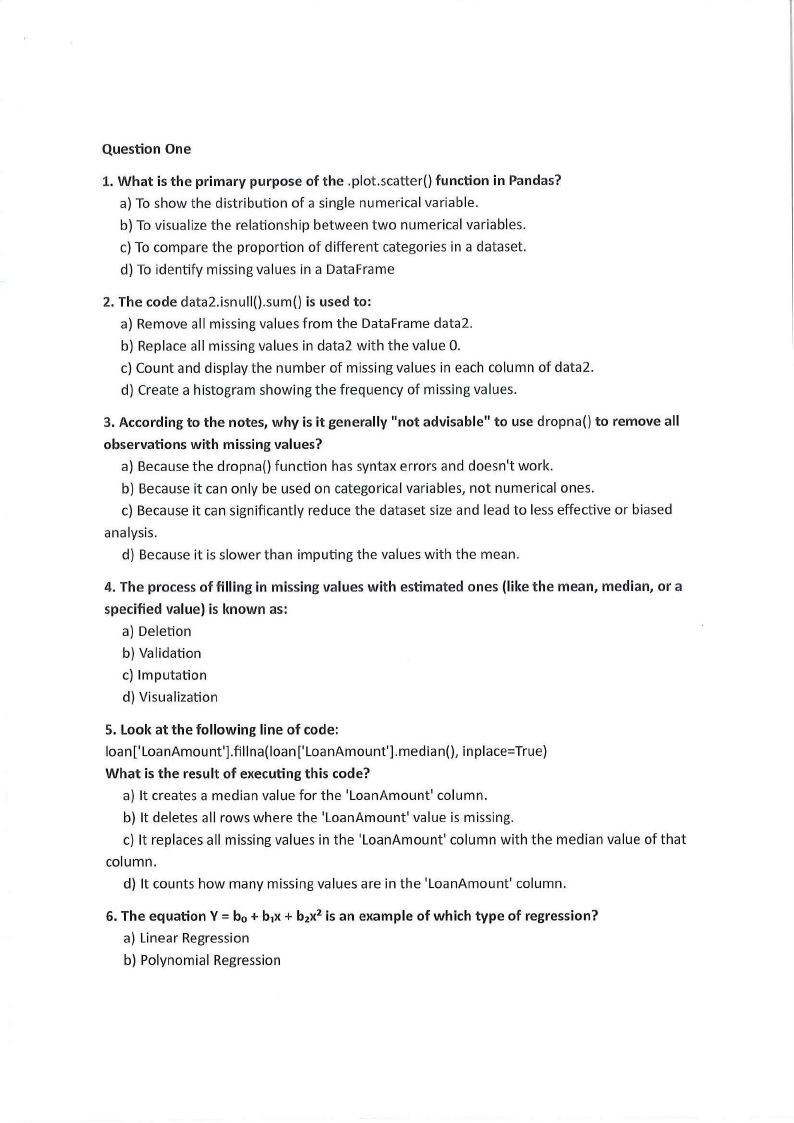
Question One
1. What is the primary purpose of the .plot.scatter() function in Pandas?
a) To show the distribution of a single numerical variable.
b) To visualize the relationship between two numerical variables.
c) To compare the proportion of different categories in a dataset.
d) To identify missing values in a Data Frame
2. The code data2.isnull().sum() is used to:
a) Remove all missing values from the DataFrame data2.
b) Replace all missing values in data2 with the value 0.
c) Count and display the number of missing values in each column of data 2.
d) Create a histogram showing the frequency of missing values.
3. According to the notes, why is it generally "not advisable" to use dropna() to remove all
observations with missing values?
a) Because the dropna() function has syntax errors and doesn't work.
b) Because it can only be used on categorical variables, not numerical ones.
c) Because it can significantly reduce the dataset size and lead to less effective or biased
analysis.
d) Because it is slower than imputing the values with the mean.
4. The process of filling in missing values with estimated ones (like the mean, median, or a
specified value) is known as:
a) Deletion
b) Validation
c) Imputation
d) Visualization
S. Look at the following line of code:
loan['LoanAmou nt'].fillna( loan['Loa nAmount'].median(), inplace=True)
What is the result of executing this code?
a) It creates a median value for the 'LoanAmount' column.
b) It deletes all rows where the 'LoanAmount' value is missing.
c) It replaces all missing values in the 'LoanAmount' column with the median value of that
column.
d) It counts how many missing values are in the 'LoanAmount' column.
6. The equation Y = b0 + b1x + b2x2 is an example of which type of regression?
a) Linear Regression
b) Polynomial Regression
|
|
3 Page 3 |
▲back to top |
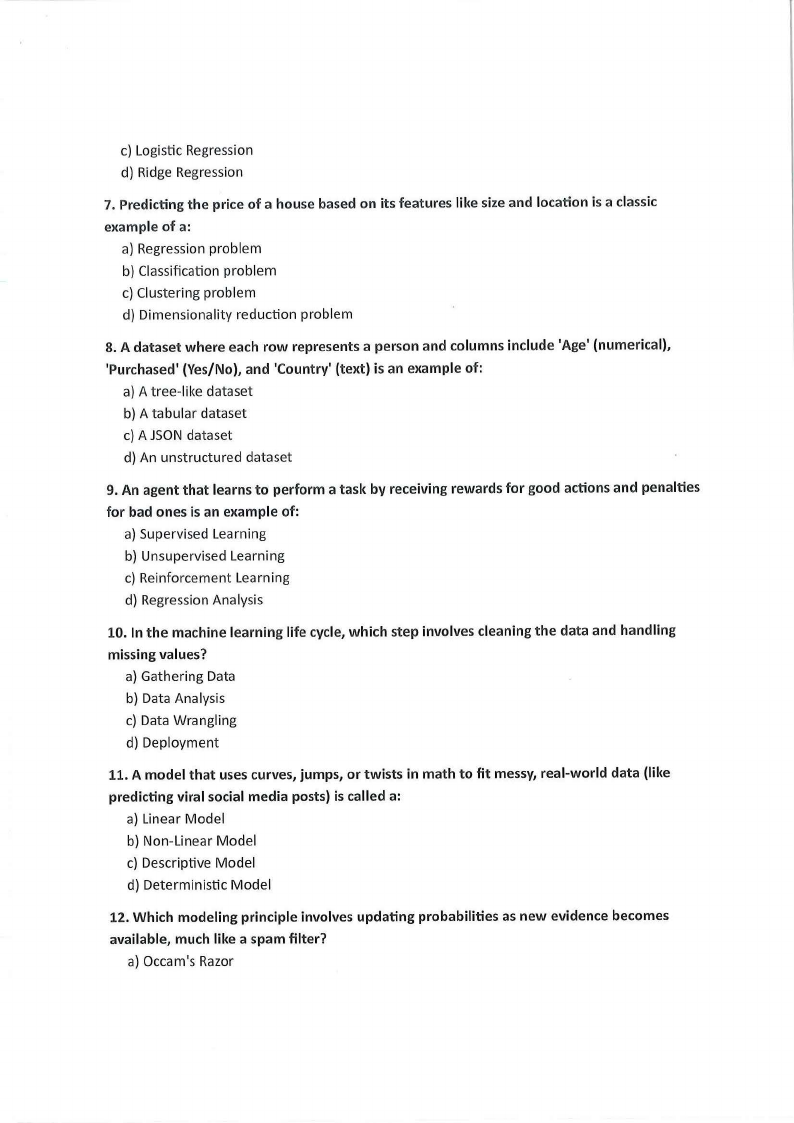
c) Logistic Regression
d) Ridge Regression
7. Predicting the price of a house based on its features like size and location is a classic
example of a:
a) Regression problem
b) Classification problem
c) Clustering problem
d) Dimensionality reduction problem
8. A dataset where each row represents a person and columns include 'Age' (numerical),
'Purchased' (Yes/No), and 'Country' (text) is an example of:
a) A tree-like dataset
b) A tabular dataset
c) A JSON dataset
d) An unstructured dataset
9. An agent that learns to perform a task by receiving rewards for good actions and penalties
for bad ones is an example of:
a) Supervised Learning
b) Unsupervised Learning
c) Reinforcement Learning
d) Regression Analysis
10. In the machine learning life cycle, which step involves cleaning the data and handling
missing values?
a) Gathering Data
b) Data Analysis
c) Data Wrangling
d) Deployment
11. A model that uses curves, jumps, or twists in math to fit messy, real-world data (like
predicting viral social media posts) is called a:
a) Linear Model
b) Non-Linear Model
c) Descriptive Model
d) Deterministic Model
12. Which modeling principle involves updating probabilities as new evidence becomes
available, much like a spam filter?
a) Occam's Razor
|
|
4 Page 4 |
▲back to top |
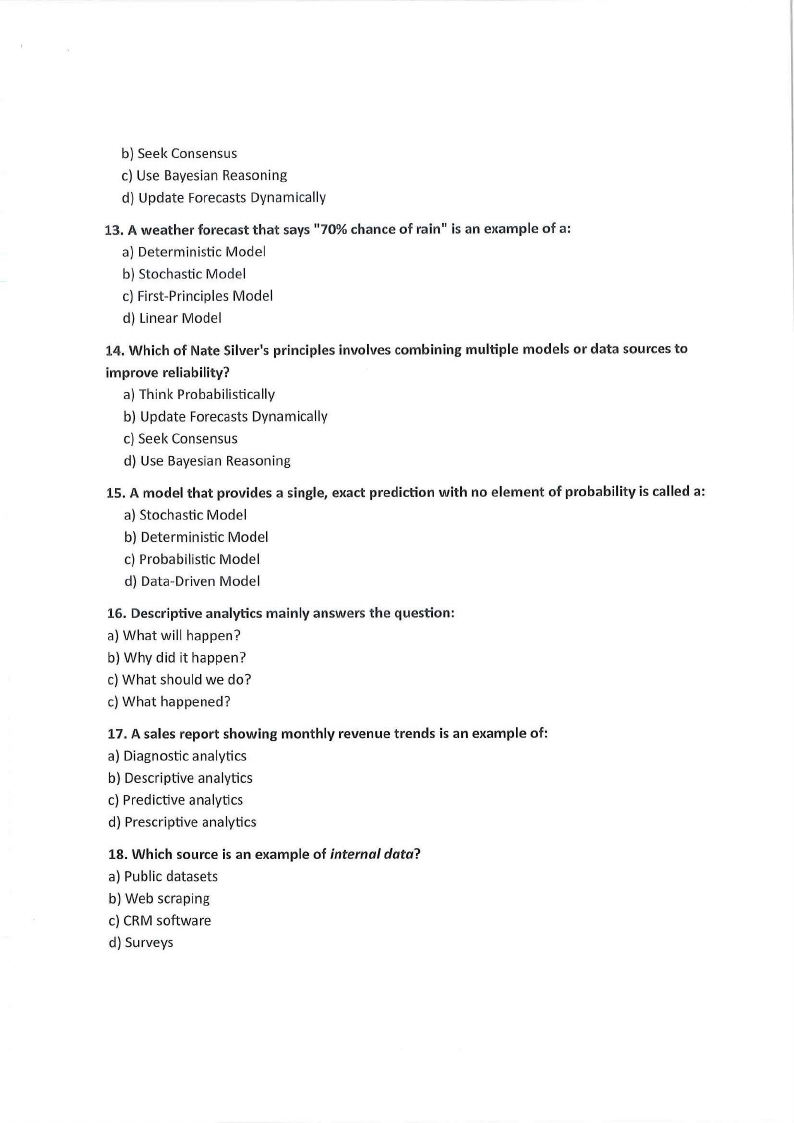
b) Seek Consensus
c) Use Bayesian Reasoning
d) Update Forecasts Dynamically
13. A weather forecast that says "70% chance of rain" is an example of a:
a) Deterministic Model
b) Stochastic Model
c) First-Principles Model
d) Linear Model
14. Which of Nate Silver's principles involves combining multiple models or data sources to
improve reliability?
a) Think Probabilistically
b) Update Forecasts Dynamically
c) Seek Consensus
d) Use Bayesian Reasoning
15. A model that provides a single, exact prediction with no element of probability is called a:
a) Stochastic Model
b) Deterministic Model
c) Probabilistic Model
d) Data-Driven Model
16. Descriptive analytics mainly answers the question:
a) What will happen?
b) Why did it happen?
c) What should we do?
c) What happened?
17. A sales report showing monthly revenue trends is an example of:
a) Diagnostic analytics
b) Descriptive analytics
c) Predictive analytics
d) Prescriptive analytics
18. Which source is an example of internal data?
a) Public datasets
b) Web scraping
c) CRM software
d) Surveys
|
|
5 Page 5 |
▲back to top |

19. Which statement best describes semi-structured data?
a) Data always stored in SQL databases
b) Has some organizational tags but no strict schema
c) Has no format or organization at all
d) Randomized raw data
20.Which method is NOT a valid way to add a new key-value pair to a dictionary?
a) dict['new_key'] = 'new_value'
b) dict.update{{'new_key': 'new_value'})
c) dict.add{'new_key', 'new_value')
d) dict.setdefault{'new_key', 'new_value')
Question two
1. Elements of a tuple can be accessed using indexing and slicing, similar to lists.
True/ False
2. The sorted{) function modifies the original tuple when it sorts it.
True/ False
3. You can create a tuple from a list using the tuple{) function.
True/ False
4. You can use the append{) method to add a new element to an existing tuple.
True/ False
5. The main goal of the bias-variance trade-off is to maximize both bias and variance for
the most robust model.
True/ False
6. A model that performs well on training data but poorly on new, unseen data is likely
overfitting.
True/ False
7. Relational operators always give the same type of output when applied to both 1-D
and multi-dimensional arrays.
True/ False
8. The transpose() function changes the orientation of a multidimensional array, while
the flatten() function collapses it into a 1-D array.
True/ False
9. The zeros() function creates an array filled with zeros, while the ones() function creates
an array filled with ones.
True/ False
10. The arange() function is used to create arrays with regularly spaced values within a
specified interval.
|
|
6 Page 6 |
▲back to top |
True/ False
Question three
a) With regard to supervised learning, explain the following terms
i. Regression task
(2 marks)
ii. Classification task
(2 marks)
iii. Multicollinearity
iv. Overfitting
(2 marks)
(2 marks)
b) Differentiate between the two types of "missing values" mentioned in the
notes: NA and NaN. Provide an example of how a NaN value might be generated. (5
marks)
c) What does the dropna(inplace=True) method do to a DataFrame? (2 marks)
d) Define the term imputation in the context of data preprocessing. (2 marks)
e) Give two examples each for
(8 marks)
i. Structured data
ii. Semi-structured data
iii. Unstructured data
iv. Ordina l data
Question four
a) The manager of "The Daily Grind" coffee shop wants to analyze the consistency of their
morning sales. The sales revenue (in dollars) for the past week (Monday to Saturday)
was recorded as follows:
Sales: 102, 115,98, 107,110,108
Calculate the following statistics to summarize the spread of this data:
I. The range.
II. The sample standard deviation.
111. The sample variance.
IV. The coefficient of variation (CV}.
(2 marks)
(5 marks)
(2 marks)
(2 marks)
|
|
7 Page 7 |
▲back to top |
b) The students in Mr. Smith's Period 1 math class were asked how many hours they spent
studying for their last test. Their responses, listed in order from least to greatest, are as
follows:
5, 6, 6, 7, 8, 9, 10, 10, 11, 12, 15
1. Calculate the following statistics needed to create a box and whisker plot:
i. Minimum
(1 mark)
ii. First quartile (Ql)
(1 mark)
iii. Median
(1 mark)
iv. Third quartile{Q3)
(1 mark)
v. Maximum
(1 mark)
2. Draw a box and whisker plot that represents the data above (Hint use a number
line from Oto 18 )
(5
marks)
3. Use your box plot to answer the following questions:
i. What is the interquartile range (IQR)?
(2 marks)
ii. Would you describe the distribution of study times as symmetrica l, skewed
left, or skewed right? Explain your reason ing based on the shape of the box
plot.
(2 marks)
Question five
a) A survey was conducted to eva luate a student's performance in five skills:
I
Skill
llcommunicationllreamworkllProblem-Solvingllcreativityl\\rechnical Skills!
lscore (out of 10)118
Jl7
119
116
118
Task:
I. Create a radar chart (spider chart) to visualize the student's performance across
the five skills.
(10 marks)
b) Data wrangling involves cleaning and transforming raw data into a usable format. List
and explain four techniques commonly used in the .data wrangling process (6 marks)
c) Supervised learning models can be categorized into regression and classification. Explain
the difference between these two types of models.
(4 marks)