


 |
IME511S - INTRODCUTION TO MARKETING AND ITS ENVIRONMENT - 1ST OPP - JUNE 2025 |
|
|
1 Page 1 |
▲back to top |
nAmlBIA un1VERSITY
OFSCIEnCEAno TECHnOLOGY
FACULTYOF COMMERCE, HUMAN SCIENCESAND EDUCATION
DEPARTMENT OF MARKETING, LOGISTICS AND SPORT MANAGEMENT
QUALIFICATION: BACHELOROF MARKETINGAND OTHERS
QUALIFICATION CODE: 07BMAK
LEVEL: 5
COURSE CODE: IME511S
COURSE NAME: INTRODUCTIONTO MARKETING
AND ITSENVIRONMENT
SESSION: JUNE 2025
DURATION: 3 HOURS
PAPER: THEORY
MARKS: 100
FIRSTOPPORTUNITYEXAMINATION QUESTION PAPER
EXAMINER{S) MS CHERLEYDU PLESSIS(FT)
MS LYDIAHEELU(PT, DI)
MODERATOR: MR JOHN-GRAFTTNDUNGAUA
INSTRUCTIONS
1.
Make sure your name and surname, and student number appear on the answer script.
2.
Answer all questions.
3.
Number your answers correctly and read the questions carefully before answering.
4.
Please ensure that your writing is legible, neat and presentable.
THIS QUESTION PAPER CONSISTS OF _06_ PAGES {Including this front page)
1
|
|
2 Page 2 |
▲back to top |
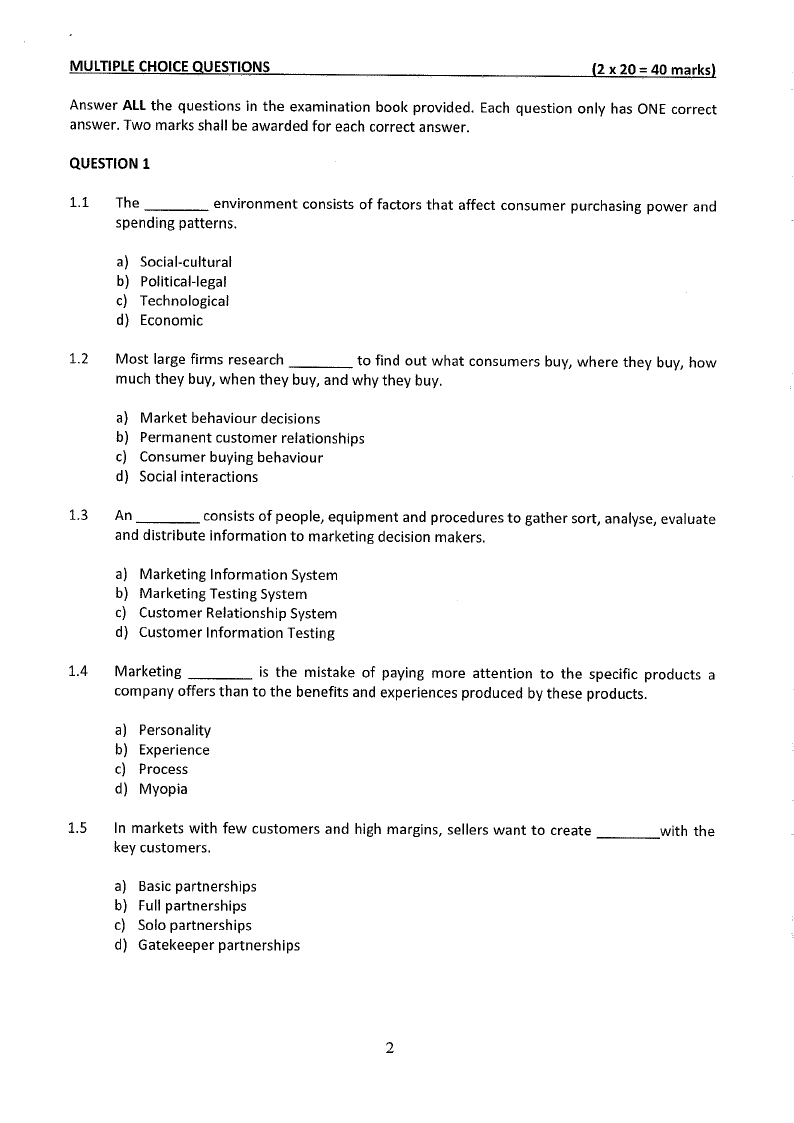
MULTIPLECHOICEQUESTIONS
(2 x 20 - 40 marks)
Answer ALL the questions in the examination book provided. Each question only has ONE correct
answer. Two marks shall be awarded for each correct answer.
QUESTION 1
1.1 The ____
environment consists of factors that affect consumer purchasing power and
spending patterns.
a) Social-cultural
b) Political-legal
c) Technological
d) Economic
1.2 Most large firms research ____
to find out what consumers buy, where they buy, how
much they buy, when they buy, and why they buy.
a) Market behaviour decisions
b) Permanent customer relationships
c) Consumer buying behaviour
d) Social interactions
1.3 An ____
consists of people, equipment and procedures to gather sort, analyse, evaluate
and distribute information to marketing decision makers.
a) Marketing Information System
b) Marketing Testing System
c) Customer Relationship System
d) Customer Information Testing
1.4 Marketing ____
is the mistake of paying more attention to the specific products a
company offers than to the benefits and experiences produced by these products.
a) Personality
b) Experience
c) Process
d) Myopia
1.5 In markets with few customers and high margins, sellers want to create ____
key customers.
with the
a) Basic partnerships
b) Full partnerships
c) Solo partnerships
d) Gatekeeper partnerships
2
|
|
3 Page 3 |
▲back to top |
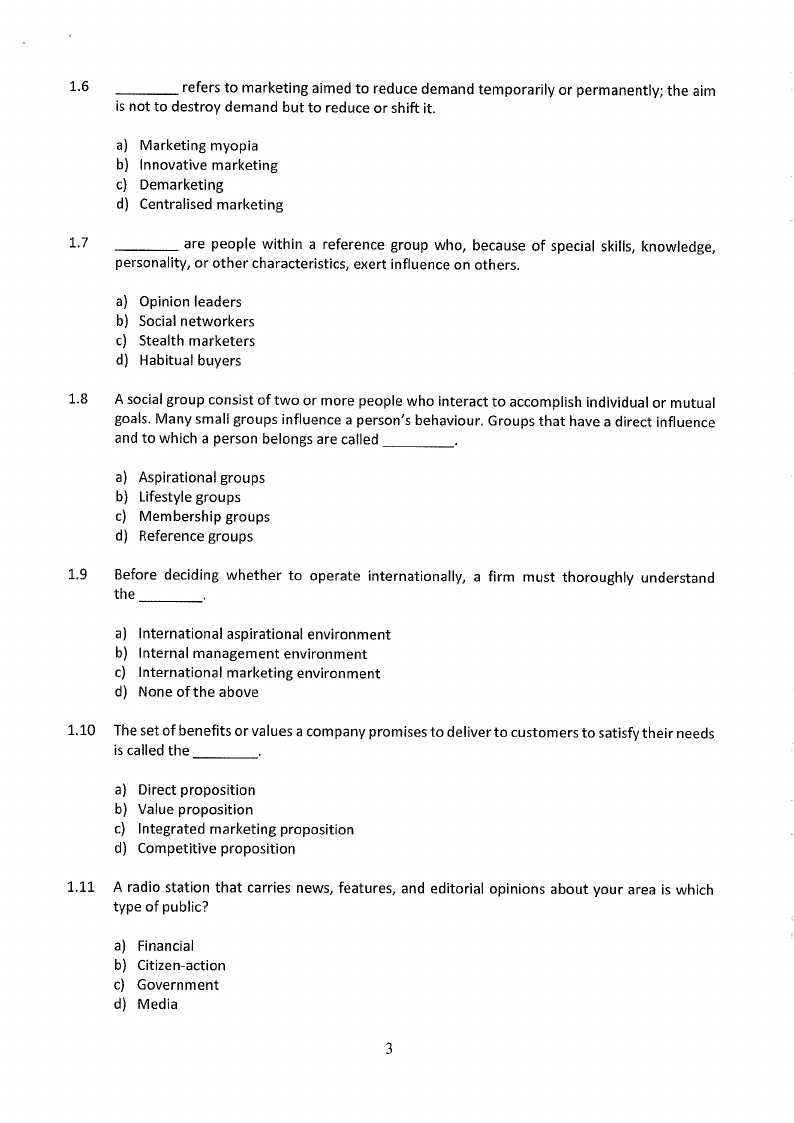
1.6 ____
refers to marketing aimed to reduce demand temporarily or permanently; the aim
is not to destroy demand but to reduce or shift it.
a) Marketing myopia
b) Innovative marketing
c) Demarketing
d) Centralised marketing
1.7 ____
are people within a reference group who, because of special skills, knowledge,
personality, or other characteristics, exert influence on others.
a) Opinion leaders
b) Social networkers
c) Stealth marketers
d) Habitual buyers
1.8 A social group consist of two or more people who interact to accomplish individual or mutual
goals. Many small groups influence a person's behaviour. Groups that have a direct influence
and to which a person belongs are called ___ _
a) Aspirational groups
b) Lifestyle groups
c) Membership groups
d) Reference groups
1.9 Before deciding whether to operate internationally, a firm must thoroughly understand
the ___ _
a) International aspirational environment
b) Internal management environment
c) International marketing environment
d) None of the above
1.10 The set of benefits or values a company promises to deliver to customers to satisfy their needs
is called the ----
a) Direct proposition
b) Value proposition
c) Integrated marketing proposition
d) Competitive proposition
1.11 A radio station that carries news, features, and editorial opinions about your area is which
type of public?
a) Financial
b) Citizen-action
c) Government
d) Media
3
|
|
4 Page 4 |
▲back to top |
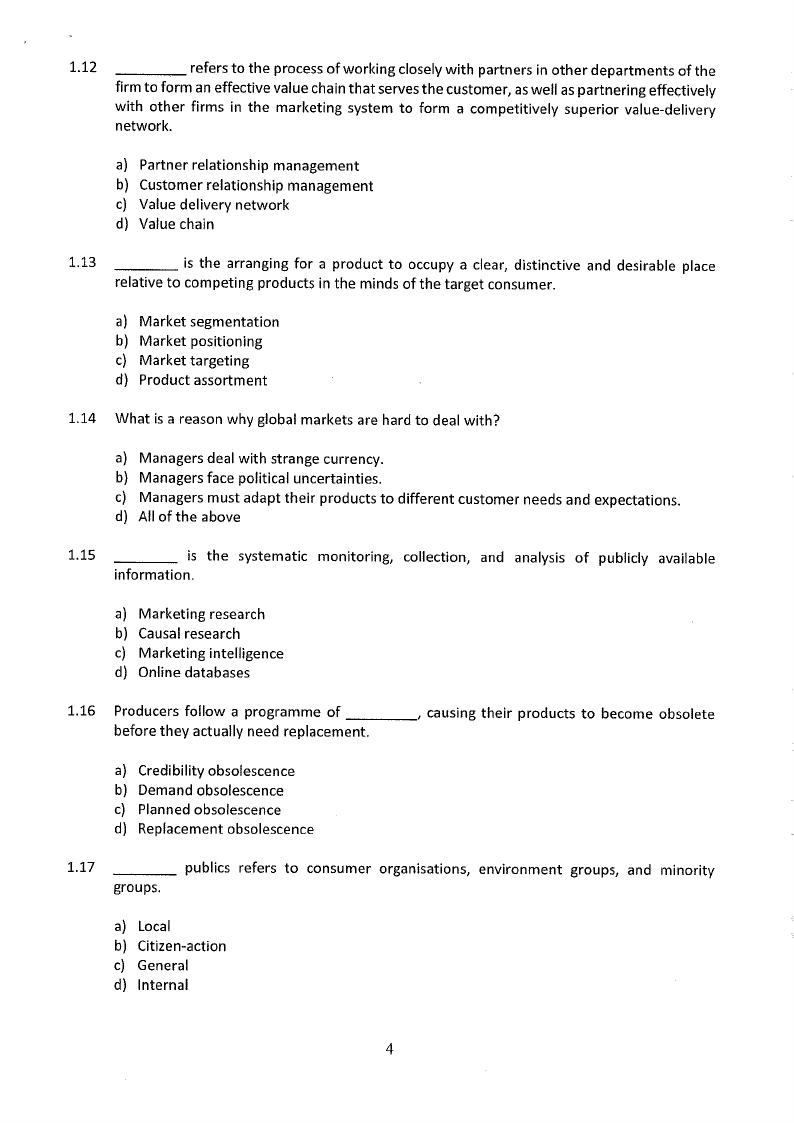
1.12 ____
refers to the process of working closely with partners in other departments of the
firm to form an effective value chain that serves the customer, as well as partnering effectively
with other firms in the marketing system to form a competitively superior value-delivery
network.
a) Partner relationship management
b) Customer relationship management
c) Value delivery network
d) Value chain
1.13 ____
is the arranging for a product to occupy a clear, distinctive and desirable place
relative to competing products in the minds of the target consumer.
a) Market segmentation
b) Market positioning
c) Market targeting
d) Product assortment
1.14 What is a reason why global markets are hard to deal with?
a) Managers deal with strange currency.
b) Managers face political uncertainties.
c) Managers must adapt their products to different customer needs and expectations.
d) All of the above
1.15
is the systematic monitoring, collection, and analysis of publicly available
information.
a) Marketing research
b) Causal research
c) Marketing intelligence
d) Online databases
1.16 Producers follow a programme of---~
before they actually need replacement.
causing their products to become obsolete
a) Credibility obsolescence
b) Demand obsolescence
c) Planned obsolescence
d) Replacement obsolescence
1.17
publics refers to consumer organisations, environment groups, and minority
groups.
a) Local
b) Citizen-action
c) General
d) Internal
4
|
|
5 Page 5 |
▲back to top |
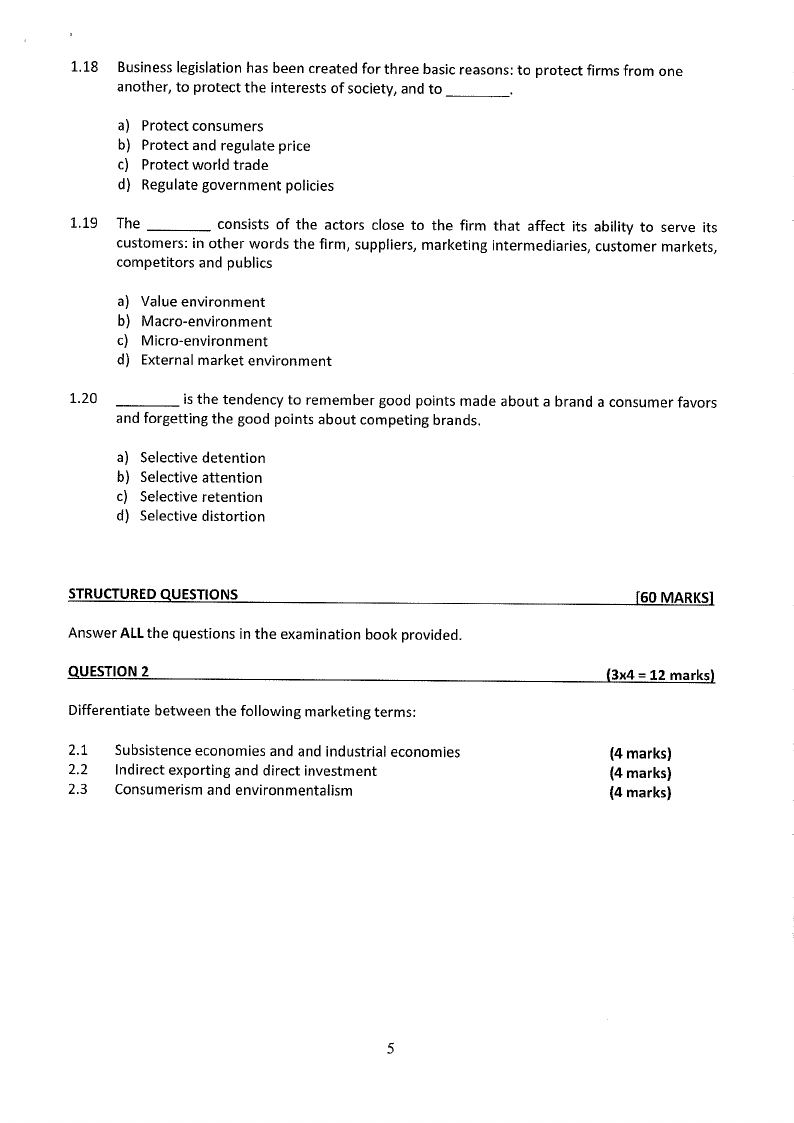
1.18 Business legislation has been created for three basic reasons: to protect firms from one
another, to protect the interests of society, and to ___ _
a) Protect consumers
b) Protect and regulate price
c) Protect world trade
d) Regulate government policies
1.19 The ____
consists of the actors close to the firm that affect its ability to serve its
customers: in other words the firm, suppliers, marketing intermediaries, customer markets,
competitors and publics
a) Value environment
b) Macro-environment
c) Micro-environment
d) External market environment
1.20 ____
is the tendency to remember good points made about a brand a consumer favors
and forgetting the good points about competing brands.
a) Selective detention
b) Selective attention
c) Selective retention
d) Selective distortion
STRUCTUREDQUESTIONS
Answer ALLthe questions in the examination book provided.
QUESTION 2
Differentiate between the following marketing terms:
2.1 Subsistence economies and and industrial economies
2.2 Indirect exporting and direct investment
2.3 Consumerism and environmentalism
(60 MARKS)
(3x4 = 12 marks)
(4 marks)
(4 marks)
(4 marks)
5
|
|
6 Page 6 |
▲back to top |
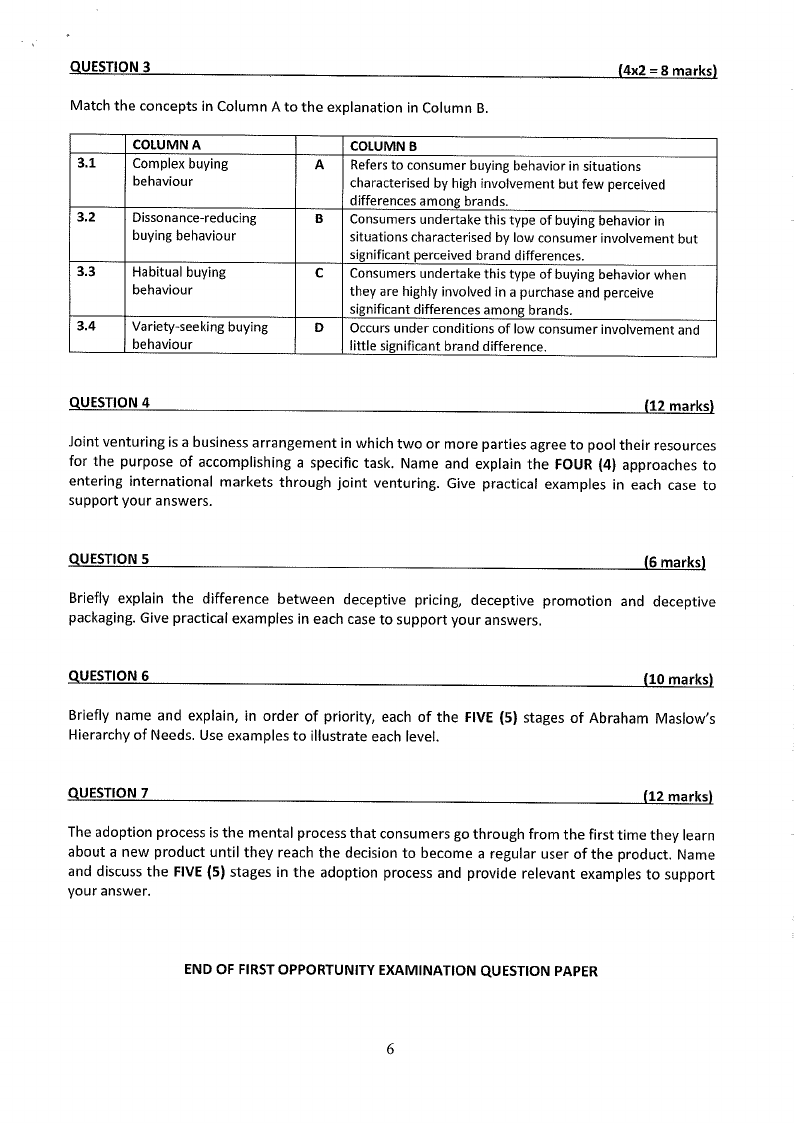
QUESTION 3
Match the concepts in Column A to the explanation in Column B.
{4x2 = 8 marks)
COLUMNA
3.1
Complex buying
behaviour
3.2
Dissonance-reducing
buying behaviour
3.3
Habitual buying
behaviour
3.4
Variety-seeking buying
behaviour
COLUMNB
A Refersto consumer buying behavior in situations
characterised by high involvement but few perceived
differences among brands.
B Consumersundertake this type of buying behavior in
situations characterised by low consumer involvement but
significant perceived brand differences.
C Consumersundertake this type of buying behavior when
they are highly involved in a purchase and perceive
significant differences among brands.
D Occursunder conditions of low consumer involvement and
little significant brand difference.
QUESTION4
(12 marks)
Joint venturing is a business arrangement in which two or more parties agree to pool their resources
for the purpose of accomplishing a specific task. Name and explain the FOUR (4) approaches to
entering international markets through joint venturing. Give practical examples in each case to
support your answers.
QUESTION 5
(6 marks)
Briefly explain the difference between deceptive pricing, deceptive promotion and deceptive
packaging. Give practical examples in each case to support your answers.
QUESTIONS
(10 marks)
Briefly name and explain, in order of priority, each of the FIVE (5) stages of Abraham Maslow's
Hierarchy of Needs. Use examples to illustrate each level.
QUESTION 7
(12 marks)
The adoption process is the mental process that consumers go through from the first time they learn
about a new product until they reach the decision to become a regular user of the product. Name
and discuss the FIVE (5) stages in the adoption process and provide relevant examples to support
your answer.
END OF FIRST OPPORTUNITY EXAMINATION QUESTION PAPER
6