


 |
BBF612S - BUSINESS FINANCE - 1ST OPP - NOV 2025 |
|
|
1 Page 1 |
▲back to top |
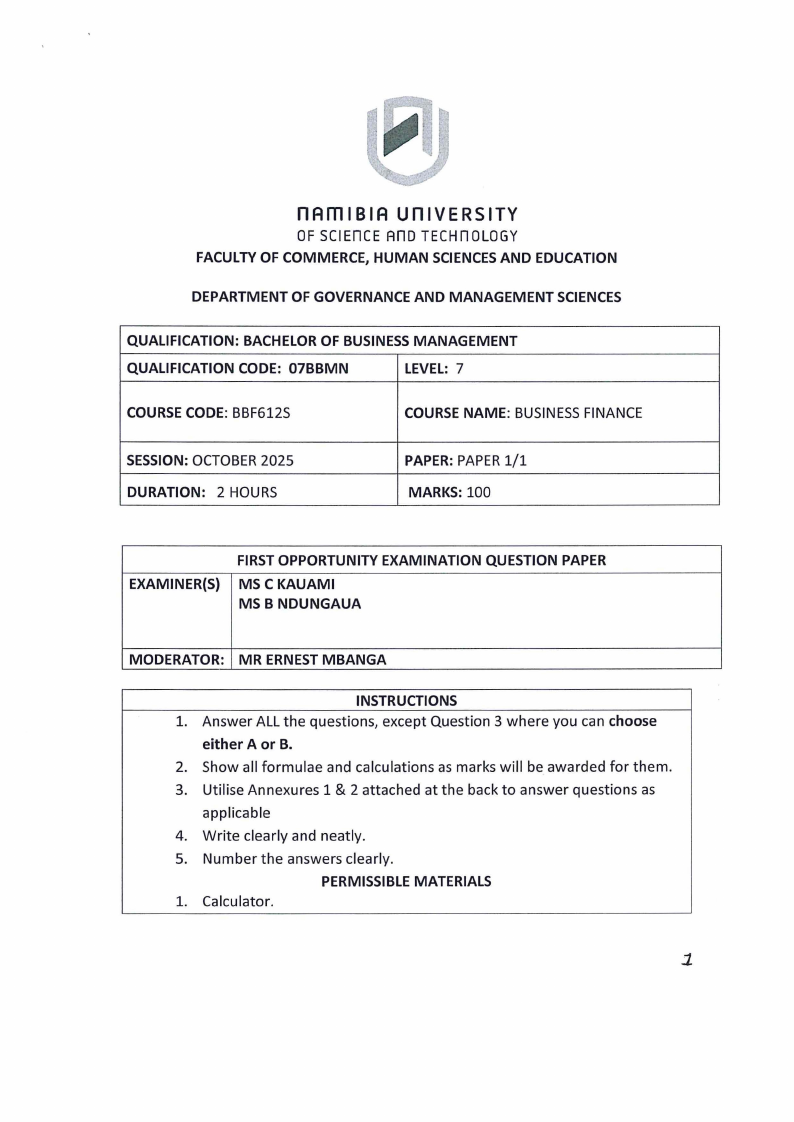
nAmlBIA UnlVERSITY
OF SCIEnCE Ano TECHnOLOGY
FACULTY OF COMMERCE, HUMAN SCIENCES AND EDUCATION
DEPARTMENT OF GOVERNANCE AND MANAGEMENT SCIENCES
QUALIFICATION: BACHELOR OF BUSINESS MANAGEMENT
QUALIFICATION CODE: 07BBMN
LEVEL: 7
COURSE CODE: BBF612S
COURSE NAME: BUSINESS FINANCE
SESSION: OCTOBER 2025
DURATION: 2 HOURS
PAPER: PAPER 1/1
MARKS: 100
EXAMINER(S)
FIRST OPPORTUNITY EXAMINATION QUESTION PAPER
MSCKAUAMI
MS B NDUNGAUA
MODERATOR: MR ERNEST MBANGA
INSTRUCTIONS
1. Answer ALL the questions, except Question 3 where you can choose
either A or B.
2. Show all formulae and calculations as marks will be awarded for them.
3. Utilise Annexures 1 & 2 attached at the back to answer questions as
applicable
4. Write clearly and neatly.
5. Number the answers clearly.
1. Calculator.
PERMISSIBLE MATERIALS
1
|
|
2 Page 2 |
▲back to top |
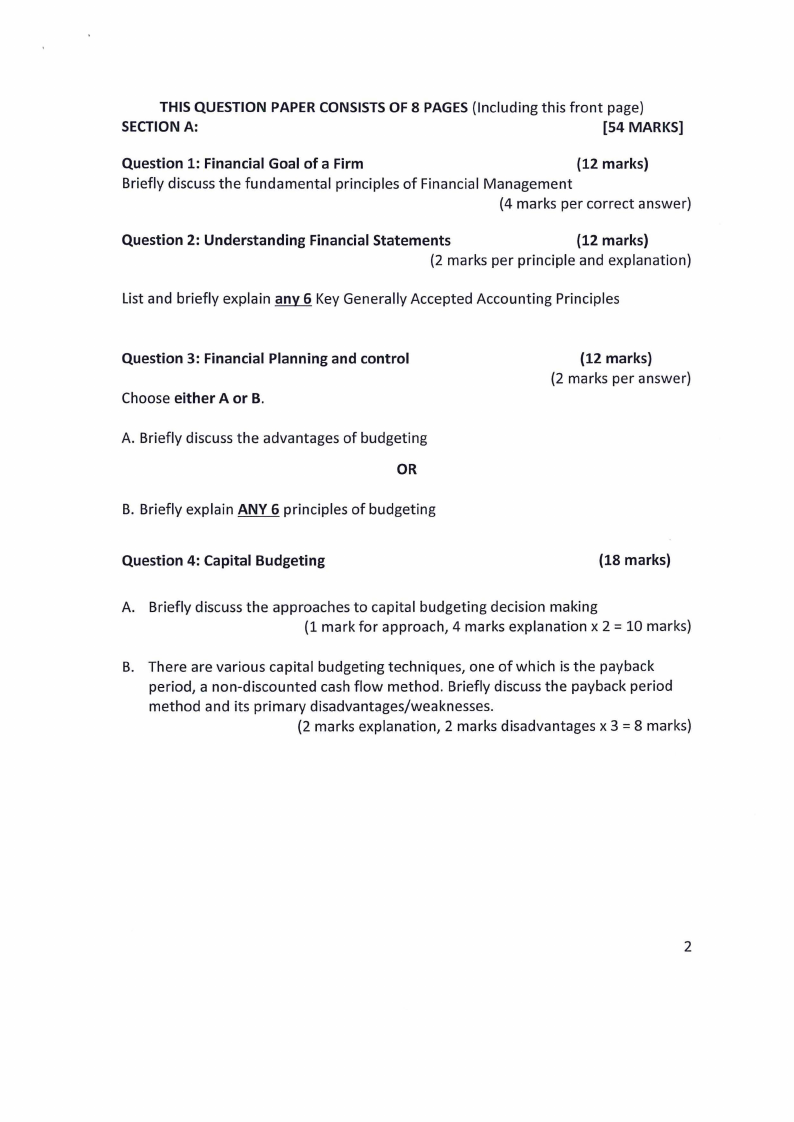
THIS QUESTION PAPER CONSISTS OF 8 PAGES {Including this front page)
SECTION A:
[54 MARKS]
Question 1: Financial Goal of a Firm
{12 marks)
Briefly discuss the fundamental principles of Financial Management
(4 marks per correct answer)
Question 2: Understanding Financial Statements
(12 marks)
(2 marks per principle and explanation)
List and briefly explain any 6 Key Generally Accepted Accounting Principles
Question 3: Financial Planning and control
Choose either A or B.
A. Briefly discuss the advantages of budgeting
OR
B. Briefly explain ANY 6 principles of budgeting
{12 marks)
(2 marks per answer)
Question 4: Capital Budgeting
(18 marks)
A. Briefly discuss the approaches to capital budgeting decision making
{1 mark for approach, 4 marks explanation x 2 = 10 marks)
B. There are various capital budgeting techniques, one of which is the payback
period, a non-discounted cash flow method. Briefly discuss the payback period
method and its primary disadvantages/weaknesses.
{2 marks explanation, 2 marks disadvantages x 3 = 8 marks)
2
|
|
3 Page 3 |
▲back to top |
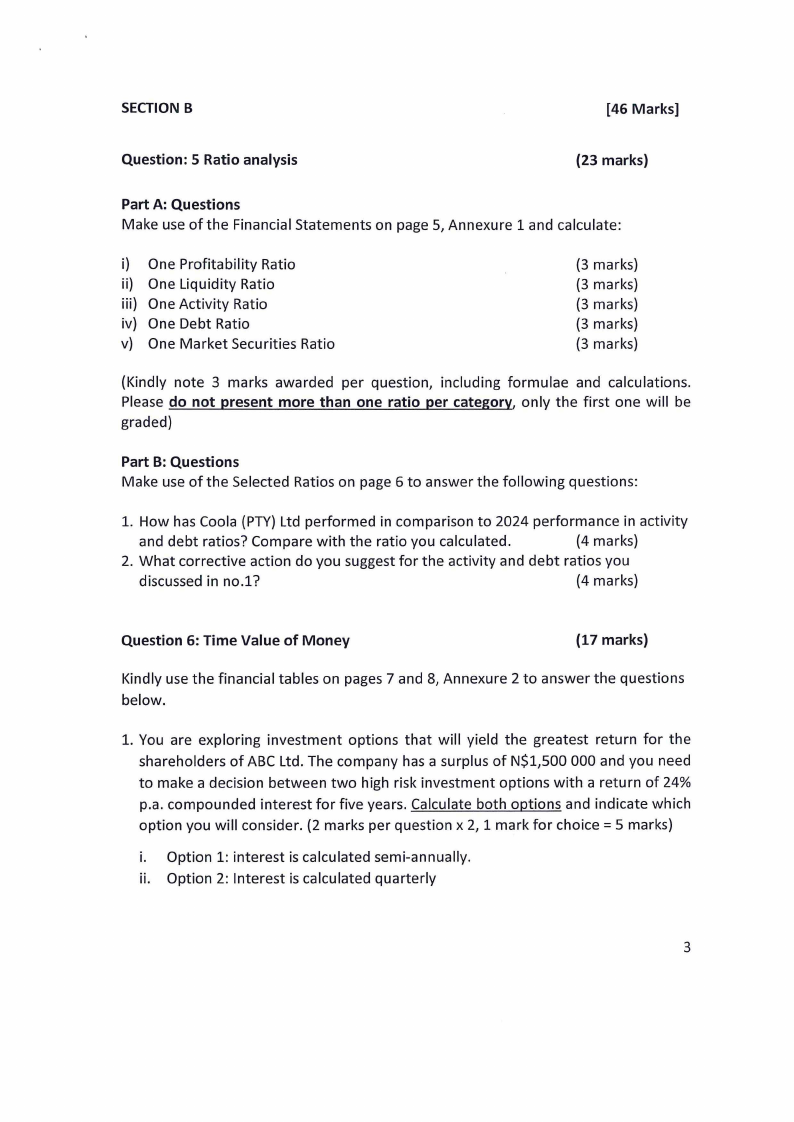
SECTION B
[46 Marks]
Question: 5 Ratio analysis
(23 marks)
Part A: Questions
Make use of the Financial Statements on page 5, Annexure 1 and calculate:
i) One Profitability Ratio
ii) One Liquidity Ratio
iii) One Activity Ratio
iv) One Debt Ratio
v) One Market Securities Ratio
(3 marks)
(3 marks)
(3 marks)
(3 marks)
(3 marks)
(Kindly note 3 marks awarded per question, including formulae and calculations.
Please do not present more than one ratio per category, only the first one will be
graded)
Part B: Questions
Make use of the Selected Ratios on page 6 to answer the following questions:
1. How has Coola (PTY) Ltd performed in comparison to 2024 performance in activity
and debt ratios? Compare with the ratio you calculated.
(4 marks)
2. What corrective action do you suggest for the activity and debt ratios you
discussed in no.1?
(4 marks)
Question 6: Time Value of Money
(17 marks)
Kindly use the financial tables on pages 7 and 8, Annexure 2 to answer the questions
below.
1. You are exploring investment options that will yield the greatest return for the
shareholders of ABC Ltd. The company has a surplus of N$1,500 000 and you need
to make a decision between two high risk investment options with a return of 24%
p.a. compounded interest for five years. Calculate both options and indicate which
option you will consider. (2 marks per question x 2, 1 mark for choice= 5 marks)
i. Option 1: interest is calculated semi-annually.
ii. Option 2: Interest is calculated quarterly
3
|
|
4 Page 4 |
▲back to top |
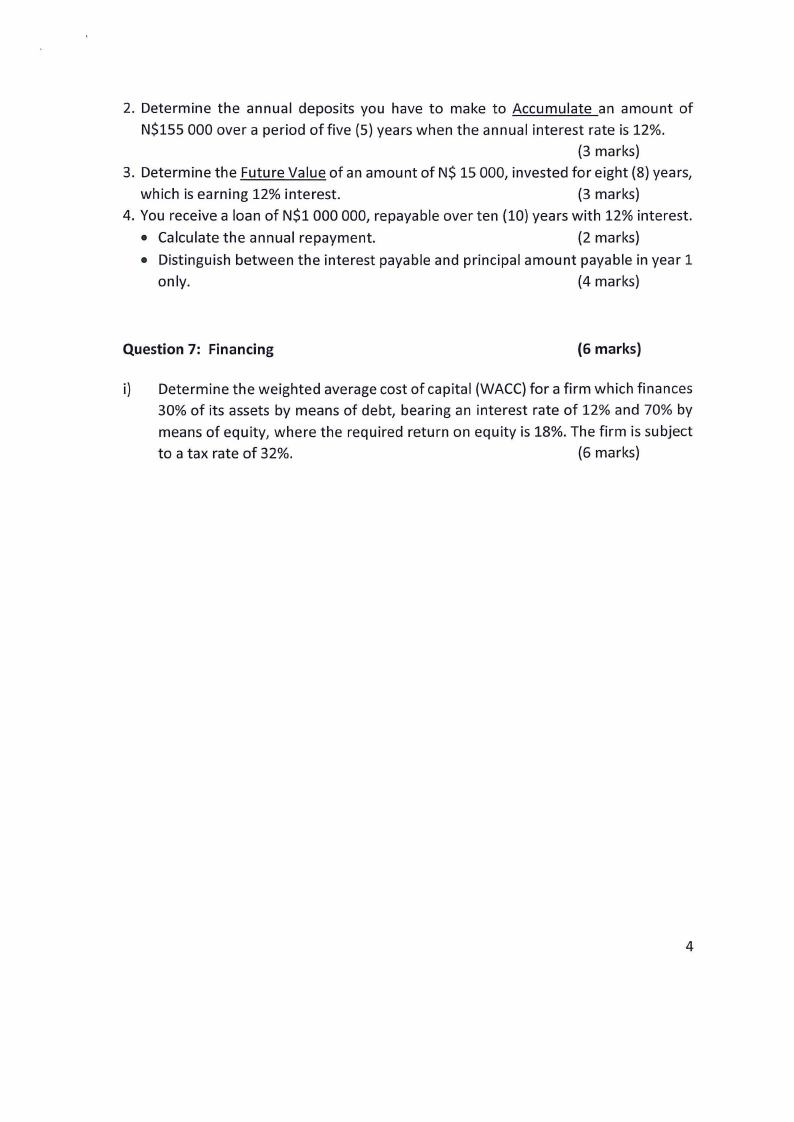
2. Determine the annual deposits you have to make to Accumulate an amount of
N$155 000 over a period of five (5) years when the annual interest rate is 12%.
(3 marks)
3. Determine the Future Value of an amount of N$ 15 000, invested for eight (8) years,
which is earning 12% interest.
(3 marks)
4. You receive a loan of N$1 000 000, repayable over ten (10) years with 12% interest.
• Calculate the annual repayment.
(2 marks)
• Distinguish between the interest payable and principal amount payable in year 1
only.
(4 marks)
Question 7: Financing
(6 marks)
i) Determine the weighted average cost of capital (WACC) for a firm which finances
30% of its assets by means of debt, bearing an interest rate of 12% and 70% by
means of equity, where the required return on equity is 18%. The firm is subject
to a tax rate of 32%.
(6 marks)
4
|
|
5 Page 5 |
▲back to top |
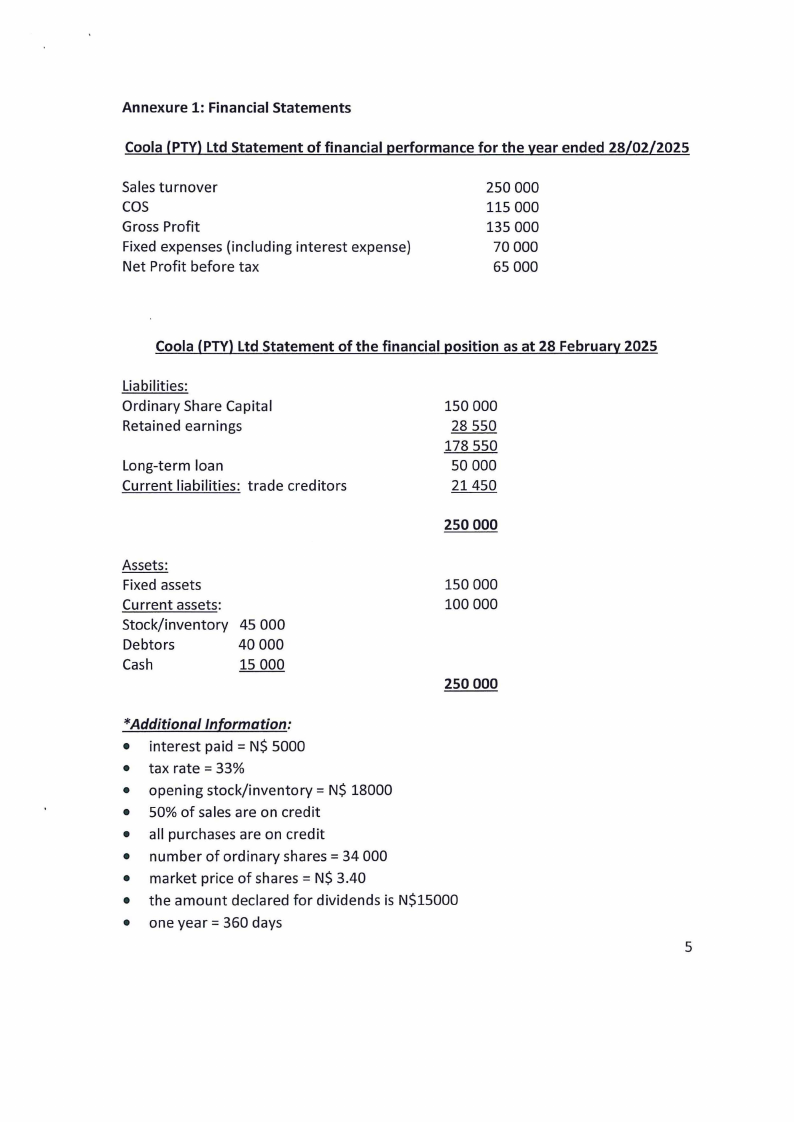
Annexure 1: Financial Statements
Coola {PTY} Ltd Statement of financial performance for the year ended 28/02/2025
Sales turnover
cos
Gross Profit
Fixed expenses (including interest expense)
Net Profit before tax
250 000
115 000
135000
70 000
65 000
Cool a {PTY} Ltd Statement of the financial position as at 28 February 2025
Liabilities:
Ordinary Share Capital
Retained earnings
Long-term loan
Current liabilities: trade creditors
150 000
28 550
178 550
so 000
21450
250 000
Assets:
Fixed assets
Current assets:
Stock/inventory 45 000
Debtors
40 000
Cash
15 000
150 000
100 000
250 000
*Additional Information:
• interest paid = N$ 5000
• tax rate = 33%
• opening stock/inventory= N$ 18000
• 50% of sales are on credit
• all purchases are on credit
• number of ordinary shares = 34 000
• market price of shares= N$ 3.40
• the amount declared for dividends is N$15000
• one year= 360 days
5
|
|
6 Page 6 |
▲back to top |
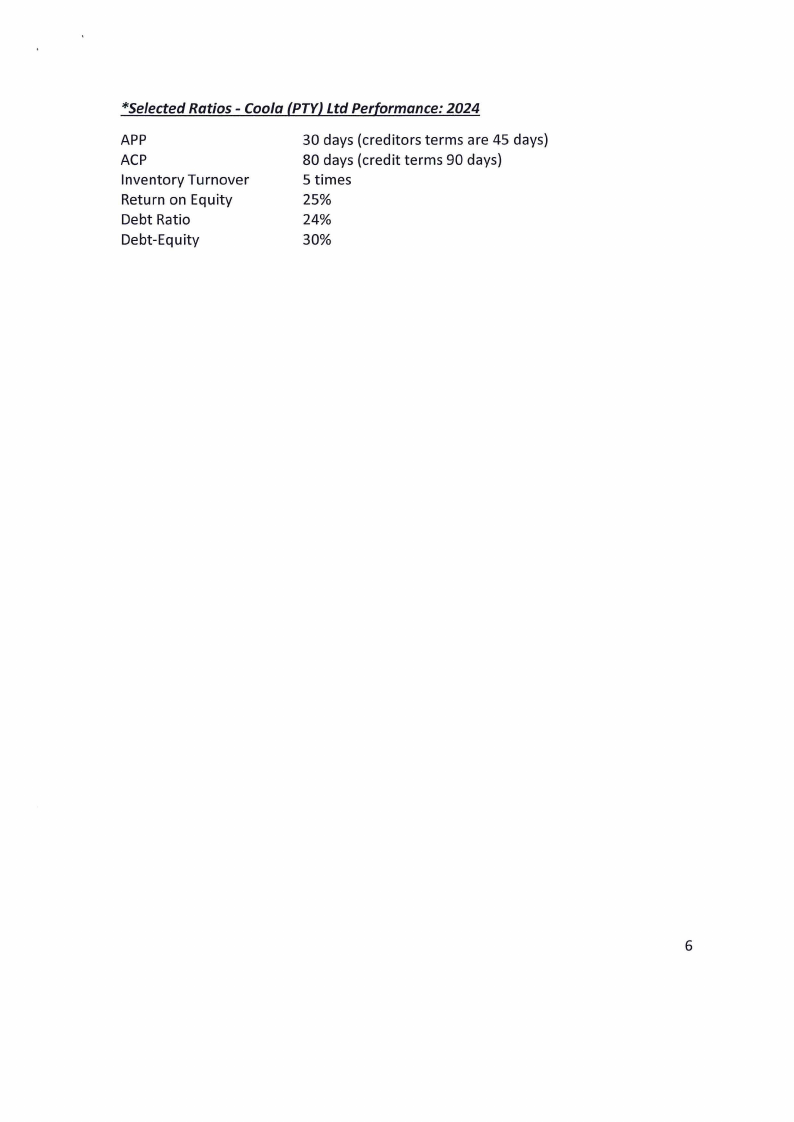
*Selected Ratios - Coo/a (PTY} Ltd Performance: 2024
APP
ACP
Inventory Turnover
Return on Equity
Debt Ratio
Debt-Equity
30 days (creditors terms are 45 days)
80 days (credit terms 90 days)
5 times
25%
24%
30%
6