BAC1100S-BUSINESS ACCOUNTING 1A-1ST OPP-NOV 2025


BAC1100S-BUSINESS ACCOUNTING 1A-1ST OPP-NOV 2025


1 Pages 1-10

▲back to top


1.1 Page 1

▲back to top


nAm I BI A u n IVE RS ITY
OF SCIEnCE Ano TECHnOLOGY
FACULTY OF COMMERCE, HUMAN SCIENCES AND EDUCATION
DEPARTMENT OF ECONOMICS, ACCOUNTING AND FINANCE
COURSE CODE: BACll00S
COURSE NAME: BUSINESS ACCOUNTING lA .
SESSION: OCTOBER/NOVEMBER 2025
PAPER: THEORY AND CALCULATIONS
DURATION: 2 HOURS
MARKS: 80
FIRST OPPORTUNITY EXAMINATION QUESTION PAPER
EXAMINER
MRS B. PETRUS
MODERATOR:
MRS Y. VANWYK
INSTRUCTIONS
1. Answer ALL the questions on the answer sheet
2. Read all the questions carefully before answering.
3. The paper consists of 55 questions.
4. The use of a non-programmable calculator is allowed.
5. All questions count for one mark unless otherwise indicated
6. There is only one correct option, the shading of more than one option
will be marked as incorrect
7. Make sure to shade your student number correctly
THIS QUESTION PAPER CONSISTS OF 15 PAGES (Including this front page)
1

1.2 Page 2

▲back to top


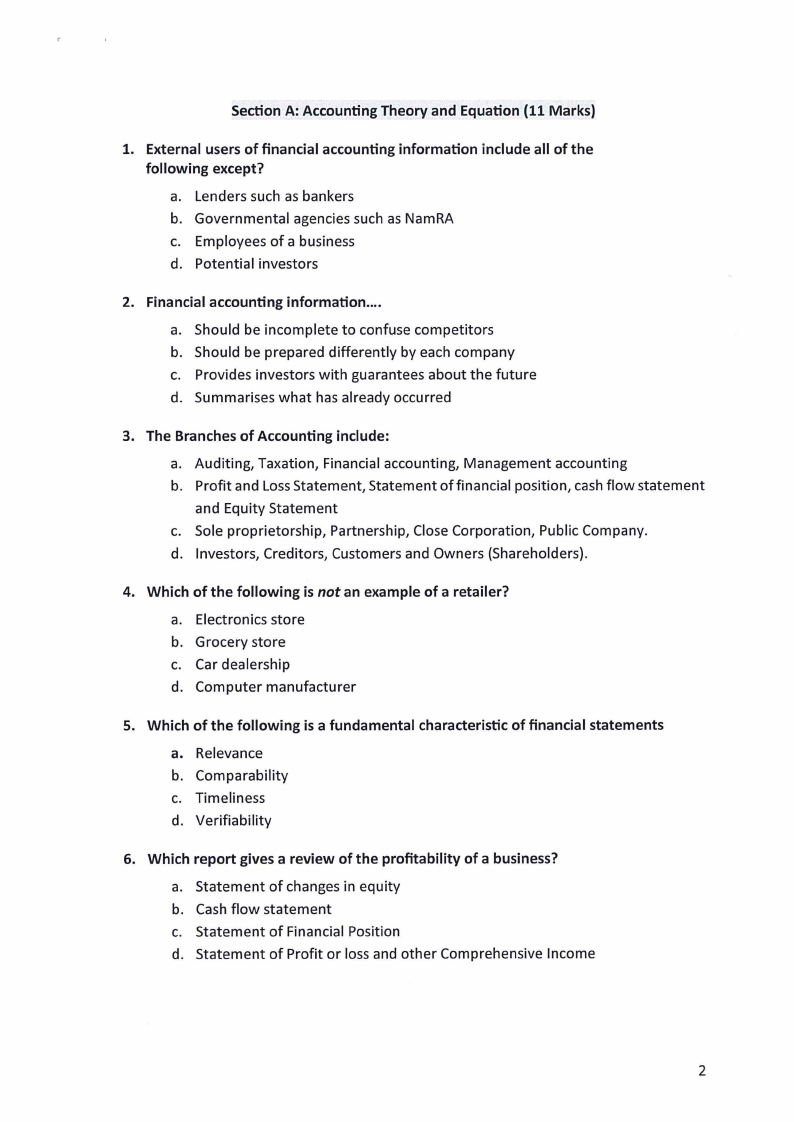
Section A: Accounting Theory and Equation (11 Marks)
1. External users of financial accounting information include all of the
following except?
a. Lenders such as bankers
b. Governmental agencies such as NamRA
c. Employees of a business
d. Potential investors
2. Financial accounting information....
a. Should be incomplete to confuse competitors
b. Should be prepared differently by each company
c. Provides investors with guarantees about the future
d. Summarises what has already occurred
3. The Branches of Accounting include:
a. Auditing, Taxation, Financial accounting, Management accounting
b. Profit and Loss Statement, Statement of financial position, cash flow statement
and Equity Statement
c. Sole proprietorship, Partnership, Close Corporation, Public Company.
d. Investors, Creditors, Customers and Owners (Shareholders).
4. Which of the following is not an example of a retailer?
a. Electronics store
b. Grocery store
c. Car dealership
d. Computer manufacturer
5. Which of the following is a fundamental characteristic of financial statements
a. Relevance
b. Comparability
C. Timeliness
d. Verifiability
6. Which report gives a review of the profitability of a business?
a. Statement of changes in equity
b. Cash flow statement
c. Statement of Financial Position
d. Statement of Profit or loss and other Comprehensive Income
2

1.3 Page 3

▲back to top


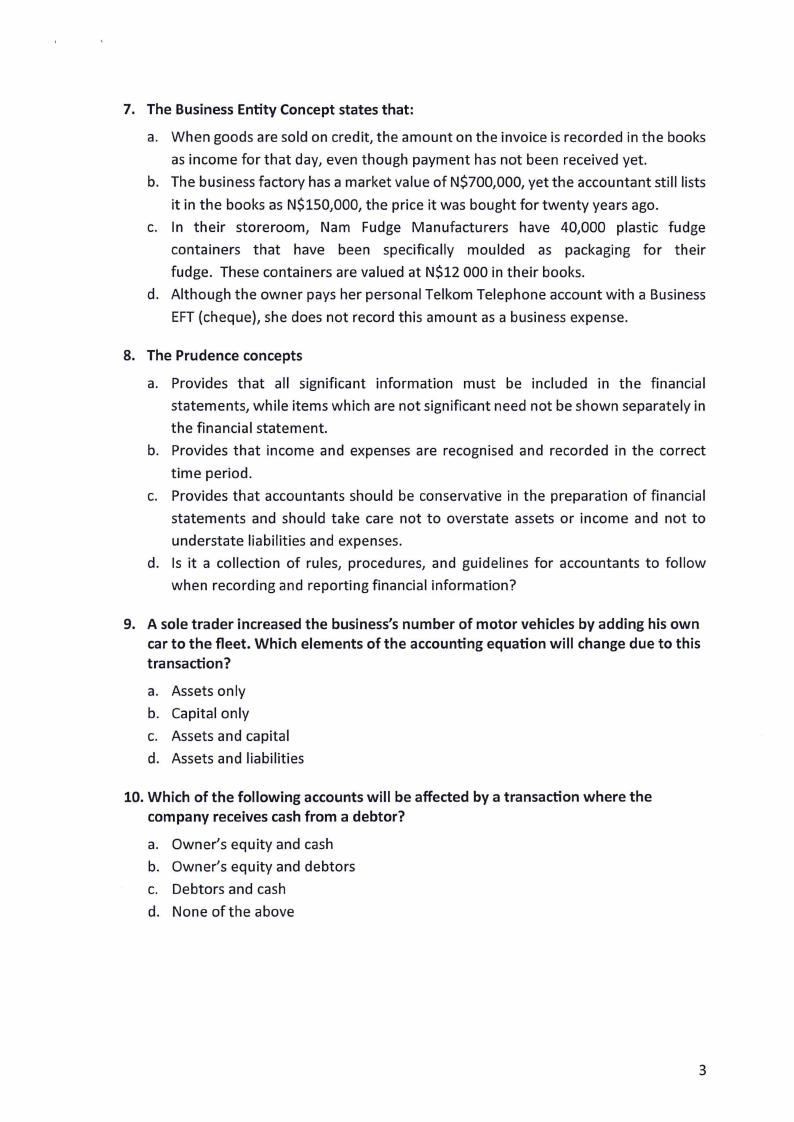
7. The Business Entity Concept states that:
a. When goods are sold on credit, the amount on the invoice is recorded in the books
as income for that day, even though payment has not been received yet.
b. The business factory has a market value of N$700,000, yet the accountant still lists
it in the books as N$150,000, the price it was bought for twenty years ago.
c. In their storeroom, Nam Fudge Manufacturers have 40,000 plastic fudge
containers that have been specifically moulded as packaging for their
fudge. These containers are valued at N$12 000 in their books.
d. Although the owner pays her personal Telkom Telephone account with a Business
EFT (cheque), she does not record this amount as a business expense.
8. The Prudence concepts
a. Provides that all significant information must be included in the financial
statements, while items which are not significant need not be shown separately in
the financial statement.
b. Provides that income and expenses are recognised and recorded in the correct
time period.
c. Provides that accountants should be conservative in the preparation of financial
statements and should take care not to overstate assets or income and not to
understate liabilities and expenses.
d. Is it a collection of rules, procedures, and guidelines for accountants to follow
when recording and reporting financial information?
9. A sole trader increased the business's number of motor vehicles by adding his own
car to the fleet. Which elements of the accounting equation will change due to this
transaction?
a. Assets only
b. Capital only
C. Assets and capital
d. Assets and liabilities
10. Which of the following accounts will be affected by a transaction where the
company receives cash from a debtor?
a. Owner's equity and cash
b. Owner's equity and debtors
c. Debtors and cash
d. None of the above
3

1.4 Page 4

▲back to top


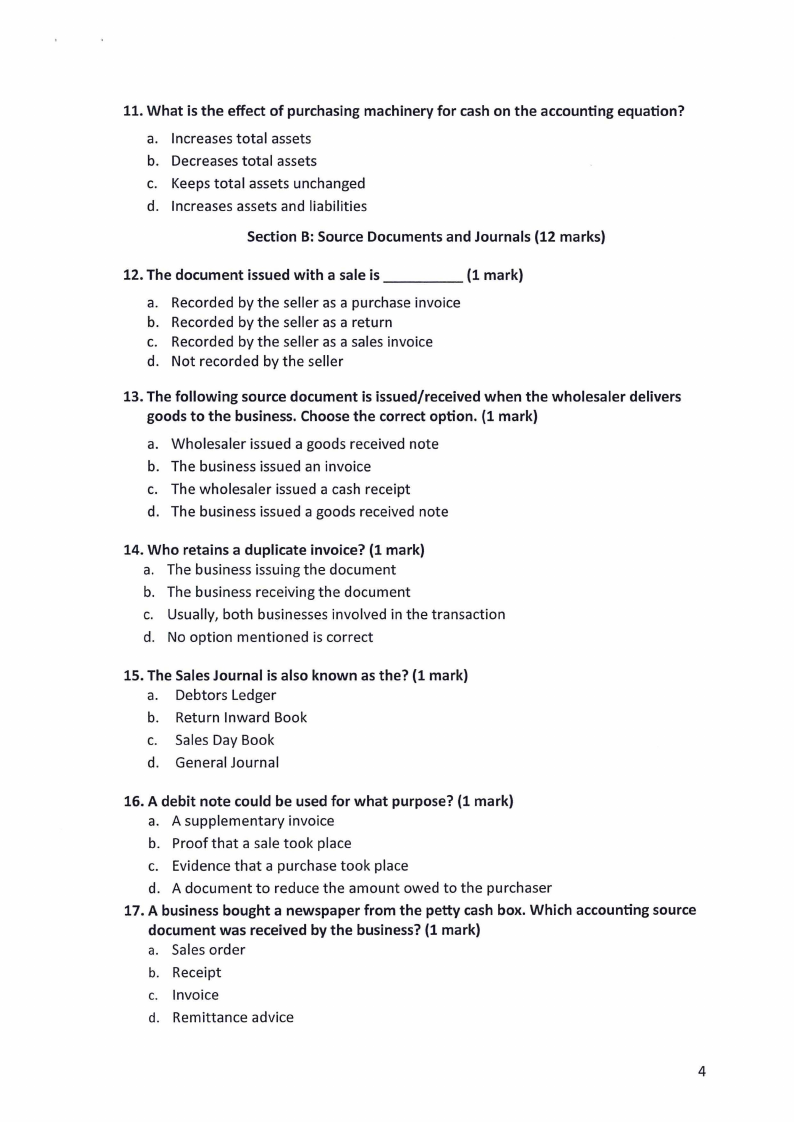
11. What is the effect of purchasing machinery for cash on the accounting equation?
a. Increases total assets
b. Decreases total assets
c. Keeps total assets unchanged
d. Increases assets and liabilities
Section B: Source Documents and Journals (12 marks)
12. The document issued with a sale is _____ (1 mark)
a. Recorded by the seller as a purchase invoice
b. Recorded by the seller as a return
c. Recorded by the seller as a sales invoice
d. Not recorded by the seller
13. The following source document is issued/received when the wholesaler delivers
goods to the business. Choose the correct option. (1 mark)
a. Wholesaler issued a goods received note
b. The business issued an invoice
c. The wholesaler issued a cash receipt
d. The business issued a goods received note
14. Who retains a duplicate invoice? (1 mark)
a. The business issuing the document
b. The business receiving the document
c. Usually, both businesses involved in the transaction
d. No option mentioned is correct
15. The Sales Journal is also known as the? (1 mark)
a. Debtors Ledger
b. Return Inward Book
c. Sales Day Book
d. General Journal
16. A debit note could be used for what purpose? (1 mark)
a. A supplementary invoice
b. Proof that a sale took place
c. Evidence that a purchase took place
d. A document to reduce the amount owed to the purchaser
17. A business bought a newspaper from the petty cash box. Which accounting source
document was received by the business? (1 mark)
a. Sales order
b. Receipt
c. Invoice
d. Remittance advice
4

1.5 Page 5

▲back to top


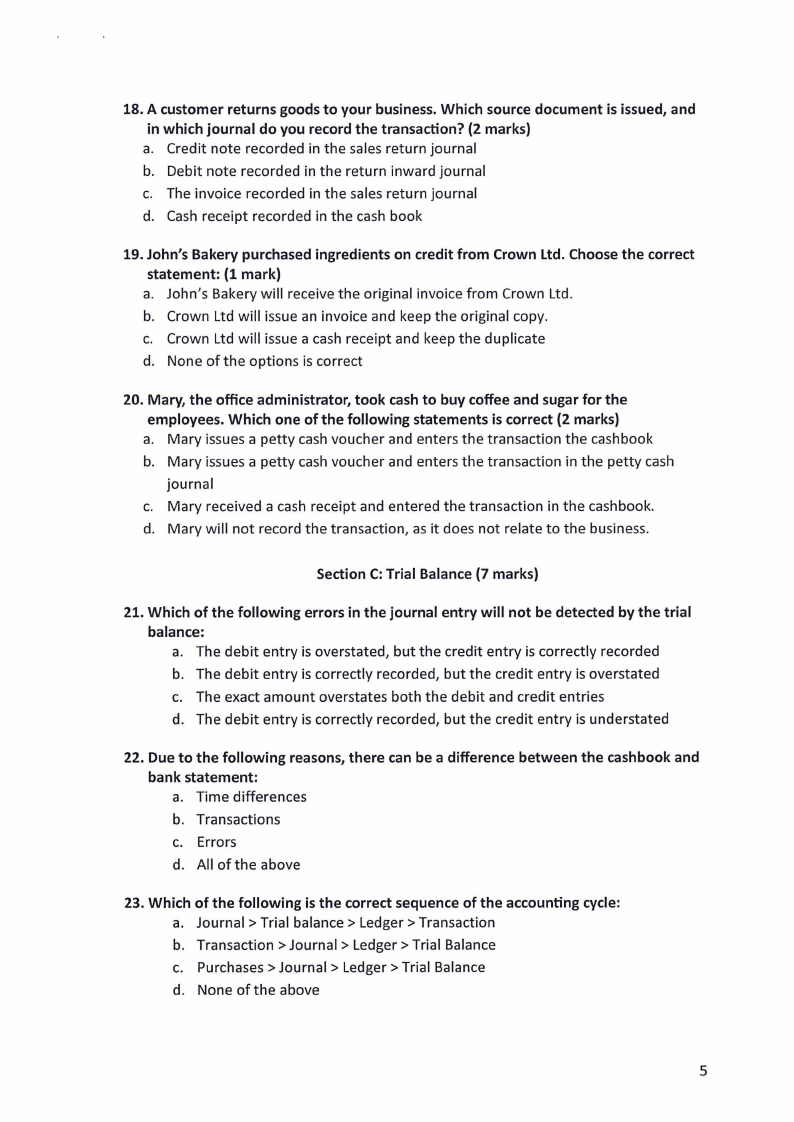
18. A customer returns goods to your business. Which source document is issued, and
in which journal do you record the transaction? (2 marks)
a. Credit note recorded in the sales return journal
b. Debit note recorded in the return inward journal
c. The invoice recorded in the sales return journal
d. Cash receipt recorded in the cash book
19. John's Bakery purchased ingredients on credit from Crown Ltd. Choose the correct
statement: (1 mark)
a. John's Bakery will receive the original invoice from Crown Ltd.
b. Crown Ltd will issue an invoice and keep the original copy.
c. Crown Ltd will issue a cash receipt and keep the duplicate
d. None of the options is correct
20. Mary, the office administrator, took cash to buy coffee and sugar for the
employees. Which one of the following statements is correct (2 marks)
a. Mary issues a petty cash voucher and enters the transaction the cashbook
b. Mary issues a petty cash voucher and enters the transaction in the petty cash
journal
c. Mary received a cash receipt and entered the transaction in the cashbook.
d. Mary will not record the transaction, as it does not relate to the business.
Section C: Trial Balance (7 marks)
21. Which of the following errors in the journal entry will not be detected by the trial
balance:
a. The debit entry is overstated, but the credit entry is correctly recorded
b. The debit entry is correctly recorded, but the credit entry is overstated
c. The exact amount overstates both the debit and credit entries
d. The debit entry is correctly recorded, but the credit entry is understated
22. Due to the following reasons, there can be a difference between the cashbook and
bank statement:
a. Time differences
b. Transactions
c. Errors
d. All of the above
23. Which of the following is the correct sequence of the accounting cycle:
a. Journal > Trial balance> Ledger> Transaction
b. Transaction > Journal > Ledger> Trial Balance
c. Purchases > Journal > Ledger> Trial Balance
d. None of the above
5

1.6 Page 6

▲back to top


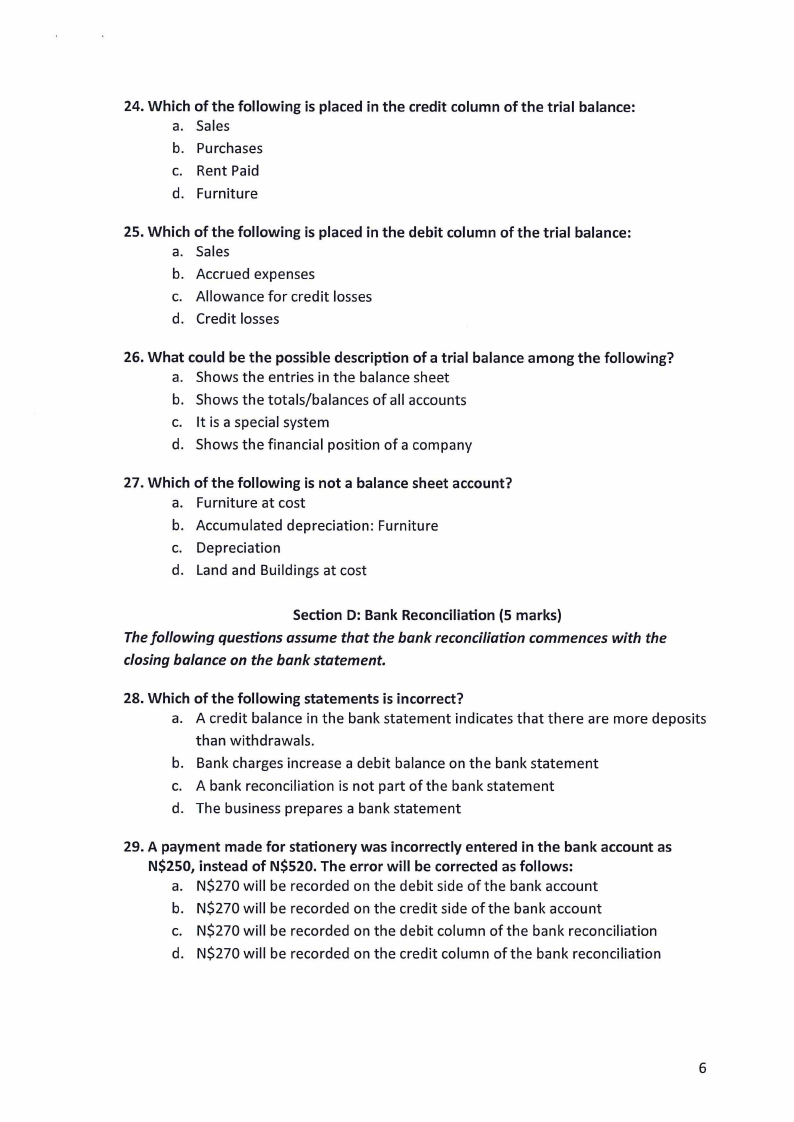
24. Which of the following is placed in the credit column of the trial balance:
a. Sales
b. Purchases
c. Rent Paid
d. Furniture
25. Which of the following is placed in the debit column of the trial balance:
a. Sales
b. Accrued expenses
c. Allowance for credit losses
d. Credit losses
26. What could be the possible description of a trial balance among the following?
a. Shows the entries in the balance sheet
b. Shows the totals/balances of all accounts
c. It is a special system
d. Shows the financial position of a company
27. Which of the following is not a balance sheet account?
a. Furn iture at cost
b. Accumulated depreciation: Furniture
c. Depreciation
d. Land and Buildings at cost
Section D: Bank Reconciliation (5 marks)
The following questions assume that the bank reconciliation commences with the
closing balance on the bank statement.
28. Which of the following statements is incorrect?
a. A credit balance in the bank statement indicates that there are more deposits
than withdrawals.
b. Bank charges increase a debit balance on the bank statement
c. A bank reconciliation is not part of the bank statement
d. The business prepares a bank statement
29. A payment made for stationery was incorrectly entered in the bank account as
N$250, instead of N$520. The error will be corrected as follows:
a. N$270 will be recorded on the debit side of the bank account
b. N$270 will be recorded on the credit side of the bank account
c. N$270 will be recorded on the debit column of the bank reconciliation
d. N$270 will be recorded on the credit column of the bank reconciliation
6

1.7 Page 7

▲back to top


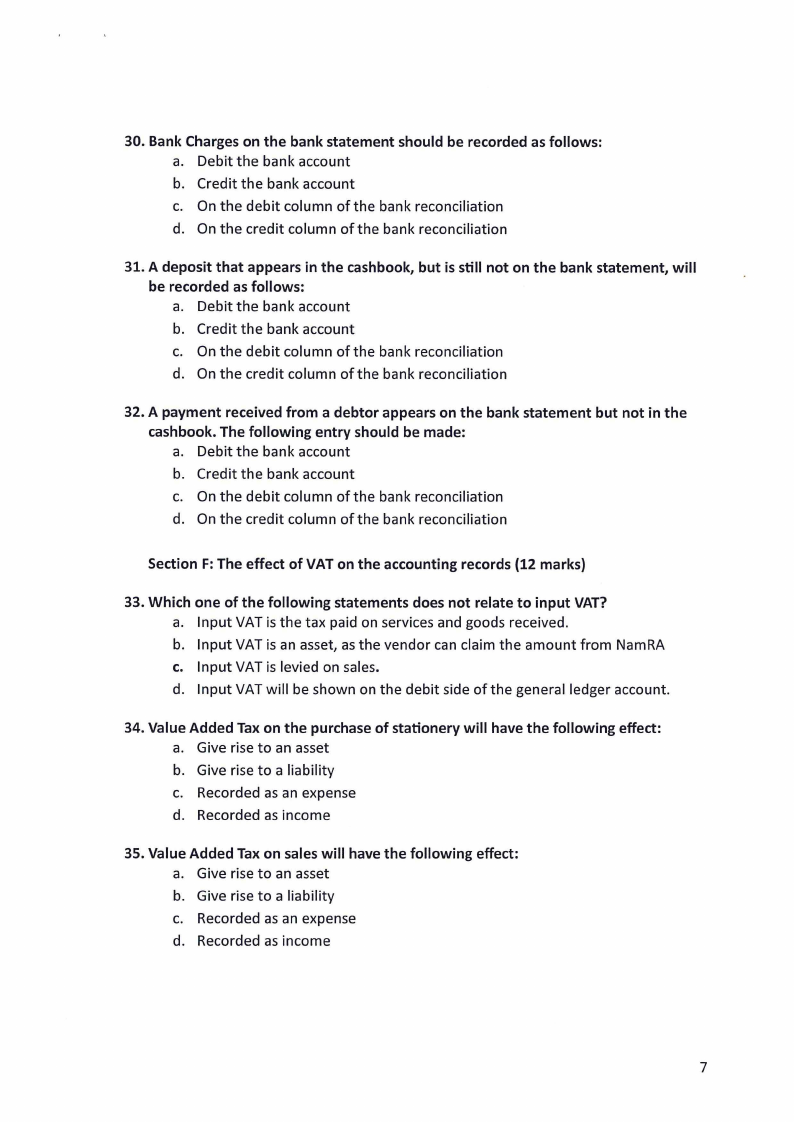
30. Bank Charges on the bank statement should be recorded as follows:
a. Debit the bank account
b. Credit the bank account
c. On the debit column of the bank reconciliation
d. On the credit column of the bank reconciliation
31. A deposit that appears in the cashbook, but is still not on the bank statement, will
be recorded as follows:
a. Debit the bank account
b. Credit the bank account
c. On the debit column of the bank reconciliation
d. On the credit column of the bank reconciliation
32. A payment received from a debtor appears on the bank statement but not in the
cashbook. The following entry should be made:
a. Debit the bank account
b. Credit the bank account
c. On the debit column of the bank reconciliation
d. On the credit column of the bank reconciliation
Section F: The effect of VAT on the accounting records (12 marks)
33. Which one of the following statements does not relate to input VAT?
a. Input VAT is the tax paid on services and goods received.
b. Input VAT is an asset, as the vendor can claim the amount from Nam RA
c. Input VAT is levied on sales.
d. Input VATwill be shown on the debit side of the general ledger account.
34. Value Added Tax on the purchase of stationery will have the following effect:
a. Give rise to an asset
b. Give rise to a liability
c. Recorded as an expense
d. Recorded as income
35. Value Added Tax on sales will have the following effect:
a. Give rise to an asset
b. Give rise to a liability
c. Recorded as an expense
d. Recorded as income
7

1.8 Page 8

▲back to top


36. Value Added is not accounted for in which one of the following:
a. Sales to farmers
b. Purchases from wholesalers
c. Salaries and wages
d. Motor vehicle oil
37. Assuming VAT is inclusive, then VAT on an amount of N$90,000 will be calculated as
(2 marks)
a. N$90,000 X 15%
b. N$90,000 x 15/115
C. N$90,000 X 115/15
d. None of the above is correct
38. Assuming the business sells goods for N$8,0S0 and purchases for N$3,450.
Calculate the VAT net effect. VAT is inclusive in this scenario (2 marks)
a. N$600 liability
b. N$600 income
c. N$690 liability
d. N$690 income
39. Assuming the business sells goods for N$9,000 and purchases for N$4,000.
Calculate the VAT net effect. VAT is exclusive in this scenario (2 marks)
a. N$750 expense
b. N$750 liability
c. N$522 asset
d. N$522 expense
40. VAT on N$10,000 interest paid to the bank will be calculated as
a. N$10,000 X 15%
b. N$10,000 x 15/115
c. N$10,000 x 100/115
d. None of the above
41. The VAT percentage on Mahangu is?
a. 10%
b. 12%
C. 15%
d. 0%
8

1.9 Page 9

▲back to top


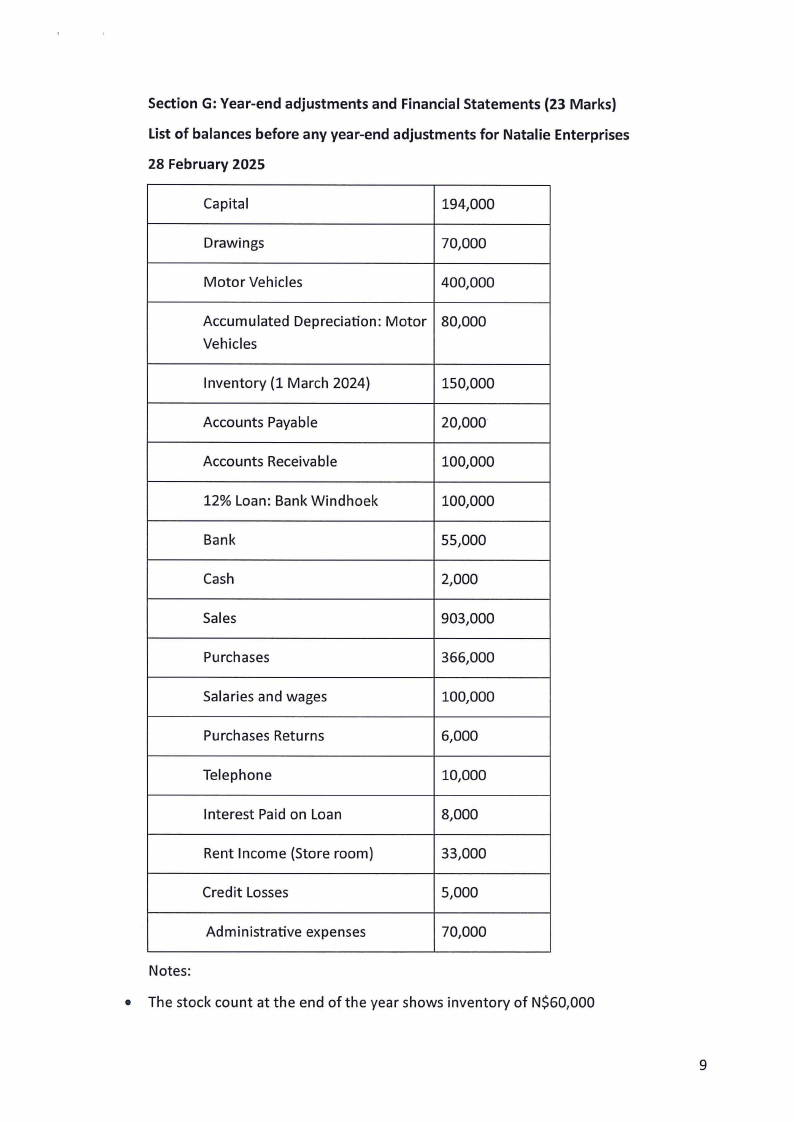
Section G: Year-end adjustments and Financial Statements (23 Marks)
List of balances before any year-end adjustments for Natalie Enterprises
28 February 2025
Capital
194,000
Drawings
70,000
Motor Vehicles
400,000
Accumulated Depreciation: Motor 80,000
Vehicles
Inventory (1 March 2024)
150,000
Accounts Payable
20,000
Accounts Receivable
100,000
12% Loan: Bank Windhoek
100,000
Bank
55,000
Cash
2,000
Sales
903,000
Purchases
366,000
Salaries and wages
100,000
Purchases Returns
6,000
Telephone
10,000
Interest Paid on Loan
8,000
Rent Income (Store room)
33,000
Credit Losses
5,000
Administrative expenses
70,000
Notes:
• The stock count at the end of the year shows inventory of N$60,000
9

1.10 Page 10

▲back to top


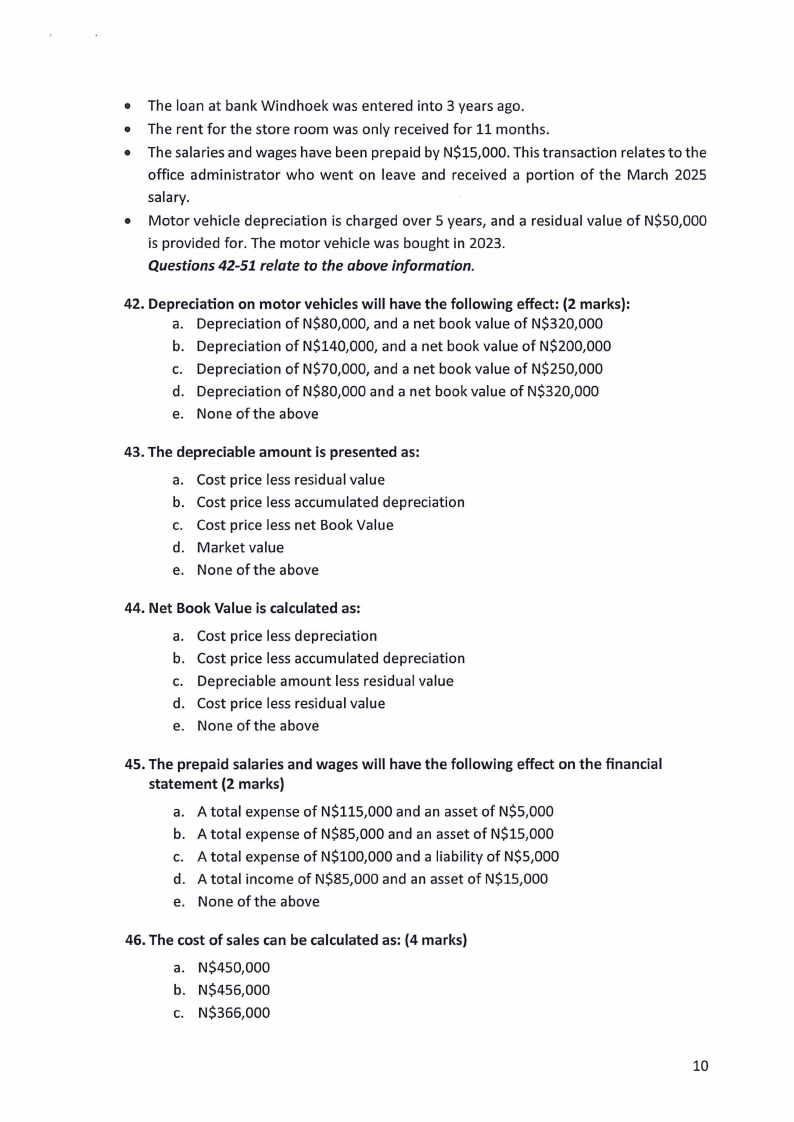
• The loan at bank Windhoek was entered into 3 years ago.
• The rent for the store room was only received for 11 months.
The salaries and wages have been prepaid by N$15,000. This transaction relates to the
office administrator who went on leave and received a portion of the March 2025
salary.
Motor vehicle depreciation is charged over 5 years, and a residual value of N$50,000
is provided for. The motor vehicle was bought in 2023.
Questions 42-51 relate to the above information.
42. Depreciation on motor vehicles will have the following effect: (2 marks):
a. Depreciation of N$80,000, and a net book value of N$320,000
b. Depreciation of N$140,000, and a net book value of N$200,000
c. Depreciation of N$70,000, and a net book value of N$250,000
d. Depreciation of N$80,000 and a net book value of N$320,000
e. None of the above
43. The depreciable amount is presented as:
a. Cost price less residual value
b. Cost price less accumulated depreciation
c. Cost price less net Book Value
d. Market value
e. None of the above
44. Net Book Value is calculated as:
a. Cost price less depreciation
b. Cost price less accumulated depreciation
c. Depreciable amount less residual value
d. Cost price less residual value
e. None of the above
45. The prepaid salaries and wages will have the following effect on the financial
statement (2 marks)
a. A total expense of N$115,000 and an asset of N$5,000
b. A total expense of N$85,000 and an asset of N$15,000
c. A total expense of N$100,000 and a liability of N$5,000
d. A total income of N$85,000 and an asset of N$15,000
e. None of the above
46. The cost of sales can be calculated as: (4 marks)
a. N$450,000
b. N$456,000
c. N$366,000
10

2 Pages 11-20

▲back to top


2.1 Page 11

▲back to top


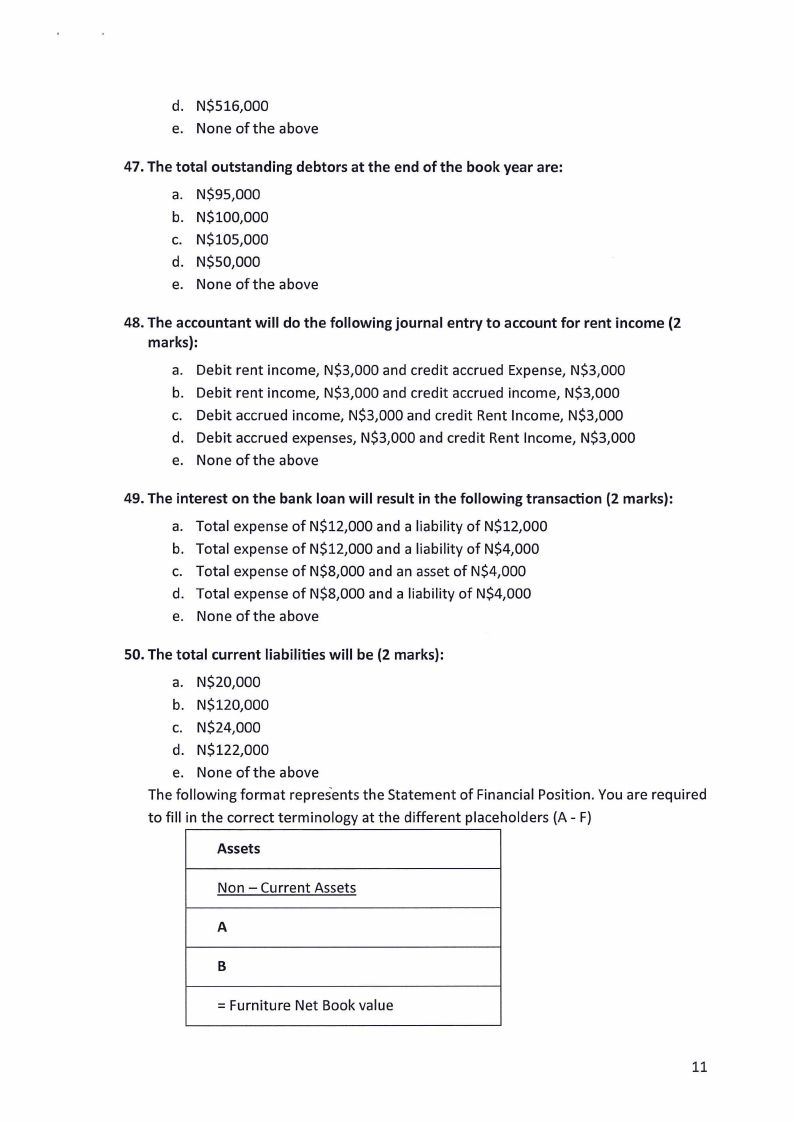
d. N$516,000
e. None of the above
47. The total outstanding debtors at the end of the book year are:
a. N$95,000
b. N$100,000
c. N$105,000
d. N$50,000
e. None of the above
48. The accountant will do the following journal entry to account for rent income (2
marks):
a. Debit rent income, N$3,000 and credit accrued Expense, N$3,000
b. Debit rent income, N$3,000 and credit accrued income, N$3,000
c. Debit accrued income, N$3,000 and credit Rent Income, N$3,000
d. Debit accrued expenses, N$3,000 and credit Rent Income, N$3,000
e. None of the above
49. The interest on the bank loan will result in the following transaction (2 marks):
a. Total expense of N$12,000 and a liability of N$12,000
b. Total expense of N$12,000 and a liability of N$4,000
c. Total expense of N$8,000 and an asset of N$4,000
d. Total expense of N$8,000 and a liability of N$4,000
e. None of the above
SO. The total current liabilities will be (2 marks):
a. N$20,000
b. N$120,000
C. N$24,000
d. N$122,000
e. None of the above
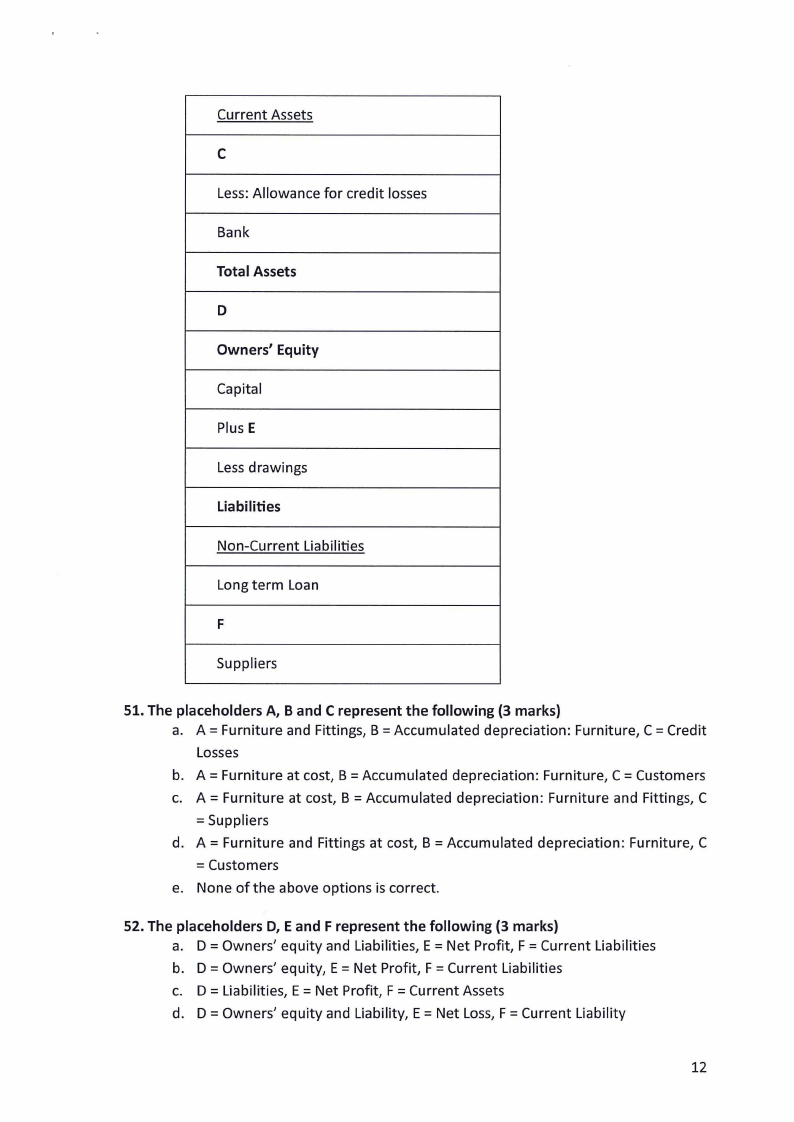
The following format represents the Statement of Financial Position. You are required
to fill in the correct terminology at the different placeholders (A - F)
Assets
Non - Current Assets
A
B
= Furniture Net Book value
11

2.2 Page 12

▲back to top


Current Assets
C
Less: Allowance for credit losses
Bank
Total Assets
D
Owners' Equity
Capital
Plus E
Less drawings
Liabilities
Non-Current Liabilities
Long term Loan
F
Suppliers
51. The placeholders A, B and C represent the following (3 marks)
a. A= Furniture and Fittings, B = Accumulated depreciation: Furniture, C = Credit
Losses
b. A= Furniture at cost, B = Accumulated depreciation: Furniture, C = Customers
c. A= Furniture at cost, B = Accumulated depreciation: Furniture and Fittings, C
= Suppliers
d. A= Furniture and Fittings at cost, B = Accumulated depreciation: Furniture, C
= Customers
e. None of the above options is correct.
52. The placeholders D, E and F represent the following (3 marks)
a. D = Owners' equity and Liabilities, E = Net Profit, F = Current Liabilities
b. D = Owners' equity, E = Net Profit, F = Current Liabilities
c. D = Liabilities, E = Net Profit, F = Current Assets
d. D = Owners' equity and Liability, E = Net Loss, F = Current Liability
12

2.3 Page 13

▲back to top


Section H: The General Ledger (10 Marks)
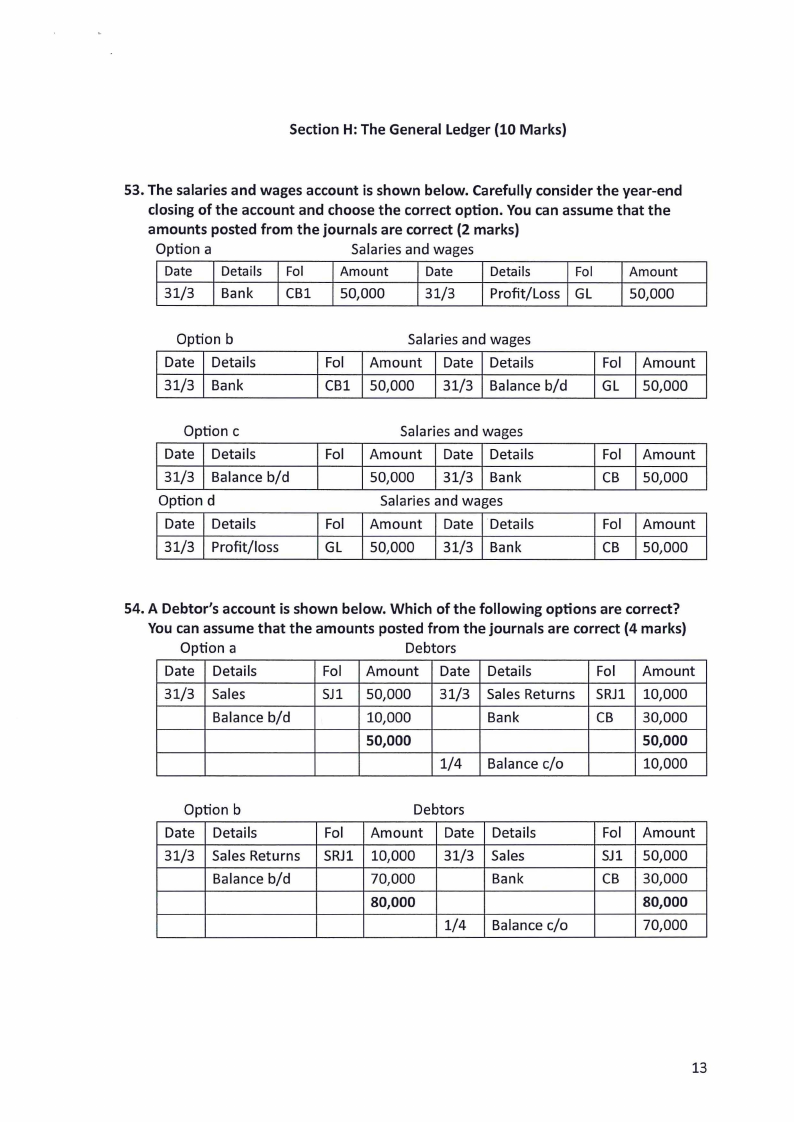
53. The salaries and wages account is shown below. Carefully consider the year-end
closing of the account and choose the correct option. You can assume that the
amounts posted from the journals are correct (2 marks)
Option a
Salaries and wages
Date Details Fol
Amount
Date
Details
Fol
Amount
31/3 Bank CBl 50,000
31/3
Profit/Loss GL
50,000
Option b
Date Details
31/3 Bank
Salaries and wages
Fol Amount Date Details
CBl 50,000 31/3 Balance b/d
Fol Amount
GL 50,000
Option c
Date Details
31/3 Balance b/d
Option d
Date Details
31/3 Profit/loss
Salaries and wages
Fol Amount Date Details
50,000 31/3 Bank
Salaries and wages
Fol Amount Date Details
GL 50,000 31/3 Bank
Fol Amount
CB 50,000
Fol Amount
CB 50,000
54. A Debtor's account is shown below. Which of the following options are correct?
You can assume that the amounts posted from the journals are correct (4 marks)
Option a
Debtors
Date Details
Fol Amount Date Details
Fol Amount
31/3 Sales
SJl 50,000 31/3 Sales Returns SRJl 10,000
Balance b/d
10,000
Bank
CB 30,000
50,000
50,000
1/4 Balance c/o
10,000
Option b
Date Details
31/3 Sales Returns
Balance b/d
Fol
SRJl
Debtors
Amount Date
10,000 31/3
70,000
80,000
1/4
Details
Sales
Bank
Balance c/o
Fol Amount
SJl 50,000
CB 30,000
80,000
70,000
13

2.4 Page 14

▲back to top


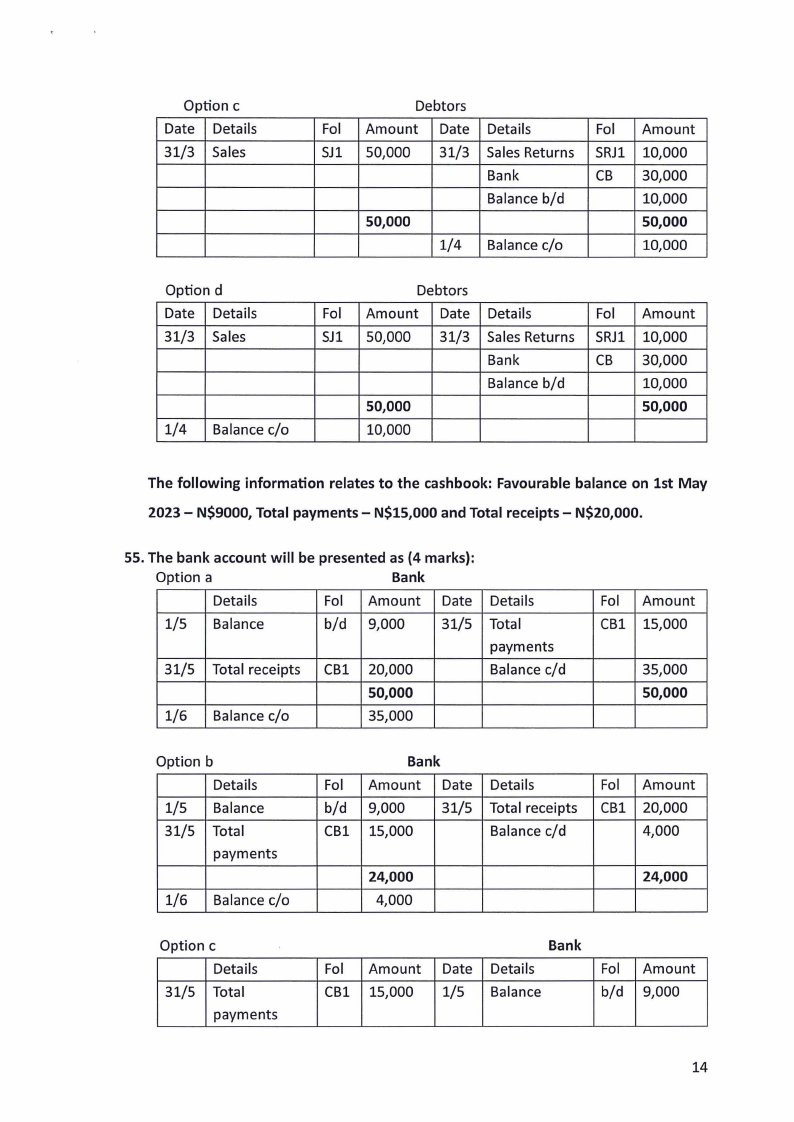
Option c
Date Details
31/3 Sales
Debtors
Fol Amount Date Details
Fol Amount
SJl 50,000 31/3 Sales Returns SRJl 10,000
Bank
CB 30,000
Balance b/d
10,000
50,000
50,000
1/4 Balance c/o
10,000
Option d
Date Details
31/3 Sales
1/4 Balance c/o
Debtors
Fol Amount Date Details
Fol Amount
SJl 50,000 31/3 Sales Returns SRJl 10,000
Bank
CB 30,000
Balance b/d
10,000
50,000
50,000
10,000
The following information relates to the cashbook: Favourable balance on 1st May
2023 - N$9000, Total payments - N$15,000 and Total receipts - N$20,000.
55. The bank account will be presented as (4 marks):
Option a
Bank
Details
Fol Amount Date
1/5 Balance
b/d 9,000 31/5
31/5 Total receipts
1/6 Balance c/o
CBl 20,000
50,000
35,000
Details
Total
payments
Balance c/d
Fol Amount
CBl 15,000
35,000
50,000
Option b
Details
1/5 Balance
31/5 Total
payments
1/6 Balance c/o
Bank
Fol Amount Date Details
b/d 9,000
31/5 Total receipts
CBl 15,000
Balance c/d
Fol Amount
CBl 20,000
4,000
24,000
4,000
24,000
Option c
Details
31/5 Total
payments
Bank
Fol Amount Date Details
Fol Amount
CBl 15,000 1/5 Balance
b/d 9,000
14

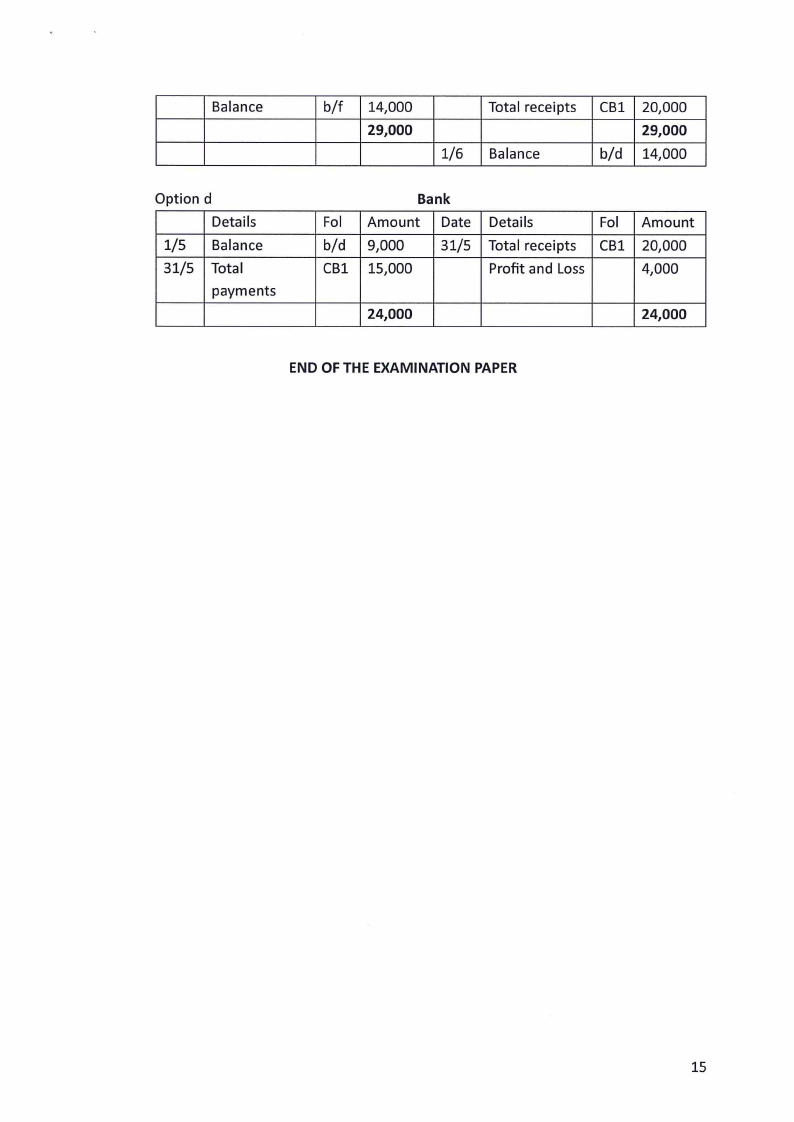
2.5 Page 15

▲back to top


Balance
Option d
Details
1/5 Balance
31/5 Total
payments
b/f 14,000
29,000
Total receipts CBl 20,000
29,000
1/6 Balance
b/d 14,000
Bank
Fol Amount Date Details
Fol Amount
b/d 9,000
31/5 Total receipts CBl 20,000
CBl 15,000
Profit and Loss
4,000
24,000
24,000
END OF THE EXAMINATION PAPER
15

2.6 Page 16

▲back to top


Student Name
Student Number
_I--~'-'--~
Mode of study/centre
I
I
0co
I
Q,
D
tl
w
1
(,;~'\\;
\\r.r.~>
1---;::,
\\..'0
,r..E:.>·,J
,r-i1/
23
0C~©C0<D
45
(~(~)(£)@©
(;_\\rs' ® 2 ,!:..) \\.::_) (c~\\) r\\.c_:i:':\\/ ~\\::\\) 24 @ c:D@<E) 46 (~®©@(~)
a
-l()
l()
C
Cl
3
(,~>.J
1c·,
\\v
fr\\
,.<~j
(-\\
-~;
r\\_~-__\\;
25
G)Ct©@CD
47
~,
(~
~--\\
(_§_;
/--.,
\\..'.:)
,f.r!-V,
\\f,_c~_\\)
0
~
cu
<(
~
4
(~(0(0(~)®
26
(;)(0(~)@®
48
'r-::9·
C·.-v,
~-'\\
C~)
r,':.\\
\\0
r;-,
1...0
C
E
cu
(!) 5 c~ (D (s) @) (l') 27 c~) ® @) (0 © 49 G) CI) (s) @CI)
X
Ll.J
-a. 6 c~®CD@)G) 28 C0C0©@<D 50 c~~)G)C:0(D
N
c~ ,.0 7 \\r !'J 0 \\~) ~ \\.::) ~ \\..!V~ ,.0 29 ~~~ -~ r~ "~?J~ t.._Si 51 0 .. ~ ~ c.~j ~ 1,.9~ 1,_9J~ t..v
+-'
Vl
..--t
<(
u..--t
<(
cc
9 c;) ct(~) CB (E) 31 0 (0 (~)CB® 53 0 C~) (~) (E) CD
10 G> ®@(£) (I) 32 G> c~ @) (0 © 54 (~J CI) C~)@(I)
11 0®@@)(D 33 C0C~)@)C~)® 55 c~®~)(~)(D
-------
12 C~®(0@® 34 @®©@CD
13 G) CE)©(~) (I) 35 G) (~ @) C0 Ci)
14 0(0@)@)CD 36 0 CtC0CEJ(E)
15
\\r..;::;_,)
I~P.~B'
r\\'-::c,.\\}
r,i.o'.-:::::'-J,
CE\\
\\._:,I
37
\\r,.-~,
,=-,
(~j
,r.S.:J,
,c.0·
\\r.--~-.).
16 0®©@)(D 38 0®©@C:D
17
(,2-,}
~,
t__~)
rr-,
\\.::,}
\\,.-!V-,
'r-:-:~-\\
39
(-, ,,....... r~ ;--;;, r::-,
\\~ \\.~ \\.0 ,_?j ,._Si
18 G)Ct©(0(I) 40 G)Ct©CGCD
19 c;) ct (~) CB (E) 41 c;) (0 (~) CB ®
20 @~)©Co)(D 42 (9~)©@®
Student Nr
21 @®©@)(~) 43 c~C0©@<D
22 C~®©C0® 44 C~®(0@)®