BAC1200S-BUSINESS ACCOUNTING 1B-2ND OPP-DEC 2025


BAC1200S-BUSINESS ACCOUNTING 1B-2ND OPP-DEC 2025


1 Pages 1-10

▲back to top


1.1 Page 1

▲back to top


n Am I BI A u n IVE RS ITV
OF SCI En CE Ano TECH n OLOGY
FACULTY OF COMMERCE, HUMAN SCIENCES AND EDUCATION
DEPARTMENT OF ECONOMICS, ACCOUNTING AND FINANCE
COURSE CODE: BAC1200S
COURSE NAME: BUSINESS ACCOUNTING lB
SESSION: DECEMBER 2025
DURATION: 2 HOURS
PAPER: THEORY AND CALCULATIONS
MARKS: 100
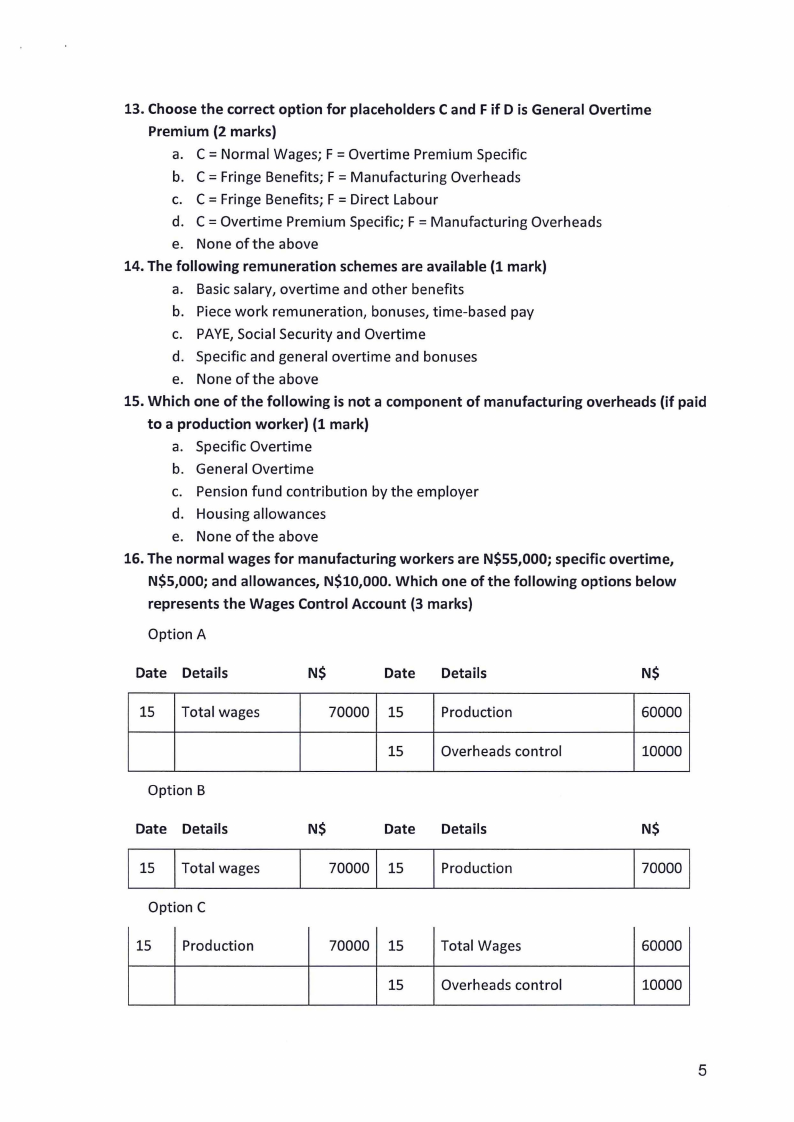
SUPPLEMENTARY EXAMINATION PAPER
EXAMINER
DR Z. VAN DER WALT
MODERATOR:
MR G. SHEEHAMA
Answer ALL the questions on the answer sheet
Read all the questions carefully before answering.
This paper consists of 53 questions.
All questions count for one mark unless otherwise indicated
There is only one correct option, the shading of more than one
option will be marked as incorrect
Make sure to shade your student number correctly
THIS MEMORANDUM CONSISTS OF 16 PAGES (Including this front page)
"Develop a passion for learning. If you do, you will never cease to grow"
1

1.2 Page 2

▲back to top


Questions 1-3
Introduction of Cost Accounting (Theory) (3 Questions x 1 mark)
1. Which one of the following statements is incorrect (1 mark)
a. Financial Accounting uses historical information.
b. No specific body or organisation govern Financial Accounting.
c. Financial Accounting produces statements for external users.
d. A cash flow statement is part of a set of financial statements.
e. None of the above.
2. Sunk costs refer to (1 mark)
a. Costs directly influenced by the decisions of the unit manager
b. Costs that should be incurred in a specific production process
c. Past costs that are now irrevocable
a. Costs that may be eliminated if production levels decrease
b. None of the above
3. Which of the following best describes a fixed cost (1 mark)
a. It may change in total where such a change is unrelated to units of production
b. It may change in total where such a change is related to units of production
c. It remains constant per unit produced
d. It may change in total, depending on production within a relevant range.
e. None of the above
Questions 4-11
Materials and inventory control (Theory, application and calculations) (16 marks)
4. Which entry is recorded when materials are transferred to production? (2 marks)
a. Debit Raw Materials and Credit Work in Process
b. Debit Manufacturing Overhead and Credit Raw Materials
c. Debit Materials Expense and Credit Raw Materials
d. Debit Work in Process and Credit Raw Materials
5. Which entry is recorded when materials with a cost of N$20,000 are sold to a
customer? The customer paid cash for the goods (4 marks)
a. Debit cost of sales, credit finished goods, debit bank, credit Sales
b. Debit finished goods, credit cost of sales, debit bank, credit Sales
c. Debit finished goods, credit cost of sales, debit bank, credit cash sales
d. Debit finished goods, credit cost of sales, debit bank, credit cash sales
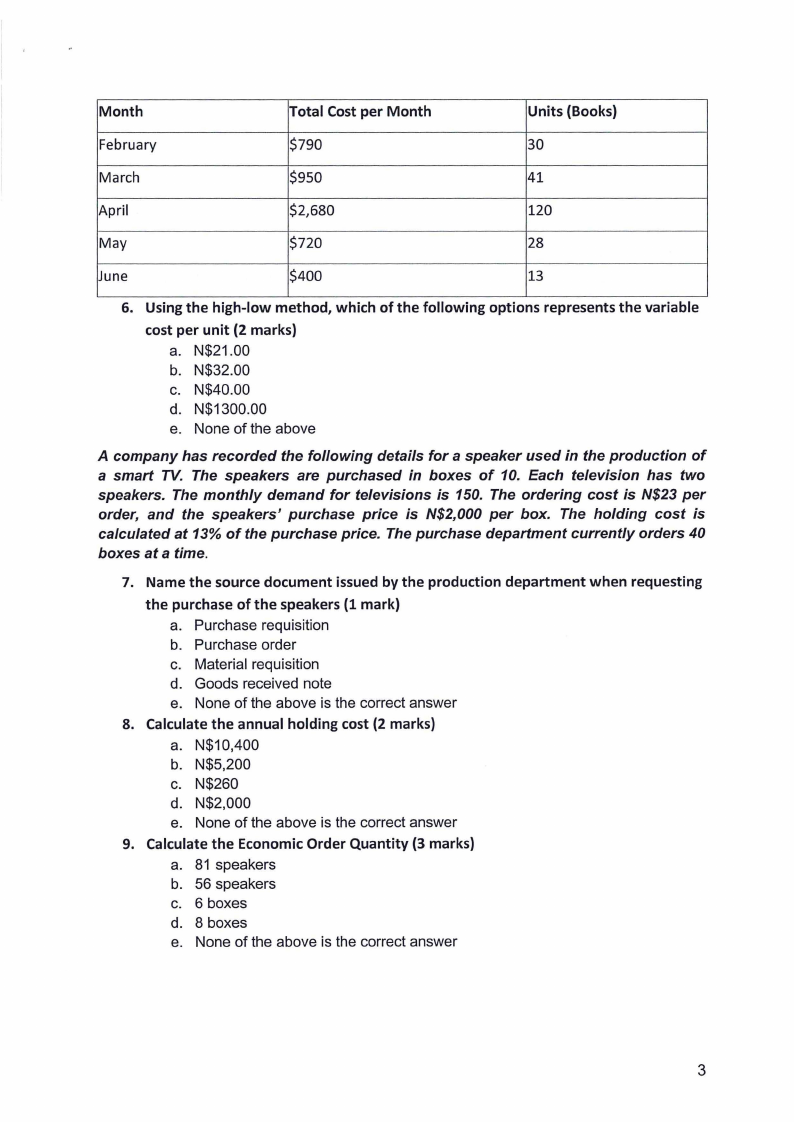
This information relates to Question 6. Below are the company's costs per month, along
with the units produced, specifically baby bottles, for a six-month period. When performing
these calculations, round the amount to the nearest N$ throughout. (Example: N$10.50 will
become N$11.00, but N$10.49 will remain N$10.00)
Month
January
Total Cost per Month
$1,650
Units (Books)
70
2

1.3 Page 3

▲back to top


Month
Total Cost per Month
Units (Books)
February
$790
30
March
$950
41
April
$2,680
120
May
$720
28
June
$400
13
6. Using the high-low method, which of the following options represents the variable
cost per unit (2 marks)
a. N$21.00
b. N$32.00
c. N$40.00
d. N$1300.00
e. None of the above
A company has recorded the following details for a speaker used in the production of
a smart TV. The speakers are purchased in boxes of 10. Each television has two
speakers. The monthly demand for televisions is 150. The ordering cost is N$23 per
order, and the speakers' purchase price is N$2,000 per box. The holding cost is
calculated at 13% of the purchase price. The purchase department currently orders 40
boxes at a time.
7. Name the source document issued by the production department when requesting
the purchase of the speakers (1 mark)
a. Purchase requisition
b. Purchase order
c. Material requisition
d. Goods received note
e. None of the above is the correct answer
8. Calculate the annual holding cost (2 marks)
a. N$10,400
b. N$5,200
c. N$260
d. N$2,000
e. None of the above is the correct answer
9. Calculate the Economic Order Quantity (3 marks)
a. 81 speakers
b. 56 speakers
c. 6 boxes
d. 8 boxes
e. None of the above is the correct answer
3

1.4 Page 4

▲back to top


10. Which one of the following costs does not form part of holding cost (1 mark)
a. Insurance
b. Deterioration
c. Obsolescence
d. Salaries and wages
e. All of the above can be included in the holding cost
11. What are the typical disadvantages of incorrect inventory levels? Which one of the
options is incorrect (1 mark)
a. Customer demand cannot be satisfied
b. Ordering and holding costs are higher than they should be
c. The cost of capital tied up in inventory due to low inventory levels
d. High inventory levels will lose value if the cost prices of raw materials suddenly
drop
e. All of the above statements are true
Questions 12-26
Labour Considerations (Theory, Application and Calculations) (28 marks)
Labour costs
A
B
\\
\\
II
E
I
C
\\
\\
F
D
I
/
/
Ii.
The placeholders can be replaced by: Normal Wages; Overtime Premium Specific; Overtime
Premium General; Fringe Benefits; Direct Labour; Manufacturing Overheads.
12. Choose the correct option for placeholders A and B if E is Direct Labour (2 Marks)
a. A= Normal Wages; B = Overtime Premium Specific
b. A = Normal wages; B = Fringe Benefits
c. A= Overtime Premium General; B = Manufacturing Overheads
d. A= Overtime Premium Specific; B = Overtime Premium general
e. None of the above
4

1.5 Page 5

▲back to top


13. Choose the correct option for placeholders C and F if D is General Overtime
Premium (2 marks)
a. C = Normal Wages; F = Overtime Premium Specific
b. C = Fringe Benefits; F = Manufacturing Overheads
c. C = Fringe Benefits; F = Direct Labour
d. C = Overtime Premium Specific; F = Manufacturing Overheads
e. None of the above
14. The following remuneration schemes are available (1 mark)
a. Basic salary, overtime and other benefits
b. Piece work remuneration, bonuses, time-based pay
c. PAYE, Social Security and Overtime
d. Specific and general overtime and bonuses
e. None of the above
15. Which one of the following is not a component of manufacturing overheads (if paid
to a production worker) (1 mark)
a. Specific Overtime
b. General Overtime
c. Pension fund contribution by the employer
d. Housing allowances
e. None of the above
16. The normal wages for manufacturing workers are N$SS,000; specific overtime,
N$5,000; and allowances, N$10,000. Which one of the following options below
represents the Wages Control Account (3 marks)
Option A
Date Details
N$
Date Details
N$
15 Total wages
70000 15
Production
60000
15
Overheads control
10000
Option B
Date Details
N$
Date Details
N$
15 Total wages
70000 15 Production
70000
Option C
15 Production
70000 15 Total Wages
60000
15
Overheads control
10000
5

1.6 Page 6

▲back to top


Option D
Date Details
Total wages
N$
Date Details
70000
Overheads control
N$
70000
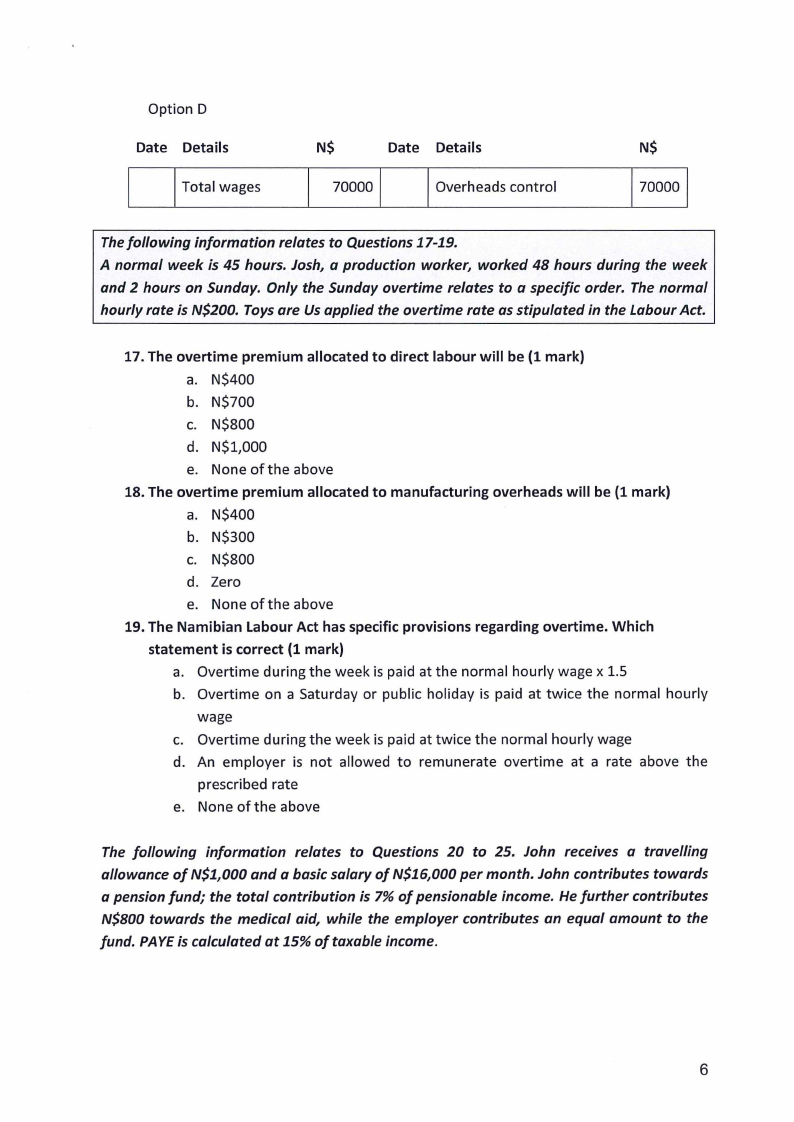
The following information relates to Questions 17-19.
A normal week is 45 hours. Josh, a production worker, worked 48 hours during the week
and 2 hours on Sunday. Only the Sunday overtime relates to a specific order. The normal
hourly rate is N$200. Toys are Us applied the overtime rate as stipulated in the Labour Act.
17. The overtime premium allocated to direct labour will be (1 mark)
a. N$400
b. N$700
c. N$800
d. N$1,000
e. None of the above
18. The overtime premium allocated to manufacturing overheads will be (1 mark)
a. N$400
b. N$300
c. N$800
d. Zero
e. None of the above
19. The Namibian Labour Act has specific provisions regarding overtime. Which
statement is correct (1 mark)
a. Overtime during the week is paid at the normal hourly wage x 1.5
b. Overtime on a Saturday or public holiday is paid at twice the normal hourly
wage
c. Overtime during the week is paid at twice the normal hourly wage
d. An employer is not allowed to remunerate overtime at a rate above the
prescribed rate
e. None of the above
The following information relates to Questions 20 to 25. John receives a travelling
allowance of N$1,000 and a basic salary of N$16,000 per month. John contributes towards
a pension fund; the total contribution is 7% of pensionable income. He further contributes
N$B00 towards the medical aid, while the employer contributes an equal amount to the
fund. PAYE is calculated at 15% of taxable income.
6

1.7 Page 7

▲back to top


20. Calculate John's gross wage (2 marks)
a. N$17,000
b. N$17,800
c. N$16,000
d. N$15,880
e. None of the above
21. Assume a taxable income of N$17,000, and a gross wage of N$16,S00, calculate the
income tax payable (2 marks):
a. N$3,150
b. N$2,550
c. N$2,475
d. N$2,382
e. None of the above
22. When the employer makes a payment to the pension fund, the following entry
should be made in the general ledger (2 marks)
a. Debit pension fund (creditor) and credit Bank
b. Debit Bank and credit pension fund (creditor)
c. Debit pension fund (creditor) and credit cash
d. Debit Bank and employee benefits
e. None of the above
23. Assuming John is directly involved in the manufacturing process, how much of his
remuneration will be allocated to manufacturing overheads (2 marks)
a. N$1,800
b. N$1,000
c. N$1,600
d. N$17,000
e. None of the above
24. Assume a taxable income of N$1S,000. Calculate the net pay before tax (2 marks)
a. N$14,200
b. N$15,000
c. N$13,080
d. N$16,000
e. None of the above
25. Which one of the following options represents the "Namra - Creditor Account"
after payment to NamRA has been made? Assume the tax liability was correctly
calculated as N$3,000 (2 marks)
Option A
Date Details
N$
Date Details
N$
30 Bank
3,000 15
Wages Control
3,000
Option B
7

1.8 Page 8

▲back to top


I 1 1s Wages Control
I 13,000 130
Bank
13,000
Option C
I 130 Bank
I 13,000 130
Employee Tax
13,000
Option D
I I 1s Wages Control
I I I 3,000 30
Payments
I 3,000
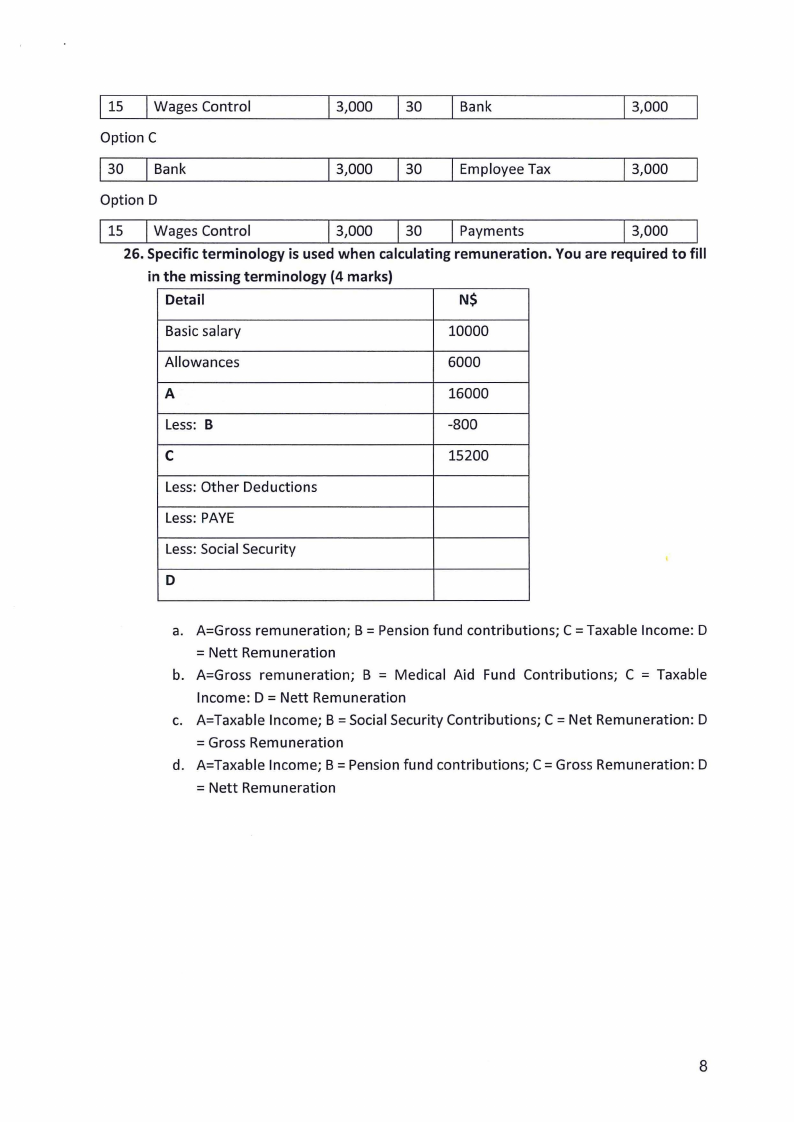
26. Specific terminology is used when calculating remuneration. You are required to fill
in the missing terminology (4 marks)
Detail
N$
Basic salary
10000
Allowances
6000
A
16000
Less: B
-800
C
15200
Less: Other Deductions
Less: PAYE
Less: Social Security
D
a. A=Gross remuneration; B = Pension fund contributions; C = Taxable Income: D
= Nett Remuneration
b. A=Gross remuneration; B = Medical Aid Fund Contributions; C = Taxable
Income: D = Nett Remuneration
c. A=Taxable Income; B = Social Security Contributions; C = Net Remuneration: D
= Gross Remuneration
d. A=Taxable Income; B = Pension fund contributions; C = Gross Remuneration: D
= Nett Remuneration
8

1.9 Page 9

▲back to top


Questions 27-31
Manufacturing overhead control (Theory, application in the accounting records and
calculations) (9 marks)
27. Which of the following is most likely to occur with the application of overheads if
the activity levels are lower than planned, while actual overhead cost is similar to
the planned cost (1 mark)
a. Over-application of overheads
b. Under-application of overheads
c. Fixed production cost will be higher
d. Fixed production cost will be lower
e. None of the above
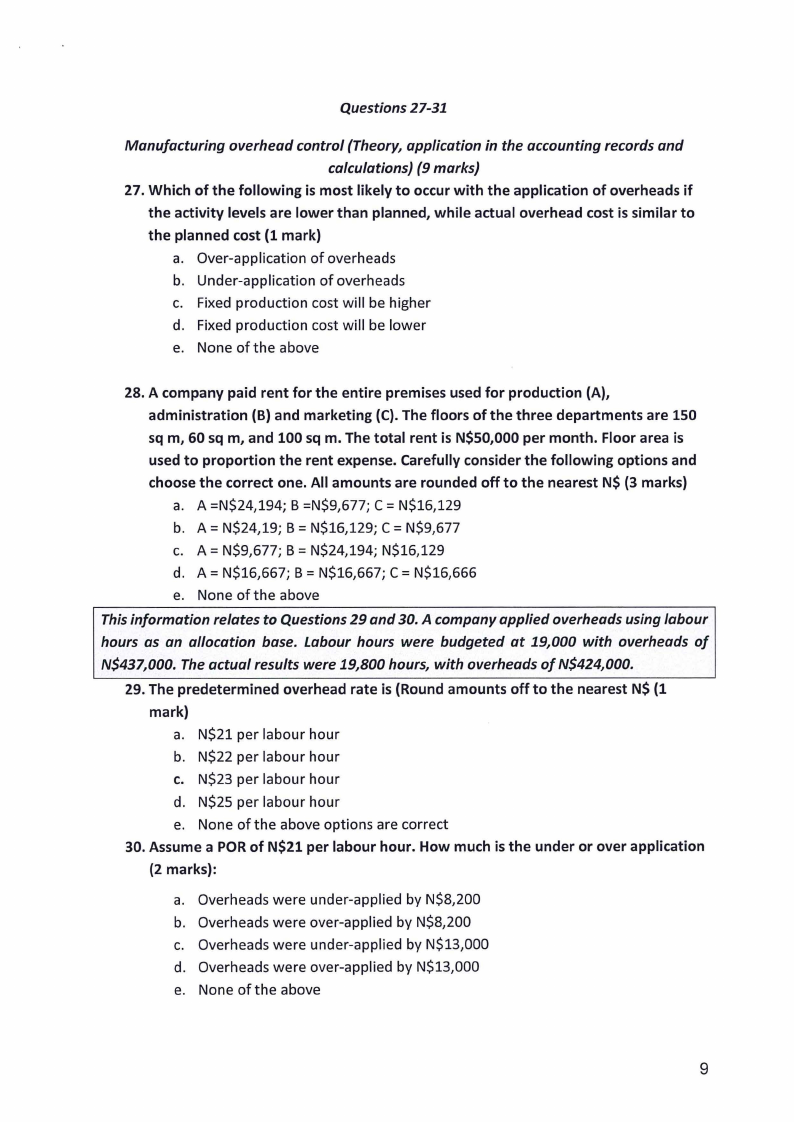
28. A company paid rent for the entire premises used for production (A),
administration (B) and marketing (C). The floors of the three departments are 150
sq m, 60 sq m, and 100 sq m. The total rent is N$50,000 per month. Floor area is
used to proportion the rent expense. Carefully consider the following options and
choose the correct one. All amounts are rounded off to the nearest N$ (3 marks)
a. A =N$24,194; B =N$9,677; C = N$16,129
b. A= N$24,19; B = N$16,129; C = N$9,677
c. A= N$9,677; B = N$24,194; N$16,129
d. A= N$16,667; B = N$16,667; C = N$16,666
e. None of the above
This information relates to Questions 29 and 30. A company applied overheads using labour
hours as an allocation base. Labour hours were budgeted at 19,000 with overheads of
N$437,000. The actual results were 19,800 hours, with overheads of N$424,000.
29. The predetermined overhead rate is (Round amounts off to the nearest N$ (1
mark)
a. N$21 per labour hour
b. N$22 per labour hour
c. N$23 per labour hour
d. N$25 per labour hour
e. None of the above options are correct
30. Assume a POR of N$21 per labour hour. How much is the under or over application
(2 marks):
a. Overheads were under-applied by N$8,200
b. Overheads were over-applied by N$8,200
c. Overheads were under-applied by N$13,000
d. Overheads were over-applied by N$13,000
e. None of the above
9

1.10 Page 10

▲back to top


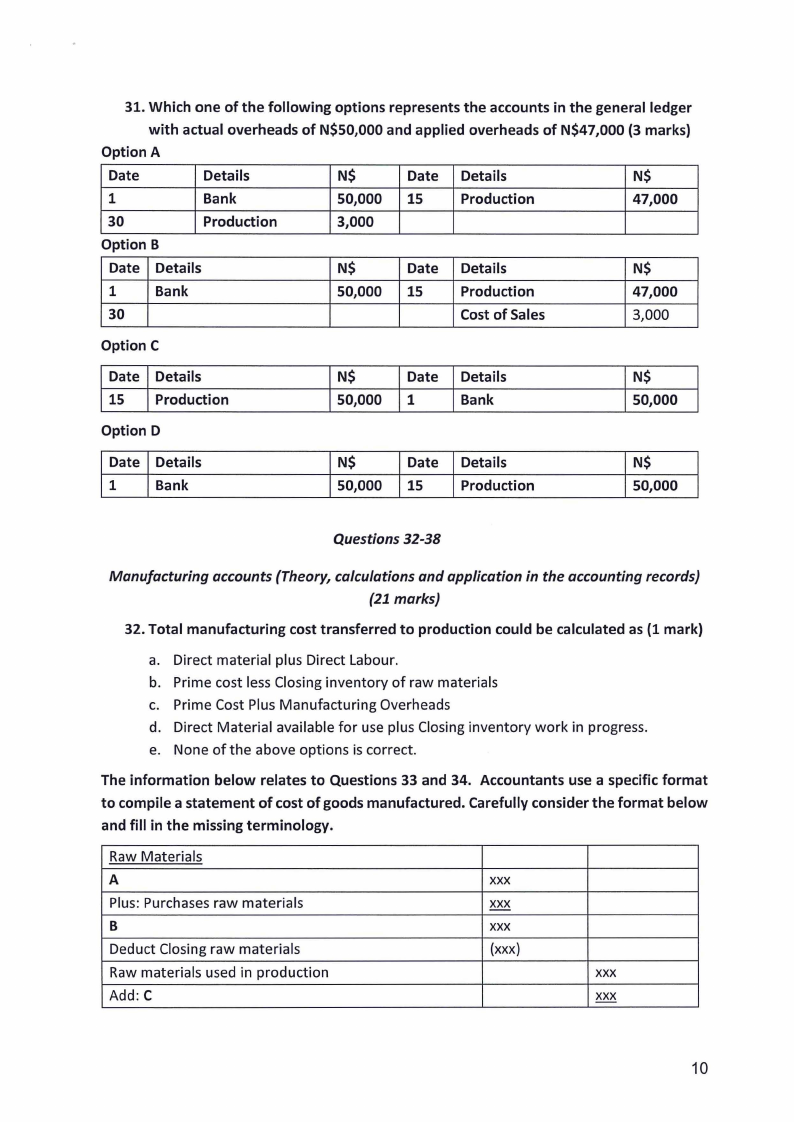
31. Which one of the following options represents the accounts in the general ledger
with actual overheads of N$50,000 and applied overheads of N$47,000 (3 marks)
Option A
Date
Details
N$
Date Details
N$
1
Bank
50,000 15
Production
47,000
30
Production
3,000
Option B
Date Details
N$
Date Details
N$
1
Bank
50,000 15
Production
47,000
30
Cost of Sales
3,000
Option C
Date Details
15 Production
N$
50,000
Date
1
Details
Bank
N$
50,000
Option D
Date Details
1
Bank
N$
50,000
Date
15
Details
Production
N$
50,000
Questions 32-38
Manufacturing accounts {Theory, calculations and application in the accounting records)
{21 marks)
32. Total manufacturing cost transferred to production could be calculated as (1 mark)
a. Direct material plus Direct Labour.
b. Prime cost less Closing inventory of raw materials
c. Prime Cost Plus Manufacturing Overheads
d. Direct Material available for use plus Closing inventory work in progress.
e. None of the above options is correct.
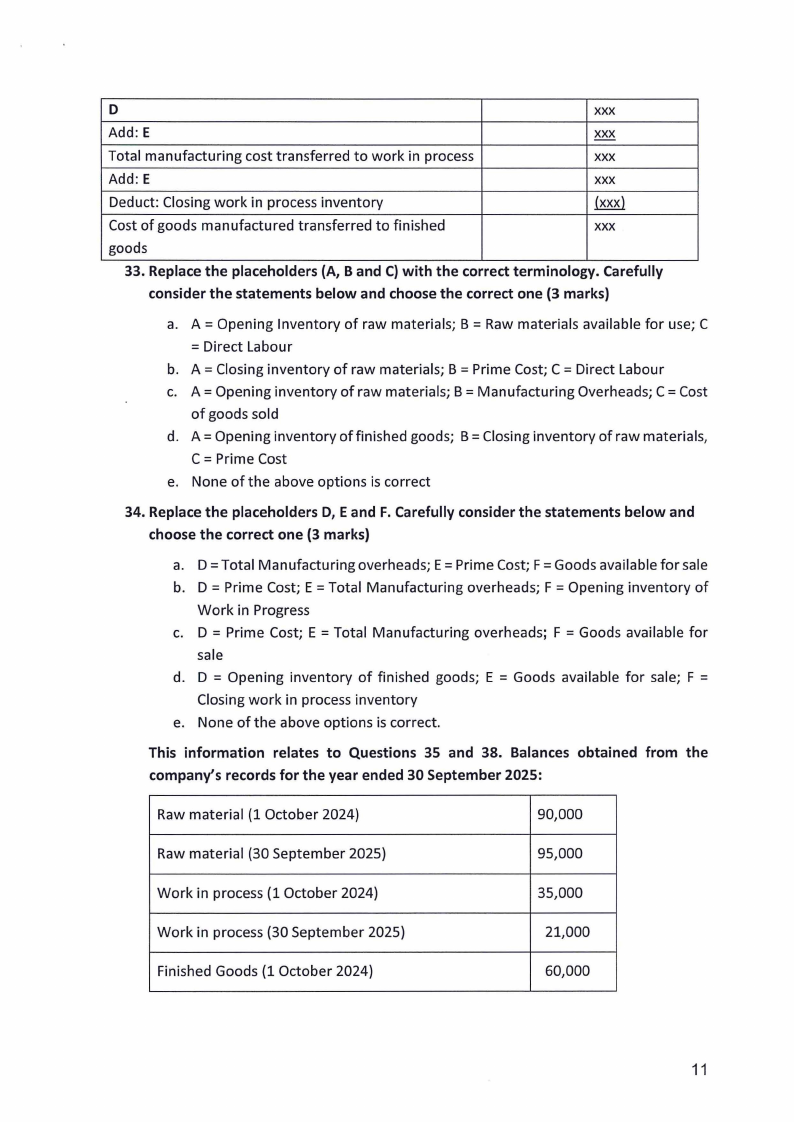
The information below relates to Questions 33 and 34. Accountants use a specific format
to compile a statement of cost of goods manufactured. Carefully consider the format below
and fill in the missing terminology.
Raw Materials
A
Plus: Purchases raw materials
B
Deduct Closing raw materials
Raw materials used in production
Add:C
XXX
XXX
XXX
(xxx)
XXX
XXX
10

2 Pages 11-20

▲back to top


2.1 Page 11

▲back to top


D
XXX
Add:E
XXX
Total manufacturing cost transferred to work in process
XXX
Add:E
XXX
Deduct: Closing work in process inventory
(xxx)
Cost of goods manufactured transferred to finished
XXX
goods
33. Replace the placeholders (A, Band C) with the correct terminology. Carefully
consider the statements below and choose the correct one (3 marks)
a. A = Opening Inventory of raw materials; B = Raw materials available for use; C
= Direct Labour
b. A= Closing inventory of raw materials; B = Prime Cost; C = Direct Labour
c. A= Opening inventory of raw materials; B = Manufacturing Overheads; C = Cost
of goods sold
d. A= Opening inventory of finished goods; B = Closing inventory of raw materials,
C = Prime Cost
e. None of the above options is correct
34. Replace the placeholders D, E and F. Carefully consider the statements below and
choose the correct one (3 marks)
a. D = Total Manufacturing overheads; E= Prime Cost; F= Goods available for sale
b. D = Prime Cost; E = Total Manufacturing overheads; F = Opening inventory of
Work in Progress
c. D = Prime Cost; E = Total Manufacturing overheads; F = Goods available for
sale
d. D = Opening inventory of finished goods; E = Goods available for sale; F =
Closing work in process inventory
e. None of the above options is correct.
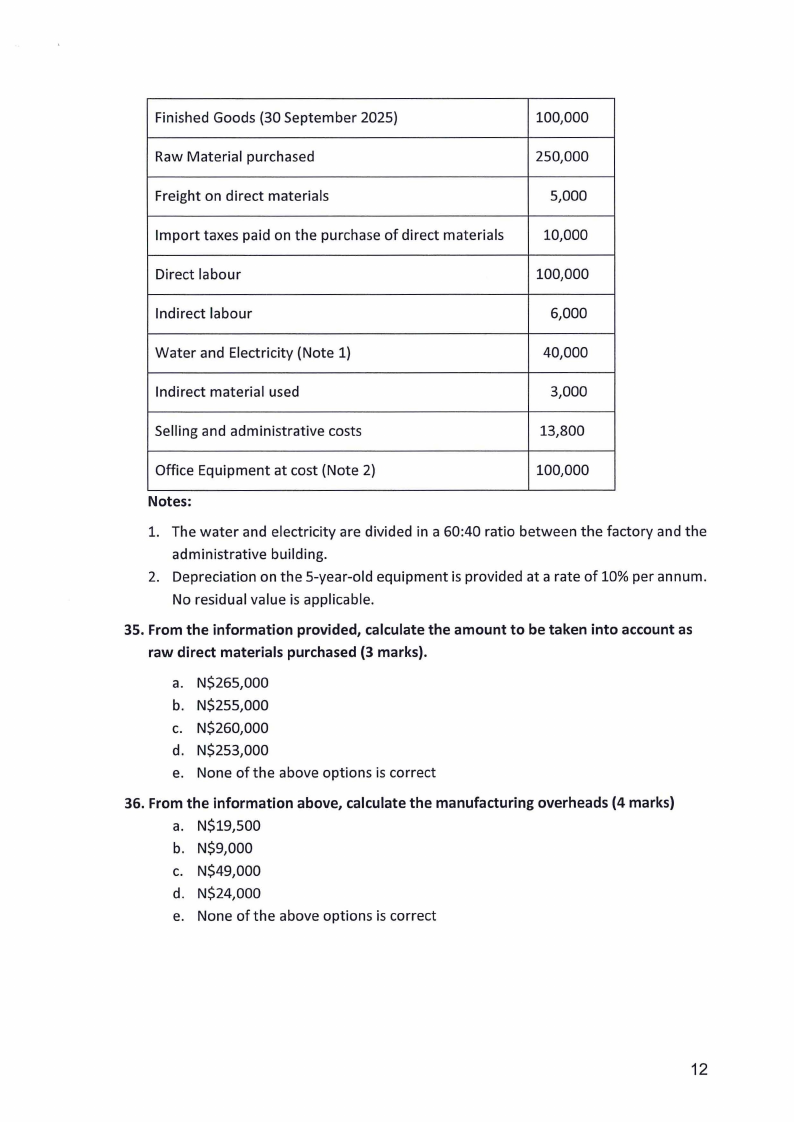
This information relates to Questions 35 and 38. Balances obtained from the
company's records for the year ended 30 September 2025:
Raw material (1 October 2024)
90,000
Raw material (30 September 2025)
95,000
Work in process (1 October 2024)
35,000
Work in process (30 September 2025)
21,000
Finished Goods (1 October 2024)
60,000
11

2.2 Page 12

▲back to top


Finished Goods (30 September 2025)
100,000
Raw Material purchased
250,000
Freight on direct materials
5,000
Import taxes paid on the purchase of direct materials
10,000
Direct labour
100,000
Indirect labour
6,000
Water and Electricity (Note 1)
40,000
Indirect material used
3,000
Selling and administrative costs
13,800
Office Equipment at cost (Note 2)
100,000
Notes:
1. The water and electricity are divided in a 60:40 ratio between the factory and the
administrative building.
2. Depreciation on the 5-year-old equipment is provided at a rate of 10% per annum.
No residual value is applicable.
35. From the information provided, calculate the amount to be taken into account as
raw direct materials purchased (3 marks).
a. N$265,000
b. N$255,000
c. N$260,000
d. N$253,000
e. None of the above options is correct
36. From the information above, calculate the manufacturing overheads (4 marks)
a. N$19,500
b. N$9,000
c. N$49,000
d. N$24,000
e. None of the above options is correct
12

2.3 Page 13

▲back to top


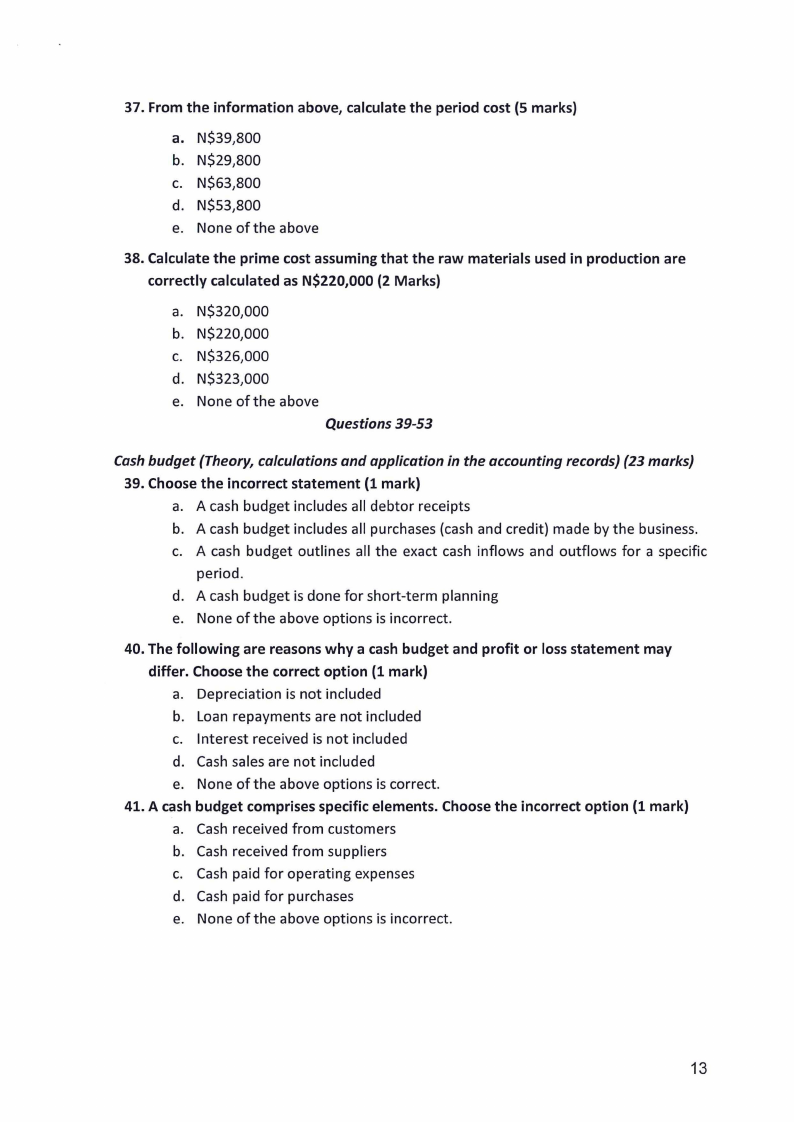
37. From the information above, calculate the period cost (5 marks)
a. N$39,800
b. N$29,800
C. N$63,800
d. N$53,800
e. None of the above
38. Calculate the prime cost assuming that the raw materials used in production are
correctly calculated as N$220,000 (2 Marks)
a. N$320,000
b. N$220,000
c. N$326,000
d. N$323,000
e. None of the above
Questions 39-53
Cash budget (Theory, calculations and application in the accounting records) {23 marks)
39. Choose the incorrect statement (1 mark)
a. A cash budget includes all debtor receipts
b. A cash budget includes all purchases (cash and credit) made by the business.
c. A cash budget outlines all the exact cash inflows and outflows for a specific
period.
d. A cash budget is done for short-term planning
e. None of the above options is incorrect.
40. The following are reasons why a cash budget and profit or loss statement may
differ. Choose the correct option (1 mark)
a. Depreciation is not included
b. Loan repayments are not included
c. Interest received is not included
d. Cash sales are not included
e. None of the above options is correct.
41. A cash budget comprises specific elements. Choose the incorrect option (1 mark)
a. Cash received from customers
b. Cash received from suppliers
c. Cash paid for operating expenses
d. Cash paid for purchases
e. None of the above options is incorrect.
13

2.4 Page 14

▲back to top


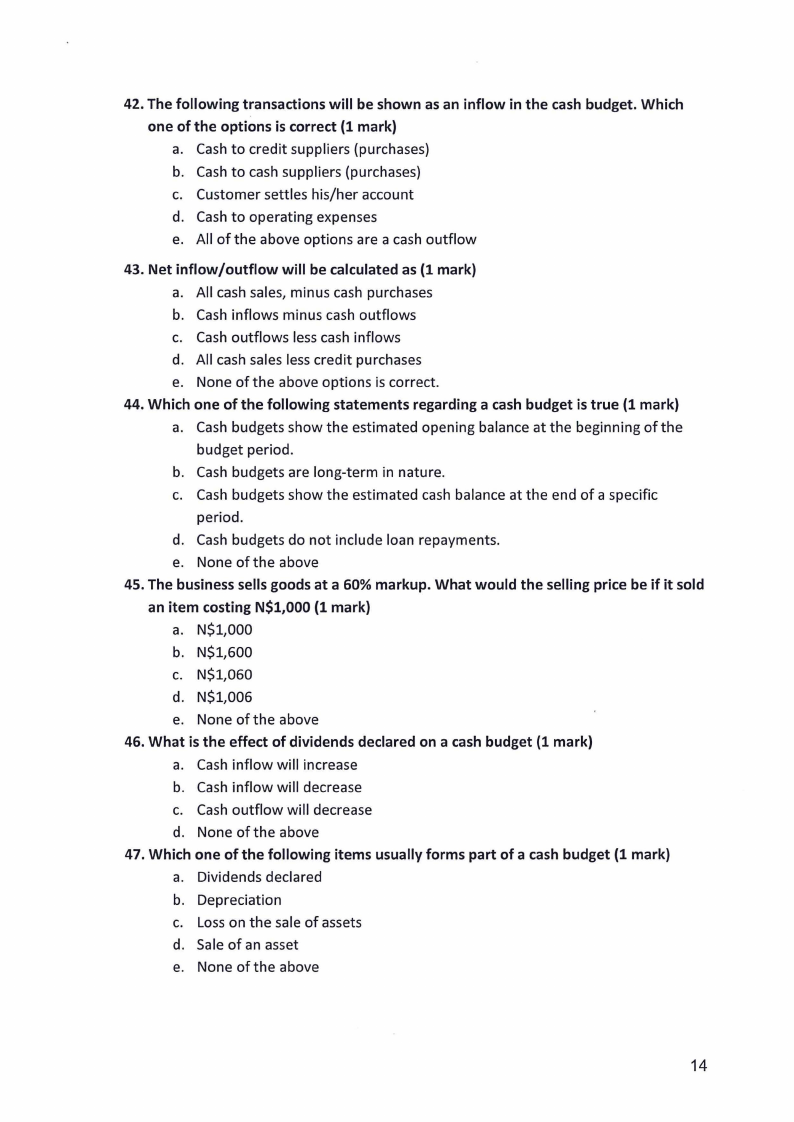
42. The following transactions will be shown as an inflow in the cash budget. Which
one of the options is correct (1 mark)
a. Cash to credit suppliers (purchases)
b. Cash to cash suppliers (purchases)
c. Customer settles his/her account
d. Cash to operating expenses
e. All of the above options are a cash outflow
43. Net inflow/outflow will be calculated as (1 mark)
a. All cash sales, minus cash purchases
b. Cash inflows minus cash outflows
c. Cash outflows less cash inflows
d. All cash sales less credit purchases
e. None of the above options is correct.
44. Which one of the following statements regarding a cash budget is true (1 mark)
a. Cash budgets show the estimated opening balance at the beginning of the
budget period.
b. Cash budgets are long-term in nature.
c. Cash budgets show the estimated cash balance at the end of a specific
period.
d. Cash budgets do not include loan repayments.
e. None of the above
45. The business sells goods at a 60% markup. What would the selling price be if it sold
an item costing N$1,000 (1 mark)
a. N$1,000
b. N$1,600
c. N$1,060
d. N$1,006
e. None of the above
46. What is the effect of dividends declared on a cash budget (1 mark)
a. Cash inflow will increase
b. Cash inflow will decrease
c. Cash outflow will decrease
d. None of the above
47. Which one of the following items usually forms part of a cash budget (1 mark)
a. Dividends declared
b. Depreciation
C. Loss on the sale of assets
d. Sale of an asset
e. None of the above
14

2.5 Page 15

▲back to top


2.6 Page 16

▲back to top


48. Which of the following will appear on a cash budget (1 mark)
a. Collection from debtors
b. Dividends paid
c. Income tax paid
d. None of the above
e. All of the above
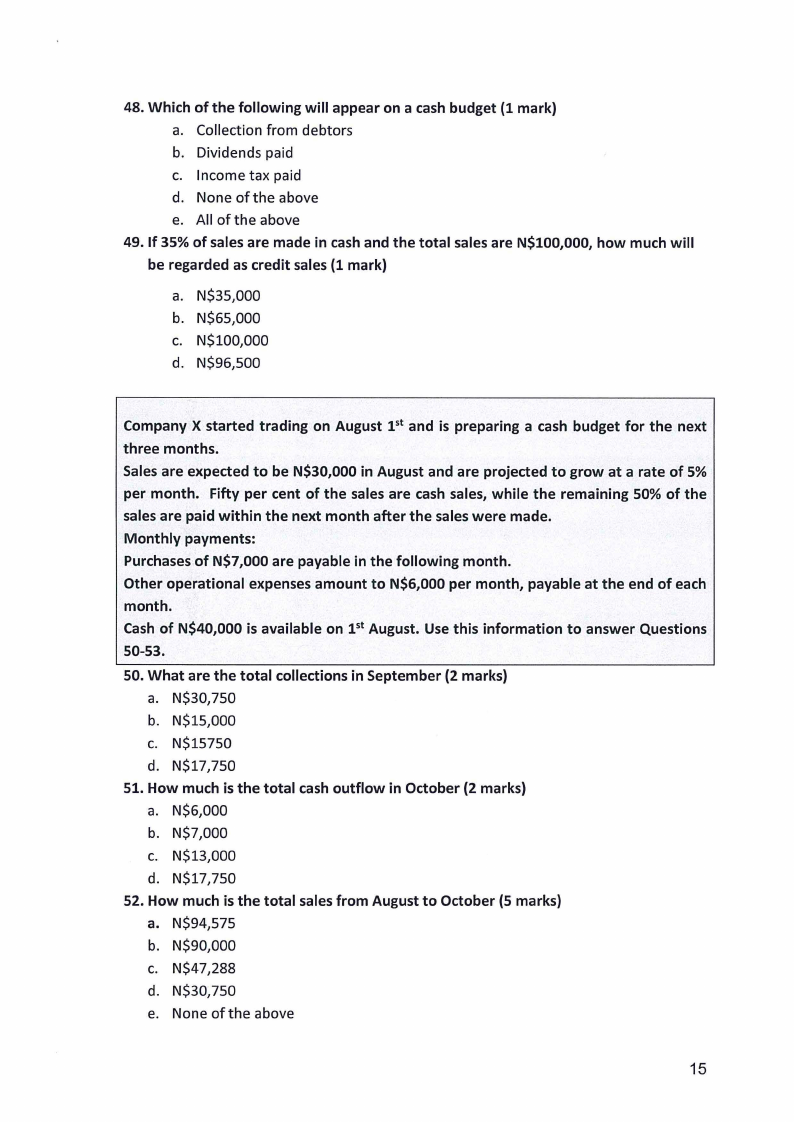
49. If 35% of sales are made in cash and the total sales are N$100,000, how much will
be regarded as credit sales (1 mark)
a. N$35,000
b. N$65,000
c. N$100,000
d. N$96,500
Company X started trading on August 1st and is preparing a cash budget for the next
three months.
Sales are expected to be N$30,000 in August and are projected to grow at a rate of 5%
per month. Fifty per cent of the sales are cash sales, while the remaining 50% of the
sales are paid within the next month after the sales were made.
Monthly payments:
Purchases of N$7,000 are payable in the following month.
Other operational expenses amount to N$6,000 per month, payable at the end of each
month.
Cash of N$40,000 is available on 1st August. Use this information to answer Questions
50-53.
50. What are the total collections in September (2 marks)
a. N$30,750
b. N$15,000
c. N$15750
d. N$17,750
51. How much is the total cash outflow in October (2 marks)
a. N$6,000
b. N$7,000
c. N$13,000
d. N$17,750
52. How much is the total sales from August to October (5 marks)
a. N$94,575
b. N$90,000
c. N$47,288
d. N$30,750
e. None of the above
15

2.7 Page 17

▲back to top


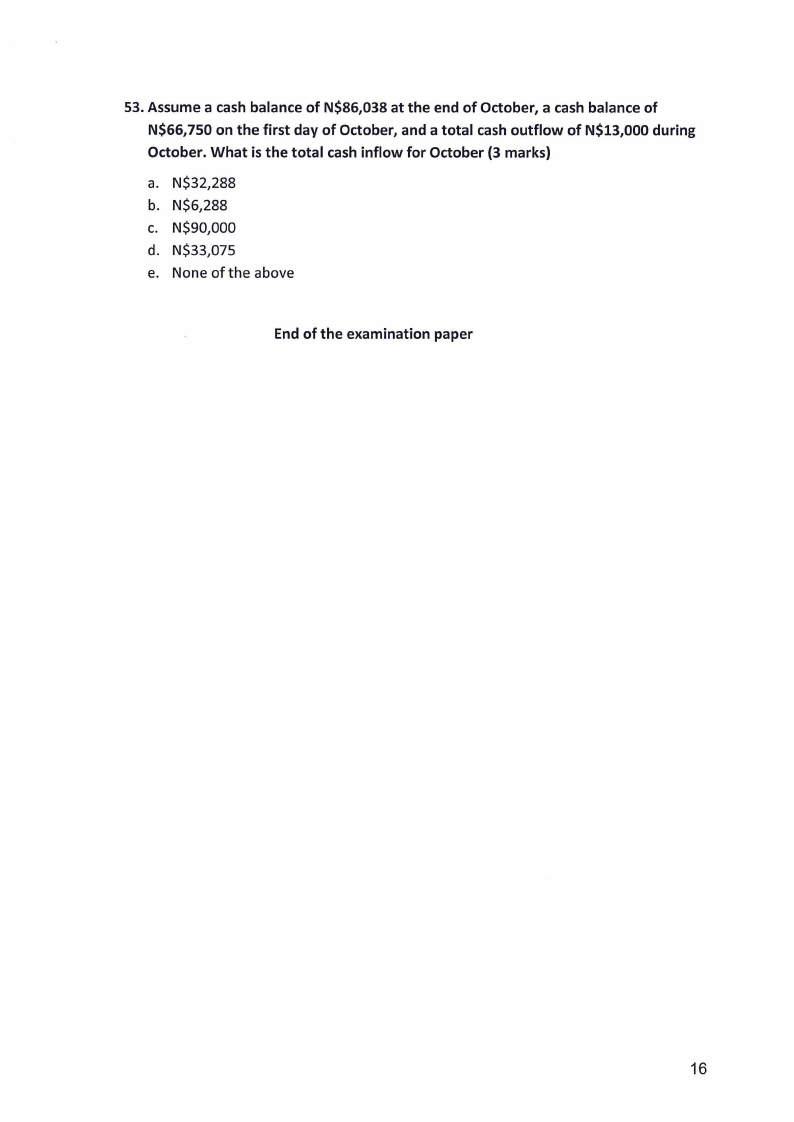
53. Assume a cash balance of N$86,038 at the end of October, a cash balance of
N$66,750 on the first day of October, and a total cash outflow of N$13,000 during
October. What is the total cash inflow for October (3 marks)
a. N$32,288
b. N$6,288
c. N$90,000
d. N$33,075
e. None of the above
End of the examination paper
16

2.8 Page 18

▲back to top


Student Name
Student Number
_ _ . - - - - - - - - - - - - . , ,,____
_____,
Mode of Study/Centre
I
I
I
D
0
0
-..--1
I'--
a
(J
w
-CV)
LJ")
LJ")
N
Cl
0
N
<{
Cl.
Cl.
~
0
-0
l!l
N-a.
C
u0
QJ
U')
O'.l
u..--1
<(
O'.l
------• •
16 @®@)@® 37 c~)~)C:~)(8CD
17
r.·
\\_:,)
\\r.,_:I·V
_c·
!,_.<:.)
\\r:._0·
\\rE,:)
38
I~' .
"-~)
[Q\\
,~;
r;:·-_
,5:)
(-.,
"~
'I-V~'\\
,~:.i "-~ v~ 18
~\\ r.:·, .r=·, r:.·, ~-\\
\\._iv \\_.<.:J \\.!V !,_SJ
39
r~-
r.::) r--::·, r-\\ t;)
\\!:::) ,~) \\.'.::.
19 0C~©@C0 40 G)CE)C~)c~)CD
20 @C~@@® 41 G)~)~)@)CD
21 C9C~(0@® 42 G)(~)~)@)(D
Student Nr
I