


 |
IPS511S - INTRODUCTION TO PROCUREMENT AND SUPPLY CHAIN MANAGEMENT - 2ND OPP - JULY 2025 |
|
|
1 Page 1 |
▲back to top |
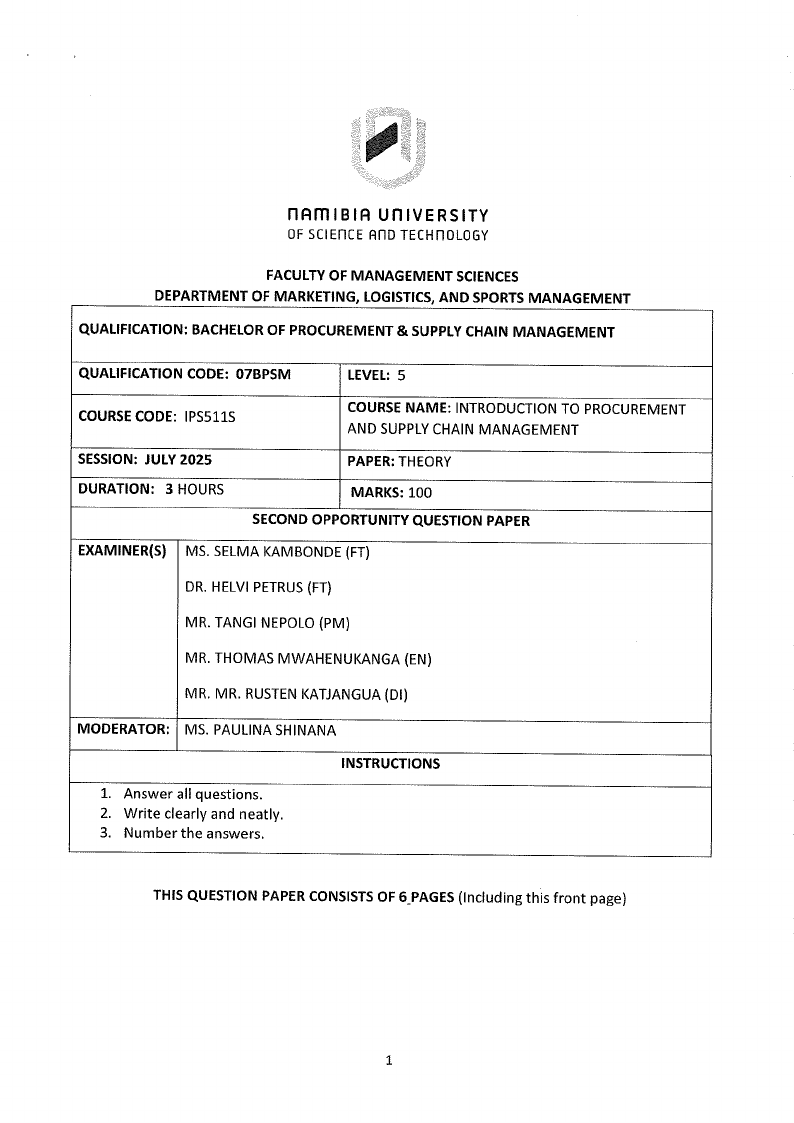
nAm I BIA un IVE RSITY
OF SCIEnCE Ano TECHnDLOGY
FACULTY OF MANAGEMENT SCIENCES
DEPARTMENT OF MARKETING, LOGISTICS, AND SPORTS MANAGEMENT
QUALIFICATION: BACHELOR OF PROCUREMENT & SUPPLY CHAIN MANAGEMENT
QUALIFICATION CODE: 07BPSM
LEVEL: 5
COURSE CODE: IPS511S
COURSE NAME: INTRODUCTION TO PROCUREMENT
AND SUPPLYCHAIN MANAGEMENT
SESSION: JULY 2025
DURATION: 3 HOURS
PAPER: THEORY
MARKS: 100
SECOND OPPORTUNITY QUESTION PAPER
EXAMINER(S} MS. SELMA KAMBONDE (FT)
DR. HELVI PETRUS(FT)
MR. TANGI NEPOLO (PM)
MR. THOMAS MWAHENUKANGA (EN)
MR. MR. RUSTEN l<ATJANGUA (DI)
MODERATOR: MS. PAULINA SHINANA
1. Answer all questions.
2. Write clearly and neatly.
3. Number the answers.
INSTRUCTIONS
THIS QUESTION PAPER CONSISTS OF 6_PAGES (Including this front page)
1
|
|
2 Page 2 |
▲back to top |
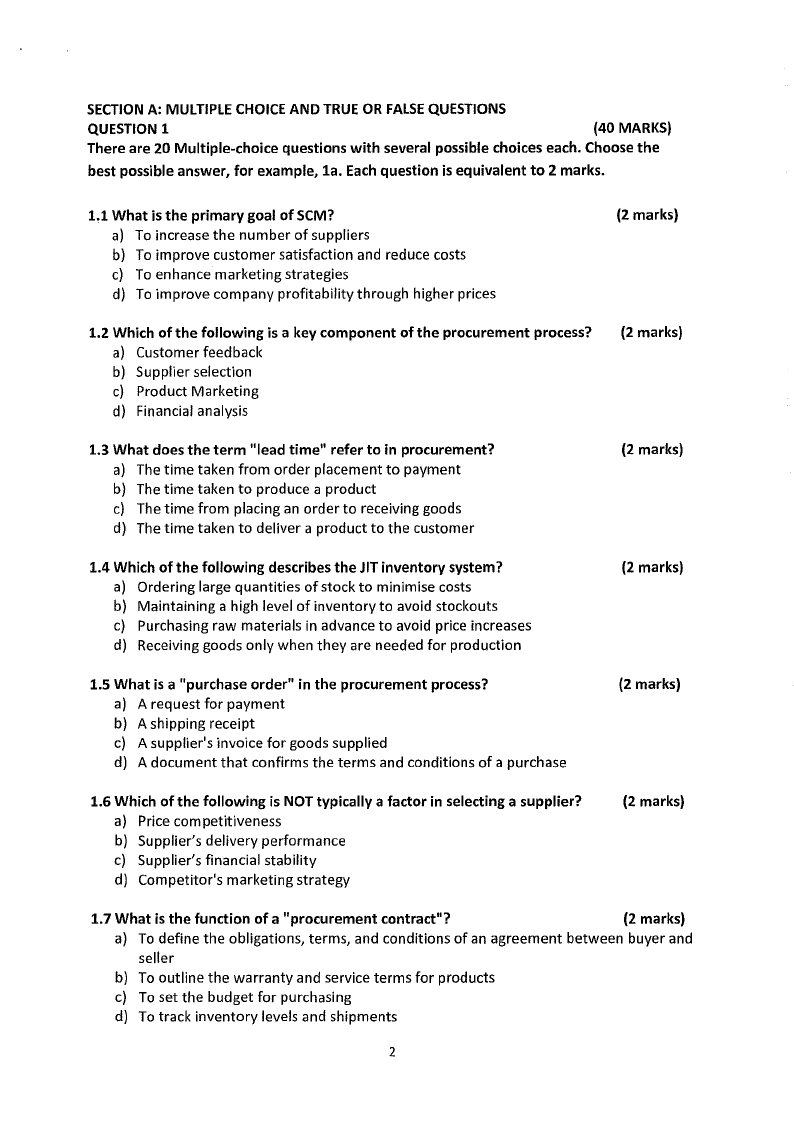
SECTIONA: MULTIPLECHOICEAND TRUE OR FALSEQUESTIONS
QUESTION 1
(40 MARKS)
There are 20 Multiple-choice questions with several possible choices each. Choose the
best possibleanswer, for example, la. Eachquestion is equivalent to 2 marks.
1,1 What is the primary goal of SCM?
a) To increase the number of suppliers
b) To improve customer satisfaction and reduce costs
c) To enhance marketing strategies
d) To improve company profitability through higher prices
(2 marks)
1.2 Which of the following is a key component of the procurement process?
a) Customer feedback
b) Supplier selection
c) Product Marketing
d) Financial analysis
(2 marks)
1.3 What does the term "lead time" refer to in procurement?
a) The time taken from order placement to payment
b) The time taken to produce a product
c) The time from placing an order to receiving goods
d) The time taken to deliver a product to the customer
(2 marks)
1.4 Which of the following describes the JIT inventory system?
a) Ordering large quantities of stock to minimise costs
b) Maintaining a high level of inventory to avoid stockouts
c) Purchasing raw materials in advance to avoid price increases
d) Receiving goods only when they are needed for production
(2 marks)
1.5 What is a "purchase order" in the procurement process?
a) A request for payment
b) A shipping receipt
c) A supplier's invoice for goods supplied
d) A document that confirms the terms and conditions of a purchase
(2 marks)
1.6 Which of the following is NOT typically a factor in selecting a supplier?
a) Price competitiveness
b) Supplier's delivery performance
c) Supplier's financial stability
d) Competitor's marketing strategy
(2 marks)
1.7 What is the function of a "procurement contract"?
(2 marks)
a) To define the obligations, terms, and conditions of an agreement between buyer and
seller
b) To outline the warranty and service terms for products
c) To set the budget for purchasing
d) To track inventory levels and shipments
2
|
|
3 Page 3 |
▲back to top |
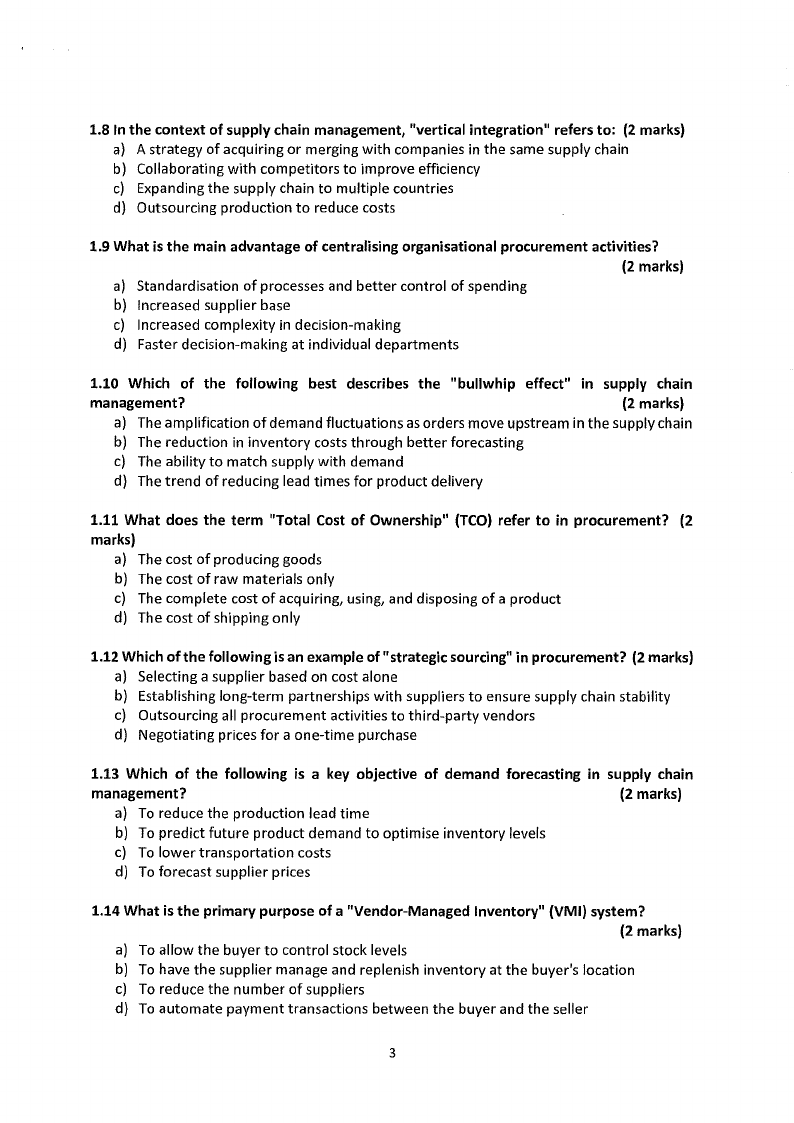
1.8 In the context of supply chain management, "vertical integration" refers to: (2 marks)
a) A strategy of acquiring or merging with companies in the same supply chain
b) Collaborating with competitors to improve efficiency
c) Expanding the supply chain to multiple countries
d) Outsourcing production to reduce costs
1.9 What is the main advantage of centralising organisational procurement activities?
(2 marks)
a) Standardisation of processes and better control of spending
b) Increased supplier base
c) Increased complexity in decision-making
d) Faster decision-making at individual departments
1.10 Which of the following best describes the "bullwhip effect" in supply chain
management?
(2 marks)
a) The amplification of demand fluctuations as orders move upstream in the supply chain
b) The reduction in inventory costs through better forecasting
c) The ability to match supply with demand
d) The trend of reducing lead times for product delivery
1.11 What does the term "Total Cost of Ownership" (TCO) refer to in procurement? (2
marks)
a) The cost of producing goods
b) The cost of raw materials only
c) The complete cost of acquiring, using, and disposing of a product
d) The cost of shipping only
1.12 Which of the following isan example of" strategicsourcing"in procurement? (2 marks)
a) Selecting a supplier based on cost alone
b) Establishing long-term partnerships with suppliers to ensure supply chain stability
c) Outsourcing all procurement activities to third-party vendors
d) Negotiating prices for a one-time purchase
1.13 Which of the following is a key objective of demand forecasting in supply chain
management?
(2 marks)
a) To reduce the production lead time
b) To predict future product demand to optimise inventory levels
c) To lower transportation costs
d) To forecast supplier prices
1.14 What is the primary purpose of a "Vendor-Managed Inventory" (VMI) system?
(2 marks)
a) To allow the buyer to control stock levels
b) To have the supplier manage and replenish inventory at the buyer's location
c) To reduce the number of suppliers
d) To automate payment transactions between the buyer and the seller
3
|
|
4 Page 4 |
▲back to top |
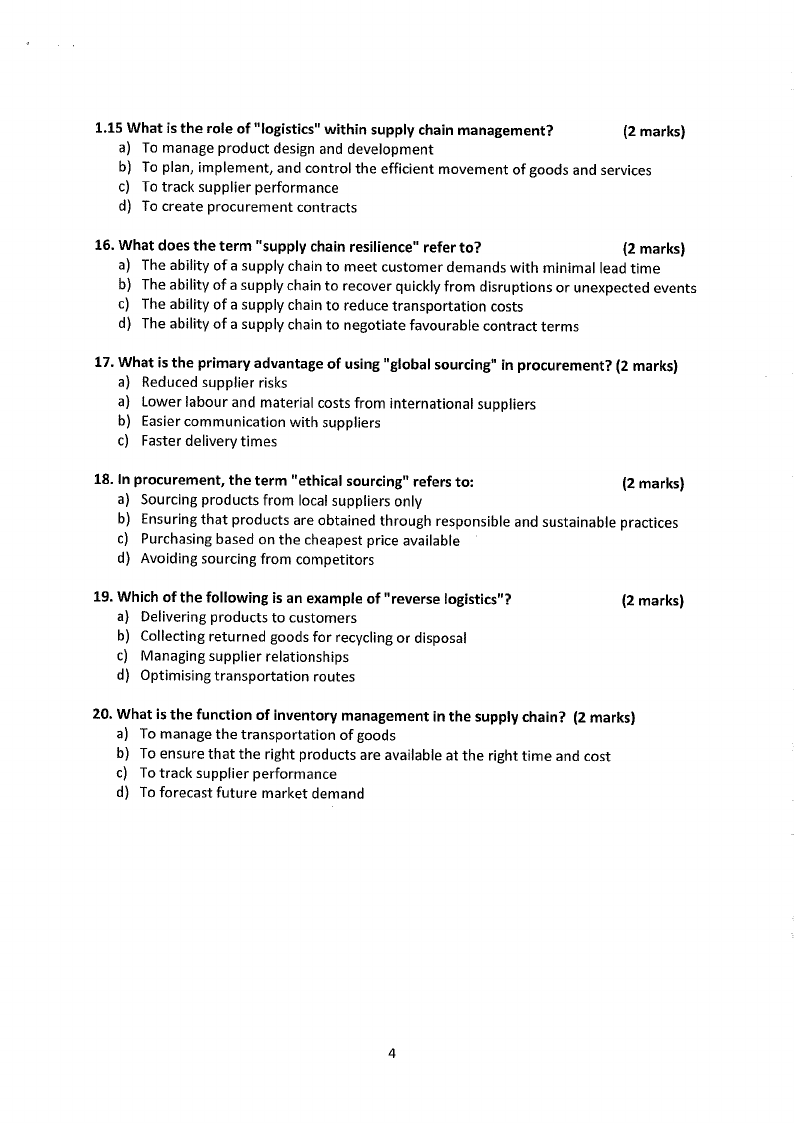
1.15 What is the role of "logistics"within supply chain management?
(2 marks)
a) To manage product design and development
b) To plan, implement, and control the efficient movement of goods and services
c) To track supplier performance
d) To create procurement contracts
16. What does the term "supply chain resilience" refer to?
(2 marks)
a) The ability of a supply chain to meet customer demands with minimal lead time
b) The ability of a supply chain to recover quickly from disruptions or unexpected events
c) The ability of a supply chain to reduce transportation costs
d) The ability of a supply chain to negotiate favourable contract terms
17. What isthe primary advantage of using "global sourcing"in procurement? (2 marks)
a) Reduced supplier risks
a) Lower labour and material costs from international suppliers
b) Easier communication with suppliers
c) Faster delivery times
18. In procurement, the term "ethical sourcing"refers to:
(2 marks)
a) Sourcing products from local suppliers only
b) Ensuring that products are obtained through responsible and sustainable practices
c) Purchasing based on the cheapest price available
d) Avoiding sourcing from competitors
19. Which of the following is an example of "reverse logistics"?
a) Delivering products to customers
b) Collecting returned goods for recycling or disposal
c) Managing supplier relationships
d) Optimising transportation routes
(2 marks)
20. What is the function of inventory management in the supply chain? (2 marks)
a) To manage the transportation of goods
b) To ensure that the right products are available at the right time and cost
c) To track supplier performance
d) To forecast future market demand
4
|
|
5 Page 5 |
▲back to top |
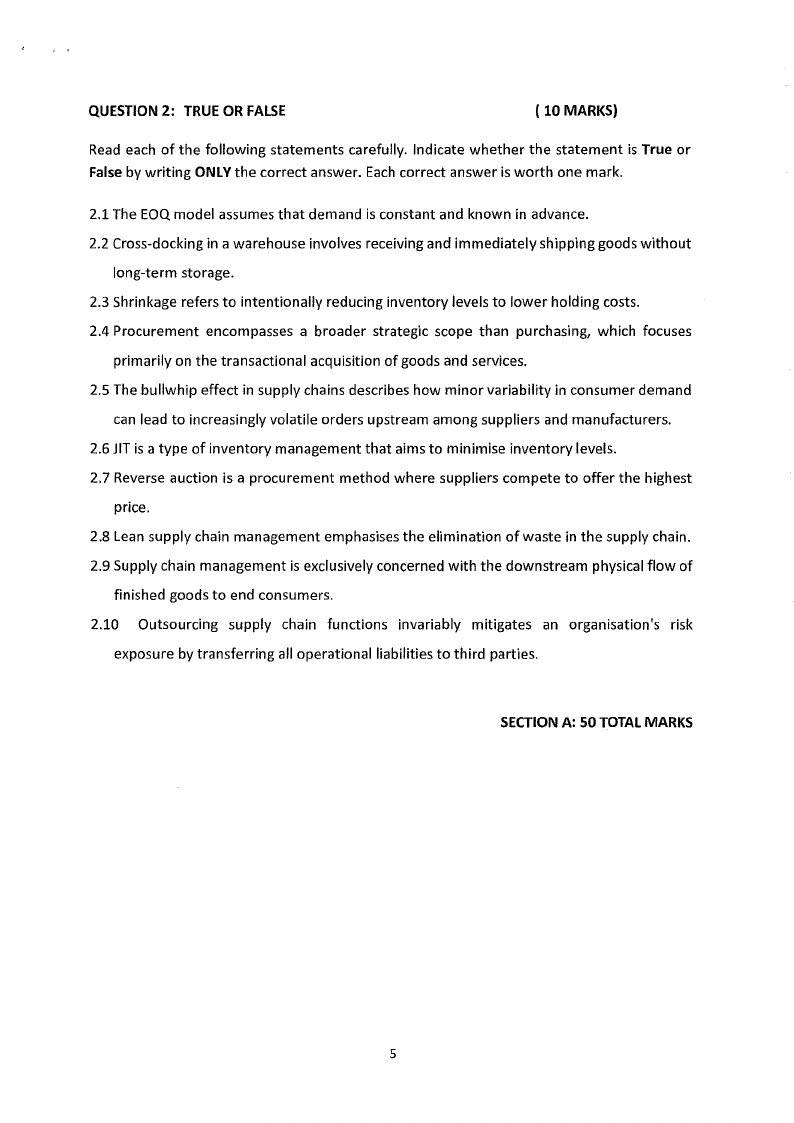
QUESTION 2: TRUE OR FALSE
( 10 MARKS)
Read each of the following statements carefully. Indicate whether the statement is True or
False by writing ONLYthe correct answer. Eachcorrect answer is worth one mark.
2.1 The EOQ model assumes that demand is constant and known in advance.
2.2 Cross-docking in a warehouse involves receiving and immediately shipping goods without
long-term storage.
2.3 Shrinkage refers to intentionally reducing inventory levels to lower holding costs.
2.4 Procurement encompasses a broader strategic scope than purchasing, which focuses
primarily on the transactional acquisition of goods and services.
2.5 The bullwhip effect in supply chains describes how minor variability in consumer demand
can lead to increasingly volatile orders upstream among suppliers and manufacturers.
2.6 JIT is a type of inventory management that aims to minimise inventory levels.
2.7 Reverse auction is a procurement method where suppliers compete to offer the highest
price.
2.8 Lean supply chain management emphasises the elimination of waste in the supply chain.
2.9 Supply chain management is exclusively concerned with the downstream physical flow of
finished goods to end consumers.
2.10 Outsourcing supply chain functions invariably mitigates an organisation's risk
exposure by transferring all operational liabilities to third parties.
SECTIONA: 50 TOTALMARKS
5
|
|
6 Page 6 |
▲back to top |
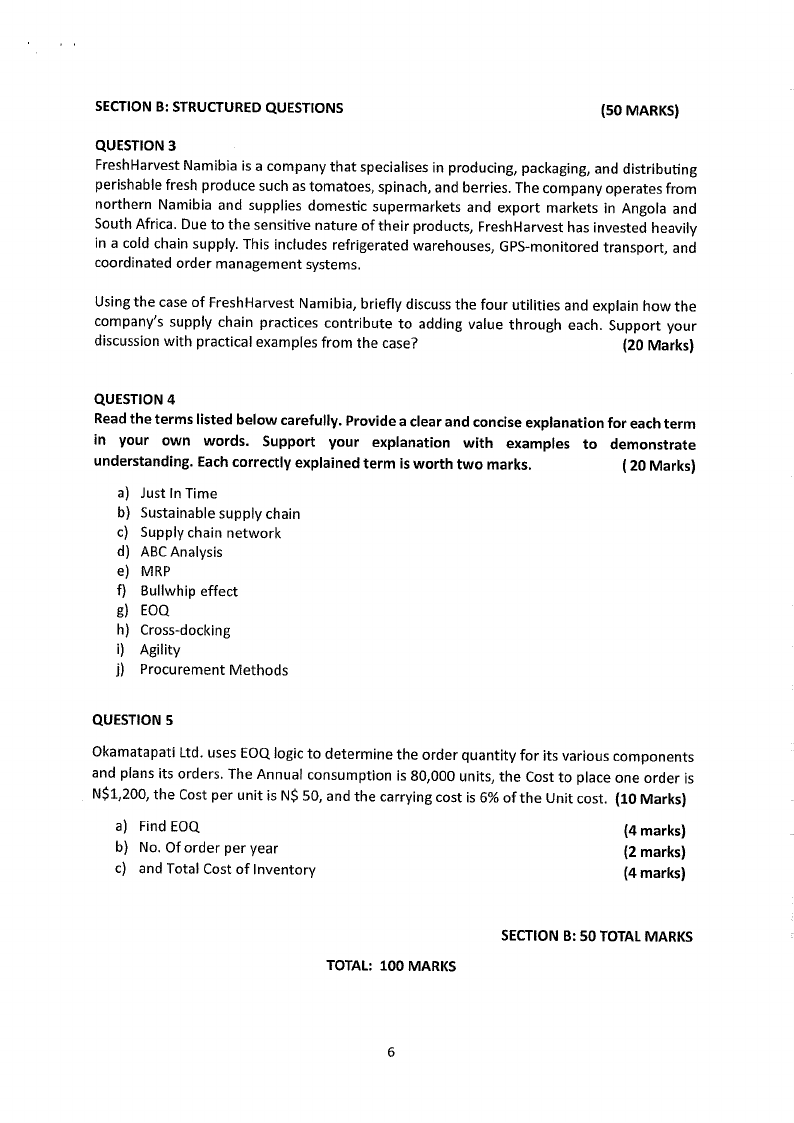
SECTION B: STRUCTURED QUESTIONS
(SO MARKS)
QUESTION 3
FreshHarvest Namibia is a company that specialises in producing, packaging, and distributing
perishable fresh produce such as tomatoes, spinach, and berries. The company operates from
northern Namibia and supplies domestic supermarkets and export markets in Angola and
South Africa. Due to the sensitive nature of their products, FreshHarvest has invested heavily
in a cold chain supply. This includes refrigerated warehouses, GPS-monitored transport, and
coordinated order management systems.
Using the case of FreshHarvest Namibia, briefly discuss the four utilities and explain how the
company's supply chain practices contribute to adding value through each. Support your
discussion with practical examples from the case?
(20 Marks)
QUESTION 4
Read the terms listed below carefully. Provide a clear and concise explanation for each term
in your own words. Support your explanation with examples to demonstrate
understanding. Each correctly explained term is worth two marks.
( 20 Marks)
a) Just In Time
b) Sustainable supply chain
c) Supply chain network
d) ABCAnalysis
e) MRP
f) Bullwhip effect
g) EOQ
h) Cross-docking
i) Agility
j) Procurement Methods
QUESTION 5
Okamatapati ltd. uses EOQ logic to determine the order quantity for its various components
and plans its orders. The Annual consumption is 80,000 units, the Cost to place one order is
N$1,200, the Cost per unit is N$ 50, and the carrying cost is 6% of the Unit cost. (10 Marks)
a) Find EOQ
b) No. Of order per year
c) and Total Cost of Inventory
(4 marks)
(2 marks)
(4 marks)
TOTAL: 100 MARKS
SECTION B: 50 TOTALMARKS
6