


 |
EAT810S - ENTERPRISE ARCHITECTURE - 2ND OPP - JULY 2025 |
|
|
1 Page 1 |
▲back to top |
n Am I BI A u n IVER s I TY
OF SCIEnCE Ano TECHnOLOGY
FACULTYOF COMPUTING AND INFORMATICS
DEPARTMENTOF INFORMATICS
QUALIFICATION: BACHELOR OF INFORMATICS HONOURS (WEB INFORMATICS,
BUSINESS INFORMATICS)
QUALIFICATION CODE:
08BIFH,O8BIH B
LEVEL: 8
COURSE CODE: EAT810S
COURSE: ENTERPRISE ARCHITECTURE
SESSION: JULY 2024
DURATION: 3 HOURS
PAPER: THEORY
MARKS: 70
SECOND OPPORTUNITY/SUPPLEMENTARY EXAMINATION - QUOUESTION PAPER
EXAMINER(S):
Prof lrja Shaanika
MODERATOR:
Ms Judith Tjiwemu
INSTRUCTIONSFORTHE CANDIDATE
1. Answer ALL the questions on the answer scripts provided. Answer EACHsection on
a new page.
2. Write clearly and neatly.
3. Be guided by the number of marks allocated when answering the questions.
4. Number your questions clearly.
PERMISSIBLEMATERIALS
None.
THIS QUESTION PAPER CONSIST OF 5 PAGES
(Including this front page)
1
|
|
2 Page 2 |
▲back to top |
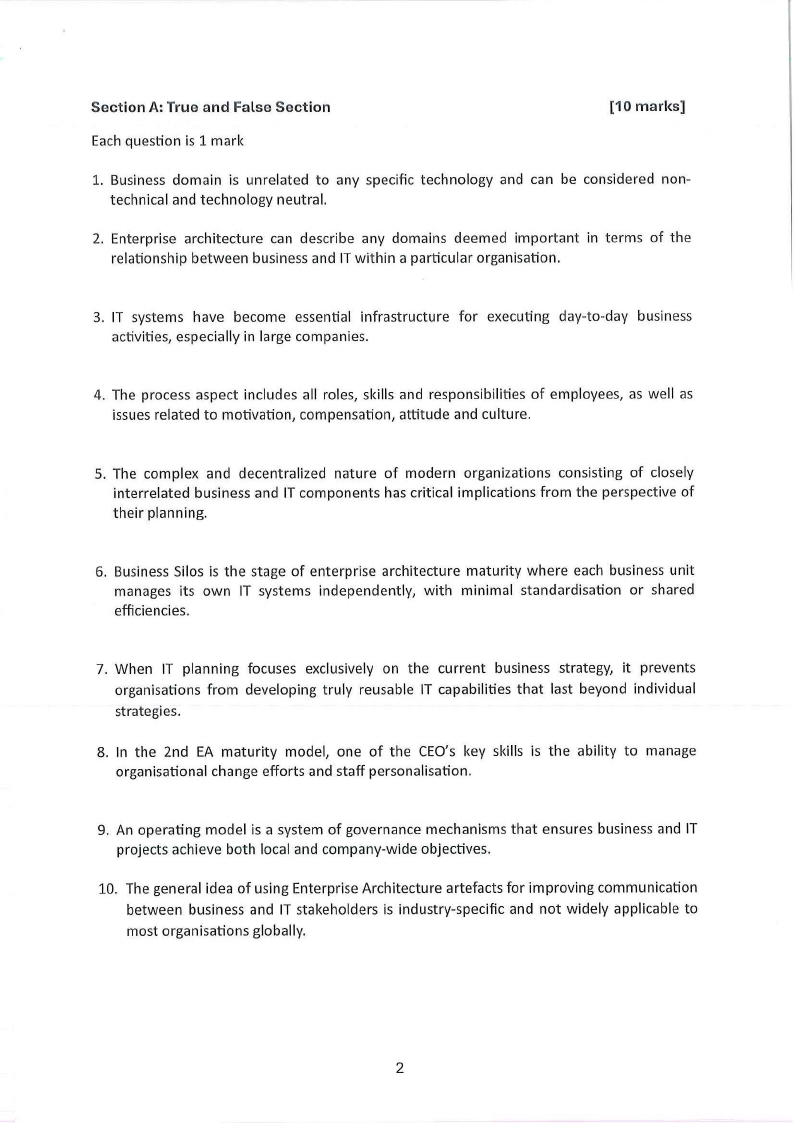
Section A: True and False Section
Each question is 1 mark
[10 marks]
1. Business domain is unrelated to any specific technology and can be considered non-
technical and technology neutral.
2. Enterprise architecture can describe any domains deemed important in terms of the
relationship between business and IT within a particular organisation.
3. IT systems have become essential infrastructure for executing day-to-day business
activities, especially in large companies.
4. The process aspect includes all roles, skills and responsibilities of employees, as well as
issues related to motivation, compensation, attitude and culture.
5. The complex and decentralized nature of modern organizations consisting of closely
interrelated business and IT components has critical implications from the perspective of
their planning.
6. Business Silos is the stage of enterprise architecture maturity where each business unit
manages its own IT systems independently, with minimal standardisation or shared
efficiencies.
7. When IT planning focuses exclusively on the current business strategy, it prevents
organisations from developing truly reusable IT capabilities that last beyond individual
strategies.
8. In the 2nd EA maturity model, one of the CEO's key skills is the ability to manage
organisational change efforts and staff personalisation.
9. An operating model is a system of governance mechanisms that ensures business and IT
projects achieve both local and company-wide objectives.
10. The general idea of using Enterprise Architecture artefacts for improving communication
between business and IT stakeholders is industry-specific and not widely applicable to
most organisations globally.
2
|
|
3 Page 3 |
▲back to top |
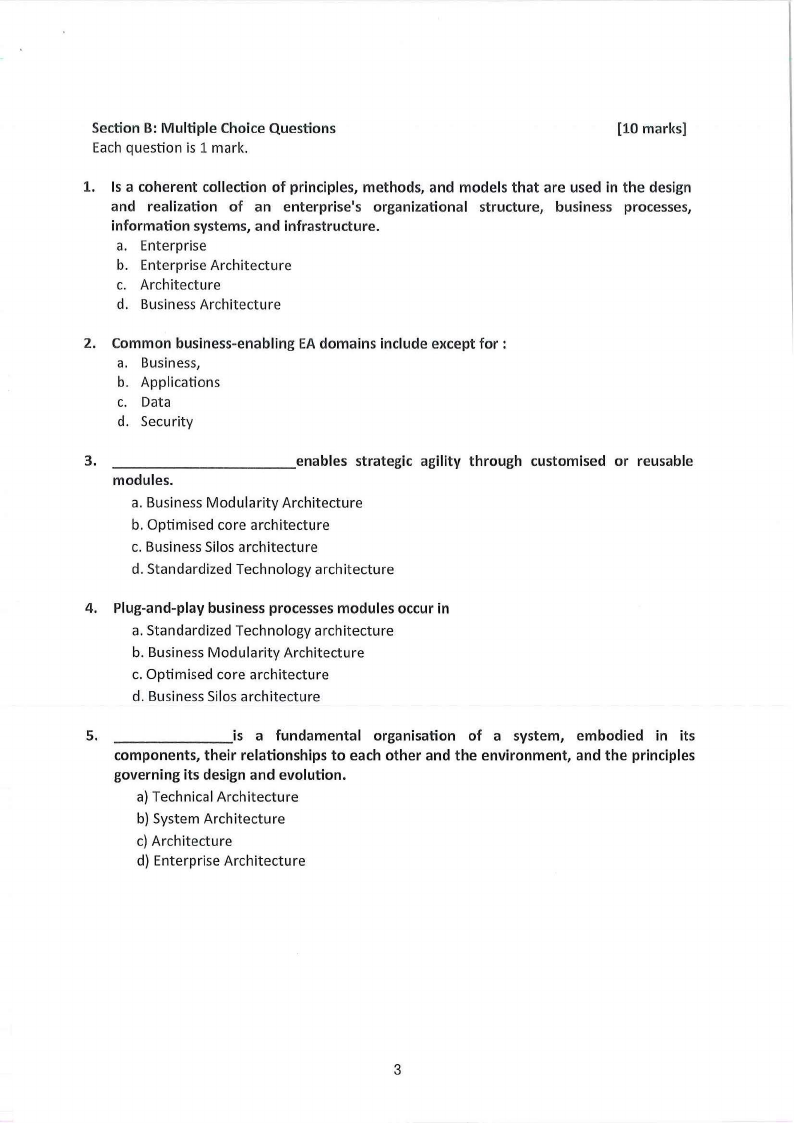
Section B: Multiple Choice Questions
Each question is 1 mark.
[10 marks]
1. Is a coherent collection of principles, methods, and models that are used in the design
and realization of an enterprise's organizational structure, business processes,
information systems, and infrastructure.
a. Enterprise
b. Enterprise Architecture
c. Architecture
d. Business Architecture
2. Common business-enabling EA domains include except for :
a. Business,
b. Applications
c. Data
d. Security
3. __________
modules.
enables strategic agility through customised or reusable
a. Business Modularity Architecture
b. Optimised core architecture
c. Business Silos architecture
d. Standardized Technology architecture
4. Plug-and-play business processes modules occur in
a. Standardized Technology architecture
b. Business Modularity Architecture
c. Optimised core architecture
d. Business Silos architecture
5. _______
is a fundamental organisation of a system, embodied in its
components, their relationships to each other and the environment, and the principles
governing its design and evolution.
a) Technical Architecture
b) System Architecture
c) Architecture
d) Enterprise Architecture
3
|
|
4 Page 4 |
▲back to top |
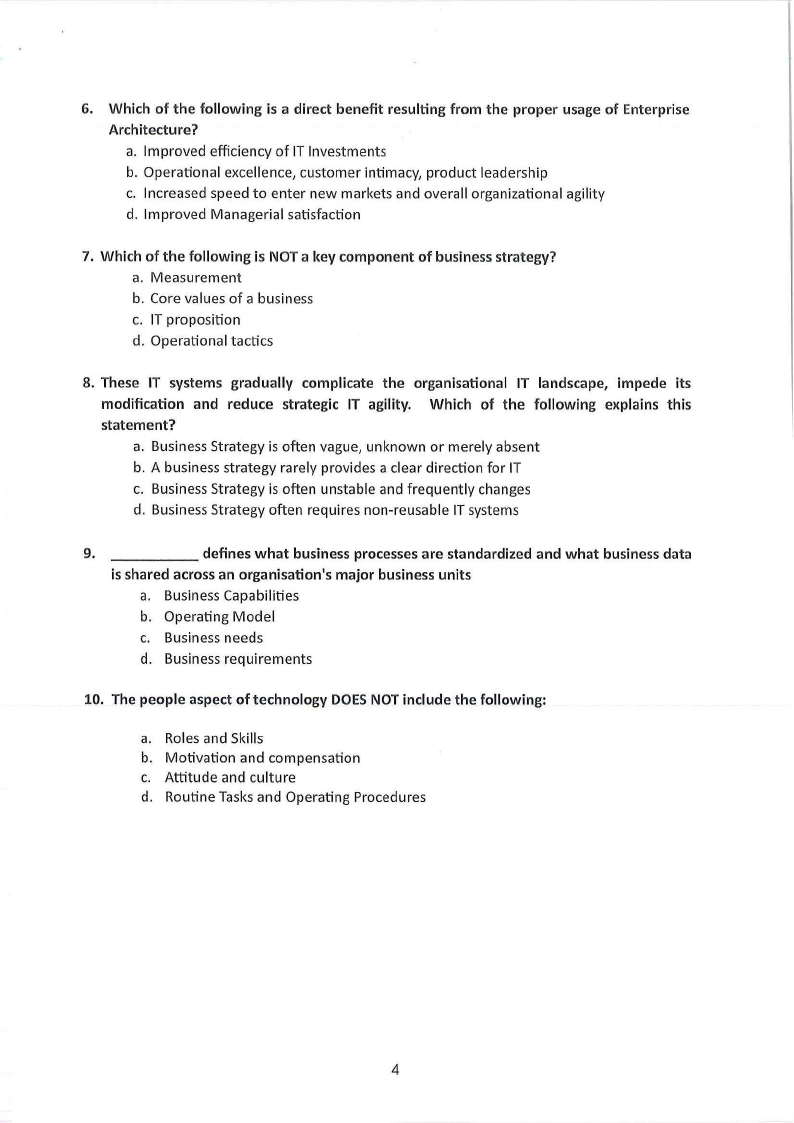
6. Which of the following is a direct benefit resulting from the proper usage of Enterprise
Architecture?
a. Improved efficiency of IT Investments
b. Operational excellence, customer intimacy, product leadership
c. Increased speed to enter new markets and overall organizational agility
d. Improved Managerial satisfaction
7. Which of the following is NOT a key component of business strategy?
a. Measurement
b. Core values of a business
c. IT proposition
d. Operational tactics
8. These IT systems gradually complicate the organisational IT landscape, impede its
modification and reduce strategic IT agility. Which of the following explains this
statement?
a. Business Strategy is often vague, unknown or merely absent
b. A business strategy rarely provides a clear direction for IT
c. Business Strategy is often unstable and frequently changes
d. Business Strategy often requires non-reusable IT systems
9. _____
defines what business processes are standardized and what business data
is shared across an organisation's major business units
a. Business Capabilities
b. Operating Model
c. Business needs
d. Business requirements
10. The people aspect of technology DOES NOT include the following:
a. Roles and Skills
b. Motivation and compensation
c. Attitude and culture
d. Routine Tasks and Operating Procedures
4
|
|
5 Page 5 |
▲back to top |
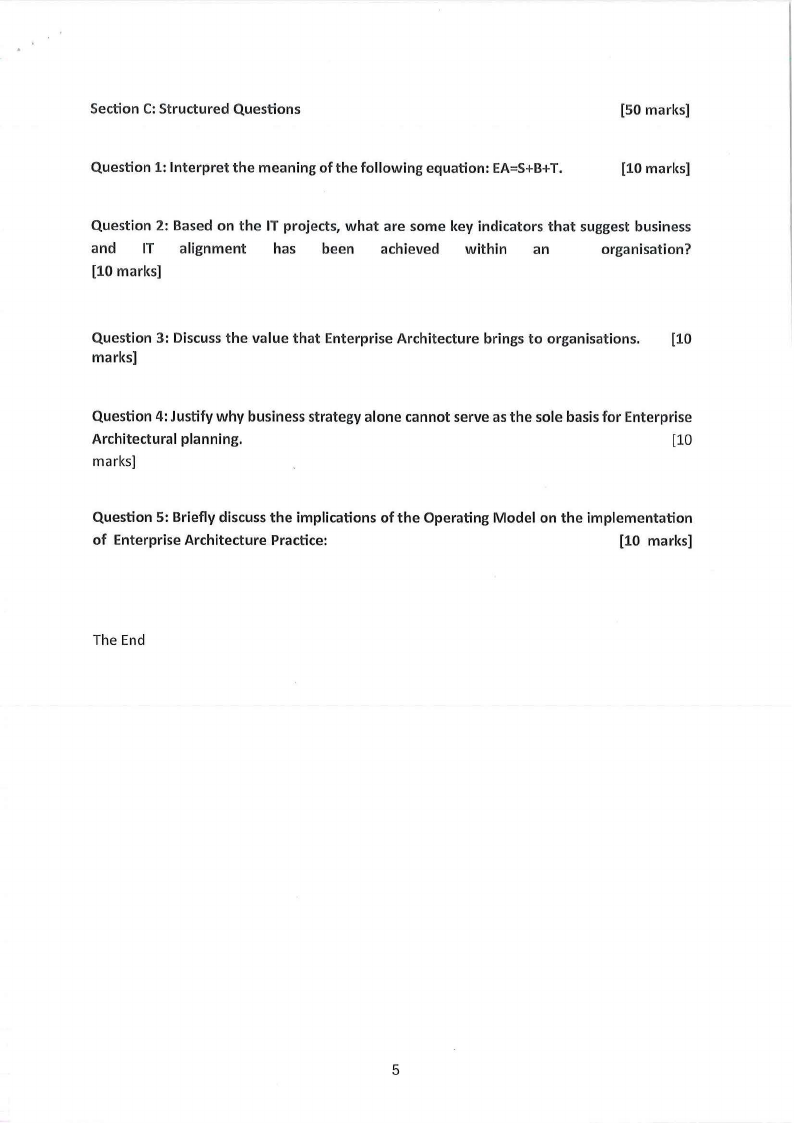
Section C: Structured Questions
[SO marks]
Question 1: Interpret the meaning of the following equation: EA=S+B+T.
[10 marks]
Question 2: Based on the IT projects, what are some key indicators that suggest business
and IT alignment has been achieved within an
organisation?
[10 marks]
Question 3: Discuss the value that Enterprise Architecture brings to organisations.
[10
marks]
Question 4: Justify why business strategy alone cannot serve as the sole basis for Enterprise
Architectural planning.
[10
marks]
Question 5: Briefly discuss the implications of the Operating Model on the implementation
of Enterprise Architecture Practice:
[10 marks]
The End
5