


 |
CSE511S-CONSERVATION ECOLOGY 1-1ST OPP- JUNE 2025 |
|
|
1 Page 1 |
▲back to top |
nAmlBIA unlVERSITY
OF SCIEn CE Ano TECHn OLOGY
FACULTY OF HEALTH, NATURAL RESOURCES AND APPLIED SCIENCES
DEPARTMENT OF NATURAL RESOURCES SCIENCES
QUALIFICATION: BACHELOR of NATURAL RESOURCE MANAGEMENT (NRM)
QUALIFICATION CODE: 07BNRS
LEVEL: 7
COURSE CODE: CSE5115
COURSE NAME: CONSERVATION ECOLOGY1
SESSION: JUNE 2025
DURATION: 3 HOURS
PAPER: THEORY
MARKS: 150
EXAMINER(S)
FIRST OPPORTUNITY EXAMINATION QUESTION PAPER
Mr. J. Amutenya and Prof. T.D. Wassenaar
MODERATOR: Mr. H. Tjikurunda
INSTRUCTIONS
1. Answer ALL the questions.
2. Read all the questions carefully before answering.
3. Number the answers clearly
4. Make sure your name and surname, question number and
the date appear on the answer script.
5. Please ensure that your writing is legible, neat and
presentable.
THIS MARKING SCHEME CONSISTS OF 7 PAGES (Including this front page)
|
|
2 Page 2 |
▲back to top |
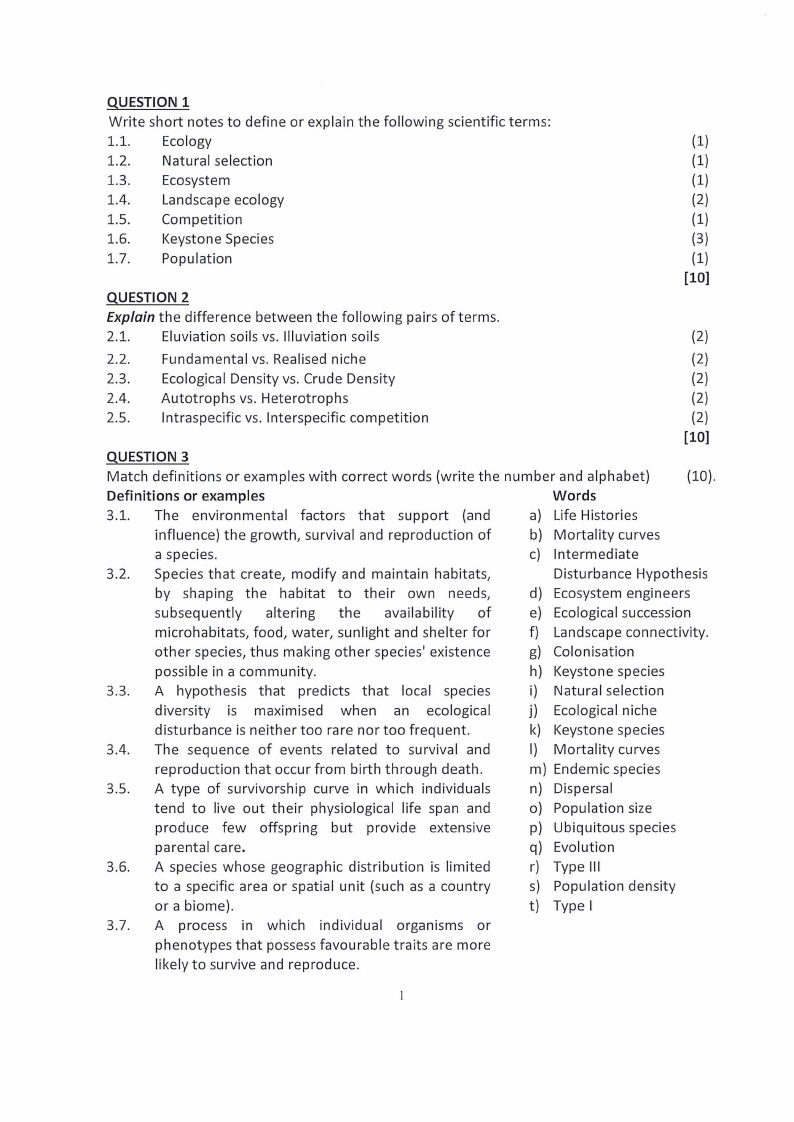
QUESTION 1
Write short notes to define or explain the following scientific terms:
1.1. Ecology
(1)
1.2. Natural selection
(1)
1.3. Ecosystem
(1)
1.4. Landscape ecology
(2)
1.5. Competition
(1)
1.6. Keystone Species
(3)
1.7. Population
(1)
[10]
QUESTION 2
Explain the difference between the following pairs of terms.
2.1. Eluviation soils vs. llluviation soils
(2)
2.2. Fundamental vs. Realised niche
(2)
2.3. Ecological Density vs. Crude Density
(2)
2.4. Autotrophs vs. Heterotrophs
(2)
2.5. lntraspecific vs. lnterspecific competition
(2)
[10]
QUESTION 3
Match definitions or examples with correct words (write the number and alphabet)
(10).
Definitions or examples
Words
3.1. The environmental factors that support (and
a) Life Histories
influence) the growth, survival and reproduction of
b) Mortality curves
a species.
c) Intermediate
3.2. Species that create, modify and maintain habitats,
Disturbance Hypothesis
by shaping the habitat to their own needs,
d) Ecosystem engineers
subsequently altering the availability of
e) Ecological succession
microhabitats, food, water, sunlight and shelter for
f) Landscape connectivity.
other species, thus making other species' existence
g) Colonisation
possible in a community.
h) Keystone species
3.3. A hypothesis that predicts that local species
i) Natural selection
diversity is maximised when an ecological
j) Ecological niche
disturbance is neither too rare nor too frequent.
k) Keystone species
3.4. The sequence of events related to survival and
I) Mortality curves
reproduction that occur from birth through death.
m) Endemic species
3.5. A type of survivorship curve in which individuals
n) Dispersal
tend to live out their physiological life span and
o) Population size
produce few offspring but provide extensive
p) Ubiquitous species
parental care.
q) Evolution
3.6. A species whose geographic distribution is limited
r) Type Ill
to a specific area or spatial unit (such as a country
s) Population density
or a biome).
t) Type I
3.7. A process in which individual organisms or
phenotypes that possess favourable traits are more
likely to survive and reproduce.
|
|
3 Page 3 |
▲back to top |
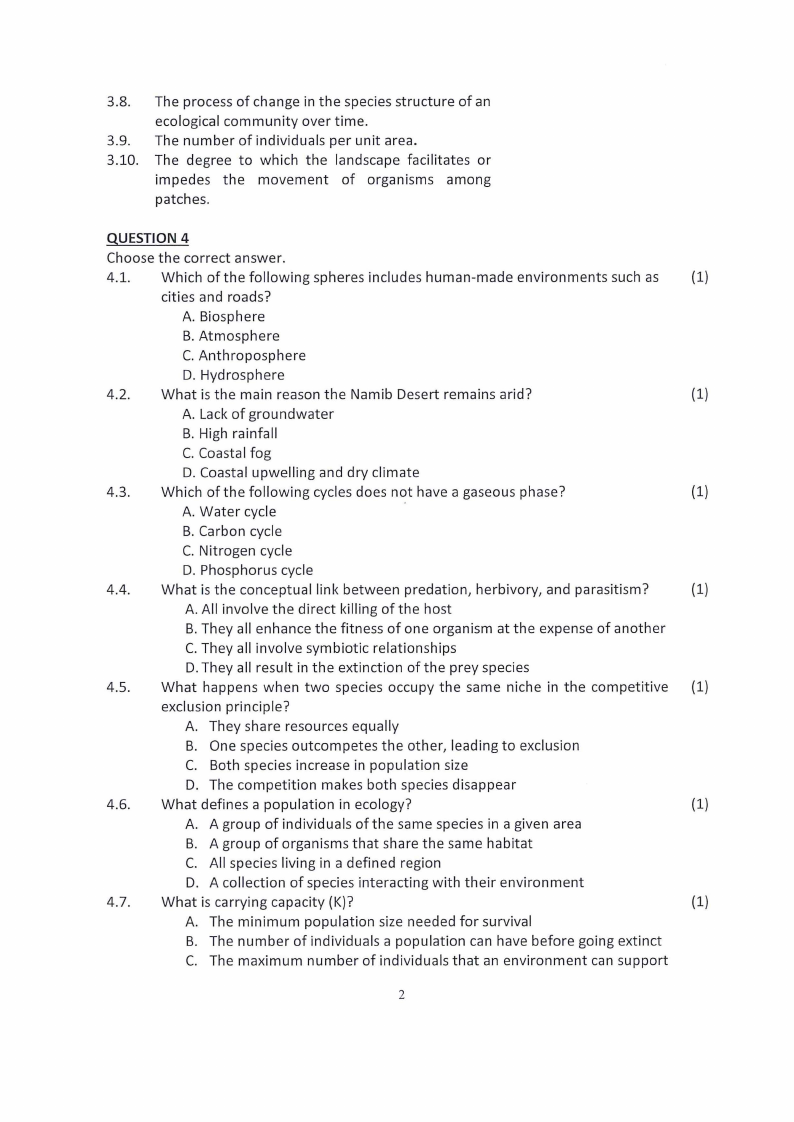
3.8.
3.9.
3.10.
The process of change in the species structure of an
ecological community over time.
The number of individuals per unit area.
The degree to which the landscape facilitates or
impedes the movement of organisms among
patches.
QUESTION 4
Choose the correct answer.
4.1. Which of the following spheres includes human-made environments such as (1)
cities and roads?
A. Biosphere
B. Atmosphere
C. Anthroposphere
D. Hydrosphere
4.2. What is the main reason the Namib Desert remains arid?
(1)
A. Lack of groundwater
B. High rainfall
C. Coastal fog
D. Coastal upwelling and dry climate
4.3. Which of the following cycles does not have a gaseous phase?
(1)
A. Water cycle
B. Carbon cycle
C. Nitrogen cycle
D. Phosphorus cycle
4.4. What is the conceptual link between predation, herbivory, and parasitism?
(1)
A. All involve the direct killing of the host
B. They all enhance the fitness of one organism at the expense of another
C. They all involve symbiotic relationships
D. They all result in the extinction of the prey species
4.5. What happens when two species occupy the same niche in the competitive (1)
exclusion principle?
A. They share resources equally
B. One species outcompetes the other, leading to exclusion
C. Both species increase in population size
D. The competition makes both species disappear
4.6. What defines a population in ecology?
(1)
A. A group of individuals of the same species in a given area
B. A group of organisms that share the same habitat
C. All species living in a defined region
D. A collection of species interacting with their environment
4.7. What is carrying capacity (K)?
(1)
A. The minimum population size needed for survival
B. The number of individuals a population can have before going extinct
C. The maximum number of individuals that an environment can support
2
|
|
4 Page 4 |
▲back to top |
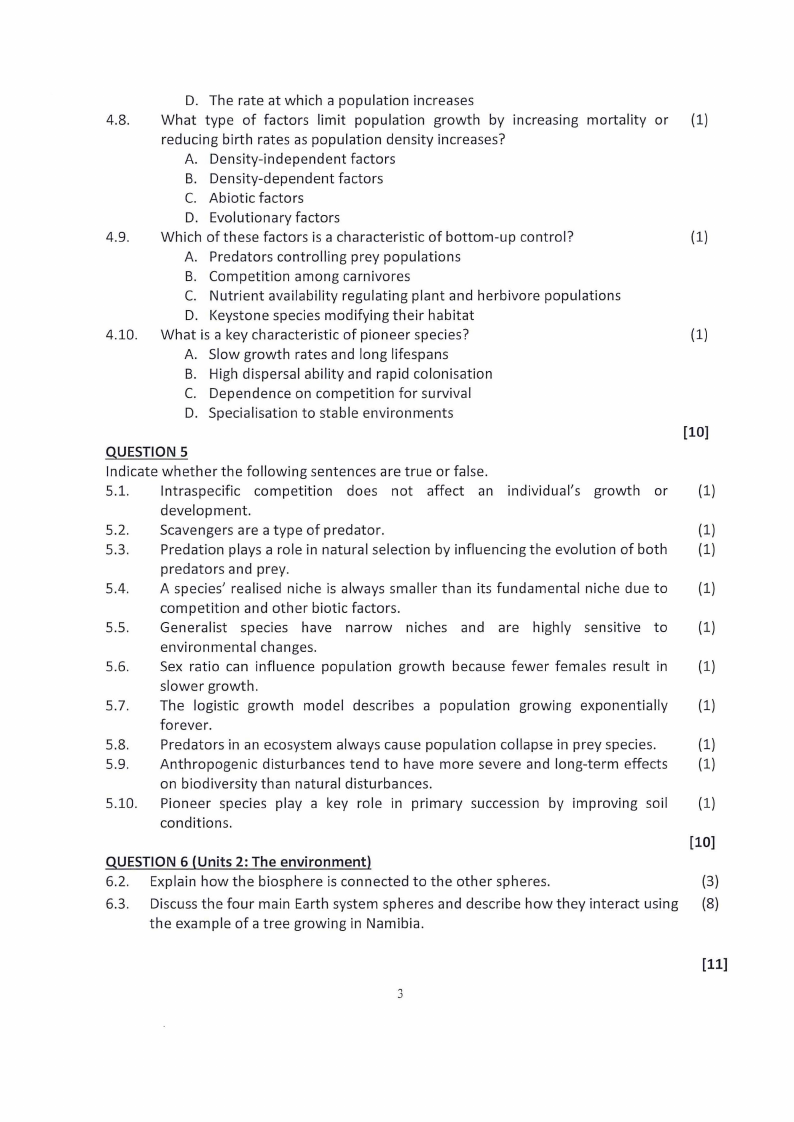
D. The rate at which a population increases
4.8. What type of factors limit population growth by increasing mortality or (1)
reducing birth rates as population density increases?
A. Density-independent factors
B. Density-dependent factors
C. Abiotic factors
D. Evolutionary factors
4.9. Which of these factors is a characteristic of bottom-up control?
(1)
A. Predators controlling prey populations
B. Competition among carnivores
C. Nutrient availability regulating plant and herbivore populations
D. Keystone species modifying their habitat
4.10. What is a key characteristic of pioneer species?
(1)
A. Slow growth rates and long lifespans
B. High dispersal ability and rapid colonisation
C. Dependence on competition for survival
D. Specialisation to stable environments
[10]
QUESTION 5
Indicate whether the following sentences are true or false.
5.1. lntraspecific competition does not affect an individual's growth or (1)
development.
5.2. Scavengers are a type of predator.
(1)
5.3. Predation plays a role in natural selection by influencing the evolution of both (1)
predators and prey.
5.4. A species' realised niche is always smaller than its fundamental niche due to (1)
competition and other biotic factors.
5.5. Generalist species have narrow niches and are highly sensitive to (1)
environmental changes.
5.6. Sex ratio can influence population growth because fewer females result in (1)
slower growth.
5.7. The logistic growth model describes a population growing exponentially
(1)
forever.
5.8. Predators in an ecosystem always cause population collapse in prey species.
(1)
5.9. Anthropogenic disturbances tend to have more severe and long-term effects (1)
on biodiversity than natural disturbances.
5.10. Pioneer species play a key role in primary succession by improving soil (1)
conditions.
[10]
QUESTION 6 (Units 2: The environment)
6.2. Explain how the biosphere is connected to the other spheres.
(3)
6.3. Discuss the four main Earth system spheres and describe how they interact using (8)
the example of a tree growing in Namibia.
[11]
3
|
|
5 Page 5 |
▲back to top |
QUESTION 7 (Unit 3: Species)
7.1. Prey species have evolved a wide range of characteristics to avoid being detected, (3)
selected, and captured by predators. List three (3) morphological defence
mechanisms adopted by animals to avoid being captured.
7.2. List the three (3) forms of exploitative interactions.
(3)
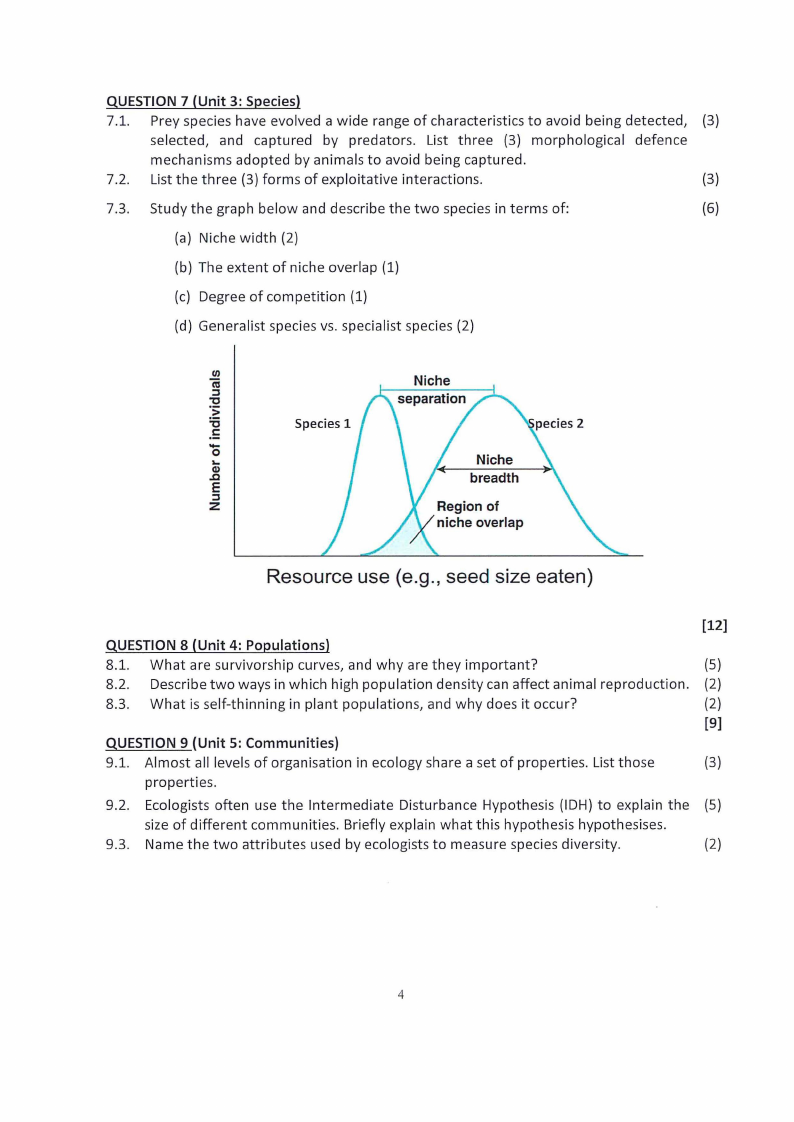
7.3. Study the graph below and describe the two species in terms of:
(6)
(a) Niche width (2)
(b) The extent of niche overlap (1)
(c) Degree of competition (1)
(d) Generalist species vs. specialist species (2)
co(/)
Niche
::J
"C
:ii!
-"C
·=
.0 ..
Niche
(I)
.0
E
breadth
z::J
Resource use (e.g., seed size eaten)
[12]
QUESTION 8 (Unit 4: Populations)
8.1. What are survivorship curves, and why are they important?
(5)
8.2. Describe two ways in which high population density can affect animal reproduction. (2)
8.3. What is self-thinning in plant populations, and why does it occur?
(2)
[9]
QUESTION 9 (Unit 5: Communities)
9.1. Almost all levels of organisation in ecology share a set of properties. List those
(3)
properties.
9.2. Ecologists often use the Intermediate Disturbance Hypothesis (IDH) to explain the (5)
size of different communities. Briefly explain what this hypothesis hypothesises.
9.3. Name the two attributes used by ecologists to measure species diversity.
(2)
4
|
|
6 Page 6 |
▲back to top |
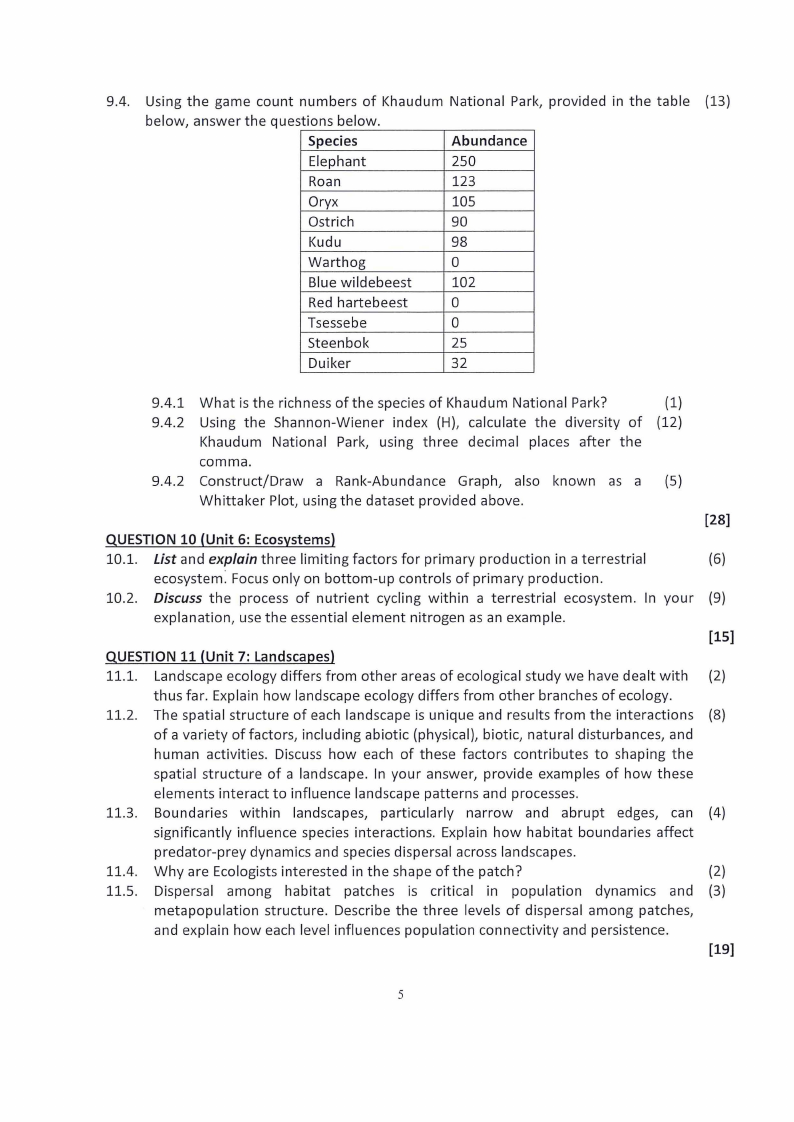
9.4. Using the game count numbers of Khaudum National Park, provided in the table {13)
below, answer the questions below.
Species
Abundance
Elephant
250
Roan
123
Oryx
105
Ostrich
90
Kudu
98
Warthog
0
Blue wildebeest
102
Red hartebeest
0
Tsessebe
0
Steenbok
25
Duiker
32
9.4.1 What is the richness of the species of Khaudum National Park?
{1)
9.4.2 Using the Shannon-Wiener index {H), calculate the diversity of {12)
Khaudum National Park, using three decimal places after the
comma.
9.4.2 Construct/Draw a Rank-Abundance Graph, also known as a (5)
Whittaker Plot, using the dataset provided above.
QUESTION 10 (Unit 6: Ecosystems)
10.1. List and explain three limiting factors for primary production in a terrestrial
ecosystem: Focus only on bottom-up controls of primary production.
10.2. Discuss the process of nutrient cycling within a terrestrial ecosystem. In your
explanation, use the essential element nitrogen as an example.
QUESTION 11 (Unit 7: Landscapes)
11.1. Landscape ecology differs from other areas of ecological study we have dealt with
thus far. Explain how landscape ecology differs from other branches of ecology.
11.2. The spatial structure of each landscape is unique and results from the interactions
of a variety of factors, including abiotic (physical), biotic, natural disturbances, and
human activities. Discuss how each of these factors contributes to shaping the
spatial structure of a landscape. In your answer, provide examples of how these
elements interact to influence landscape patterns and processes.
11.3. Boundaries within landscapes, particularly narrow and abrupt edges, can
significantly influence species interactions. Explain how habitat boundaries affect
predator-prey dynamics and species dispersal across landscapes.
11.4. Why are Ecologists interested in the shape of the patch?
11.5. Dispersal among habitat patches is critical in population dynamics and
metapopulation structure. Describe the three levels of dispersal among patches,
and explain how each level influences population connectivity and persistence.
[28]
(6)
(9)
[15]
(2)
(8)
(4)
(2)
(3)
[19]
5
|
|
7 Page 7 |
▲back to top |

QUESTION 12 (Unit 8: Global ecology)
12.1. Explain the key principles of the Theory of Island Biogeography and discuss its
(2)
relevance to natural resource management.
12.2. The Millennium Ecosystem Assessment (MEA) presented key findings on the state (4)
and trends of global biodiversity. Summarise the main findings of the Millennium
Ecosystem Assessment regarding biodiversity.
[6]
TOTAL: 150 marks
6