BSS511S - BUILDING SERVICES - 2ND OPP - JULY 2025


BSS511S - BUILDING SERVICES - 2ND OPP - JULY 2025


1 Page 1

▲back to top


nAmlBIA UnlVERSITY
OFSCIEnCEAno TECHnOLOGY
FACULTYOF ENGINEERINGAND THEBUILTENVIRONMENT
DEPARTMENTOF LANDAND SPATIALSCIENCES
QUALIFICATION(S):
BACHELOROF PROPERTYSTUDIESand DIPLOMA IN PROPERTYSTUDIES
QUALIFICATION(SC) ODE:
08BOPS, 06DIPS
NQF LEVEL:5
COURSECODE: BSS511S
COURSENAME: BUILDING SERVICES
DATE: JULY 2025
PAPER: THEORY
DURATION: 3 HOURS
MARKS:100
SECONDOPPORTUNITY/SUPPLEMENTAREYXAMINATIONQUESTIONPAPER
EXAMINER:
Mrs Elina Teodol
MODERATOR: Mr Verinjaerako Kangotue
INSTRUCTIONS
1. Read the entire question paper before answering the Questions.
2. Please write clearly and legibly!
3. Please STARTEACHQUESTIONON A FRESHPAGE.
4. The question paper contains a total of 4 questions.
5. You must answer ALLQUESTIONS.
6. Make sure your Student Number is on the EXAMINATION BOOK(S).
PERMISSIBLEMATERIALS
1. Non-programmable Scientific Calculator
THIS QUESTIONPAPERCONSISTSOF 9 PAGES(Including this front page)

2 Page 2

▲back to top


Building Services
B5S511S
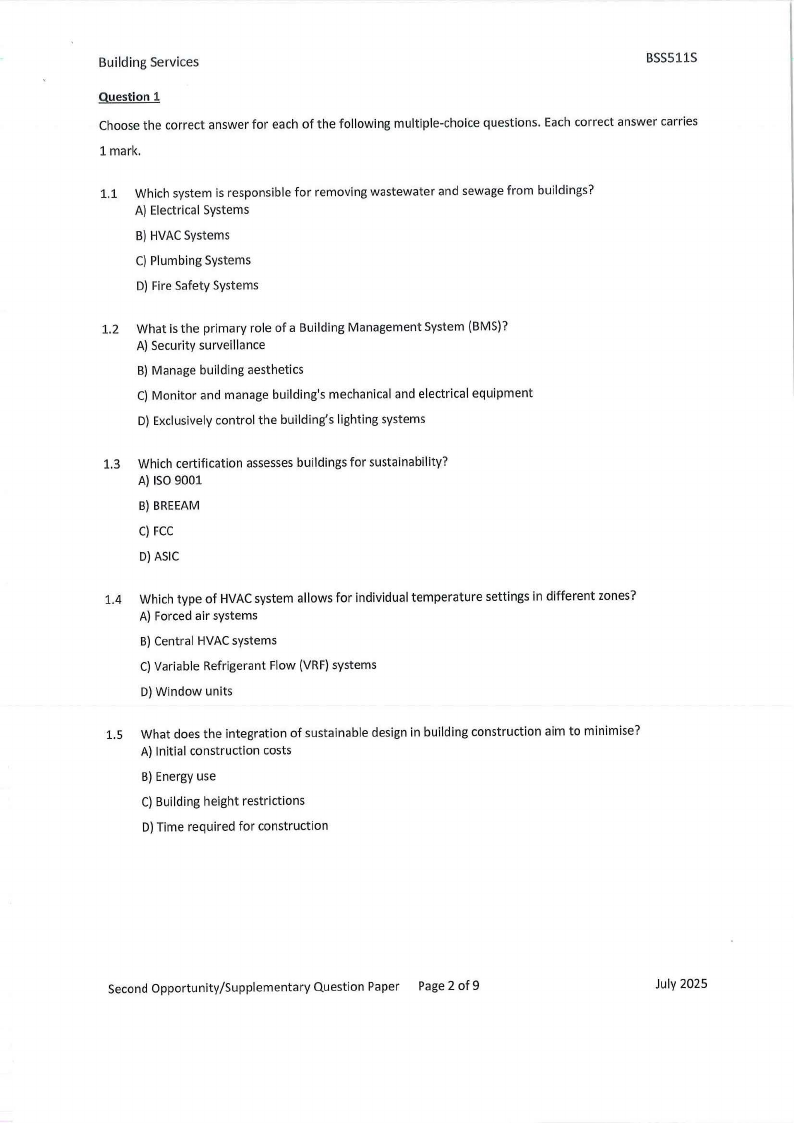
Question 1
Choose the correct answer for each of the following multiple-choice questions. Each correct answer carries
1 mark.
1.1 Which system is responsible for removing wastewater and sewage from buildings?
A) Electrical Systems
B) HVACSystems
C) Plumbing Systems
D) Fire Safety Systems
1.2 What is the primary role of a Building Management System (BMS)?
A) Security surveillance
B) Manage building aesthetics
C) Monitor and manage building's mechanical and electrical equipment
D) Exclusively control the building's lighting systems
1.3 Which certification assessesbuildings for sustainability?
A) ISO9001
B) BREEAM
C) FCC
D) ASIC
1.4 Which type of HVACsystem allows for individual temperature settings in different zones?
A) Forced air systems
B) Central HVAC systems
C) Variable Refrigerant Flow (VRF)systems
D) Window units
1.5 What does the integration of sustainable design in building construction aim to minimise?
A) Initial construction costs
B) Energy use
C) Building height restrictions
D) Time required for construction
Second Opportunity/Supplementary Question Paper Page 2 of 9
July 2025

3 Page 3

▲back to top


Building Services
BSS511S
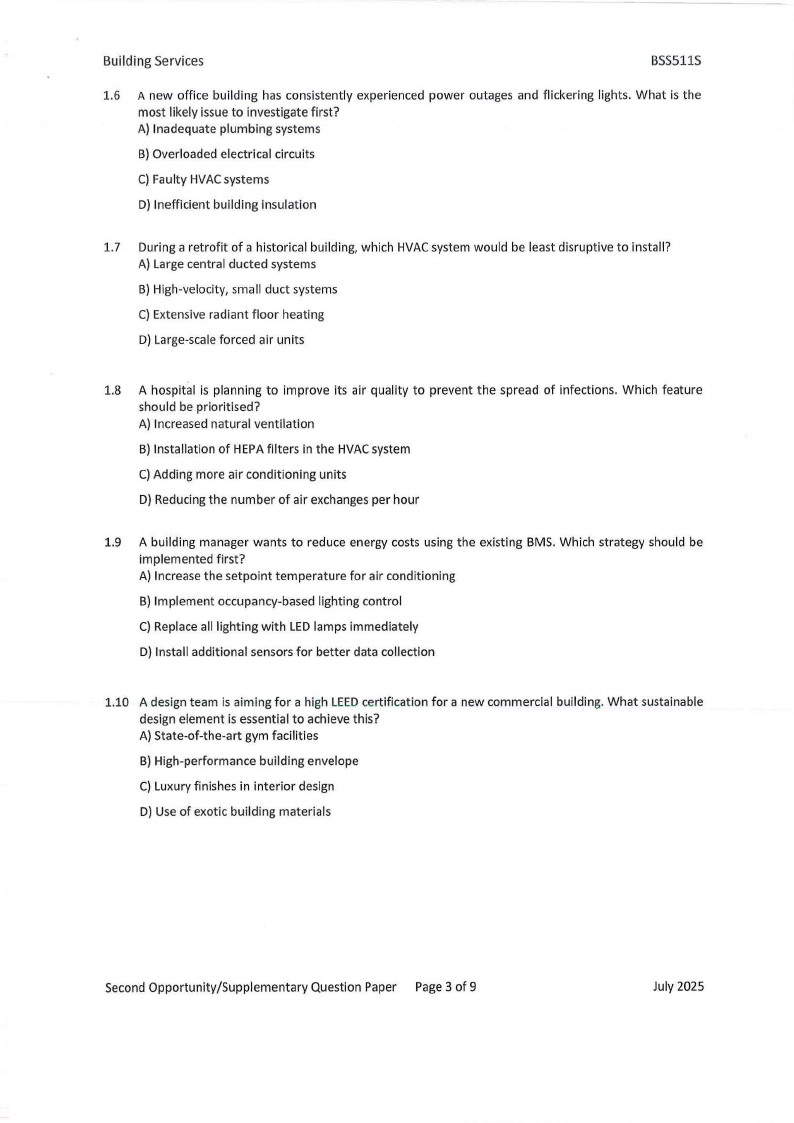
1.6 A new office building has consistently experienced power outages and flickering lights. What is the
most likely issue to investigate first?
A) Inadequate plumbing systems
B) Overloaded electrical circuits
C) Faulty HVACsystems
D) Inefficient building insulation
1.7 During a retrofit of a historical building, which HVACsystem would be least disruptive to install?
A) Large central ducted systems
B) High-velocity, small duct systems
C) Extensive radiant floor heating
D) Large-scaleforced air units
1.8 A hospital is planning to improve its air quality to prevent the spread of infections. Which feature
should be prioritised?
A) Increased natural ventilation
B) Installation of HEPAfilters in the HVACsystem
C)Adding more air conditioning units
D) Reducing the number of air exchanges per hour
1.9 A building manager wants to reduce energy costs using the existing BMS. Which strategy should be
implemented first?
A) Increase the setpoint temperature for air conditioning
B) Implement occupancy-based lighting control
C) Replaceall lighting with LEDlamps immediately
D) Install additional sensors for better data collection
1.10 A design team is aiming for a high LEEDcertification for a new commercial building. What sustainable
design element is essential to achieve this?
A) State-of-the-art gym facilities
B) High-performance building envelope
C) Luxury finishes in interior design
D) Use of exotic building materials
Second Opportunity/Supplementary Question Paper Page 3 of 9
July 2025

4 Page 4

▲back to top


Building Services
B5S511S
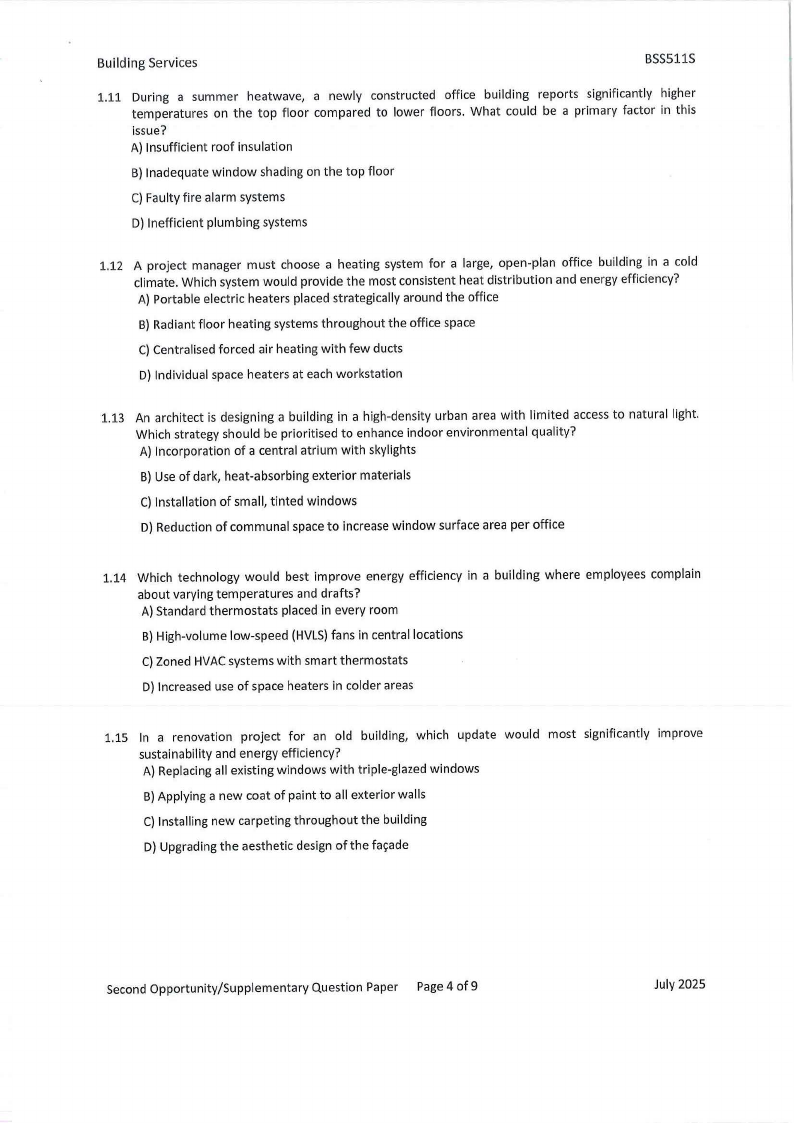
1.11 During a summer heatwave, a newly constructed office building reports significantly higher
temperatures on the top floor compared to lower floors. What could be a primary factor in this
issue?
A) Insufficient roof insulation
B) Inadequate window shading on the top floor
C) Faulty fire alarm systems
D) Inefficient plumbing systems
1.12 A project manager must choose a heating system for a large, open-plan office building in a cold
climate. Which system would provide the most consistent heat distribution and energy efficiency?
A) Portable electric heaters placed strategically around the office
B) Radiant floor heating systems throughout the office space
C) Centralised forced air heating with few ducts
D) Individual space heaters at each workstation
1.13 An architect is designing a building in a high-density urban area with limited accessto natural light.
Which strategy should be prioritised to enhance indoor environmental quality?
A) Incorporation of a central atrium with skylights
B) Use of dark, heat-absorbing exterior materials
C) Installation of small, tinted windows
D) Reduction of communal space to increase window surface area per office
1.14 Which technology would best improve energy efficiency in a building where employees complain
about varying temperatures and drafts?
A) Standard thermostats placed in every room
B) High-volume low-speed (HVLS)fans in central locations
C)Zoned HVACsystems with smart thermostats
D) Increased use of space heaters in colder areas
1.lS In a renovation project for an old building, which update would most significantly improve
sustainability and energy efficiency?
A) Replacingall existing windows with triple-glazed windows
B) Applying a new coat of paint to all exterior walls
C) Installing new carpeting throughout the building
D) Upgrading the aesthetic design of the fa~ade
SecondOpportunity/Supplementary Question Paper Page4 of 9
July 2025

5 Page 5

▲back to top


Building Services
BSSSllS
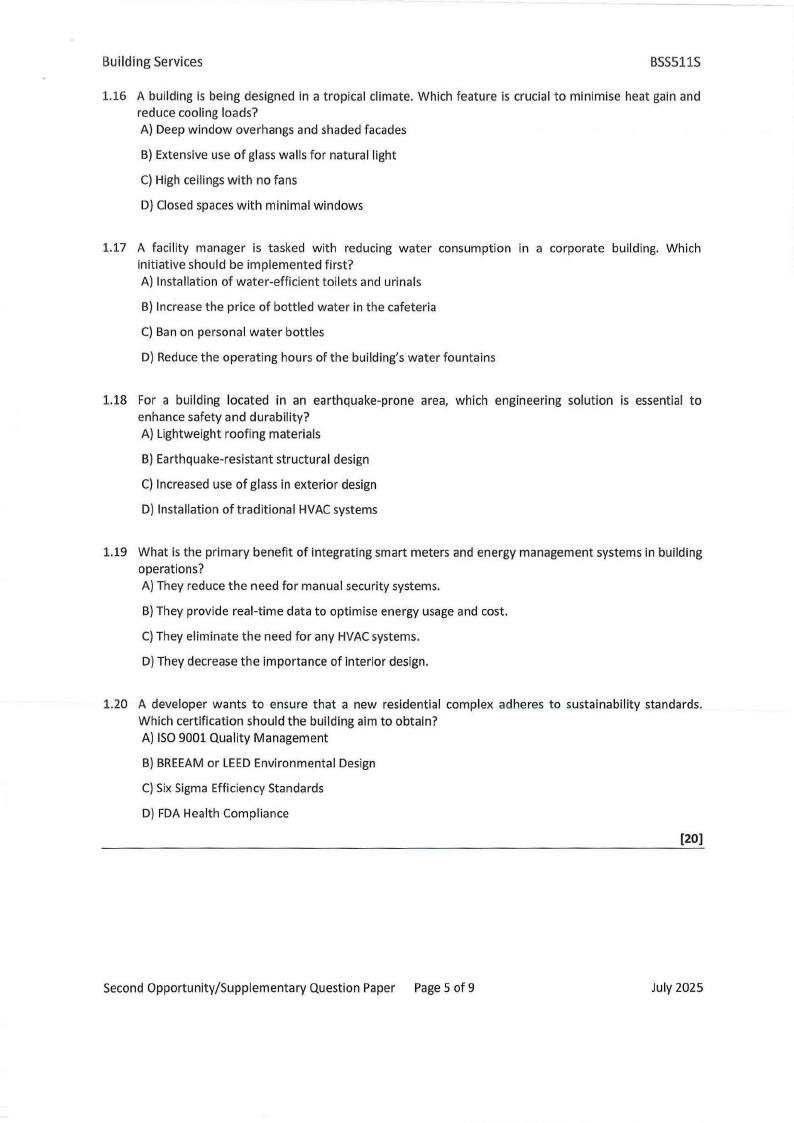
1.16 A building is being designed in a tropical climate. Which feature is crucial to minimise heat gain and
reduce cooling loads?
A) Deep window overhangs and shaded facades
B) Extensive use of glass walls for natural light
C) High ceilings with no fans
D) Closed spaces with minimal windows
1.17 A facility manager is tasked with reducing water consumption in a corporate building. Which
initiative should be implemented first?
A) Installation of water-efficient toilets and urinals
B) Increase the price of bottled water in the cafeteria
C) Ban on personal water bottles
D) Reduce the operating hours of the building's water fountains
1.18 For a building located in an earthquake-prone area, which engineering solution is essential to
enhance safety and durability?
A) Lightweight roofing materials
B) Earthquake-resistant structural design
C) Increased use of glass in exterior design
D) Installation of traditional HVACsystems
1.19 What is the primary benefit of integrating smart meters and energy management systems in building
operations?
A) They reduce the need for manual security systems.
B) They provide real-time data to optimise energy usage and cost.
C)They eliminate the need for any HVACsystems.
D) They decrease the importance of interior design.
1.20 A developer wants to ensure that a new residential complex adheres to sustainability standards.
Which certification should the building aim to obtain?
A) ISO9001 Quality Management
B) BREEAMor LEEDEnvironmental Design
C) Six Sigma Efficiency Standards
D) FDA Health Compliance
(20)
Second Opportunity/Supplementary Question Paper PageS of 9
July 2025

6 Page 6

▲back to top


Building Services
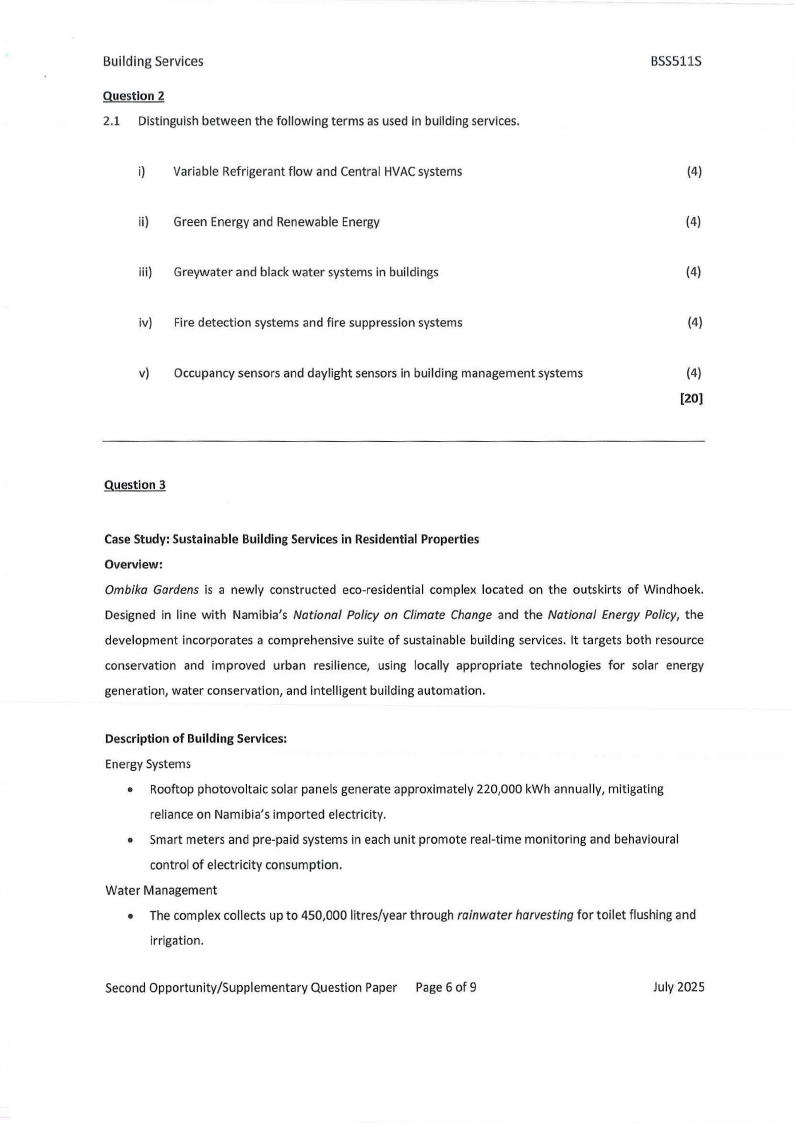
Question 2
2.1 Distinguish between the following terms as used in building services.
i) Variable Refrigerant flow and Central HVACsystems
ii) Green Energy and Renewable Energy
iii) Greywater and black water systems in buildings
iv) Fire detection systems and fire suppression systems
v) Occupancy sensors and daylight sensors in building management systems
85S511S
(4)
(4)
(4)
(4)
(4)
[20]
Question 3
CaseStudy:SustainableBuildingServicesin ResidentialProperties
Overview:
Ombika Gardens is a newly constructed eco-residential complex located on the outskirts of Windhoek.
Designed in line with Namibia's National Policy on Climate Change and the National Energy Policy, the
development incorporates a comprehensive suite of sustainable building services. It targets both resource
conservation and improved urban resilience, using locally appropriate technologies for solar energy
generation, water conservation, and intelligent building automation.
Descriptionof BuildingServices:
Energy Systems
• Rooftop photovoltaic solar panels generate approximately 220,000 kWh annually, mitigating
reliance on Namibia's imported electricity.
• Smart meters and pre-paid systems in each unit promote real-time monitoring and behavioural
control of electricity consumption.
Water Management
• The complex collects up to 450,000 litres/year through rainwater harvesting for toilet flushing and
irrigation.
Second Opportunity/Supplementary Question Paper Page 6 of 9
July 2025

7 Page 7

▲back to top


Building Services
B$S511S
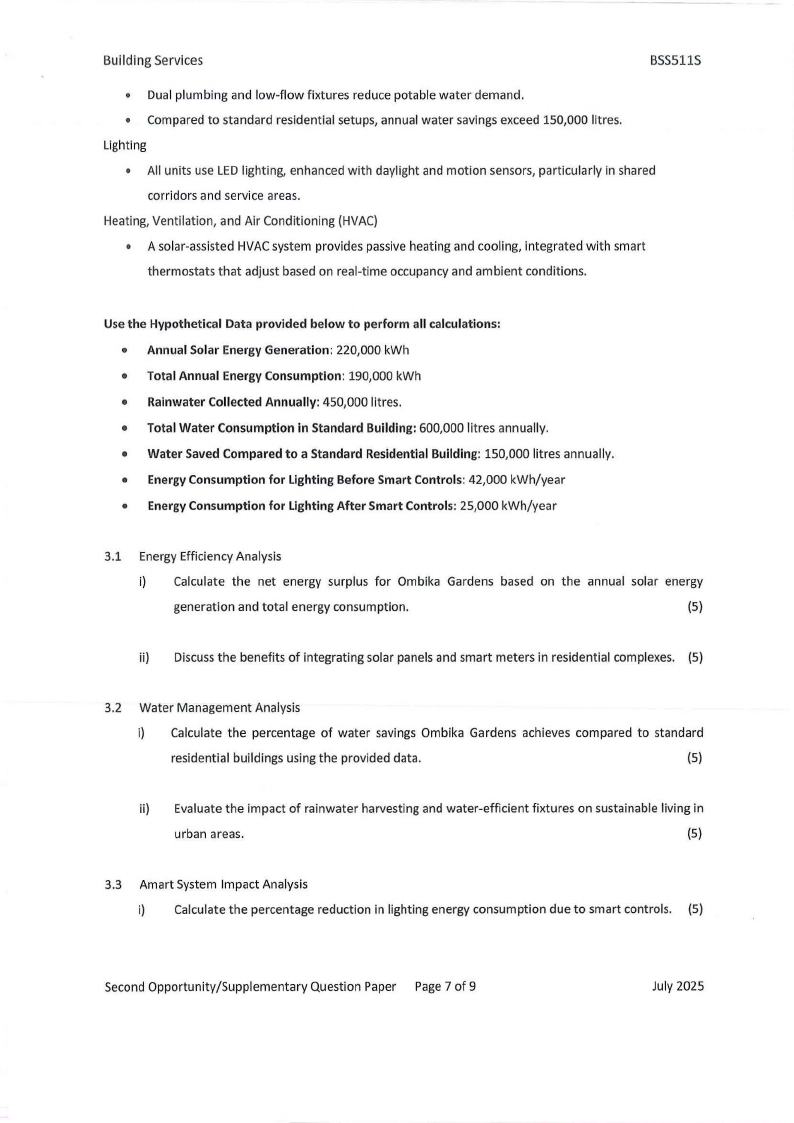
• Dual plumbing and low-flow fixtures reduce potable water demand.
• Compared to standard residential setups, annual water savings exceed 150,000 litres.
Lighting
• All units use LEDlighting, enhanced with daylight and motion sensors, particularly in shared
corridors and service areas.
Heating, Ventilation, and Air Conditioning (HVAC)
• A solar-assisted HVACsystem provides passive heating and cooling, integrated with smart
thermostats that adjust based on real-time occupancy and ambient conditions.
Usethe Hypothetical Data provided below to perform all calculations:
AnnualSolar EnergyGeneration: 220,000 kWh
Total Annual EnergyConsumption:190,000 kWh
RainwaterCollectedAnnually:450,000 litres.
Total Water Consumptionin StandardBuilding:600,000 litres annually.
Water SavedComparedto a Standard ResidentialBuilding:150,000 litres annually.
EnergyConsumptionfor LightingBefore Smart Controls:42,000 kWh/year
EnergyConsumptionfor LightingAfter Smart Controls:25,000 kWh/year
3.1 Energy Efficiency Analysis
i) Calculate the net energy surplus for Ombika Gardens based on the annual solar energy
generation and total energy consumption.
(5)
ii) Discussthe benefits of integrating solar panels and smart meters in residential complexes. (5)
3.2 Water Management Analysis
i) Calculate the percentage of water savings Omblka Gardens achieves compared to standard
residential buildings using the provided data.
(5)
ii) Evaluate the impact of rainwater harvesting and water-efficient fixtures on sustainable living in
urban areas.
(5)
3.3 Amart System Impact Analysis
i) Calculate the percentage reduction in lighting energy consumption due to smart controls. (5)
Second Opportunity/Supplementary Question Paper Page7 of 9
July 2025

8 Page 8

▲back to top


Building Services
B5S511S
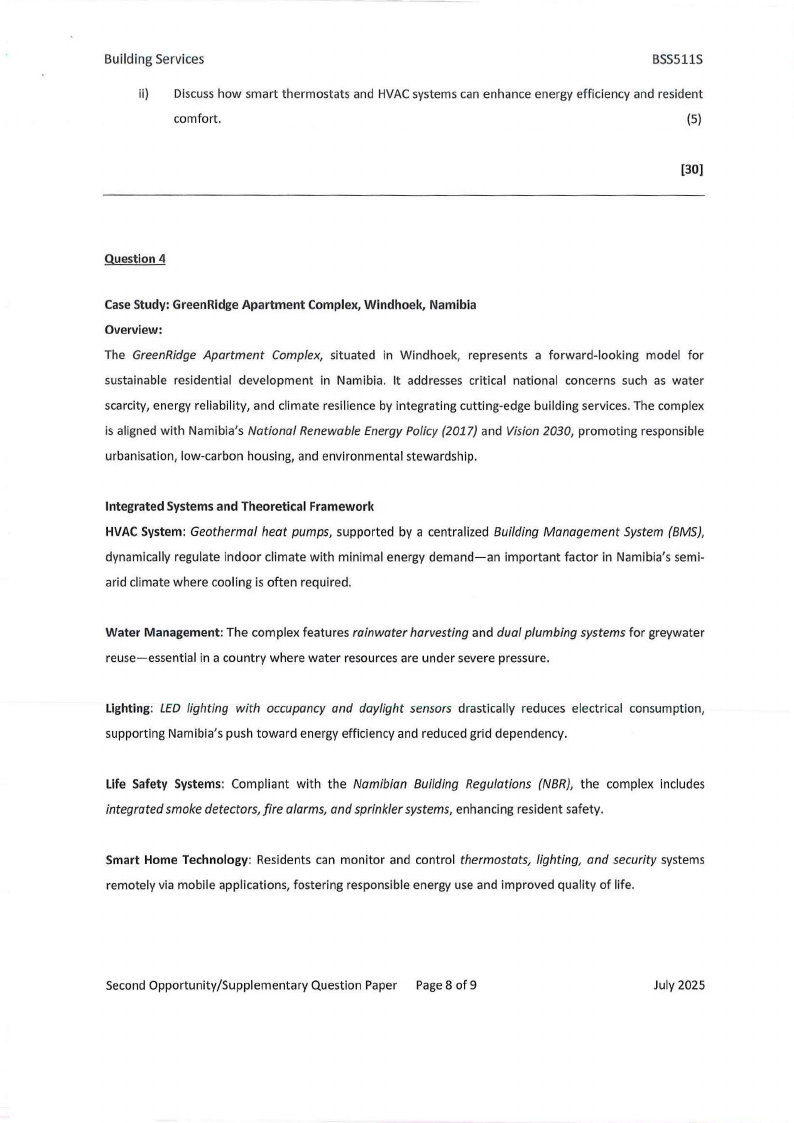
ii) Discusshow smart thermostats and HVACsystems can enhance energy efficiency and resident
comfort.
(S)
[30]
Question 4
Case Study: GreenRidge Apartment Complex, Windhoek, Namibia
Overview:
The GreenRidge Apartment Complex, situated in Windhoek, represents a forward-looking model for
sustainable residential development in Namibia. It addresses critical national concerns such as water
scarcity, energy reliability, and climate resilience by integrating cutting-edge building services. The complex
is aligned with Namibia's National Renewable Energy Policy (2017} and Vision 2030, promoting responsible
urbanisation, low-carbon housing, and environmental stewardship.
Integrated Systems and Theoretical Framework
HVAC System: Geothermal heat pumps, supported by a centralized Building Management System (BMS),
dynamically regulate indoor climate with minimal energy demand-an important factor in Namibia's semi-
arid climate where cooling is often required.
Water Management: The complex features rainwater harvesting and dual plumbing systems for greywater
reuse-essential in a country where water resources are under severe pressure.
lighting: LED lighting with occupancy and daylight sensors drastically reduces electrical consumption,
supporting Namibia's push toward energy efficiency and reduced grid dependency.
Life Safety Systems: Compliant with the Namibian Building Regulations (NBR), the complex Includes
integrated smoke detectors, fire alarms, and sprinkler systems, enhancing resident safety.
Smart Home Technology: Residents can monitor and control thermostats, lighting, and security systems
remotely via mobile applications, fostering responsible energy use and improved quality of life.
SecondOpportunity/Supplementary Question Paper Page8 of 9
July 2025

9 Page 9

▲back to top


Building Services
B5S511S
Questions:
4.1 Define a Building Management System (BMS) and explain how it contributes to energy efficiency in
Namibian residential developments such as GreenRidge.
(5)
4.2 What are geothermal heating and cooling systems, and why are they suitable for sustainable design
in Namibia?
(5)
4.3 Compare traditional lighting systems with LEDtechnology in terms of energy efficiency and lifecycle
cost, particularly in the Namibian context.
(5)
4.4 Explain how smart home technologies benefit Namibian households, using GreenRidge as an
example.
(5)
4.5 Define 'rainwater harvesting' and assess its relevance for water conservation in Namibia's urban
residential developments.
(5)
4.6 Outline key safety systems required by Namibian building codes and evaluate how these enhance
resident safety in developments like GreenRidge.
(5)
[30]
SecondOpportunity/Supplementary Question Paper Page9 of 9
July 2025