


 |
BRM711C-RETAIL MANAGEMENT -1ST OPP- NOV 2025 |
|
|
1 Page 1 |
▲back to top |
nAm I BIA u nlVERS ITV
OF SCIEnCE Ano TECHnOLOGY
FACULTY OF COMMERCE; HUMAN SCIENCES AND EDUCATION
CENTRE FOR ENTERPRISE DEVELOPMENT (CED)
QUALIFICATION: DIPLOMA IN BUSINESS PROCESS MANAGEMENT
QUALIFICATION CODE: 06DBPM LEVEL: 6
COURSE CODE: BRM 71 IC
COURSE NAME: RETAIL MANAGEMENT
SESSION: NOVEMBER 2025
DURATION: 3 HOURS
PAPER: PAPER I
MARKS: 100
FIRST OPPORTUNITY EXAMINATION - QUESTION PAPER
EXAMINER(S) MR. S. TJITAMUNISA
MODERATOR: MR. R. RITTER
I. Answer ALL the questions.
2. Write clearly and neatly.
INSTRUCTIONS
THIS QUESTION PAPER CONSISTS OF 6 PAGES (Including this front page)
llP age
|
|
2 Page 2 |
▲back to top |
SECTION A
ANALYTICAL QUESTIONS
60 marks
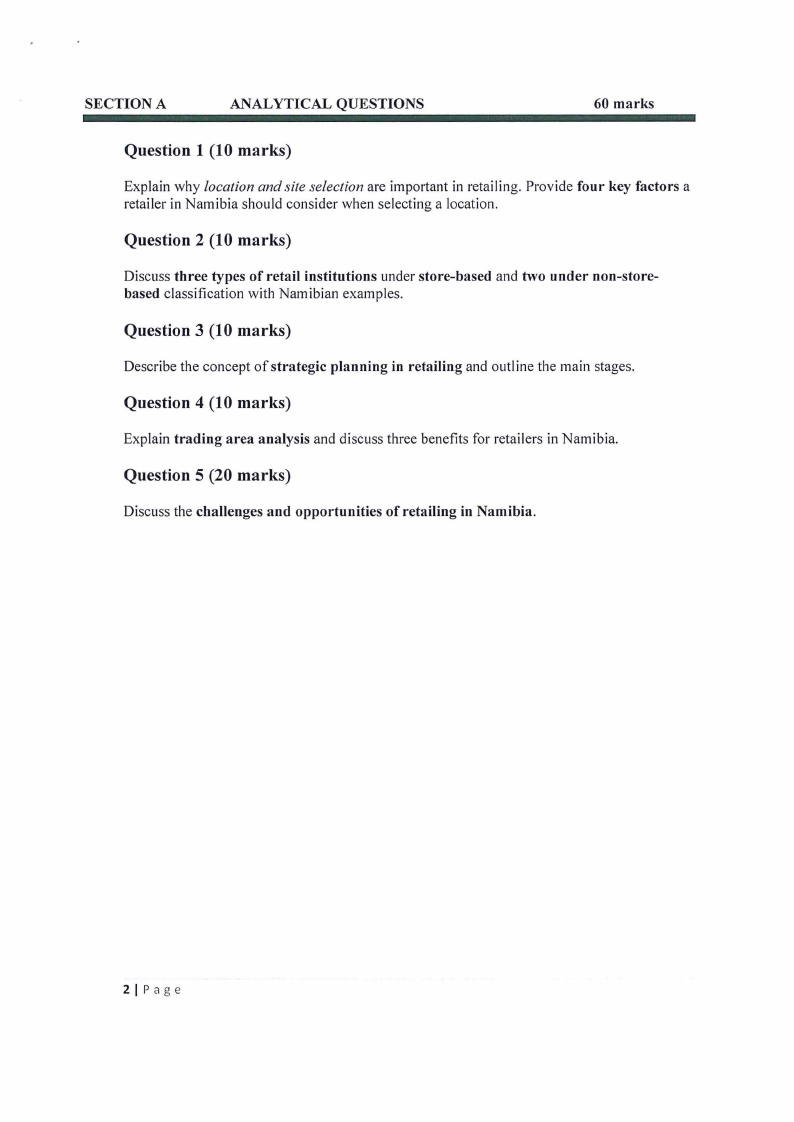
Question 1 (10 marks)
Explain why location and site selection are important in retailing. Provide four key factors a
retailer in Namibia should consider when selecting a location.
Question 2 (10 marks)
Discuss three types of retail institutions under store-based and two under non-store-
based classification with Namibian examples.
Question 3 (10 marks)
Describe the concept of strategic planning in retailing and out! ine the main stages.
Question 4 (10 marks)
Explain trading area analysis and discuss three benefits for retailers in Namibia.
Question 5 (20 marks)
Discuss the challenges and opportunities of retailing in Namibia .
21P age
|
|
3 Page 3 |
▲back to top |
SECTIONB MULTIPLE CHOICE QUESTIONS
(20 Marks)
Use Table A on page 7 to answer and detach, hand in with your answer sheet.
Section A: Multiple Choice Questions (20 marks)
(Answer ALL. Each question= 2 marks)
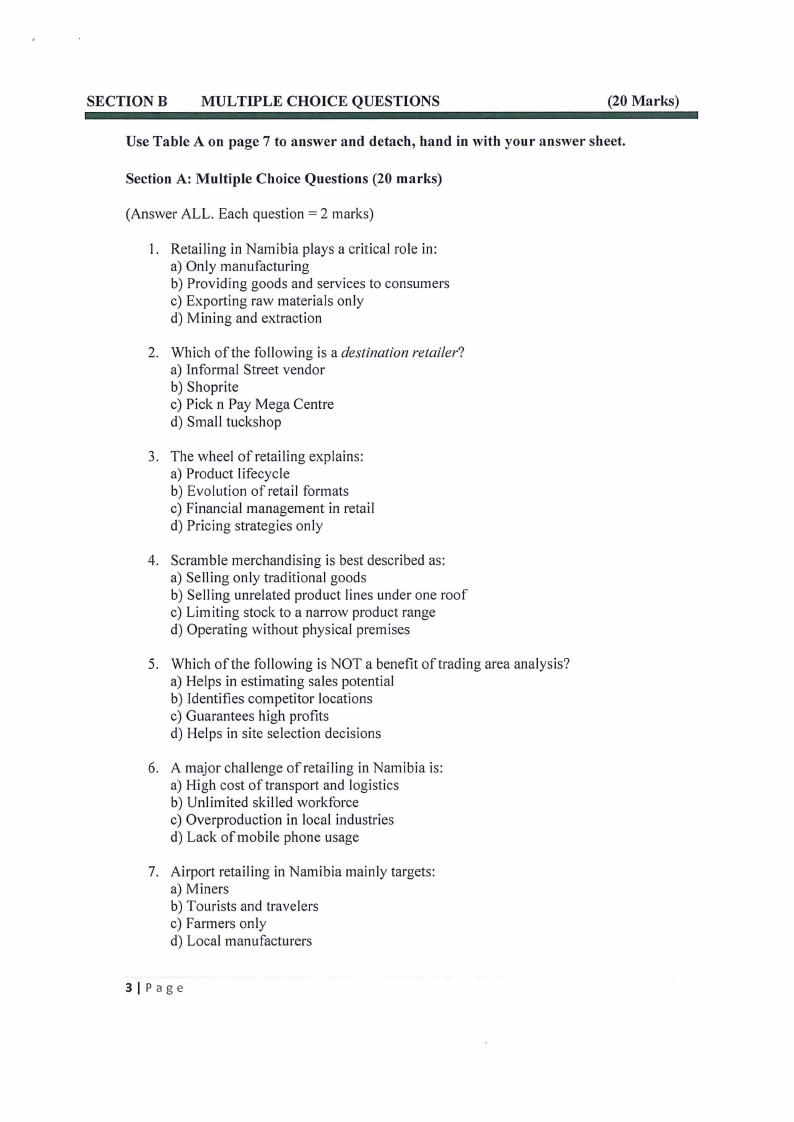
1. Retailing in Namibia plays a critical role in:
a) Only manufacturing
b) Providing goods and services to consumers
c) Exporting raw materials only
d) Mining and extraction
2. Which of the following is a destination retailer?
a) Informal Street vendor
b) Shoprite
c) Pick n Pay Mega Centre
d) Small tuckshop
3. The wheel of retailing explains:
a) Product lifecycle
b) Evolution of retail formats
c) Financial management in retail
d) Pricing strategies only
4. Scramble merchandising is best described as:
a) Selling only traditional goods
b) Selling unrelated product lines under one roof
c) Limiting stock to a narrow product range
d) Operating without physical premises
5. Which of the following is NOT a benefit of trading area analysis?
a) Helps in estimating sales potential
b) Identifies competitor locations
c) Guarantees high profits
d) Helps in site selection decisions
6. A major challenge of retailing in Namibia is:
a) High cost of transport and logistics
b) Unlimited skilled workforce
c) Overproduction in local industries
d) Lack of mobile phone usage
7. Airport retailing in Namibia mainly targets:
a) Miners
b) Tourists and travelers
c) Farmers only
d) Local manufacturers
3IPage
|
|
4 Page 4 |
▲back to top |
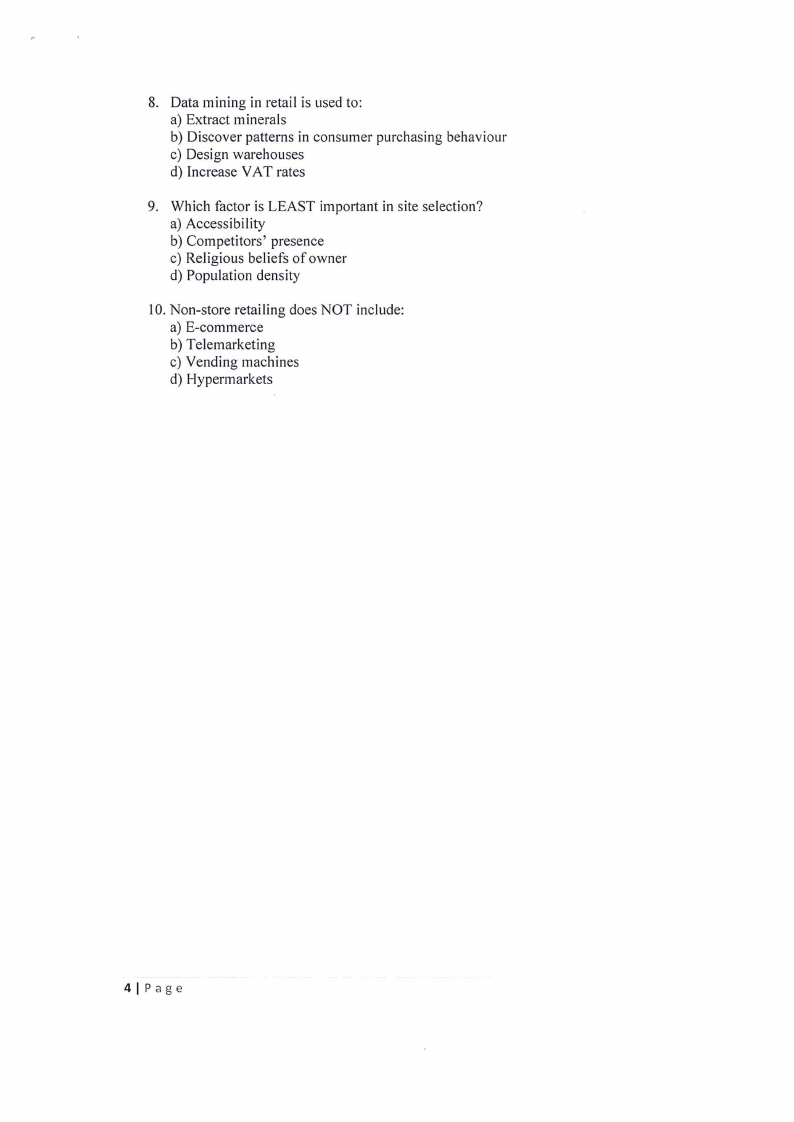
8. Data mining in retail is used to:
a) Extract minerals
b) Discover patterns in consumer purchasing behaviour
c) Design warehouses
d) Increase VAT rates
9. Which factor is LEAST important in site selection?
a) Accessibility
b) Competitors' presence
c) Religious be! iefs of owner
d) Population density
10. Non-store retailing does NOT include:
a) E-commerce
b) Telemarketing
c) Vending machines
d) Hypermarkets
41P age
|
|
5 Page 5 |
▲back to top |
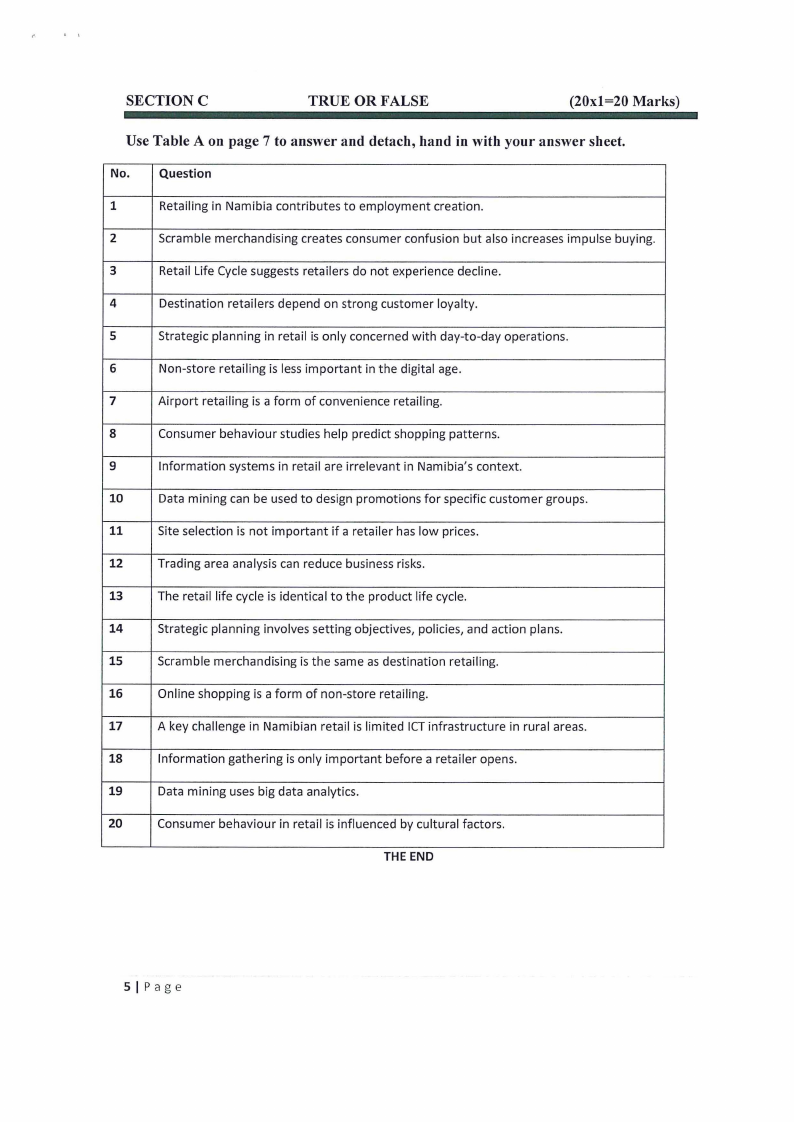
SECTIONC
TRUE OR FALSE
(20xl=20 Marks)
Use Table A on page 7 to answer and detach, hand in with your answer sheet.
No. Question
1
Retailing in Namibia contributes to employment creation.
2
Scramble merchandising creates consumer confusion but also increases impulse buying.
3
Retail Life Cycle suggests retailers do not experience decline.
4
Destination retailers depend on strong customer loyalty.
5
Strategic planning in retail is only concerned with day-to-day operations.
6
Non-store retailing is less important in the digital age .
7
Airport retailing is a form of convenience retailing.
8
Consumer behaviour studies help predict shopping patterns.
9
Information systems in retail are irrelevant in Namibia' s context.
10
Data mining can be used to design promotions for specific customer groups.
11
Site selection is not important if a retailer has low prices.
12
Trading area analysis can reduce business risks .
13
The retail life cycle is identical to the product life cycle.
14
Strategic planning involves setting objectives, policies, and action plans.
15
Scramble merchandising is the same as destination retailing.
16
Online shopping is a form of non-store retailing.
17
A key challenge in Namibian retail is limited ICT infrastructure in rural areas.
18
Information gathering is only important before a retailer opens.
19
Data mining uses big data analytics.
20
Consumer behaviour in retail is influenced by cultural factors.
THE END
SI P age
|
|
6 Page 6 |
▲back to top |
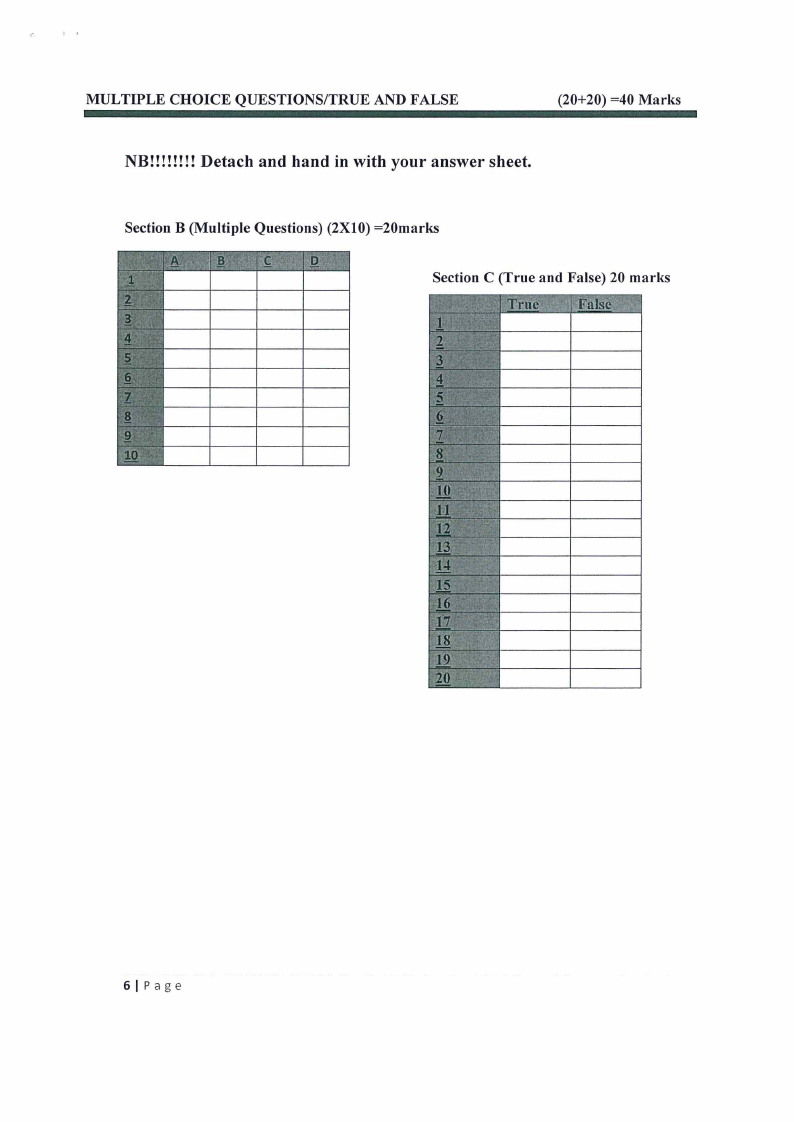
MULTIPLE CHOICE QUESTIONS/TRUE AND FALSE
(20+20) =40 Marks
NB!!!!!!!! Detach and hand in with your answer sheet.
Section B (Multiple Questions) (2Xl0) =20marks
Section C (True and False) 20 marks
GI Pa ge