


 |
EAT810S - ENTERPRISE ARCHITECTURE - 1ST OPP - JUNE 2025 |
|
|
1 Page 1 |
▲back to top |
nAm I BIA un IVERSITY
OF SCIEnCE Ano TECHn OLOGY
FACULTYOF COMPUTING AND INFORMATICS
DEPARTMENTOF INFORMATICS
QUALIFICATION: BACHELOR OF INFORMATICS HONOURS (WEB INFORMATICS,
BUSINESS INFORMATICS)
QUALIFICATION CODE:
08BIFH,O8BIHB
COURSE CODE: EAT810S
SESSION: JUNE 2025
DURATION: 3 HOURS
LEVEL: 8
COURSE: ENTERPRISE ARCHITECTURE
PAPER: THEORY
I\\/IARKS: 70
FIRST OPPORTUNITY EXAMINATION - QUESTION PAPER
EXAMINER(S):
Prof lrja Shaanika
MODERATOR:
Ms Judith Tjiwemu
INSTRUCTIONS FOR THE CANDIDATE
1. Answer ALLthe questions on the answer scripts provided. Answer EACHsection on
a new page.
2. Write clearly and neatly.
3. Be guided by the number of marks allocated when answering the questions.
4. Number your questions clearly.
PERMISSIBLEMATERIALS
Non_e__. ________________________
THIS QUESTION PAPER CONSIST OF 5 PAGES
(Including this front page)
___,
|
|
2 Page 2 |
▲back to top |
SectionA: True and FalseQuestions
Each question is 1 marl<.
[10 marks]
1. EAdomains positioned at the higher layers of the stack tend to be less relevant to business
managers, while lower-level domains tend to be more interesting to the business audience.
2. Business-enabling EA domains can be viewed as functional domains.
3. Companies moving into business modularity have digitized their core business processes
and have access to the critical customer and product data they need to develop new
products and services.
4. Business Modularity Architecture is the stage of enterprise architecture maturity where
companies manage and reuse loosely coupled IT-enabled business process components to
preserve global standards while enabling local differences.
5. Business-supporting EA domains occupy the top layers of the stack and can be considered
as non-functional domains.
6. Information systems does not always help companies execute their business strategies and
gain a strategic competitive advantage .
7. Business capabilities of a modern organization are often determined largely by the
capabilities of its IT systems.
8. Enterprise Architecture should lead you to selecting a single vendor's technology.
9. Moving from one maturity stage to another involves the benefits of reduced IT operating
costs to greater strategic agility.
10. Even if clearly formulated, business strategy and objectives can be essentially useless for IT
planners to act upon.
2
|
|
3 Page 3 |
▲back to top |
Section B: Multiple Choice Questions
Each question is 1 mark
(10 marks]
1. The following explanation is talking about which benefit of Enterprise Architecture:
Enterprisearchitecture help plan the changesin the IT landscape,explore available
implementationoptionsin a timely mannerand ensurethat new IT solutionsseamlessly
fit into the existingIT environment.
a. Improved overall conceptual consistency
b. Increased agility of IT planning
c. Increased reuse of available IT assets
d. Reduced complexity of the IT landscape
2. Which of the followingis not an indirect benefit of an EnterpriseArchitecturepractice?
a. Operational excellence, custome·r intimacy, product leadership
b. Increased speed to enter new markets and overall organizational agility
c. Improved Managerial satisfaction
d. Reduced costs of IT operations
3. The term enterprise means
a. Higher level, strategic view of an entity
b. An organisation with interlinked business units
c. A legal entity with a culture and pattern of behaviours
d. A collection of business activities and supporting technologies
4. Companiesoperating at ______
EAmaturity model providescompanywide
data and processstandardizationasappropriatefor the operating model.
a. Business Modularity Architecture
b. Optimised core architecture
c. Business Silos architecture
d. Standardized Technology architecture
5. It isa strategicinstrument in guidingan organizationthrough a plannedcourseof
development.
a. Framework
b. Strategic Management
c. Architecture
d. Enterprise Architecture
3
|
|
4 Page 4 |
▲back to top |
6. Companiesin ------------------ usuallyincreaseaccessto shared data by introducingdata
warehouses,but transactiondata isstillembedded in individualapplications.
a. Standardized Technology architecture
b. Business Modularity Architecture
c. Optimised core architecture
d. Business Silos architecture
7. What are the 3 important aspectsof EAascontainedin the formula EA= X + Y + Z 7
a. Strategy+ Products+ Technology
b. Strategy+ Business+ Technology
c. Strategy+ Technology+ Business
d. Strategy+ Information Systems +Information Technology
8. Isa collectionof organizationsthat hasa commonset of goals,objectives,and/or a
singletargeted outcome.
a. Enterprise
b. Enterprise Architecture
c. Architecture
d. Business Architecture
9. The people aspect of technologyDOESNOT includethe following:
a. Roles and Skills
b. Motivation and compensation
c. Attitude and culture
d. Routine Tasksand Operating Procedures
10. Which statement best describesorganisationuseof IT systemsto achieveoperational
excellenceand costleadership:
a. IT systems can be used to fully automate operations, eliminate delays and deviations,
avoid manual labour and achieve standardized, fine-tuned and predictable business
processes.
b. IT systems can be used to facilitate the design of new products, support teamwork,
collaboration and creativity and provide unique, innovative products or services to
the market.
c. IT systems can be used to collect and store customer data, analyze customer needs
and preferences, identify broad customer segments, target specific customer groups
and even develop highly customized offers for particular customers.
d. For the IT systems the larger the organization, the larger the presence of the EA roles
and the more they approach EAfrom a business perspective.
4
|
|
5 Page 5 |
▲back to top |
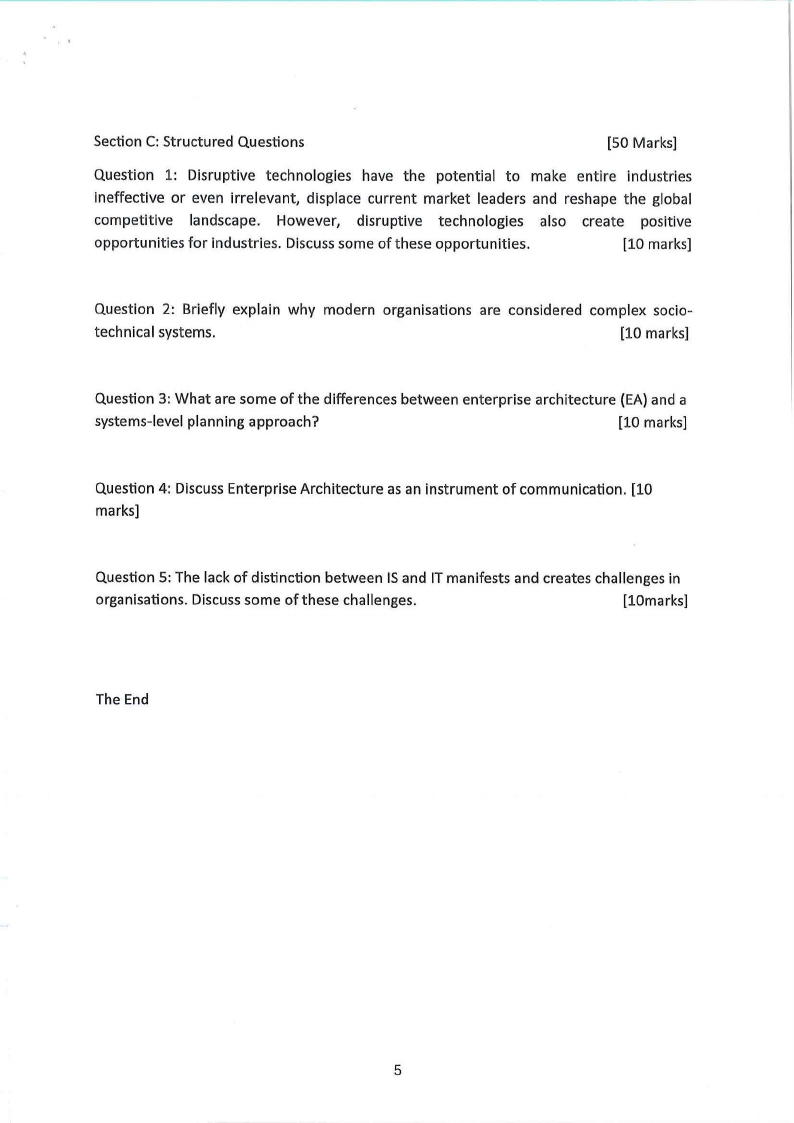
Section C: Structured Questions
[SO Marks]
Question 1: Disruptive technologies have the potential to make entire industries
ineffective or even irrelevant, displace current market leaders and reshape the global
competitive landscape. However, disruptive technologies also create positive
opportunities for industries. Discusssome of these opportunities.
[10 marks]
Question 2: Briefly explain why modern organisations are considered complex socio-
technical systems.
[10 marks]
Question 3: What are some of the differences between enterprise architecture (EA) and a
systems-level planning approach?
[10 marks]
Question 4: DiscussEnterprise Architecture as an instrument of communication. [10
marks]
Question 5: The lack of distinction between ISand IT manifests and creates challenges in
organisations. Discusssome of these challenges.
[lOmarks]
The End
5