


 |
PPN610S - PLANT PRODUCTION - 2ND OPP - JUNE 2025 |
|
|
1 Page 1 |
▲back to top |
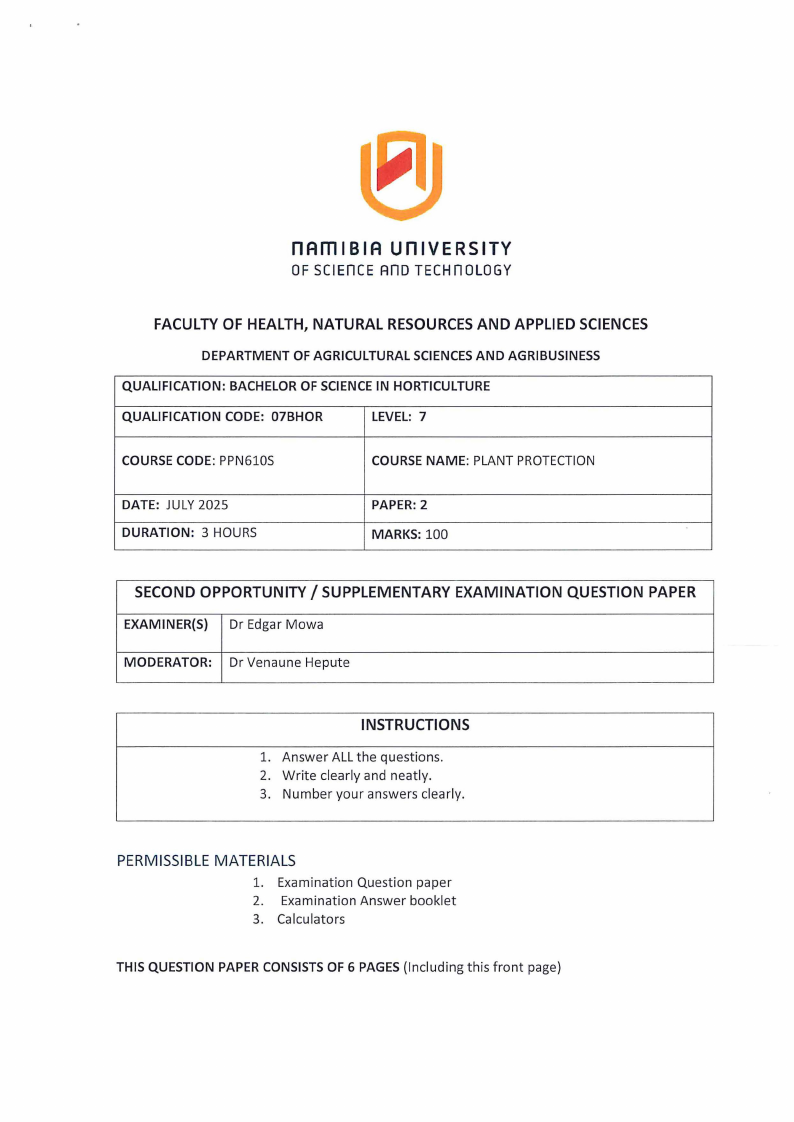
nAmlBIA unlVERSITY
OF SCIEnCE Ano TECHn OLOGY
FACULTYOF HEALTH,NATURALRESOURCESAND APPLIEDSCIENCES
DEPARTMENT OF AGRICULTURAL SCIENCES AND AGRIBUSINESS
QUALIFICATION: BACHELOR OF SCIENCE IN HORTICULTURE
QUALIFICATION CODE: 07BHOR
LEVEL: 7
COURSE CODE: PPN610S
COURSE NAME: PLANT PROTECTION
DATE: JULY 2025
DURATION: 3 HOURS
PAPER: 2
MARKS: 100
SECONDOPPORTUNITY/ SUPPLEMENTARYEXAMINATION QUESTION PAPER
EXAMINER(S) Dr Edgar Mowa
MODERATOR: Dr Venaune Hepute
INSTRUCTIONS
1. Answer ALL the questions.
2. Write clearly and neatly.
3. Number your answers clearly.
PERMISSIBLEMATERIALS
1. Examination Question paper
2. Examination Answer booklet
3. Calculators
THIS QUESTION PAPER CONSISTS OF 6 PAGES (Including this front page)
|
|
2 Page 2 |
▲back to top |
SECTION A: MULTIPLE CHOICE QUESTIONS
[10 MARKS]
1. Which of the following organisms can be used as a biocontrol agent for aphids:
A. Fruit fly
B. Lacewing
C. Whitefly
D. Thrips
2. Which group of chemical products are used to control weeds in the field
A. Bactericides
B. Fungicides
C. Herbicides
D. Tutacides
3. Any cultivation will damage the crop to some extent and should be avoided when
the crop is wet. Which group of pathogens (s) will be spread most readily if a crop is
cultivated under wet conditions?
A. Bacteria
B. Viruses
C. Fungi
D. Nematodes
4. Which of the following pieces of information is not usually found on a pesticide label?
A. Active ingredient
B. Product name
C. Cost
D. Directions for use
5. Which of the following is not a feature of annual weeds?
A. Rapid growth
B. Short life cycle
C. High seed output
D. They have storage organs
6. Which of the following pathogens belongs to the oomycete group?
A. Pythium myriotylum
B. Rhizoctonia solani
C. Colletotrichum coccodes
D. Tobacco Mosaic virus
7. What are the stages of complete metamorphosis in insects?
A. Eggs, larva, pupa, adult
B. Eggs, nymph, adult, larva
Plant Protection (PPN610S)
2nd Opportunity July 2025
2
|
|
3 Page 3 |
▲back to top |
C. Pupa, nymph, adult, moth
D. Eggs, Pupa, adult, Larva
8. A weed with a long narrow leaf, parallel veins; round hollow stem and leaves are aligned
up and down the stem in two rows is called
A. Broadleaves
B. Grass
C. Sedges
D. Herbaceous
9. Which of the following is a plant disease that tends to produce only one infection cycle
per host cycle?
A. Soil-borne disease
B. Foliar diseases caused by fungi
C. Fruit diseases
D. Stem diseases
10. Which of the following
A. Bacteria
B. Insects
C. Nematodes
D. Nitrogen deficiency
is not a biotic cause of diseases
SECTION B: SHORT/LONG ANSWER QUESTIONS
Question 1
Define or explain the following terms used in plant protection with examples.
i. Sign
ii. Pathogen
iii. Annual weed
[90 MARKS]
[6 MARKS]
[2)
[2)
(2)
Question 2
[4 MARKS]
a. Explain the difference between disease severity and disease incidence.
(2)
b. Show how you will calculate disease incidence.
[2)
Question 3
Plant Protection (PPN610S)
[6 MARKS]
2nd Opportunity July 2025
3
|
|
4 Page 4 |
▲back to top |
List six (6) major factors to consider when planning an integrated insect control program.
Question 4
(20 MARKS]
2. In March 2023, Ndonga Linena Green Scheme Irrigation, located in Rundu started to see
an increase in the number of cucumber plants with stunted growth followed by wilting.
Suppose you are the horticulturalist at Ndonga Linena Green Scheme responsible for
ensuring good production of horticultural crops;
a. List four (4) probable causes of cucumber wilting at the green scheme and
explain how you can identify (diagnose) each of the causes.
[8]
b. Describe the disease pentahedron and how it can be targeted to control root-
knot nematodes on tomato crops. Illustrate with a diagram.
[10]
c. Explain the difference between sedentary and migratory nematodes with
examples?
[2]
Question 5
(12 MARKS]
a) Describe the difference between epidemic and pandemic diseases giving examples of
each
[4]
b.) Explain the four (4) host factors that affect disease epidemics.
[8]
Question 6
(8 MARKS]
Explain how weeds are classified according to life cycle, giving an example of each class.
Plant Protection (PPN610S)
2nd Opportunity July 2025
4
|
|
5 Page 5 |
▲back to top |
Question 9
[8 MARKS]
Design an Integrated Weed Management (IWM) strategy for controlling broad leaf
weeds on irrigated cabbages.
Question 10
[4 MARKS]
What is the difference between monocyclic and polycyclic disease cycles? Giving
examples.
Question 11
[8 MARKS]
Let's say in February 2023, there was an outbreak of disease Y, at Shaddy Kongolo
irrigation scheme that destroyed the whole crop in the field. Suppose you have just been
appointed as a horticulturalist responsible for overseeing production of horticultural
crops at Shaddy Kongolo and you are told disease Y is caused by either a fungus and/or a
bacteria. You have now been assigned the responsibility of identifying the actual causative
agent of the disease.
Briefly, describe with aid of diagrams, an experiment that you would carry out to
demonstrate that disease Y is indeed caused by a fungus and/or bacteria.
Hints:
1. Use any crop of your choice commonly grown in Namibia
2. Identify a disease that commonly occur on that crop
3. Name the causative agent of that disease
4. Detail the experiment you would do to identify the causative agent and if indeed it's
the cause
Question 12
Plant Protection (PPN610S)
[3 MARKS]
2nd Opportunity July 2025
5
|
|
6 Page 6 |
▲back to top |
Explain some of the causes of insect outbreaks in a crop field.
[3]
Question 13
[11 MARKS]
10. Etunda Green Scheme, is involved in intensive production of horticultural , and
ornamental plants. Sonop farms does not have a horticulturalist and therefore has little
knowledge on crop production especially plant and crop diseases. Thy have approached
you as a consulting Horticulturalist with knowledge in plant diseases to investigate
diseases occurring at its farm. You discovered upon investigation that the plants are
infected with Phytophthora infestans, the causative agent of late blight on tomatoes.
Describe
a. The Disease cycle
[3]
b. Epidemiology of disease
[8]
END OF QUESTION PAPER
Plant Protection {PPN6105)
2nd Opportunity July 2025
6