PLU411S - PRINCIPLES OF LANGUAGE USE FM - 1ST OPP - JUNE 2025


PLU411S - PRINCIPLES OF LANGUAGE USE FM - 1ST OPP - JUNE 2025


1 Page 1

▲back to top


nAmlBIA
OF SCIEnCE
UnlVERSITY
AnD TECHnOLOGY
FACULTY OF COMMERCE, HUMAN SCIENCE AND EDUCATION
DEPARTMENT OF COMMUNICATION AND LANGUAGES
QUALIFICATION: VARIOUS
QUALIFICATION CODE: VARIOUS
COURSE CODE: PLU411S
SESSION:
JUNE/ JULY 2025
DURATION:
3 HOURS
LEVEL: 4
COURSE NAME: PRINCIPLESOF LANGUAGE USE
PAPER:
THEORY
MARKS:
100
FIRST OPPORTUNITY EXAMINATION QUESTION PAPER
EXAMINER(S)
Dr R. Nekongo
Dr E.lithindi
Ms N. Haimbodi
Ms N. Ashimbuli
Ms K. Tameja
Ms J. Ndamanhomhata
Ms V.Verbeeck
Ms R.Ndengu
Mr R.Muyunda
MODERATOR: Mr C. Gwasira
INSTRUCTIONS
1. Answer ALL the questions.
2. Write clearly and neatly.
3. Number the answers clearly.
THIS QUESTION PAPER CONSISTS OF 10 PAGES {Including this front page)

2 Page 2

▲back to top


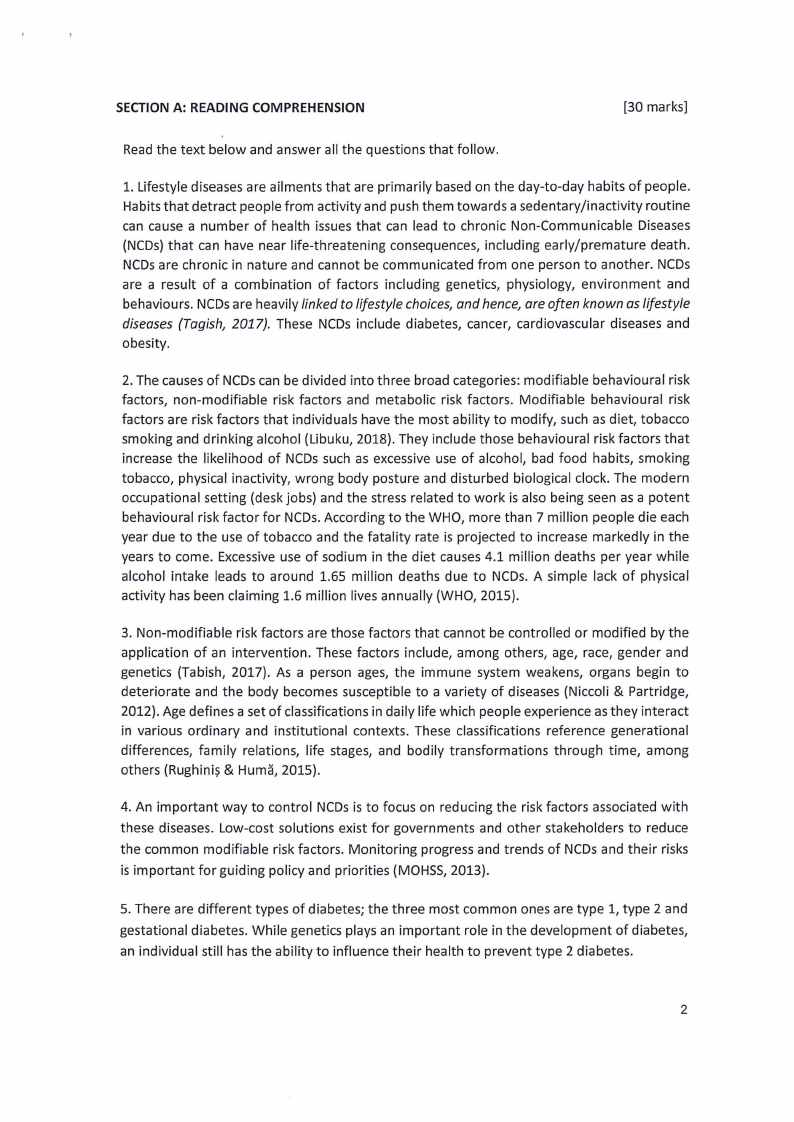
SECTION A: READING COMPREHENSION
[30 marks]
Readthe text below and answer all the questions that follow.
1. Lifestyle diseases are ailments that are primarily based on the day-to-day habits of people.
Habits that detract people from activity and push them towards a sedentary/inactivity routine
can cause a number of health issues that can lead to chronic Non-Communicable Diseases
(NCDs)that can have near life-threatening consequences, including early/premature death.
NCDsare chronic in nature and cannot be communicated from one person to another. NCDs
are a result of a combination of factors including genetics, physiology, environment and
behaviours. NCDsare heavily linked to lifestyle choices, and hence, are often known as lifestyle
diseases (Tagish, 2017). These NCDs include diabetes, cancer, cardiovascular diseases and
obesity.
2. The causes of NCDscan be divided into three broad categories: modifiable behavioural risk
factors, non-modifiable risk factors and metabolic risk factors. Modifiable behavioural risk
factors are risk factors that individuals have the most ability to modify, such as diet, tobacco
smoking and drinking alcohol (Libuku, 2018). They include those behavioural risk factors that
increase the likelihood of NCDs such as excessive use of alcohol, bad food habits, smoking
tobacco, physical inactivity, wrong body posture and disturbed biological clock. The modern
occupational setting (desk jobs) and the stress related to work is also being seen as a potent
behavioural risk factor for NCDs.According to the WHO, more than 7 million people die each
year due to the use of tobacco and the fatality rate is projected to increase markedly in the
years to come. Excessive use of sodium in the diet causes 4.1 million deaths per year while
alcohol intake leads to around 1.65 million deaths due to NCDs. A simple lack of physical
activity has been claiming 1.6 million lives annually (WHO, 2015).
3. Non-modifiable risk factors are those factors that cannot be controlled or modified by the
application of an intervention. These factors include, among others, age, race, gender and
genetics (Tabish, 2017). As a person ages, the immune system weakens, organs begin to
deteriorate and the body becomes susceptible to a variety of diseases (Niccoli & Partridge,
2012). Age defines a set of classifications in daily life which people experience as they interact
in various ordinary and institutional contexts. These classifications reference generational
differences, family relations, life stages, and bodily transformations through time, among
others (Rughini~ & Huma, 2015).
4. An important way to control NCDsis to focus on reducing the risk factors associated with
these diseases. Low-cost solutions exist for governments and other stakeholders to reduce
the common modifiable risk factors. Monitoring progress and trends of NCDsand their risks
is important for guiding policy and priorities (MOHSS,2013).
5. There are different types of diabetes; the three most common ones are type 1, type 2 and
gestational diabetes. While genetics plays an important role in the development of diabetes,
an individual still has the ability to influence their health to prevent type 2 diabetes.
2

3 Page 3

▲back to top


6. Diabetes is the classic example of a disease that is on the rise due to aging, caused by
changes in lifestyle, such as diet and levels of physical activity (Kesavadev, Short & Nair,
2003). Age escalates the risk of developing diabetes in several ways. By the age of 60, the
Islet-of-Langerhans beta cell would have become dysfunctional due to the increase of the
insulin precursor and pro-insulin to insulin ratio. Another explanation is that aging is
associated with an accumulation of sugar-derived substances known as advanced glycation
end products (AGE),which increase as glucose concentration in the blood increases with the
loss of muscle fibre (Nayak et al., 2014). As an individual ages, several changes in body
composition take place, such as the accumulation of fat in the abdomen. This change is a key
causal factor of diabetes in aging populations (Kesavadev,Short, & Nair, 2003).
7. A family history of diabetes is another well-known risk factor for the onset of diabetes
which is associated with lifestyle factors such as obesity, alcohol consumption and diet
(Sakurai et al., 2013).
8. Smoking contributes to the onset of type-two diabetes. In fact, individuals that smoke are
30 to 40% more likely to develop type-two diabetes than non-smokers (Centre for disease
control and prevention, 2017).
9. Carbohydrate-rich diets play an important role in the prevention of diabetes. "When food
containing carbohydrates is eaten, your body digests the carbohydrate into sugar (called
glucose), which can then be used as energy by the cells in your body" (Diabetes Australia
Victoria, 2009).
10. Eating plenty of fruits and vegetables produces health benefits for an individual. The WHO
recommends at least 400 grams of fruits and vegetables (roughly five, 80-gram portions are
needed to meet a person's daily nutritional requirements and protect them from diseases).
In fact, eating five portions of vegetable each day is an advisable minimum as it can help
reduce the risk of NCDs.It appears that the more fruits and vegetables we consume, the more
we maximise our protection from diet-related diseases such as diabetes (WHO, 2008).
11. Further, it is believed that between 30-50% of cancers can be prevented by living healthy
lifestyles and implementing existing evidence-based prevention strategies. The cancer burden
can also be reduced through early detection of cancer and management of patients who
develop cancer. Many cancers have a higher chance of cure if diagnosed early and treated
adequately (Plummer, de Martel, Vignat, Ferlay, Bray, Franceschi, 2012).
12. Cancer prevention must be considered in the context of activities to prevent other chronic
diseases, especially those with which cancer shares common risk factors, such as
cardiovascular diseases, diabetes, chronic respiratory diseases and alcohol dependence
(Guide & Programmes, n.d.). Common risk factors underlying all these conditions include:
Tobacco use, alcohol use, dietary factors including low fruit and vegetable intake, physical
3

4 Page 4

▲back to top


inactivity and overweight and obesity. So, avoiding tobacco use, excessive alcohol
consumption and consuming fruits and vegetables reduce the risk of developing NCDs.
13. In brief, cessation of tobacco use, reduction of salt in the diet, consuming fruits and
vegetables, regular physical activity and avoiding harmful use of alcohol have been shown to
reduce the risk of cardiovascular diseases (WHO, 2017).
Adapted from:https://www.ndtv.com/world-news
1. Which topic is discussed in the reading passage?
(1)
2. What kind of register is used in this passage?
(1)
3. Who is the target audience of this article?
(1)
4. In your own words, define the phrase "lifestyle diseases".
(2)
5. What does the author mean by "NCDs are chronic in nature and cannot be communicated
from one person to another"? (par. 1)
(2)
6. Name the four non-communicable diseases that are mentioned in this text. (4)
7. Explain the difference between modifiable behavioural risk factors and non-modifiable
risk factors. Provide one example of risk factors in each case.
(4)
8. Name the three most common types of diabetes.
(3)
9. In what way do carbohydrate-rich diets help in preventing diabetes?
(2)
10. State whether the following statements are true (T) or False (F).
10.1. Eating plenty of fruits and vegetables reduces health benefits for an individual. (1)
10.2. More than half of the cancers can be prevented by living healthy lifestyles and
implementing existing evidence-based prevention strategies.
(1)
10.3. Early detection of cancer and management of patients who develop cancer are
paramount to the reduction of the cancer burden.
(1)
10.4 There is absolutely no cure for cancer.
(1)
4

5 Page 5

▲back to top


10.5. Avoiding tobacco use, avoiding excessive alcohol consumption and consuming fruits
and vegetables lessen the risk of developing NCDs.
(1)
11. Using context, provide synonyms of the following concepts as used in the reading text:
11.1. ailments (Par. 1)
(1)
11.2. excessive (Par. 2)
(1)
11.3. deteriorate (Par. 3)
(1)
11.4. escalates (Par. 6)
(1)
11.5. onset (Par. 7)
(1)
SECTIONB: GRAMMAR
[30 Marks]
Readthe essay below and answer all the questions that follow.
The Importance of Effective Communication
1. Communication is a fundamental aspect of human interaction. It allows individuals to
express their thoughts, share information, and build relationships. Whether in personal or
professional settings, the ability to communicate effectively plays a crucial role in success.
People who develop strong communication skills often find it easier to collaborate with others
and convey their ideas clearly.
2. Effective communication involves both speaking and listening. !1person must articulate
their messagewell, and at the same time, they should be able to understand the perspectives
of others. Active listening, which requires full attention and thoughtful responses, is an
essential component of meaningful interactions. Additionally, nonverbal communication,
such ~body language and facial expressions, can impact how messages are received.
3. In professional environments, communication is vital for teamwork and productivity. If
employees do not communicate effectively, misunderstandings may arise, which can lead to
inefficiencies and conflicts. Clear instructions and constructive feedback help create a positive
and efficient workplace.
5

6 Page 6

▲back to top


4. Technology has transformed communication in many ways. While digital tools make it
easier to connect with others, they can also present challenges. People may rely too much on
text-based communication, which lacks tone and body language. Misinterpretations can
occur when messages are not conveyed with enough clarity.
5. Despite these challenges, improving communication skills is possible through practice and
awareness. When individuals take time to listen actively, express themselves clearly, and use
appropriate nonverbal cues, they can build stronger relationships and achieve their goals.
6. In conclusion, communication is an essential skill that influences all aspects of life. By
enhancing their ability to speak, listen, and understand others, individuals can improve their
personal and professional relationships. The ability to communicate effectively is a key factor
in achieving success and fostering meaningful connections.
Adapted from: https://chatgpt.com/
1. Name the highlighted parts of speech in paragraph 2 as used in the context of the
article.
[7]
1.1. communication
1.2. at
1.3. A
1.4. understand
1.5. as
1.6. thoughtful
1.7. they
2. Articles form parts of speech in English. Construct a sentence in which you use all the
words that constitute the articles and underline them. Each article must be used once
only.
[3]
3. What tense is the sentence in bold and underlined in paragraph 1?
[1]
Sentence: It allows individuals to express their thoughts, share information, and build
relationships.
6

7 Page 7

▲back to top


4. Write the sentence in question 3 above in the following tenses:
[6]
Sentence: It allows individuals to express their thoughts, share information, and build
relationships.
4.1. Past perfect tense
4.2. Present perfect continuous tense
4.3. Future simple tense
5. Write the same sentence in question 3 in the following forms:
Sentence: It allows individuals to express their thoughts, share information, and build
relationships.
5.1. Negative form
[2]
5.2. Question form
[2]
6. Subject-verb Agreement
Firstly, identify and write down the subject and verb in the following sentence. Then
indicate if the subject and the verb agree or disagree.
Sentence: Clear instructions and constructive feedback help create a positive and
efficient workplace.
Subject:
[1]
Verb:
[1]
Agree or Disagree:
[1]
7. Sentence structure
You were taught four different sentence structures. Write down the types of sentence
structure each of the following sentences is:
[6]
7.1. People may rely too much on text-based communication, which lacks tone and
body language, and misinterpretations can occur when messages are not
conveyed with enough clarity.
7.2. Clear instructions and constructive feedback help create a positive and
efficient workplace.
7

8 Page 8

▲back to top


7.3. If employees do not communicate effectively, misunderstandings may arise,
which can lead to inefficiencies and conflicts.
SECTIONC: PARAGRAPHAND ESSAYANALYSIS
Carefully read the passage below and answer all the questions that follow.
[30 marks]
The Role of Critical Thinking in Decision-Making
1 (A) Every day, people make decisions that shape their personal and professional lives.
(B)While some choices may seem straightforward, others require deep reflection and
analysis. (C) Critical thinking is an essential skill that enables individuals to evaluate
information objectively, weigh different perspectives, and make informed decisions.
2 One major aspect of critical thinking is the ability to question assumptions. Many people
accept information at face value without examining its accuracy or reliability. For instance, a
student might believe that studying for long hours without breaks is the best way to prepare
for an exam. However, research shows that effective study techniques involve strategic
breaks and active recall methods rather than sheer hours of memorisation. By questioning
assumptions, individuals can adopt better decision-making strategies that lead to positive
outcomes.
3. Another important aspect of critical thinking is logical reasoning. Decisions based on
emotions rather than facts often lead to unintended consequences. Consider an employee
who quits a job impulsively after a disagreement with a supervisor. Interestingly, penguins
can swim at speeds up to 15 miles per hour. Without analysing the situation objectively, they
might overlook potential solutions, such as addressing concerns through proper
communication channels. Logical reasoning helps individuals analyse situations from multiple
angles, ensuring well-informed choices.
4 .Moreover, critical thinking enhances problem-solving skills. Life presents numerous ch
allenges that require creative and analytical solutions. Whether managing personal finances,
resolving workplace conflicts, or making career choices, individuals benefit from evaluating
options systematically. Those who rely solely on intuition may overlook better alternatives,
whereas those who apply critical thinking skills can assess risks, benefits, and long-term
consequences effectively.
5.(0) In conclusion, critical thinking is a crucial component of effective decision-making. (E)
By questioning assumptions, applying logical reasoning, and refining problem-solving skills,
individuals can make more rational and informed choices. (F) Many people fail to think
critically when facing challenges they rely only on instinct and ignore rational alternatives that
could improve their outcomes.
Source: https://chat.openai.com/
8

9 Page 9

▲back to top


1. Which of the sentences numbered A to C in Paragraph 1 is the thesis statement of this
essay?
(2)
Sentence: ____
_
2. Choose the correct answer from the options given below.
The strategy used to introduce the topic under discussion in this essay is:
(2)
A Using an anecdote
B Moving from general to specific
C Using a famous quote
D None of these strategies
3. List three components of a well-structured body paragraph of an essay.
{3)
4. Answer the following questions based on Paragraph 4.
4.1 Identify and write down the topic sentence of Paragraph 4.
(2)
4.2 Write down the topic of the topic sentence you identified in 4.1.
(1)
4.3 Write down the controlling idea of the topic sentence you identified in 4.1. (2)
Find and write down three transitional words/phrases used to link ideas
within Paragraph 3.
(3)
6. Identify and write down an irrelevant sentence in Paragraph 3.
(2)
7. Answer the following questions based on Paragraph 5.
7.1 Identify a run-on sentence in Paragraph 5 and write it down.
(2)
7.2 Suggest 3 ways that we can use to correct the run-on sentence you identified in 7.1
above.
{3)
8. Use one of the 3 ways that you have suggested above to correct the run-on sentence that
you have identified.
(2)
9. Choose two supporting ideas presented in Paragraph 4 by circling two correct letters of
your choice. C)<t.:fY C(~Q..,,.
(2)
9

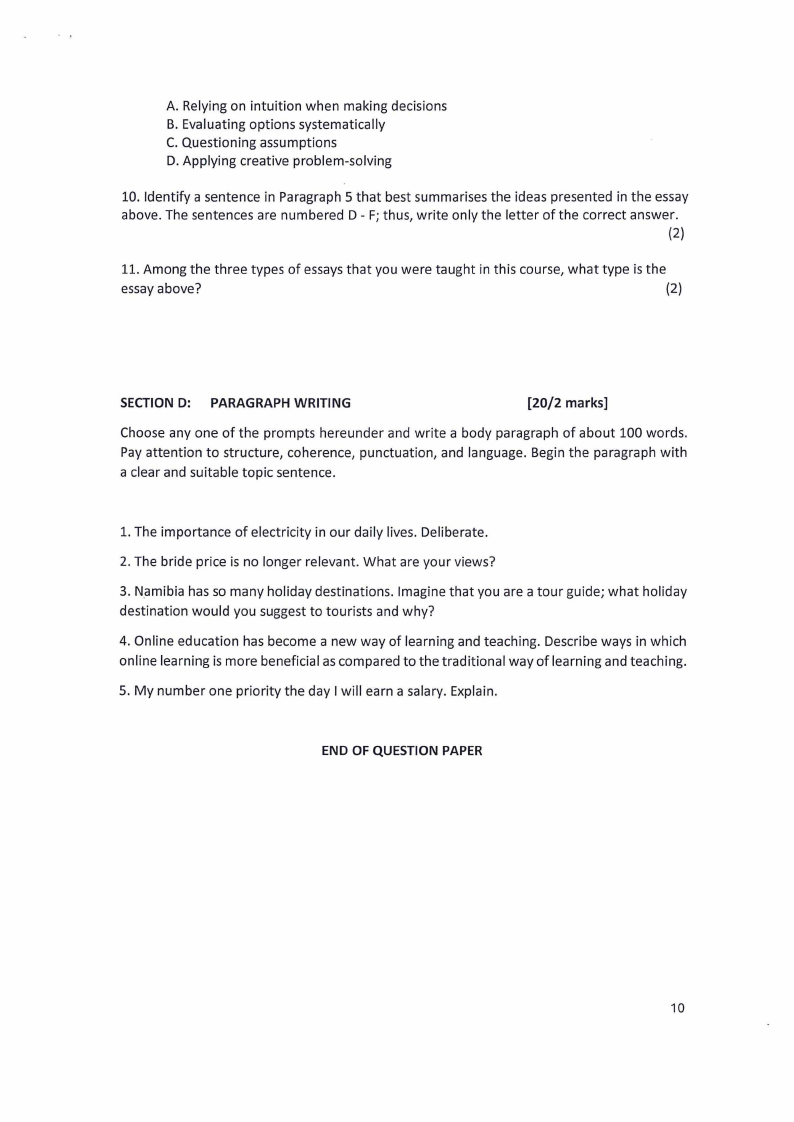
10 Page 10

▲back to top


A. Relying on intuition when making decisions
B. Evaluating options systematically
C. Questioning assumptions
D. Applying creative problem-solving
10. Identify a sentence in Paragraph 5 that best summarises the ideas presented in the essay
above. The sentences are numbered D - F; thus, write only the letter of the correct answer.
(2)
11. Among the three types of essaysthat you were taught in this course, what type is the
essay above?
(2)
SECTION D: PARAGRAPH WRITING
[20/2 marks]
Choose any one of the prompts hereunder and write a body paragraph of about 100 words.
Pay attention to structure, coherence, punctuation, and language. Begin the paragraph with
a clear and suitable topic sentence.
1. The importance of electricity in our daily lives. Deliberate.
2. The bride price is no longer relevant. What are your views?
3. N.amibiahas so many holiday destinations. Imagine that you are a tour guide; what holiday
destination would you suggest to tourists and why?
4. Online education has become a new way of learning and teaching. Describe ways in which
online learning is more beneficial as compared to the traditional way of learning and teaching.
5. My number one priority the day I will earn a salary. Explain.
END OF QUESTION PAPER
10