STR521S - Sport Tourism And Recreation - 2nd Opp - Nov 2025


STR521S - Sport Tourism And Recreation - 2nd Opp - Nov 2025


1 Page 1

▲back to top


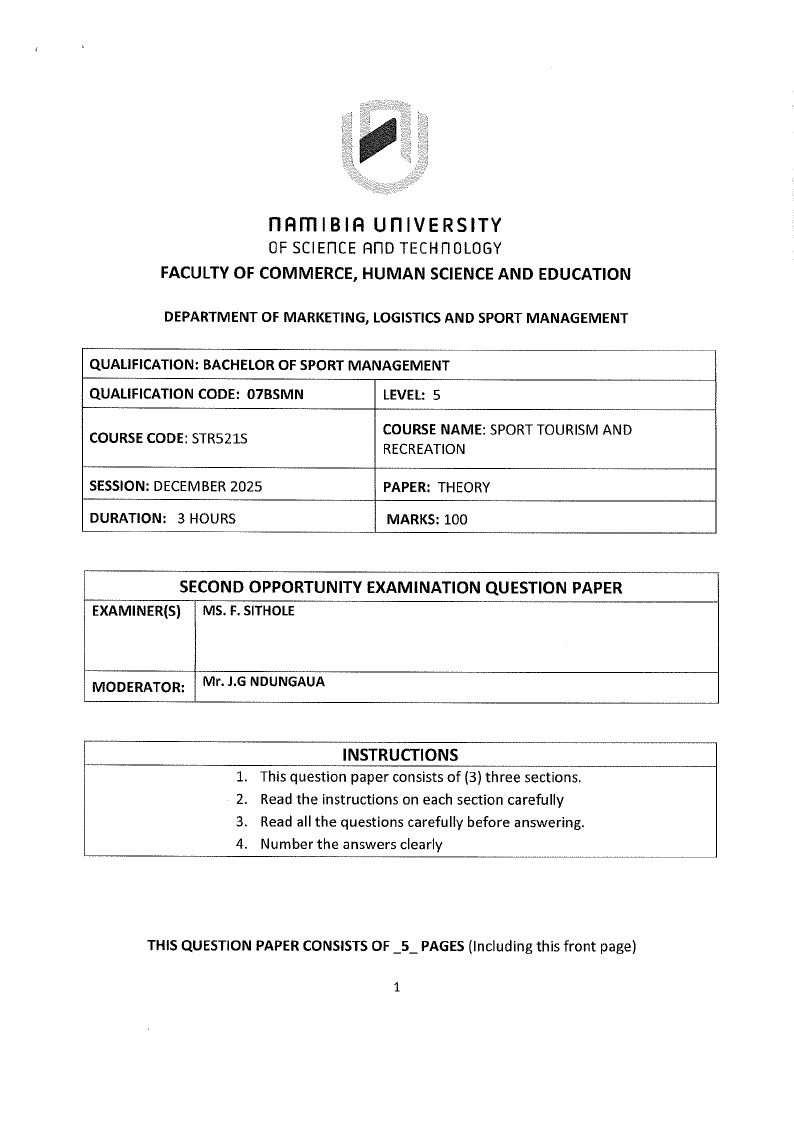
nAmlBIA UnlVERSITY
OF SCIEnCE Ano TECHnOLOGY
FACULTY OF COMMERCE, HUMAN SCIENCE AND EDUCATION
DEPARTMENT OF MARKETING, LOGISTICS AND SPORT MANAGEMENT
QUALIFICATION: BACHELOR OF SPORT MANAGEMENT
QUALIFICATION CODE: 07BSMN
LEVEL: 5
COURSE CODE: STR521S
COURSE NAME: SPORT TOURISM AND
RECREATION
SESSION: DECEMBER 2025
DURATION: 3 HOURS
PAPER: THEORY
MARKS: 100
SECOND OPPORTUNITY EXAMINATION QUESTION PAPER
EXAMINER(S) MS. F. SITHOLE
MODERATOR: Mr. J.G NDUNGAUA
INSTRUCTIONS
1. This question paper consists of (3) three sections.
2. Read the instructions on each section carefully
3. Read all the questions carefully before answering.
4. Number the answers clearly
THIS QUESTION PAPER CONSISTS OF _5_ PAGES (Including this front page)
1

2 Page 2

▲back to top


3 Page 3

▲back to top


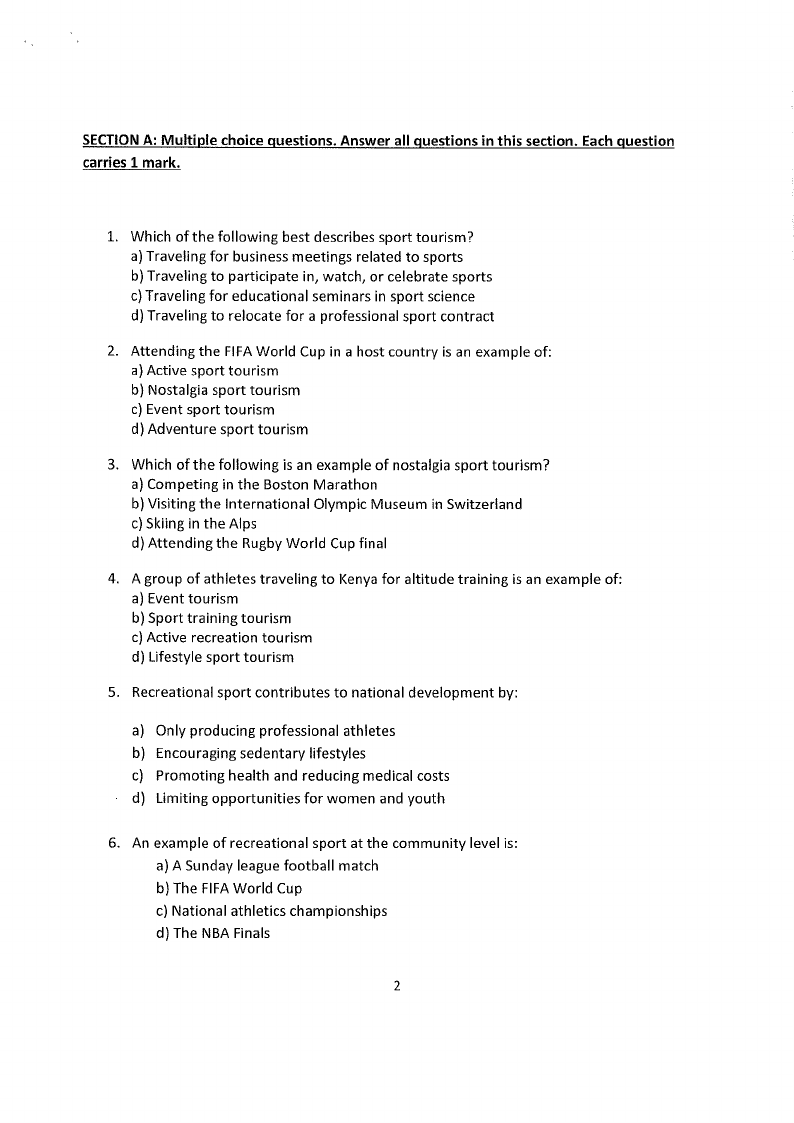
SECTION A: Multiple choice questions. Answer all questions in this section. Each question
carries 1 mark.
1. Which of the following best describes sport tourism?
a) Traveling for business meetings related to sports
b) Traveling to participate in, watch, or celebrate sports
c) Traveling for educational seminars in sport science
d) Traveling to relocate for a professional sport contract
2. Attending the FIFA World Cup in a host country is an example of:
a) Active sport tourism
b) Nostalgia sport tourism
c) Event sport tourism
d) Adventure sport tourism
3. Which of the following is an example of nostalgia sport tourism?
a) Competing in the Boston Marathon
b) Visiting the International Olympic Museum in Switzerland
c) Skiing in the Alps
d) Attending the Rugby World Cup final
4. A group of athletes traveling to Kenya for altitude training is an example of:
a) Event tourism
b) Sport training tourism
c) Active recreation tourism
d) Lifestyle sport tourism
5. Recreational sport contributes to national development by:
a) Only producing professional athletes
b) Encouraging sedentary lifestyles
c) Promoting health and reducing medical costs
d) Limiting opportunities for women and youth
6. An example of recreational sport at the community level is:
a) A Sunday league football match
b) The FIFA World Cup
c) National athletics championships
d) The NBA Finals
2

4 Page 4

▲back to top


5 Page 5

▲back to top


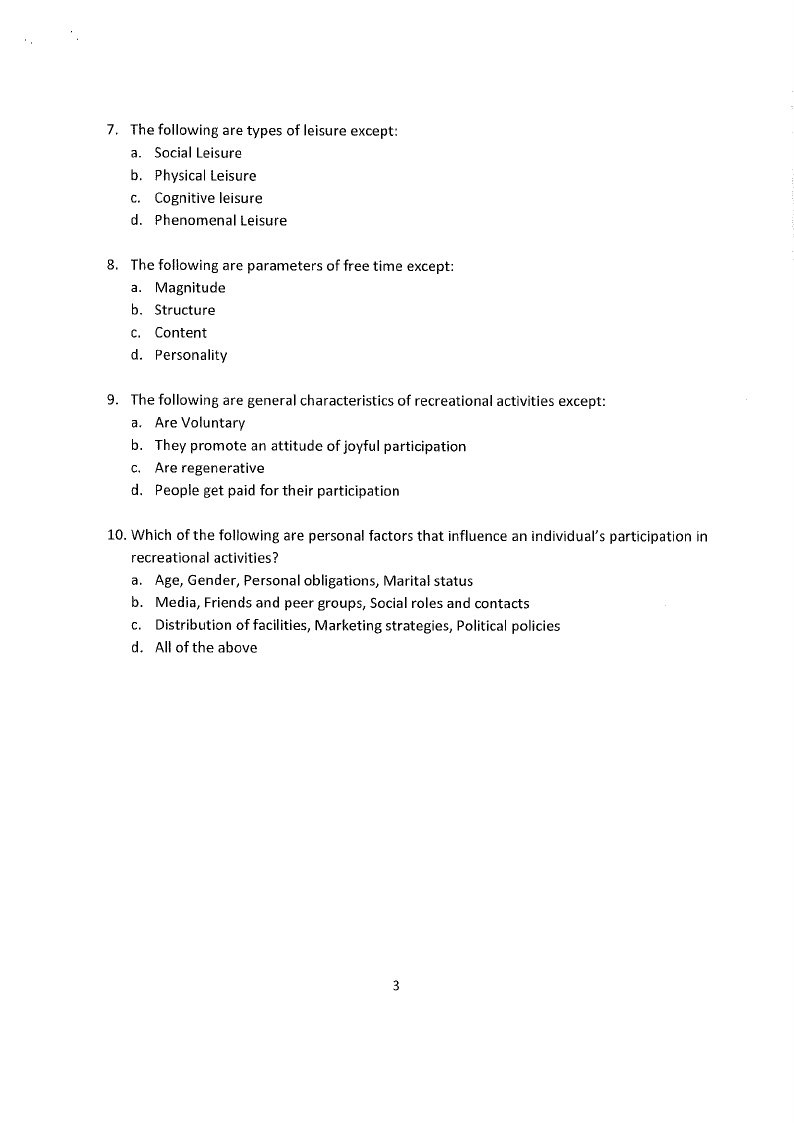
7. The following are types of leisure except:
a. Social Leisure
b. Physical Leisure
c. Cognitive leisure
d. Phenomenal Leisure
8. The following are parameters of free time except:
a. Magnitude
b. Structure
c. Content
d. Personality
9. The following are general characteristics of recreational activities except:
a. Are Voluntary
b. They promote an attitude of joyful participation
c. Are regenerative
d. People get paid for their participation
10. Which of the following are personal factors that influence an individual's participation in
recreational activities?
a. Age, Gender, Personal obligations, Marital status
b. Media, Friends and peer groups, Social roles and contacts
c. Distribution of facilities, Marketing strategies, Political policies
d. All of the above
3

6 Page 6

▲back to top


7 Page 7

▲back to top


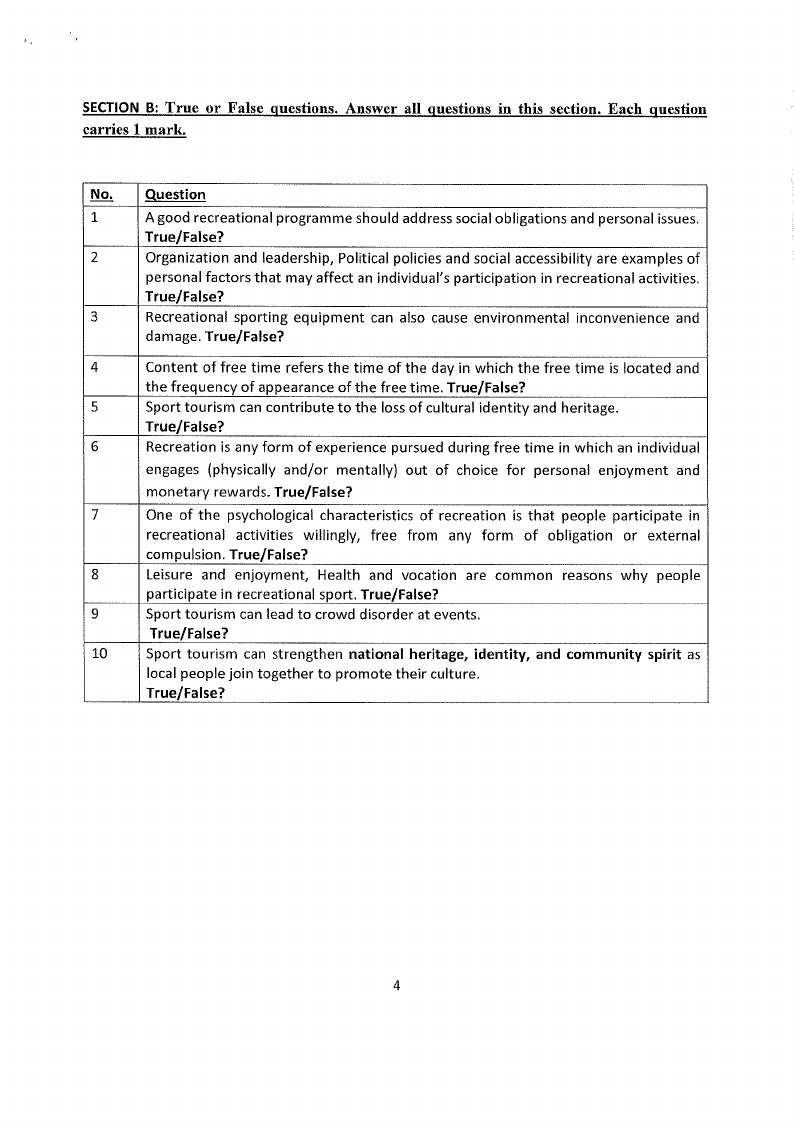
SECTION B: True or False questions. Answer all questions in this section. Each question
carries 1 mark.
No. guestion
1
A good recreational programme should address social obligations and personal issues.
True/False?
2
Organization and leadership, Political policies and social accessibility are examples of
personal factors that may affect an individual's participation in recreational activities.
True/False?
3
Recreational sporting equipment can also cause environmental inconvenience and
damage. True/False?
4
Content of free time refers the time of the day in which the free time is located and
the frequency of appearance of the free time. True/False?
5
Sport tourism can contribute to the loss of cultural identity and heritage.
True/False?
6
Recreation is any form of experience pursued during free time in which an individual
engages (physically and/or mentally) out of choice for personal enjoyment and
monetary rewards. True/False?
7
One of the psychological characteristics of recreation is that people participate in
recreational activities willingly, free from any form of obligation or external
compulsion. True/False?
8
Leisure and enjoyment, Health and vocation are common reasons why people
participate in recreational sport. True/False?
9
Sport tourism can lead to crowd disorder at events.
True/False?
10
Sport tourism can strengthen national heritage, identity, and community spirit as
local people join together to promote their culture.
True/False?
4

8 Page 8

▲back to top


9 Page 9

▲back to top


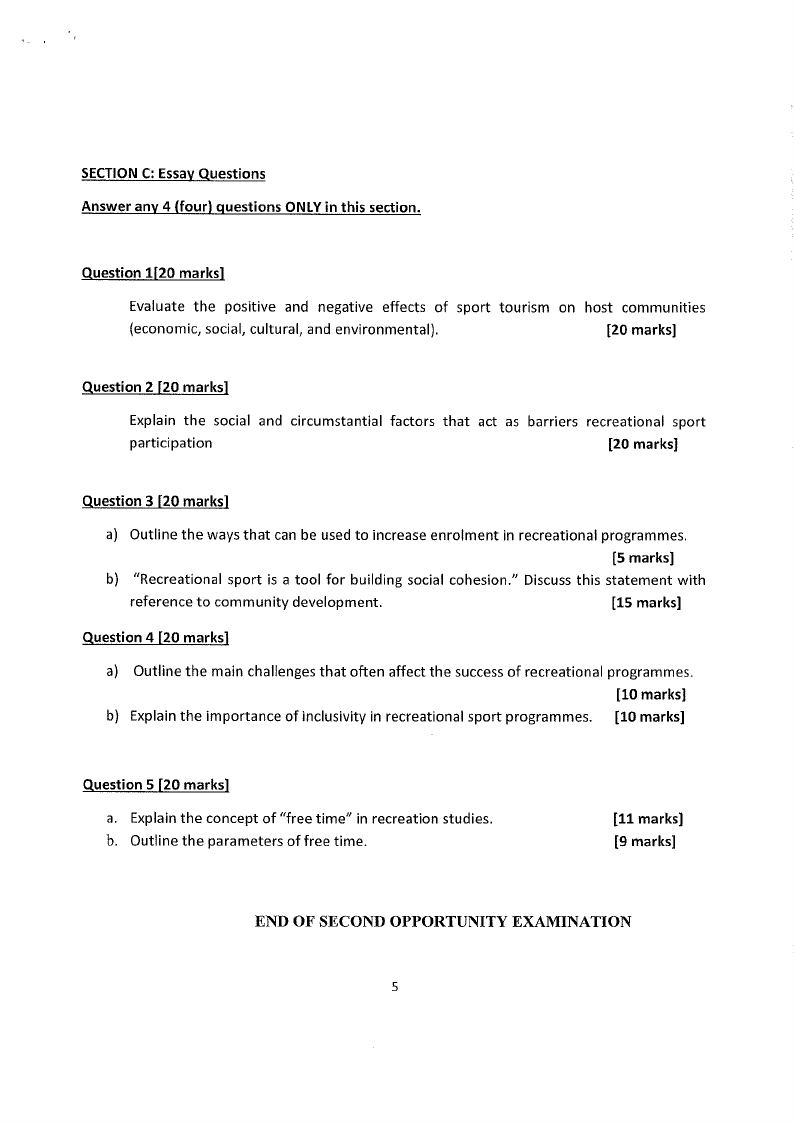
SECTION C: Essay Questions
Answer any 4 (four) questions ONLY in this section.
Question 1[20 marks)
Evaluate the positive and negative effects of sport tourism on host communities
(economic, social, cultural, and environmental).
[20 marks)
Question 2 [20 marks)
Explain the social and circumstantial factors that act as barriers recreational sport
participation
[20 marks]
Question 3 [20 marks]
a) Outline the ways that can be used to increase enrolment in recreational programmes.
[5 marks)
b) "Recreational sport is a tool for building social cohesion." Discuss this statement with
reference to community development.
[15 marks]
Question 4 [20 marks)
a) Outline the main challenges that often affect the success of recreational programmes.
[10 marks)
b) Explain the importance of inclusivity in recreational sport programmes. [10 marks]
Question 5 [20 marks)
a. Explain the concept of "free time" in recreation studies.
b. Outline the parameters of free time.
[11 marks)
[9 marks)
END OF SECOND OPPORTUNITY EXAMINATION
5

10 Page 10

▲back to top