


 |
ADR811S - ADVANCED INDUSTRIAL RELATIONS - 1ST OPP - JUNE 2025 |
|
|
1 Page 1 |
▲back to top |
nAmI BIA un IVERSITY
OF SCIEnCE Ano TECHnOLOGY
FACULTY OF COMMERCE, HUMAN SCIENCES AND EDUCATION
DEPARTMENT OF GOVERNANCE AND MANAGEMENT SCIENCES
QUALi FiCA TION : BACHELOR OF HUMAN RESOURCES MANAGEMENT HONOURS
DEGREE
QUALi FiCA TION CODE: 08HRM
LEVEL: 8
COURSE CODE: ADR811 S
COURSE NAME: ADVANCED INDUSTRIAL
RELATIONS
DATE: JUNE 2025
DURATION: 3 HOURS
PAPER: 1
MARKS: 100
EXAMINER(S)
FIRST OPPORTUNITY QUESTION PAPER
Ms. Fiina Shimaneni
MODERATOR:
Dr Felix Musukubili
INSTRUCTIONS
1. Answer ALL questions.
2. Write clearly and neatly.
3. Number your answers clearly.
THIS QUESTION PAPER CONSISTS OF 7 PAGES _(Includingthis front page)
|
|
2 Page 2 |
▲back to top |
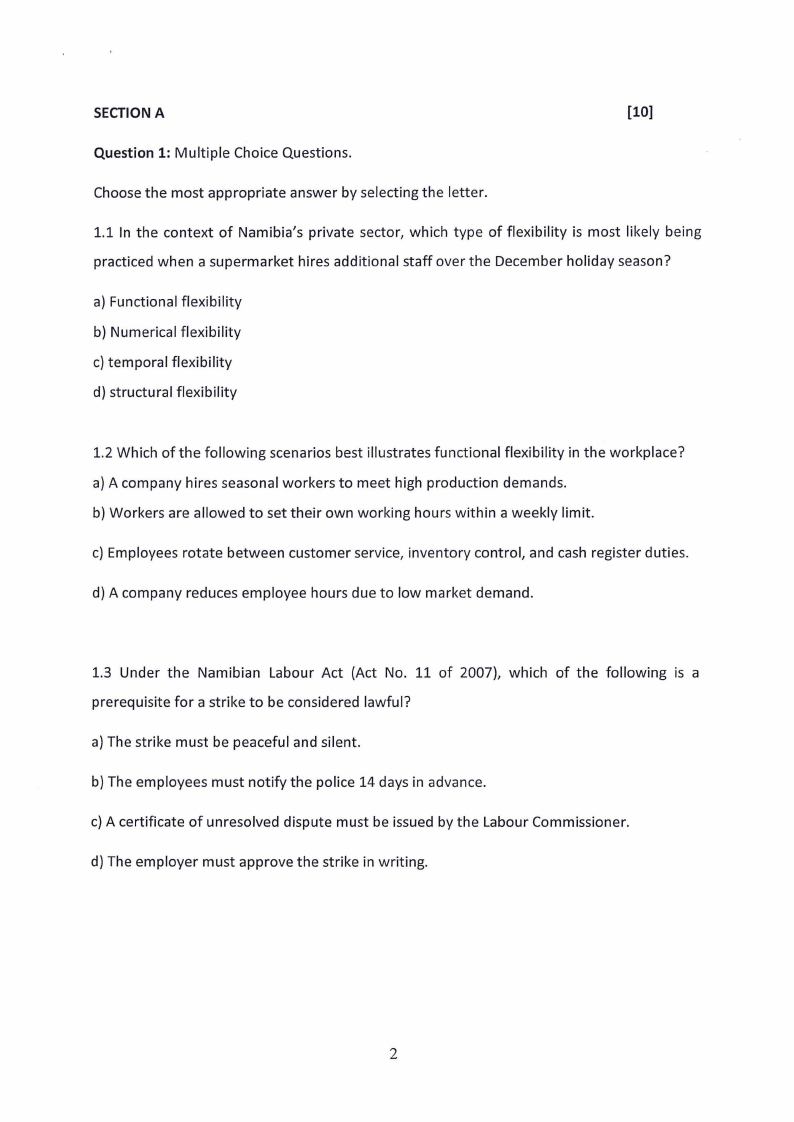
SECTIONA
[10]
Question 1: Multiple Choice Questions.
Choose the most appropriate answer by selecting the letter.
1.1 In the context of Namibia's private sector, which type of flexibility is most likely being
practiced when a supermarket hires additional staff over the December holiday season?
a) Functional flexibility
b) Numerical flexibility
c) temporal flexibility
d) structural flexibility
1.2 Which of the following scenarios best illustrates functional flexibility in the workplace?
a) A company hires seasonal workers to meet high production demands.
b) Workers are allowed to set their own working hours within a weekly limit.
c) Employees rotate between customer service, inventory control, and cash register duties.
d) A company reduces employee hours due to low market demand.
1.3 Under the Namibian Labour Act (Act No. 11 of 2007), which of the following is a
prerequisite for a strike to be considered lawful?
a) The strike must be peaceful and silent.
b) The employees must notify the police 14 days in advance.
c) A certificate of unresolved dispute must be issued by the Labour Commissioner.
d) The employer must approve the strike in writing.
2
|
|
3 Page 3 |
▲back to top |
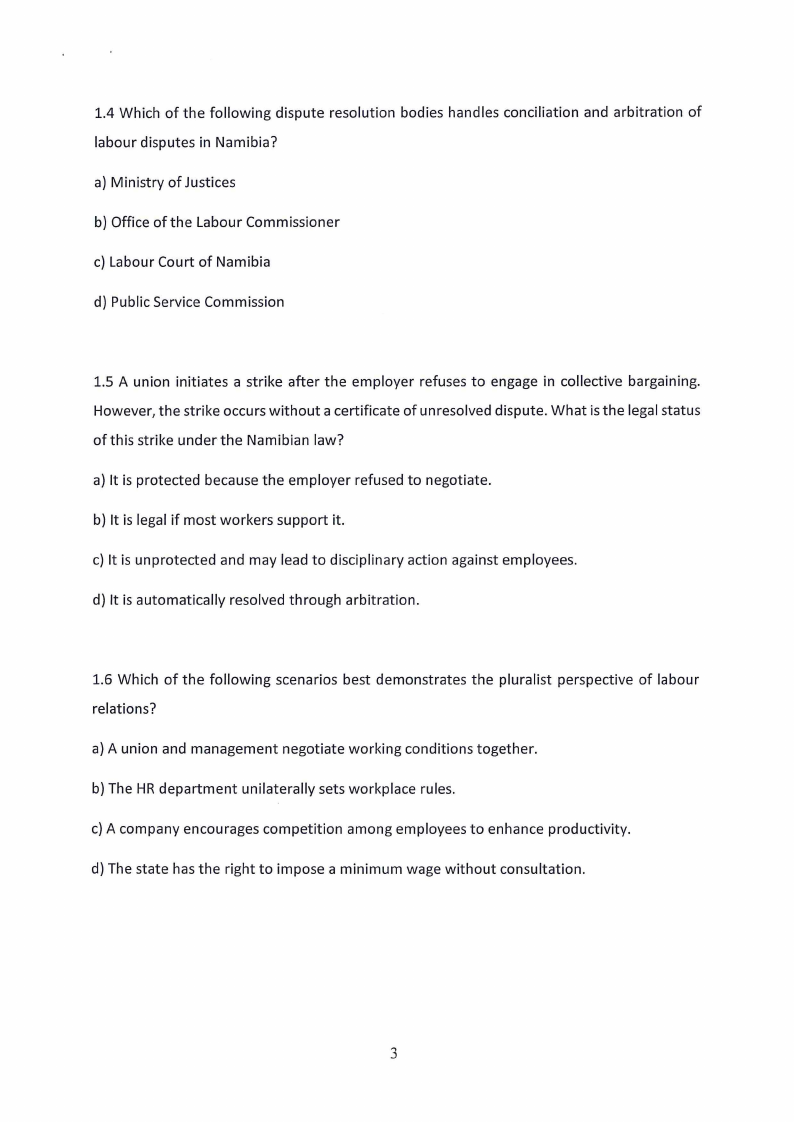
1.4 Which of the following dispute resolution bodies handles conciliation and arbitration of
labour disputes in Namibia?
a) Ministry of Justices
b) Office of the Labour Commissioner
c) Labour Court of Namibia
d) Public Service Commission
1.5 A union initiates a strike after the employer refuses to engage in collective bargaining.
However, the strike occurs without a certificate of unresolved dispute. What is the legal status
of this strike under the Namibian law?
a) It is protected because the employer refused to negotiate.
b) It is legal if most workers support it.
c) It is unprotected and may lead to disciplinary action against employees.
d) It is automatically resolved through arbitration.
1.6 Which of the following scenarios best demonstrates the pluralist perspective of labour
relations?
a) A union and management negotiate working conditions together.
b) The HR department unilaterally sets workplace rules.
c) A company encourages competition among employees to enhance productivity.
d) The state has the right to impose a minimum wage without consultation.
3
|
|
4 Page 4 |
▲back to top |
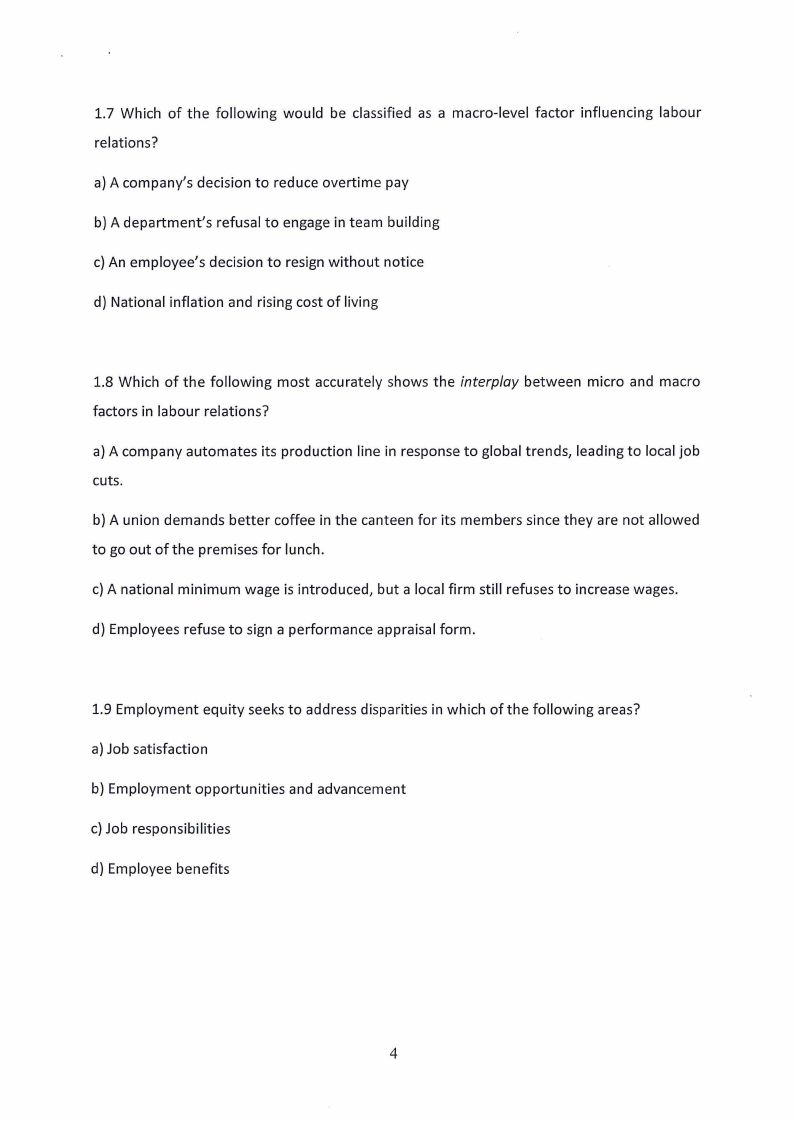
1.7 Which of the following would be classified as a macro-level factor influencing labour
relations?
a) A company's decision to reduce overtime pay
b) A department's refusal to engage in team building
c) An employee's decision to resign without notice
d) National inflation and rising cost of living
1.8 Which of the following most accurately shows the interplay between micro and macro
factors in labour relations?
a) A company automates its production line in response to global trends, leading to local job
cuts.
b) A union demands better coffee in the canteen for its members since they are not allowed
to go out of the premises for lunch.
c) A national minimum wage is introduced, but a local firm still refuses to increase wages.
d) Employees refuse to sign a performance appraisal form.
1.9 Employment equity seeks to address disparities in which of the following areas?
a) Job satisfaction
b) Employment opportunities and advancement
c) Job responsibilities
d) Employee benefits
4
|
|
5 Page 5 |
▲back to top |
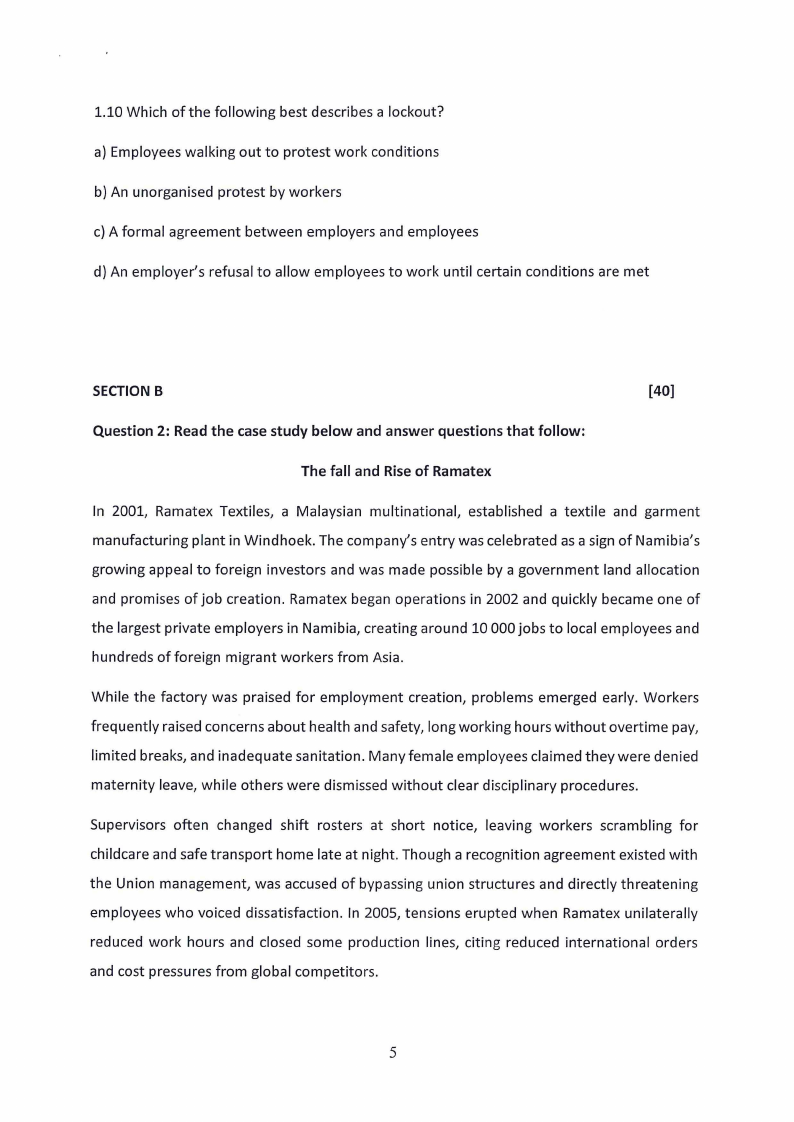
1.10 Which of the following best describes a lockout?
a) Employees walking out to protest work conditions
b) An unorganised protest by workers
c) A formal agreement between employers and employees
d) An employer's refusal to allow employees to work until certain conditions are met
SECTION B
[40)
Question 2: Read the case study below and answer questions that follow:
The fall and Rise of Ramatex
In 2001, Ramatex Textiles, a Malaysian multinational, established a textile and garment
manufacturing plant in Windhoek. The company's entry was celebrated as a sign of Namibia's
growing appeal to foreign investors and was made possible by a government land allocation
and promises of job creation. Ramatex began operations in 2002 and quickly became one of
the largest private employers in Namibia, creating around 10 000 jobs to local employees and
hundreds of foreign migrant workers from Asia.
While the factory was praised for employment creation, problems emerged early. Workers
frequently raised concerns about health and safety, long working hours without overtime pay,
limited breaks, and inadequate sanitation. Many female employees claimed they were denied
maternity leave, while others were dismissed without clear disciplinary procedures.
Supervisors often changed shift rosters at short notice, leaving workers scrambling for
childcare and safe transport home late at night. Though a recognition agreement existed with
the Union management, was accused of bypassing union structures and directly threatening
employees who voiced dissatisfaction. In 2005, tensions erupted when Ramatex unilaterally
reduced work hours and closed some production lines, citing reduced international orders
and cost pressures from global competitors.
5
|
|
6 Page 6 |
▲back to top |
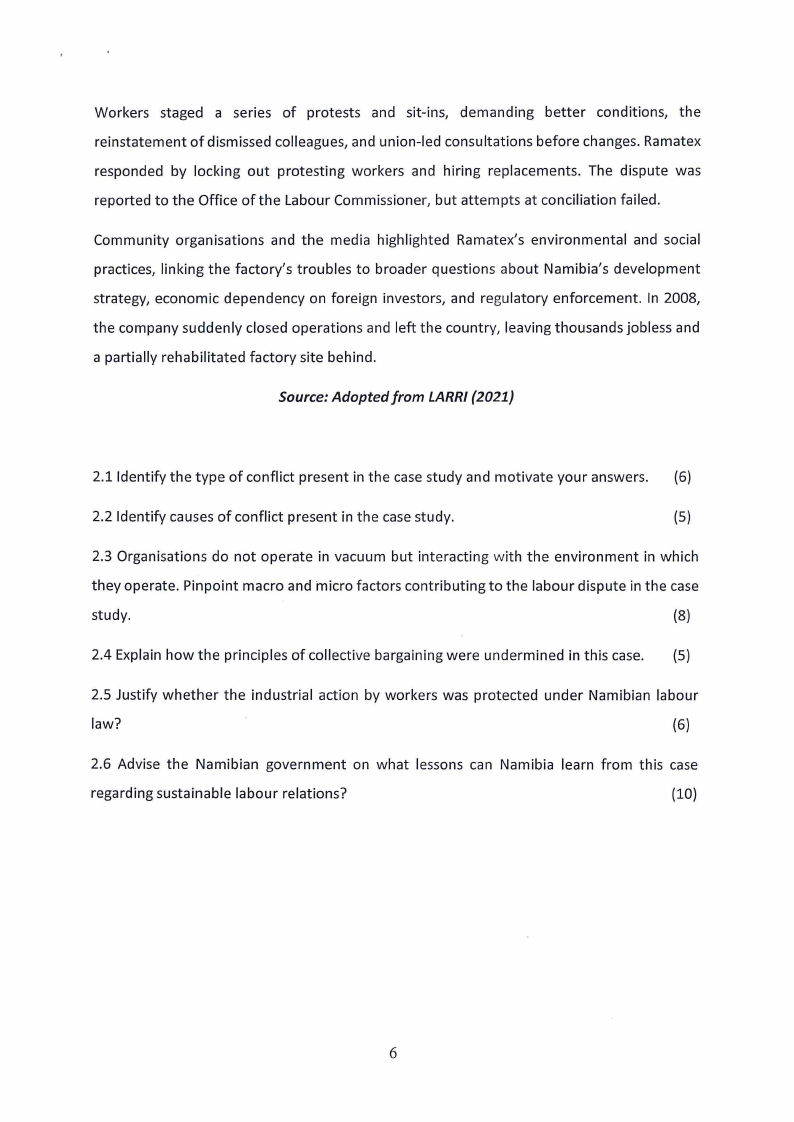
Workers staged a series of protests and sit-ins, demanding better conditions, the
reinstatement of dismissed colleagues, and union-led consultations before changes. Ramatex
responded by locking out protesting workers and hiring replacements. The dispute was
reported to the Office of the Labour Commissioner, but attempts at conciliation failed.
Community organisations and the media highlighted Ramatex's environmental and social
practices, linking the factory's troubles to broader questions about Namibia's development
strategy, economic dependency on foreign investors, and regulatory enforcement. In 2008,
the company suddenly closed operations and left the country, leaving thousands jobless and
a partially rehabilitated factory site behind.
Source: Adopted from LARR/ {2021)
2.1 Identify the type of conflict present in the case study and motivate your answers. (6)
2.2 Identify causes of conflict present in the case study.
(5)
2.3 Organisations do not operate in vacuum but interacting with the environment in which
they operate. Pinpoint macro and micro factors contributing to the labour dispute in the case
study.
(8)
2.4 Explain how the principles of collective bargaining were undermined in this case. (5)
2.5 Justify whether the industrial action by workers was protected under Namibian labour
law?
(6)
2.6 Advise the Namibian government on what lessons can Namibia learn from this case
regarding sustainable labour relations?
(10)
6
|
|
7 Page 7 |
▲back to top |
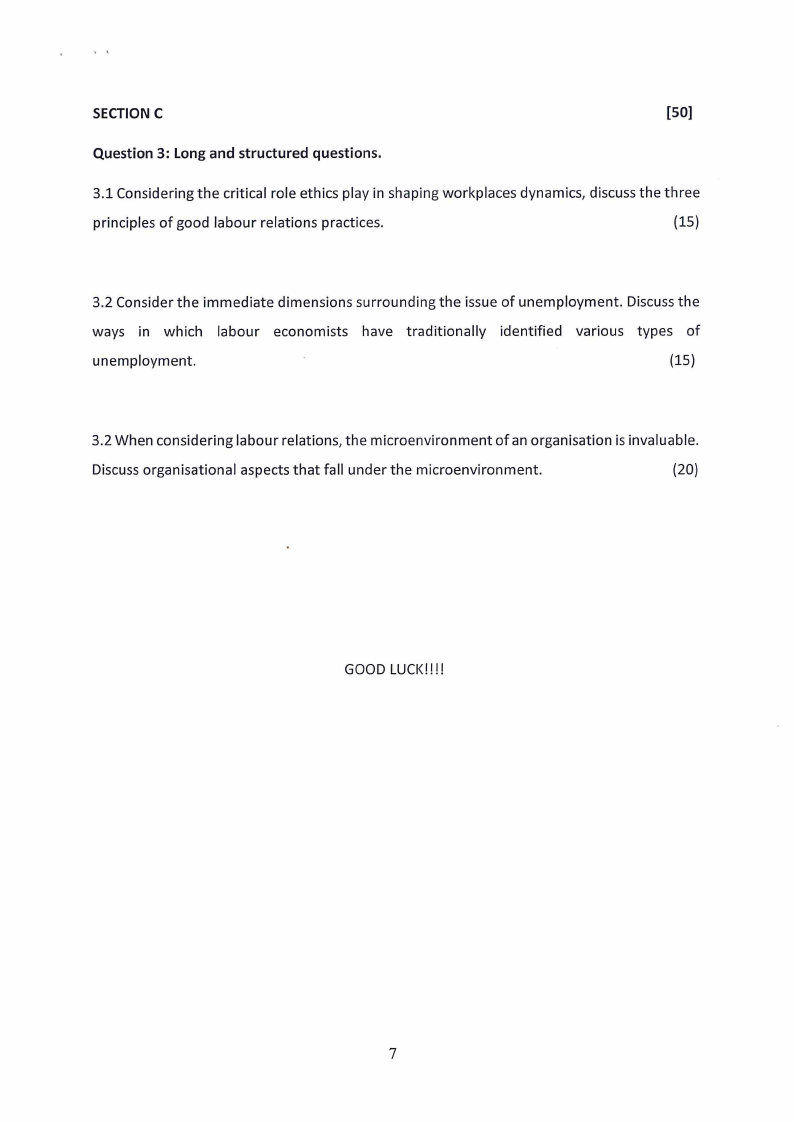
SECTION C
[SO]
Question 3: Long and structured questions.
3.1 Considering the critical role ethics play in shaping workplaces dynamics, discuss the three
principles of good labour relations practices.
(15)
3.2 Consider the immediate dimensions surrounding the issue of unemployment. Discuss the
ways in which labour economists have traditionally identified various types of
unemployment.
(15)
3.2 When considering labour relations, the microenvironment of an organisation is invaluable.
Discuss organisational aspects that fall under the microenvironment.
(20)
GOOD LUCK!!!!
7