


 |
ADR811S - ADVANCED INDUSTRIAL RELATIONS - 2ND OPP - JUNE 2025 |
|
|
1 Page 1 |
▲back to top |
nAmlBIA UnlVERSITY
OF SCIEn CE Ano TECHn OLOGY
FACULTY OF COMMERCE, HUMAN SCIENCES AND EDUCATION
DEPARTMENT OF GOVERNANCE AND MANAGEMENT SCIENCES
QUALIFICATION: BACHELOR OF HUMAN RESOURCES MANAGEMENT HONOURS
DEGREE
QUALIFICATION CODE: 08HRM
LEVEL: 8
COURSE CODE: ADR811S
COURSE NAME: ADVANCED INDUSTRIAL
RELATIONS
DATE: JULY 2025
DURATION: 3 HOURS
PAPER: 1
MARKS: 100
EXAMINER($)
SECOND OPPORTUNITY QUESTION PAPER
Ms. Fiina Shimaneni
MODERATOR:
Dr Felix Musukubili
INSTRUCTIONS
1. Answer ALL questions.
2. Write clearly and neatly.
3. Number your answers clearly.
THIS QUESTION PAPER CONSISTS OF 6 PAGES (Including this front page)
|
|
2 Page 2 |
▲back to top |
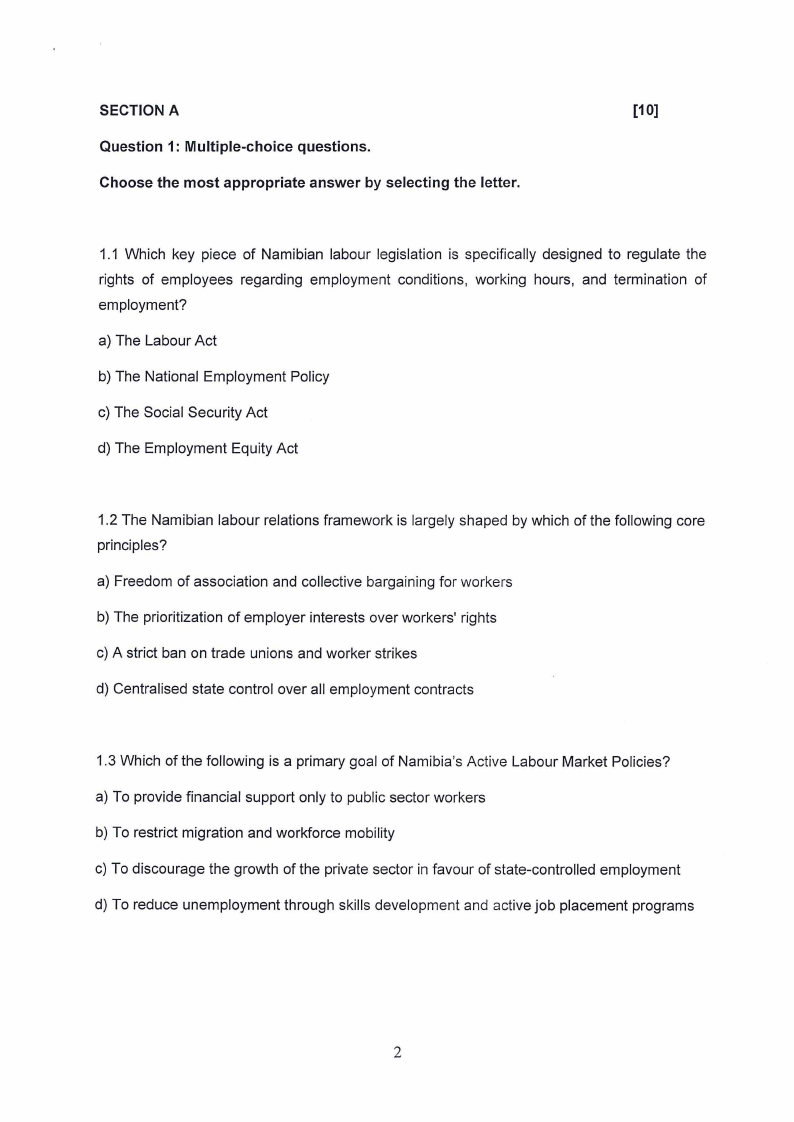
SECTION A
[10]
Question 1: Multiple-choice questions.
Choose the most appropriate answer by selecting the letter.
1.1 Which key piece of Namibian labour legislation is specifically designed to regulate the
rights of employees regarding employment conditions, working hours, and termination of
employment?
a) The Labour Act
b) The National Employment Policy
c) The Social Security Act
d) The Employment Equity Act
1.2 The Namibian labour relations framework is largely shaped by which of the following core
principles?
a) Freedom of association and collective bargaining for workers
b) The prioritization of employer interests over workers' rights
c) A strict ban on trade unions and worker strikes
d) Centralised state control over all employment contracts
1.3 Which of the following is a primary goal of Namibia's Active Labour Market Policies?
a) To provide financial support only to public sector workers
b) To restrict migration and workforce mobility
c) To discourage the growth of the private sector in favour of state-controlled employment
d) To reduce unemployment through skills development and active job placement programs
2
|
|
3 Page 3 |
▲back to top |
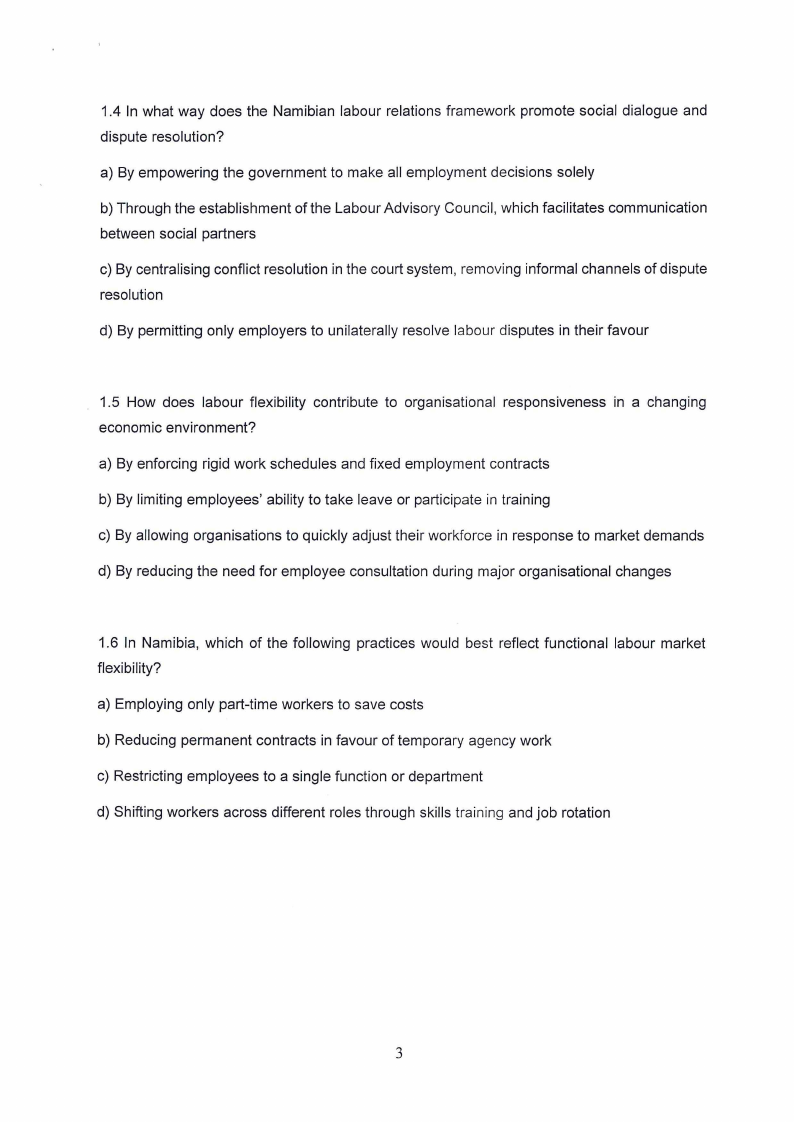
1.4 In what way does the Namibian labour relations framework promote social dialogue and
dispute resolution?
a) By empowering the government to make all employment decisions solely
b) Through the establishment of the Labour Advisory Council, which facilitates communication
between social partners
c) By centralising conflict resolution in the court system, removing informal channels of dispute
resolution
d) By permitting only employers to unilaterally resolve labour disputes in their favour
1.5 How does labour flexibility contribute to organisational responsiveness in a changing
economic environment?
a) By enforcing rigid work schedules and fixed employment contracts
b) By limiting employees' ability to take leave or participate in training
c) By allowing organisations to quickly adjust their workforce in response to market demands
d) By reducing the need for employee consultation during major organisational changes
1.6 In Namibia, which of the following practices would best reflect functional labour market
flexibility?
a) Employing only part-time workers to save costs
b) Reducing permanent contracts in favour of temporary agency work
c) Restricting employees to a single function or department
d) Shifting workers across different roles through skills training and job rotation
3
|
|
4 Page 4 |
▲back to top |
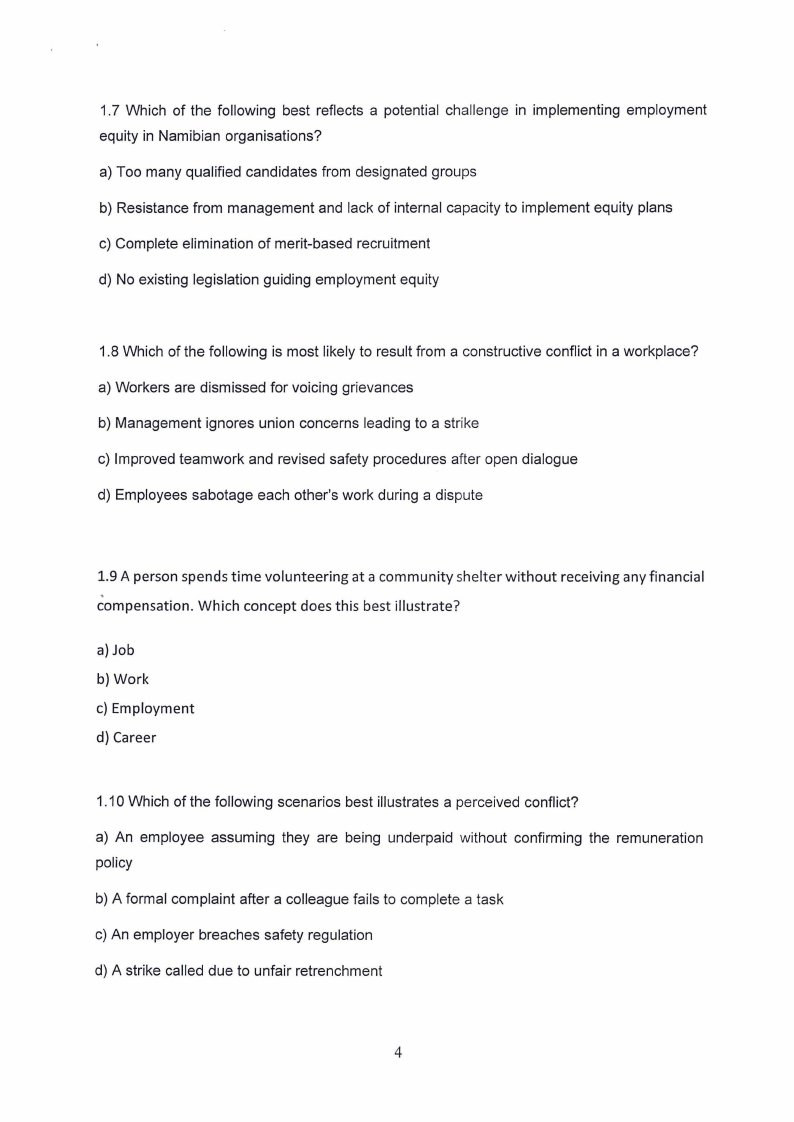
1.7 Which of the following best reflects a potential challenge in implementing employment
equity in Namibian organisations?
a) Too many qualified candidates from designated groups
b) Resistance from management and lack of internal capacity to implement equity plans
c) Complete elimination of merit-based recruitment
d) No existing legislation guiding employment equity
1.8 Which of the following is most likely to result from a constructive conflict in a workplace?
a) Workers are dismissed for voicing grievances
b) Management ignores union concerns leading to a strike
c) Improved teamwork and revised safety procedures after open dialogue
d) Employees sabotage each other's work during a dispute
1.9 A person spends time volunteering at a community shelter without receiving any financial
compensation. Which concept does this best illustrate?
a} Job
b} Work
c} Employment
d} Career
1.10 Which of the following scenarios best illustrates a perceived conflict?
a) An employee assuming they are being underpaid without confirming the remuneration
policy
b) A formal complaint after a colleague fails to complete a task
c) An employer breaches safety regulation
d) A strike called due to unfair retrenchment
4
|
|
5 Page 5 |
▲back to top |
SECTION B
[40]
Question 2: Read the case study below and answer questions that follow:
Case Study: The Shoprite Namibia Workers' Strike
In December 2020, employees of Shoprite Namibia, embarked on a nationwide strike. The
industrial action was organized by the Namibia Food and Allied Workers Union (NAFAU),
which had been negotiating with the employer over wages, working hours, and job security.
Workers demanded wage increases and improvements in their employment terms, citing long-
standing grievances about being employed on short-term contracts for extended periods, low
pay, and alleged unfair treatment between categories of staff.
The dispute escalated when Shoprite continued operations during the strike by employing
temporary workers, including casual and fixed-term staff, to perform the duties of the striking
employees. The Union accused the company of undermining the strike and violating fair labour
practices. The matter was taken to the Labour Court, where the union sought an interdict to
prevent Shoprite from employing replacement labour during the strike. The court's ruling,
issued in early January 2021, addressed the legality and fairness of the company's actions,
balancing the rights of workers to strike with the company's right to continue its business
operations.
This case raised broader concerns regarding the application of employment equity, the ethics
of labour relations, and the effectiveness of collective bargaining structures in Namibia's labour
market. It also revealed deeper tensions in the relationship between workers and employers
in the retail sector, especially in balancing commercial interests with decent work principles.
Source: adapted from: https://namiblii .org/akn/na/judgment/nalcmd/2021 /45/eng%402021-
01-08
2.1 Briefly explain the role that NAFAU played in this case?
(4)
2.2 Describe the underlying reasons for the 2020 strike at Shoprite Namibia.
(5)
2.3 Discuss whether Shoprite's decision to hire replacement workers during the strike was
ethically justified, given the Namibia's Labour Laws.
(6)
2.4 This case reflects on challenges of achieving employment equity in the retail sector in
Namibia? Do you agree or disagree with this statement?
(6)
5
|
|
6 Page 6 |
▲back to top |
2.5 Using the facts from the case, identify and describe the type(s) of conflict experienced by
the parties involved.
(12)
2.6 Examine how collective bargaining took place in this case. What bargaining styles and at
what level did it occur?
(7)
SECTION C
[50]
Question 3: Long and structured questions.
3.1 It is empirically demonstrable that unions do far better for their members in wage outcomes
based on collective bargaining than those whose wages are determined unilaterally by
employers. Discuss the effects which occur in these bargaining dynamics.
(15)
3.2 In labour relations context, power influence interactions between employers, employees,
and trade unions. Discuss the concept of power and its determinants.
(15)
3. 3 Discuss major factors that lead to a differentiation in earnings (wage differentials) (20)
GOOD LUCK!!!!!
6