


 |
HEC820S-HEALTH ECONOMICS-1ST OPP-JUNE 2025 |
|
|
1 Page 1 |
▲back to top |

nAm I BI A un IVERS ITY
OF SCIEnCE Ano TECHnOLOGY
FACULTY OF MANAGEMENT SCIENCES
DEPARTMENT OF ECONOMICS, ACCOUNTING AND FINANCE
QUALIFICATION: BACHELOR OF ECONOMICS HONORS
QUALIFICATION CODE: 08HECO
LEVEL: 8
COURSE CODE: HEC802S
COURSE NAME: HEALTH ECONOMICS
SESSION: JUNE 2025
DURATION: 3 HOURS
PAPER: THEORY
MARKS: 100
FIRST OPPORTUNITY EXAMINATION QUESTION PAPER
EXAMINER{S)
MR IMMANUEL NASHIVELA
'
MODERATOR: MS. OLIVIA SHUULUKA
INSTRUCTIONS
1. This paper consists of 5 questions
2. Answer ALL questions
3. Number your answers in accordance with the question paper.
4. Start each question answer on a new page
5. Write clearly and legibly
PERMISSIBLE MATERIALS
1. Pen
2. Ruler
3. Calculator
THIS QUESTION PAPER CONSISTS OF Z PAGES (Including
this front
page)
|
|
2 Page 2 |
▲back to top |
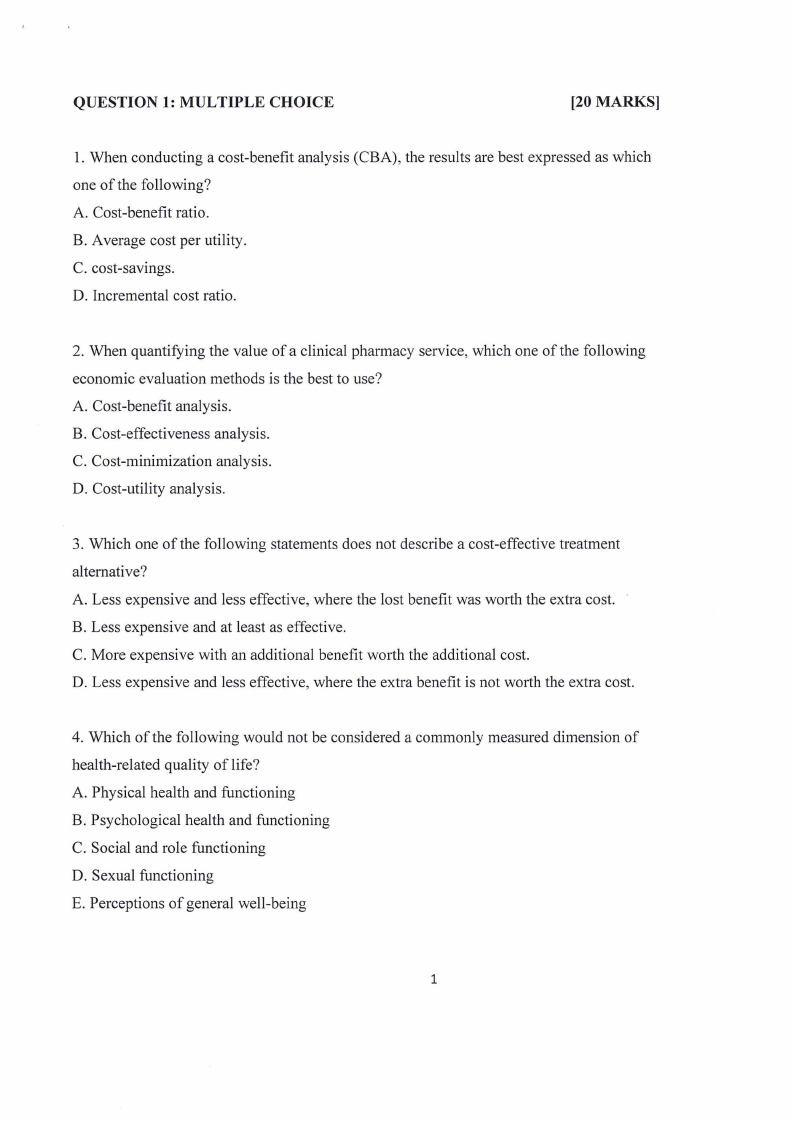
QUESTION 1: MULTIPLE CHOICE
[20 MARKS]
1. When conducting a cost-benefit analysis (CBA), the results are best expressed as which
one of the following?
A. Cost-benefit ratio.
B. Average cost per utility.
C. cost-savings.
D. Incremental cost ratio.
2. When quantifying the value of a clinical pharmacy service, which one of the following
economic evaluation methods is the best to use?
A. Cost-benefit analysis.
B. Cost-effectiveness analysis.
C. Cost-minimization analysis.
D. Cost-utility analysis.
3. Which one of the following statements does not describe a cost-effective treatment
alternative?
A. Less expensive and less effective, where the lost benefit was w011hthe extra cost.
B. Less expensive and at least as effective.
C. More expensive with an additional benefit worth the additional cost.
D. Less expensive and less effective, where the extra benefit is not wo1ih the extra cost.
4. Which of the following would not be considered a commonly measured dimension of
health-related quality of life?
A. Physical health and functioning
B. Psychological health and functioning
C. Social and role functioning
D. Sexual functioning
E. Perceptions of general well-being
1
|
|
3 Page 3 |
▲back to top |
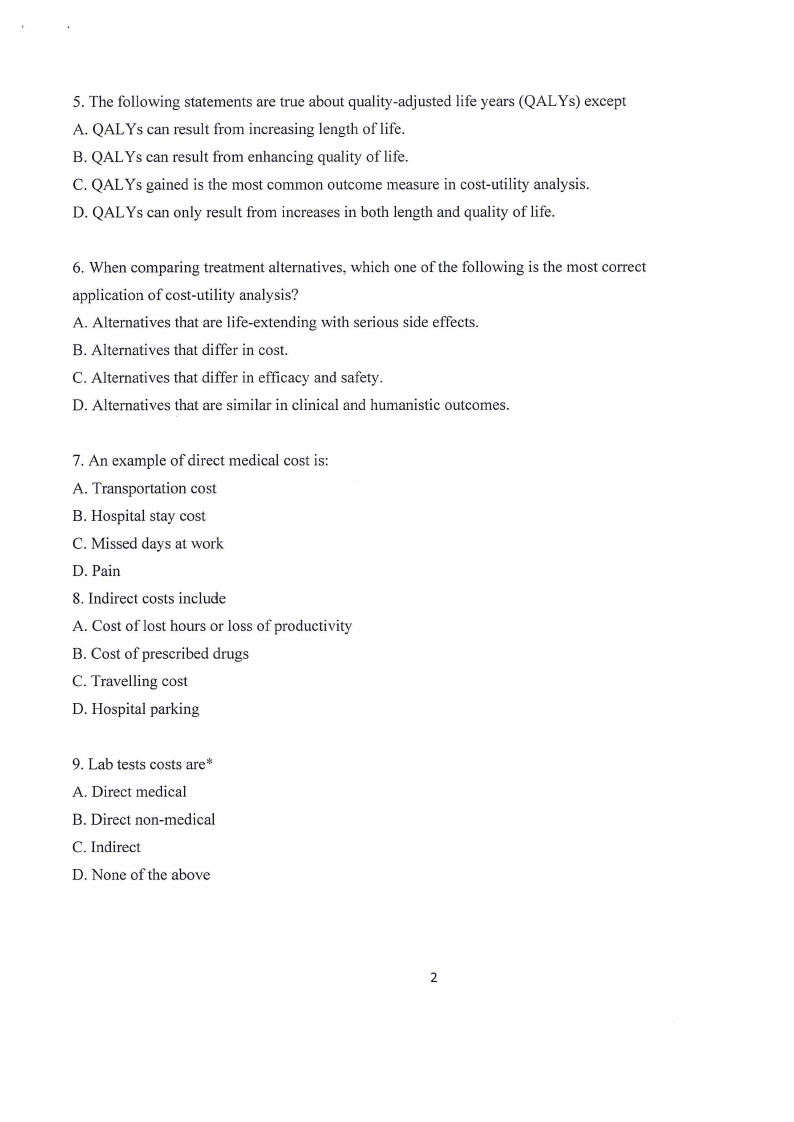
5. The following statements are true about quality-adjusted life years (QAL Ys) except
A. QAL Ys can result from increasing length of life.
B. QAL Ys can result from enhancing quality oflife.
C. QAL Ys gained is the most common outcome measure in cost-utility analysis.
D. QAL Ys can only result from increases in both length and quality oflife.
6. When comparing treatment alternatives, which one of the following is the most con-ect
application of cost-utility analysis?
A. Alternatives that are life-extending with serious side effects.
B. Alternatives that differ in cost.
C. Alternatives that differ in efficacy and safety.
D. Alternatives that are similar in clinical and humanistic outcomes.
7. An example of direct medical cost is:
A. Transportation cost
B. Hospital stay cost
C. Missed days at work
D. Pain
8. Indirect costs include
A. Cost of lost hours or loss of productivity
B. Cost of prescribed drugs
C. Travelling cost
D. Hospital parking
9. Lab tests costs are*
A. Direct medical
B. Direct non-medical
C. Indirect
D. None of the above
2
|
|
4 Page 4 |
▲back to top |
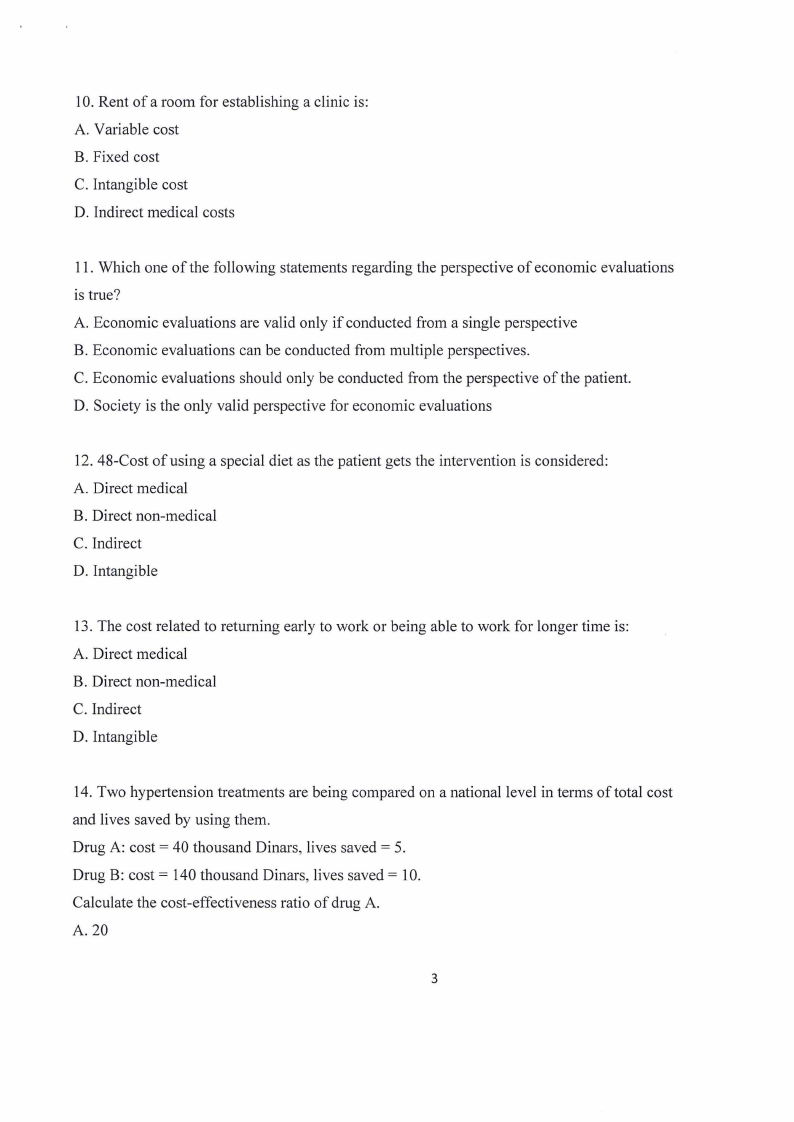
10. Rent of a room for establishing a clinic is:
A. Variable cost
B. Fixed cost
C. Intangible cost
D. Indirect medical costs
11. Which one of the following statements regarding the perspective of economic evaluations
is true?
A. Economic evaluations are valid only if conducted from a single perspective
B. Economic evaluations can be conducted from multiple perspectives.
C. Economic evaluations should only be conducted from the perspective of the patient.
D. Society is the only valid perspective for economic evaluations
12. 48-Cost of using a special diet as the patient gets the intervention is considered:
A. Direct medical
B. Direct non-medical
C. Indirect
D. Intangible
13. The cost related to returning early to work or being able to work for longer time is:
A. Direct medical
B. Direct non-medical
C. Indirect
D. Intangible
14. Two hypertension treatments are being compared on a national level in terms of total cost
and lives saved by using them.
Drug A: cost= 40 thousand Dinars, lives saved= 5.
Drug B: cost= 140 thousand Dinars, lives saved= 10.
Calculate the cost-effectiveness ratio of drug A.
A. 20
3
|
|
5 Page 5 |
▲back to top |
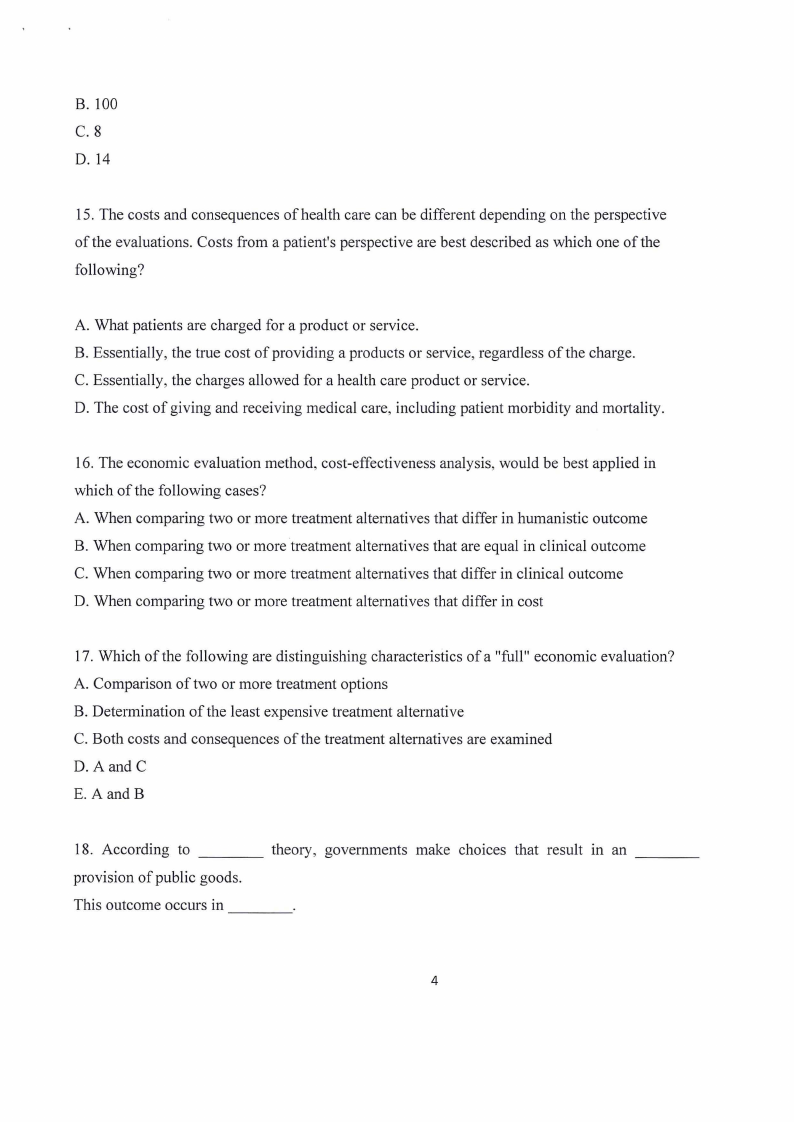
B. 100
C. 8
D. 14
15. The costs and consequences of health care can be different depending on the perspective
of the evaluations. Costs from a patient's perspective are best described as which one of the
following?
A. What patients are charged for a product or service.
B. Essentially, the true cost of providing a products or service, regardless of the charge.
C. Essentially, the charges allowed for a health care product or service.
D. The cost of giving and receiving medical care, including patient morbidity and mortality.
16. The economic evaluation method, cost-effectiveness analysis, would be best applied in
which of the following cases?
A. When comparing two or more treatment alternatives that differ in humanistic outcome
B. When comparing two or more treatment alternatives that are equal in clinical outcome
C. When comparing two or more treatment alternatives that differ in clinical outcome
D. When comparing two or more treatment alternatives that differ in cost
17. Which of the following are distinguishing characteristics of a "full" economic evaluation?
A. Comparison of two or more treatment options
B. Determination of the least expensive treatment alternative
C. Both costs and consequences of the treatment alternatives are examined
D. A and C
E. AandB
18. According to ____
theory, governments make choices that result m an ___ _
provision of public goods.
This outcome occurs in ----
4
|
|
6 Page 6 |
▲back to top |
A) public choice; efficient; political markets in which voters are rationally ignorant
B) public choice; inefficient; a perfect political system in which voters are full informed about the
effects of policies
C) social interest; inefficient; political markets in which voters are rationally ignorant
D) social interest; efficient; political markets in which voters are rationally ignorant
E) social interest; efficient; a perfect political system in which voters are fully informed about the
effects of policies
19. Public goods are provided by government because
A) private firms do not take into account the impact of external costs.
B) governments are more efficient than private firms at producing public goods.
C) people value national defense very highly.
D) private firms will make an economic profit.
E) free-rider problems result in underproduction by private markets
20. Which one of the following statements is not true about cost-minimization analysis?
A. Cost-minimization analysis is a tool used to compare the costs of two or more treatment
alternatives.
B. Cost-minimization analysis shows only a cost- savings of one treatment alternative over
another.
C. Cost-minimization analysis measures the costs of treatment alternatives in dollars and
assumes comparable efficacy.
D. Cost-minimization analysis is a method to be used when no evidence exists to support the
therapeutic equivalence of two or more treatment alternatives.
5
|
|
7 Page 7 |
▲back to top |
, .' '
Question 2 [20 Marks]
a) Distinguish between Cost Utility Analysis and Cost Benefit Analysis and provides advantages
and disadvantages for each.
(15 Marks)
b) Differentiate between positive and normative economics.
(5 Marks)
Question 3 [20 Marks]
Discuss the role of Role of Government in the health care market
(20 Marks)
Question 4 [20 Marks]
With the use of a graph, assess the role of technology in the cost of health care. (20 Marks)
Question 5 [20 Marks]
Use the Le_mqnspri.nciples by Nobel Laureate George Akerlof to illustrate the Asymmetry of
information in health care market.
(20 Marks)
Good Luck!
6