SFM711S - STRATEGIC FLEET MANAGEMENT - 2ND OPP -JULY 2025


SFM711S - STRATEGIC FLEET MANAGEMENT - 2ND OPP -JULY 2025


1 Page 1

▲back to top


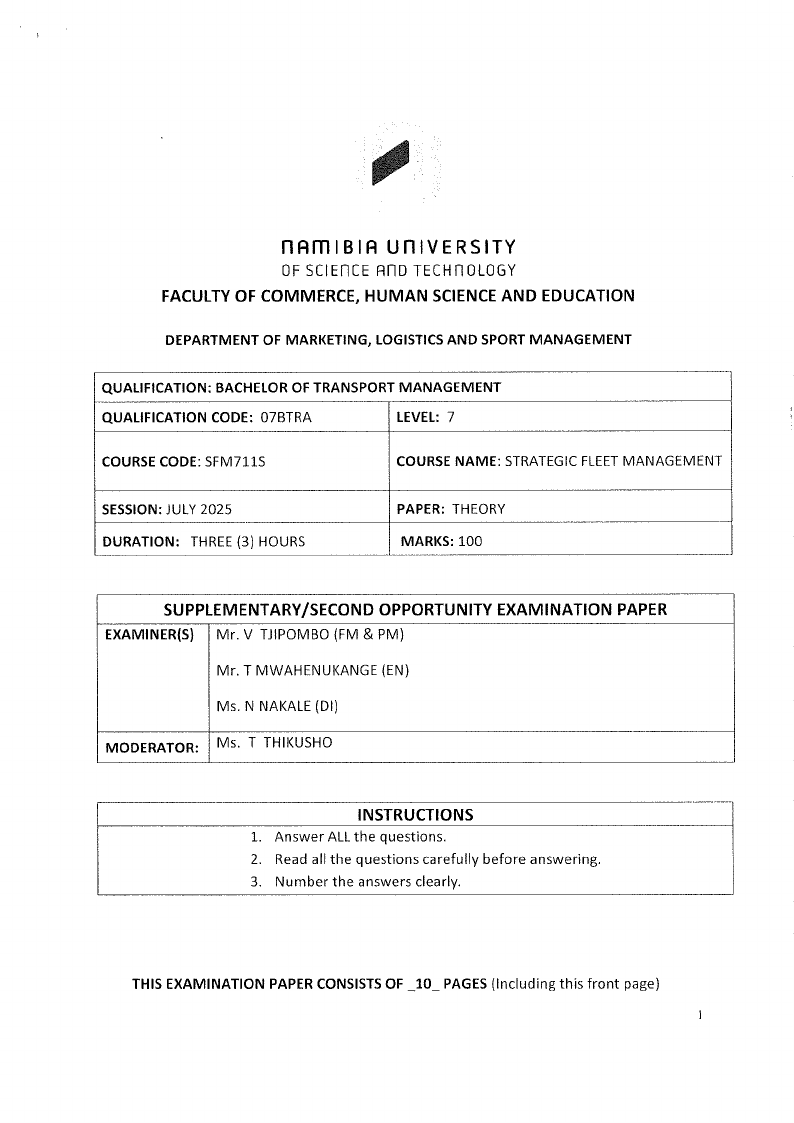
nAmlBIA untVERSITY
OF SCIEnCE Ano TECHnOLOGY
FACULTYOF COMMERCEH, UMAN SCIENCEAND EDUCATION
DEPARTMENT OF MARKETING, LOGISTICS AND SPORT MANAGEMENT
QUALIFICATION: BACHELOR OF TRANSPORT MANAGEMENT
QUALIFICATION CODE: 07BTRA
LEVEL: 7
COURSE CODE: SFM711S
COURSE NAME: STRATEGICFLEETMANAGEMENT
SESSION: JULY 2025
DURATION: THREE (3) HOURS
PAPER: THEORY
MARKS: 100
SUPPLEMENTARY/SECONODPPORTUNITYEXAMINATIONPAPER
EXAMINER(S) Mr. V TJIPOMBO (FM & PM)
Mr. T MWAHENUKANGE (EN)
Ms. N NAKALE (DI)
MODERATOR: Ms. T THIKUSHO
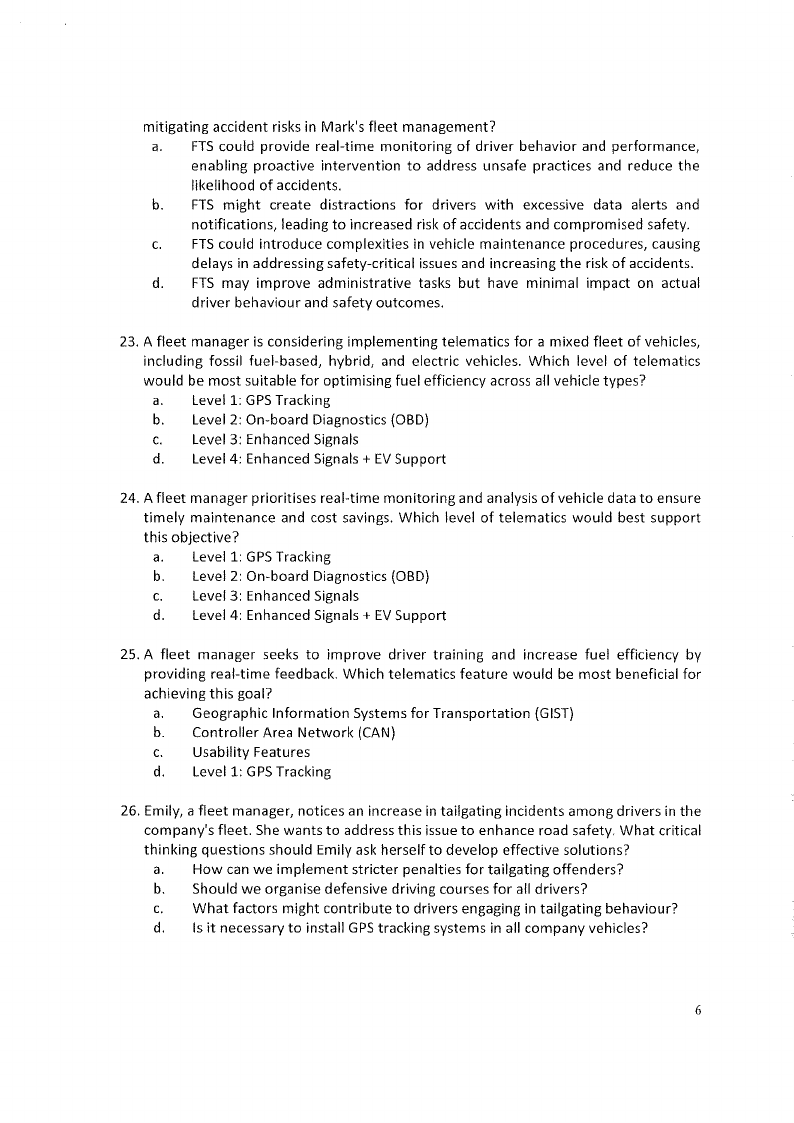
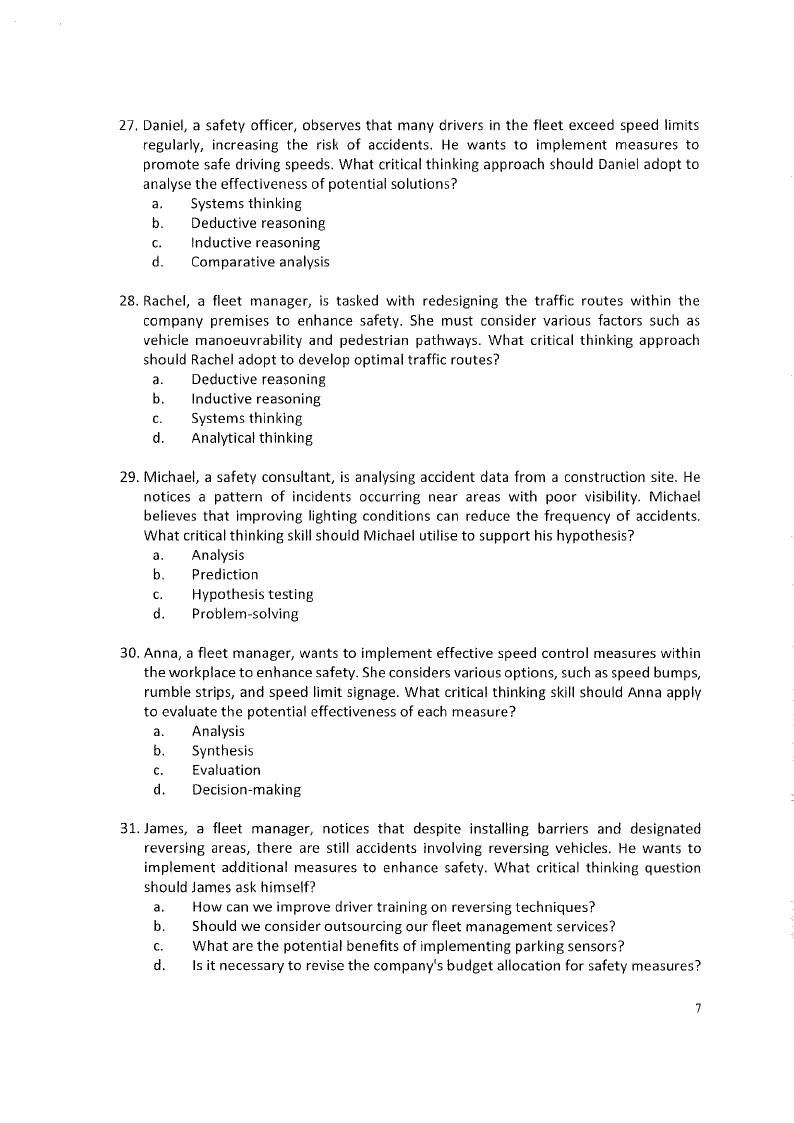
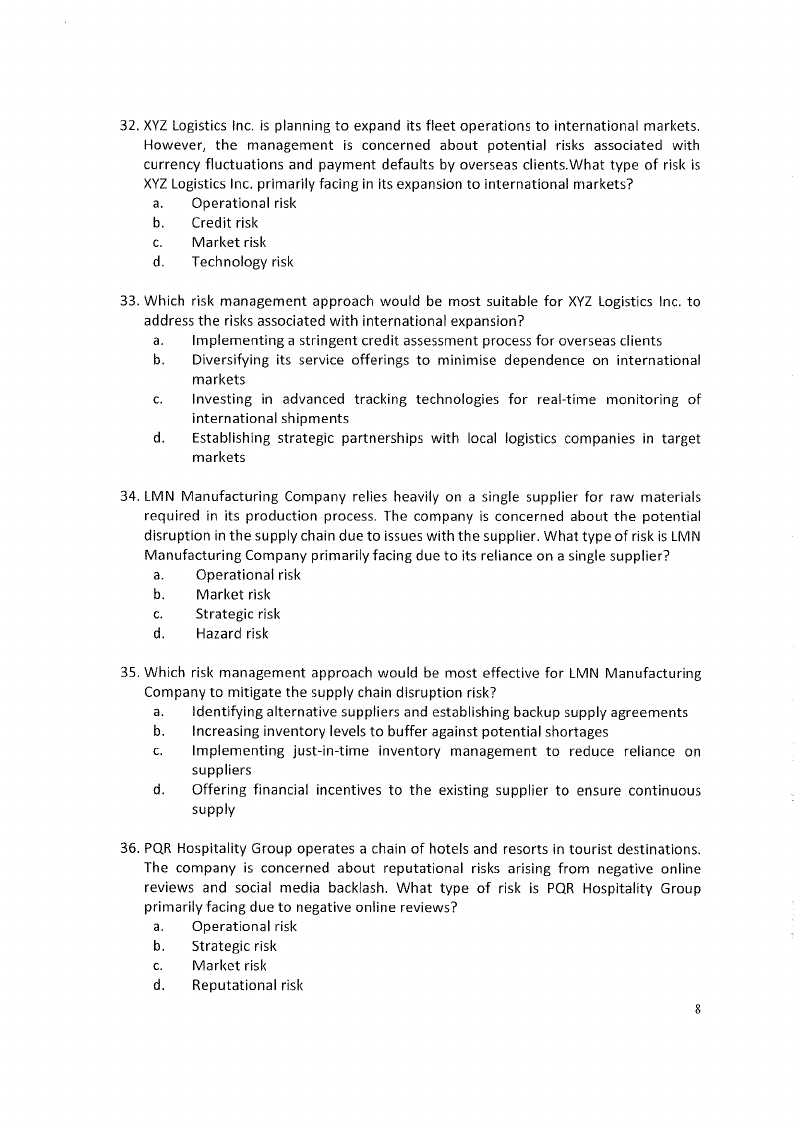
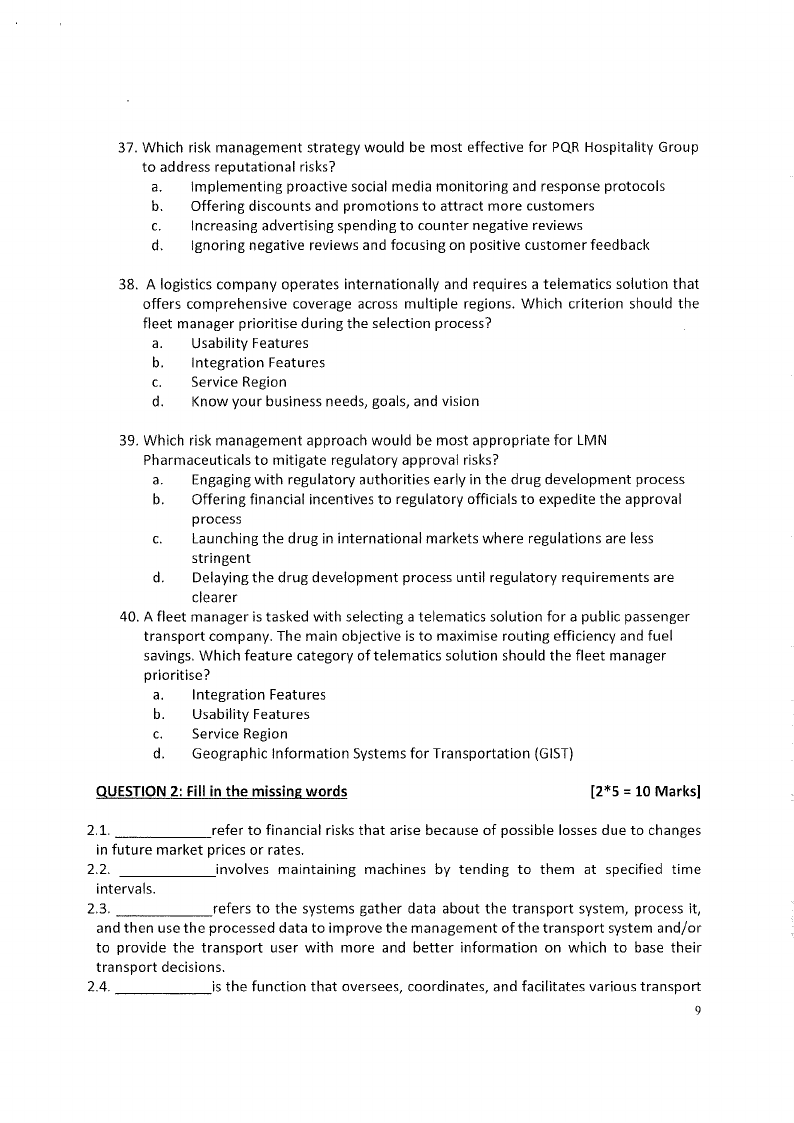
INSTRUCTIONS
1. Answer ALL the questions.
2. Read all the questions carefully before answering.
3. Number the answers clearly.
THIS EXAMINATION PAPER CONSISTS OF _10_ PAGES (Including this front page)

2 Page 2

▲back to top


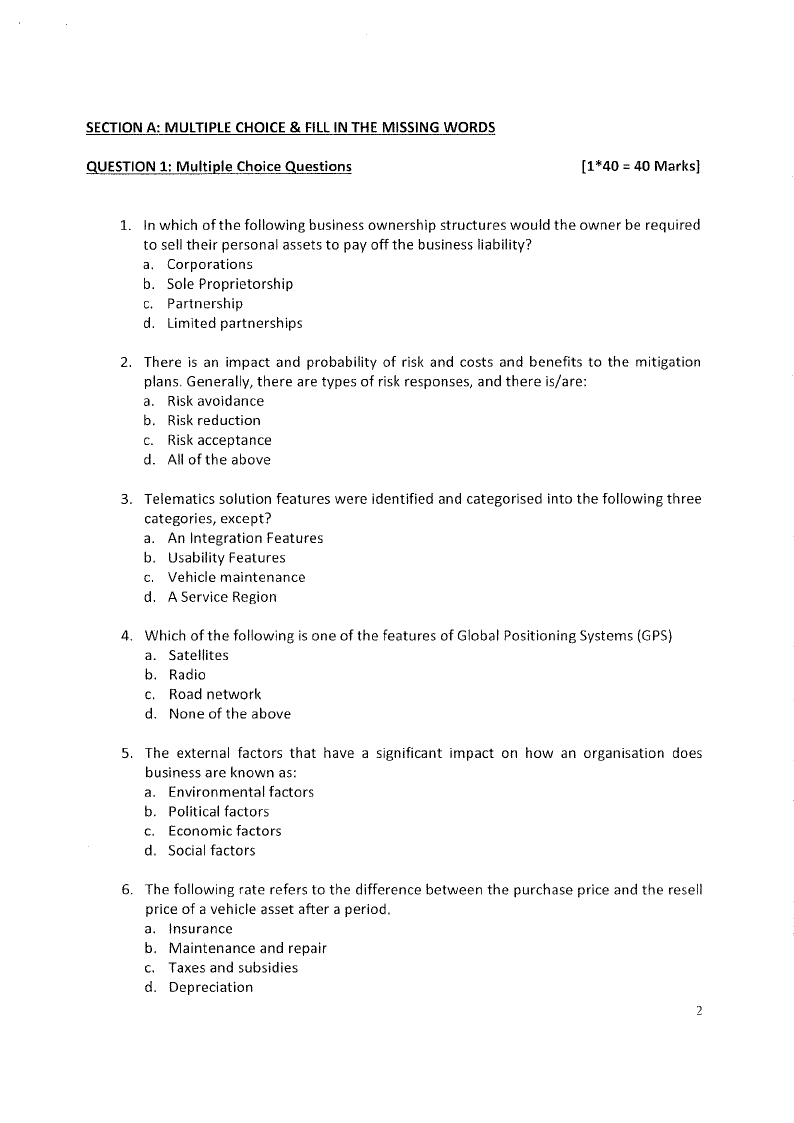
SECTION A: MULTIPLE CHOICE & FILL IN THE MISSING WORDS
QUESTION 1: Multiple Choice Questions
[1 *40 = 40 Marks]
1. In which of the following business ownership structures would the owner be required
to sell their personal assets to pay off the business liability?
a. Corporations
b. Sole Proprietorship
c. Partnership
d. Limited partnerships
2. There is an impact and probability of risk and costs and benefits to the mitigation
plans. Generally, there are types of risk responses, and there is/are:
a. Risk avoidance
b. Risk reduction
c. Risk acceptance
d. All of the above
3. Telematics solution features were identified and categorised into the following three
categories, except?
a. An Integration Features
b. Usability Features
c. Vehicle maintenance
d. A Service Region
4. Which of the following is one of the features of Global Positioning Systems (GPS)
a. Satellites
b. Radio
c. Road network
d. None of the above
5. The external factors that have a significant
business are known as:
a. Environmental factors
b. Political factors
c. Economic factors
d. Social factors
impact on how an organisation
does
6. The following rate refers to the difference between the purchase price and the resell
price of a vehicle asset after a period.
a. Insurance
b. Maintenance and repair
c. Taxes and subsidies
d. Depreciation
2

3 Page 3

▲back to top


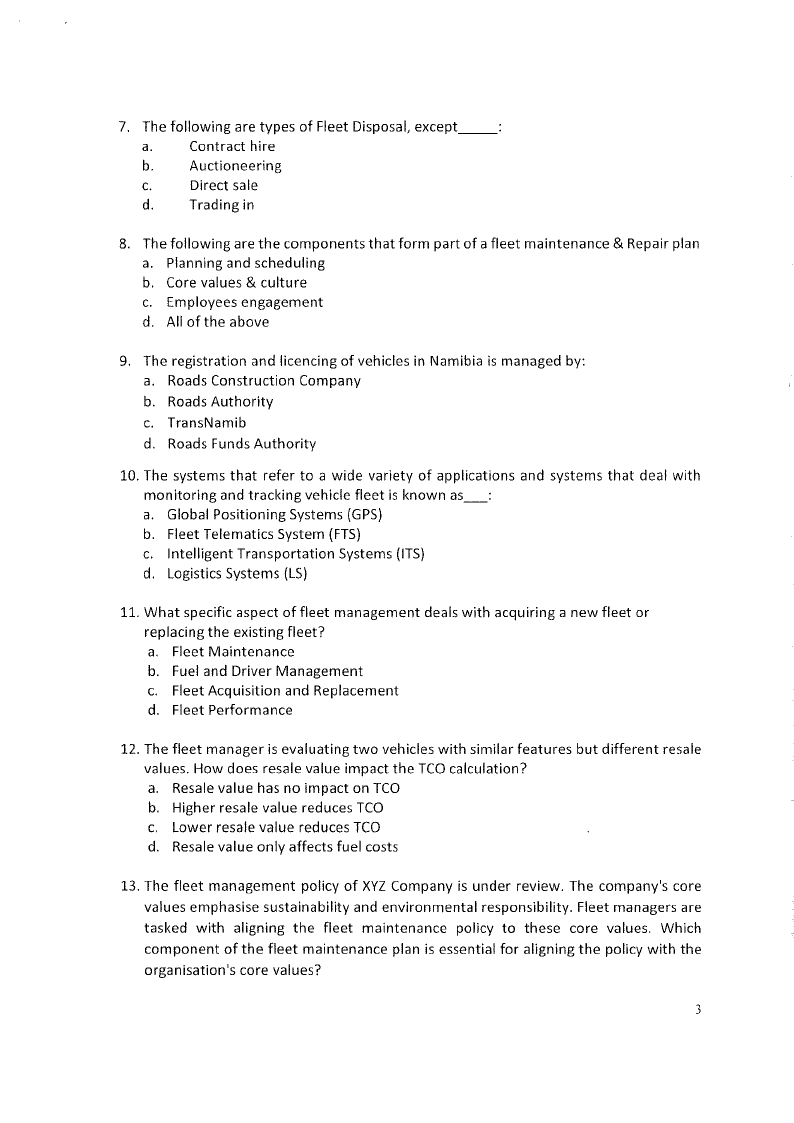
7. The following are types of Fleet Disposal, except __ :
a.
Contract hire
b.
Auctioneering
C.
Direct sale
d.
Trading in
8. The following are the components that form part of a fleet maintenance & Repair plan
a. Planning and scheduling
b. Core values & culture
c. Employees engagement
d. All of the above
9. The registration and licencing of vehicles in Namibia is managed by:
a. Roads Construction Company
b. Roads Authority
c. TransNamib
d. Roads Funds Authority
10. The systems that refer to a wide variety of applications and systems that deal with
monitoring and tracking vehicle fleet is known as_:
a. Global Positioning Systems (GPS)
b. Fleet Telematics System (FTS)
c. Intelligent Transportation Systems (ITS)
d. Logistics Systems (LS)
11. What specific aspect of fleet management deals with acquiring a new fleet or
replacing the existing fleet?
a. Fleet Maintenance
b. Fuel and Driver Management
c. Fleet Acquisition and Replacement
d. Fleet Performance
12. The fleet manager is evaluating two vehicles with similar features but different resale
values. How does resale value impact the TCO calculation?
a. Resale value has no impact on TCO
b. Higher resale value reduces TCO
c. Lower resale value reduces TCO
d. Resale value only affects fuel costs
13. The fleet management policy of XYZ Company is under review. The company's core
values emphasise sustainability and environmental responsibility. Fleet managers are
tasked with aligning the fleet maintenance policy to these core values. Which
component of the fleet maintenance plan is essential for aligning the policy with the
organisation's core values?
3

4 Page 4

▲back to top


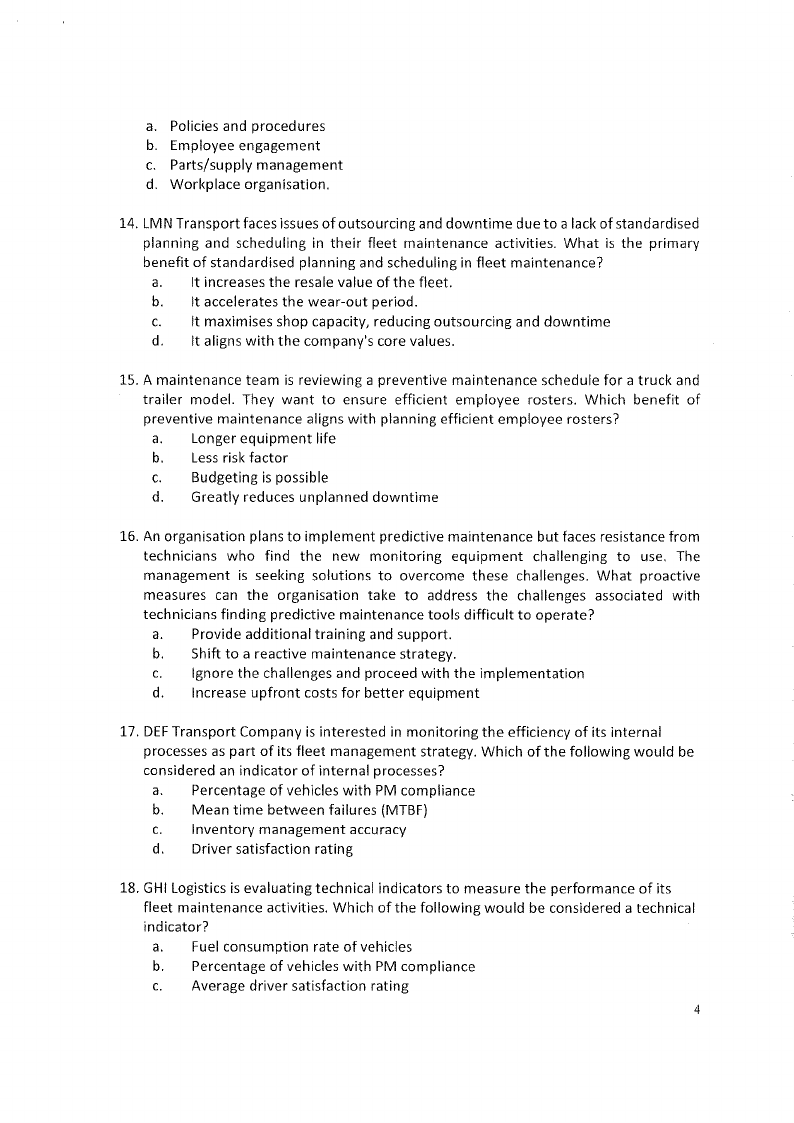
a. Policies and procedures
b. Employee engagement
c. Parts/supply management
d. Workplace organisation.
14. LMN Transport faces issues of outsourcing and downtime due to a lack of standardised
planning and scheduling in their fleet maintenance activities. What is the primary
benefit of standardised planning and scheduling in fleet maintenance?
a. It increases the resale value of the fleet.
b. It accelerates the wear-out period.
c. It maximises shop capacity, reducing outsourcing and downtime
d. It aligns with the company's core values.
15. A maintenance team is reviewing a preventive maintenance schedule for a truck and
trailer model. They want to ensure efficient employee rosters. Which benefit of
preventive maintenance aligns with planning efficient employee rosters?
a. Longer equipment life
b. Less risk factor
c. Budgeting is possible
d. Greatly reduces unplanned downtime
16. An organisation plans to implement predictive maintenance but faces resistance from
technicians who find the new monitoring equipment challenging to use, The
management is seeking solutions to overcome these challenges. What proactive
measures can the organisation take to address the challenges associated with
technicians finding predictive maintenance tools difficult to operate?
a. Provide additional training and support.
b. Shift to a reactive maintenance strategy.
c. Ignore the challenges and proceed with the implementation
d. Increase upfront costs for better equipment
17. DEFTransport Company is interested in monitoring the efficiency of its internal
processes as part of its fleet management strategy. Which of the following would be
considered an indicator of internal processes?
a. Percentage of vehicles with PM compliance
b. Mean time between failures (MTBF)
c. Inventory management accuracy
d. Driver satisfaction rating
18. GHI Logistics is evaluating technical indicators to measure the performance of its
fleet maintenance activities. Which of the following would be considered a technical
indicator?
a. Fuel consumption rate of vehicles
b. Percentage of vehicles with PM compliance
c. Average driver satisfaction rating
4

5 Page 5

▲back to top


d. Total maintenance costs compared to manufacturing costs
19. ABC Transport Company has recently implemented a new fleet management policy
aimed at improving performance and efficiency. As part of this initiative, the
management team decides to track Preventive Maintenance (PM) Compliance. Which
of the following statements best describes PM Compliance?
a. PM Compliance measures the total number of breakdowns in the fleet over a
specified period.
b. PM Compliance assesses the number of vehicles that have undergone
preventive maintenance within a given timeframe.
c. PM Compliance evaluates the financial performance of the company based on
maintenance costs.
d. PM Compliance measures the utilisation rate of vehicles in the fleet.
20. XYZ Enterprises is reviewing its fleet management strategy and is considering
incorporating financial indicators into its performance metrics. Which of the following
is an example of a financial indicator relevant to fleet management?
a. Percentage of vehicles with PM compliance
b. Mean time to repair (MTTR)
c. Return on Investment (ROI)
d. Driver satisfaction rating
21. John, a logistics manager, is analysing the potential benefits of implementing Fleet
Telematics Systems (FTS)in his company's vehicle fleet. He is particularly interested in
how FTScould impact fuel consumption and environmental sustainability.
How might the adoption of Fleet Telematics Systems (FTS)contribute to reducing fuel
consumption and promoting environmental sustainability in John's fleet
management?
a. FTScould optimise route planning and vehicle maintenance schedules, leading
to reduced fuel consumption and lower emissions, thus promoting
environmental sustainability.
b. FTS could increase idling time and fuel wastage due to inaccurate data
collection, resulting in higher fuel consumption and environmental
degradation.
c. FTS might complicate fuel tracking and reporting processes, leading to
inefficiencies in fuel management and minimal impact on environmental
sustainability.
d. FTS could introduce complexities in vehicle operations and maintenance,
causing disruptions that outweigh any potential fuel savings and
environmental benefits.
22. Mark, a safety supervisor, is exploring the potential safety benefits of implementing
Fleet Telematics Systems (FTS)in his company's vehicle fleet. He wants to understand
how FTS could improve overall driver safety and reduce the risk of accidents. How
might Fleet Telematics Systems (FTS) contribute to enhancing driver safety and
5

6 Page 6

▲back to top


mitigating accident risks in Mark's fleet management?
a. FTS could provide real-time monitoring of driver behavior and performance,
enabling proactive intervention to address unsafe practices and reduce the
likelihood of accidents.
b. FTS might create distractions for drivers with excessive data alerts and
notifications, leading to increased risk of accidents and compromised safety.
c. FTScould introduce complexities in vehicle maintenance procedures, causing
delays in addressing safety-critical issues and increasing the risk of accidents.
d. FTS may improve administrative tasks but have minimal impact on actual
driver behaviour and safety outcomes.
23. A fleet manager is considering implementing telematics for a mixed fleet of vehicles,
including fossil fuel-based, hybrid, and electric vehicles. Which level of telematics
would be most suitable for optimising fuel efficiency across all vehicle types?
a. Level 1: GPSTracking
b. Level 2: On-board Diagnostics (OBD)
c. Level 3: Enhanced Signals
d. Level 4: Enhanced Signals+ EV Support
24. A fleet manager prioritises real-time monitoring and analysis of vehicle data to ensure
timely maintenance and cost savings. Which level of telematics would best support
this objective?
a. Level 1: GPSTracking
b. Level 2: On-board Diagnostics (OBD)
c. Level 3: Enhanced Signals
d. Level 4: Enhanced Signals+ EV Support
25. A fleet manager seeks to improve driver training and increase fuel efficiency by
providing real-time feedback. Which telematics feature would be most beneficial for
achieving this goal?
a. Geographic Information Systems for Transportation (GIST)
b. Controller Area Network (CAN)
c. Usability Features
d. Level 1: GPSTracking
26. Emily, a fleet manager, notices an increase in tailgating incidents among drivers in the
company's fleet. She wants to address this issue to enhance road safety. What critical
thinking questions should Emily ask herself to develop effective solutions?
a. How can we implement stricter penalties for tailgating offenders?
b. Should we organise defensive driving courses for all drivers?
c. What factors might contribute to drivers engaging in tailgating behaviour?
d. Is it necessary to install GPStracking systems in all company vehicles?
6

7 Page 7

▲back to top


27. Daniel, a safety officer, observes that many drivers in the fleet exceed speed limits
regularly, increasing the risk of accidents. He wants to implement measures to
promote safe driving speeds. What critical thinking approach should Daniel adopt to
analyse the effectiveness of potential solutions?
a. Systems thinking
b. Deductive reasoning
c. Inductive reasoning
d. Comparative analysis
28. Rachel, a fleet manager, is tasked with redesigning the traffic routes within the
company premises to enhance safety. She must consider various factors such as
vehicle manoeuvrability and pedestrian pathways. What critical thinking approach
should Rachel adopt to develop optimal traffic routes?
a. Deductive reasoning
b. Inductive reasoning
c. Systems thinking
d. Analytical thinking
29. Michael, a safety consultant, is analysing accident data from a construction site. He
notices a pattern of incidents occurring near areas with poor visibility. Michael
believes that improving lighting conditions can reduce the frequency of accidents.
What critical thinking skill should Michael utilise to support his hypothesis?
a. Analysis
b. Prediction
c. Hypothesis testing
d. Problem-solving
30. Anna, a fleet manager, wants to implement effective speed control measures within
the workplace to enhance safety. She considers various options, such as speed bumps,
rumble strips, and speed limit signage. What critical thinking skill should Anna apply
to evaluate the potential effectiveness of each measure?
a. Analysis
b. Synthesis
C. Evaluation
d. Decision-making
31. James, a fleet manager, notices that despite installing barriers and designated
reversing areas, there are still accidents involving reversing vehicles. He wants to
implement additional measures to enhance safety. What critical thinking question
should James ask himself?
a. How can we improve driver training on reversing techniques?
b. Should we consider outsourcing our fleet management services?
c. What are the potential benefits of implementing parking sensors?
d. Is it necessary to revise the company's budget allocation for safety measures?
7

8 Page 8

▲back to top


32. XYZ Logistics Inc. is planning to expand its fleet operations to international markets.
However, the management is concerned about potential risks associated with
currency fluctuations and payment defaults by overseas clients.What type of risk is
XYZ Logistics Inc. primarily facing in its expansion to international markets?
a. Operational risk
b. Credit risk
c. Market risk
d. Technology risk
33. Which risk management approach would be most suitable for XYZ Logistics Inc. to
address the risks associated with international expansion?
a. Implementing a stringent credit assessment process for overseas clients
b. Diversifying its service offerings to minimise dependence on international
markets
c. Investing in advanced tracking technologies for real-time monitoring of
international shipments
d. Establishing strategic partnerships with local logistics companies in target
markets
34. LMN Manufacturing Company relies heavily on a single supplier for raw materials
required in its production process. The company is concerned about the potential
disruption in the supply chain due to issues with the supplier. What type of risk is LMN
Manufacturing Company primarily facing due to its reliance on a single supplier?
a. Operational risk
b. Market risk
c. Strategic risk
d. Hazard risk
35. Which risk management approach would be most effective for LMN Manufacturing
Company to mitigate the supply chain disruption risk?
a. Identifying alternative suppliers and establishing backup supply agreements
b. Increasing inventory levels to buffer against potential shortages
c. Implementing just-in-time inventory management to reduce reliance on
suppliers
d. Offering financial incentives to the existing supplier to ensure continuous
supply
36. PQR Hospitality Group operates a chain of hotels and resorts in tourist destinations.
The company is concerned about reputational risks arising from negative online
reviews and social media backlash. What type of risk is PQR Hospitality Group
primarily facing due to negative online reviews?
a. Operational risk
b. Strategic risk
c. Market risk
d. Reputational risk
8

9 Page 9

▲back to top


37. Which risk management strategy would be most effective for PQR Hospitality Group
to address reputational risks?
a. Implementing proactive social media monitoring and response protocols
b. Offering discounts and promotions to attract more customers
c. Increasing advertising spending to counter negative reviews
d. Ignoring negative reviews and focusing on positive customer feedback
38. A logistics company operates internationally and requires a telematics solution that
offers comprehensive coverage across multiple regions. Which criterion should the
fleet manager prioritise during the selection process?
a. Usability Features
b. Integration Features
c. Service Region
d. Know your business needs, goals, and vision
39. Which risk management approach would be most appropriate for LMN
Pharmaceuticals to mitigate regulatory approval risks?
a. Engaging with regulatory authorities early in the drug development process
b. Offering financial incentives to regulatory officials to expedite the approval
process
c. Launching the drug in international markets where regulations are less
stringent
d. Delaying the drug development process until regulatory requirements are
clearer
40. A fleet manager is tasked with selecting a telematics solution for a public passenger
transport company. The main objective is to maximise routing efficiency and fuel
savings. Which feature category of telematics solution should the fleet manager
prioritise?
a. Integration Features
b. Usability Features
c. Service Region
d. Geographic Information Systems for Transportation (GIST)
QUESTION 2: Fill in the missing words
[2*5 = 10 Marks]
2.1. ______
refer to financial risks that arise because of possible losses due to changes
in future market prices or rates.
2.2. ______
involves maintaining machines by tending to them at specified time
intervals.
2.3. ______
refers to the systems gather data about the transport system, process it,
and then use the processed data to improve the management of the transport system and/or
to provide the transport user with more and better information on which to base their
transport decisions.
2.4. ______
is the function that oversees, coordinates, and facilitates various transport
9

10 Page 10

▲back to top


and transport-related activities in an organisation.
2.5. -----~rovides
customised commercial vehicle insurance policies designed
specifically for smaller courier companies with delivery drivers using one or two vans.
SECTION B: STRUCTURED QUESTIONS
Question 1
Sub-total: SOMarks
[25 Marks]
You are the newly appointed Fleet Manager for a multinational logistics company tasked with
overseeing the operations of a diverse fleet comprising trucks, vans, and specialised vehicles.
The company operates across various geographical regions, serving clients with a wide range
of logistical needs. However, recent incidents involving accidents, vehicle breakdowns, and
regulatory compliance issues have highlighted the pressing need for a robust risk
management framework within the fleet management department,
The fleet consists of a combination of owned and leased vehicles, each serving a specific
purpose in the logistics chain. These vehicles are utilised for transporting goods of varying
sizes, from perishable goods requiring temperature-controlled environments to oversized
cargo requiring specialised handling.
Your role involves not only optimising fleet efficiency and minimising operational costs but
also ensuring compliance with safety regulations, environmental standards, and industry best
practices. As the new Fleet Manager, you are expected to conduct a comprehensive risk
assessment of the fleet operations and develop strategies to mitigate identified risks while
enhancing overall performance.
1.1. You have been tasked with developing a comprehensive risk management framework
for the company's fleet operations. Outline at least two key stages of the risk
management cycle and discuss the importance of each stage in effectively managing
fleet-related risks
[10 Marks]
1.2. Please discuss atleat three importance of fleet insurance in mitigating the financial
risks associated with operating a fleet of vehicles. Provide examples of scenarios where
fleet insurance can provide protection to the company.
[15 marks]
Question 2
[25 Marks]
XYZenterprises a passenger transportation company in Windhoek has a fleet of 30 buses
that needs disposal. The CEOan accountant by profession has little knowledge on fleet
disposal strategies. You were recently hired as a fleet manager to provide expert guidance
on all fleet related issue. You have discovered that XYZenterprises does not have a fleet
disposal policy. Develop a report (addressed to the CEO) highlighting the importance of a
fleet disposal policy, In your report compare and contrast at least three (3) vehicle disposal
strategies of your choice and propose which in your opinion would be suitable for XYZ
enterprises and why?
Sub-total: 50 Marks
Paper total: 100 Marks
END OF EXAMINATION PAPER
10