


 |
PFN712S-PUBLIC FINANCE-2ND OPP-JULY 2025 |
|
|
1 Page 1 |
▲back to top |
nAmlBIA
unlVERSITY
OF SCIEnCE Ano TECHnOLOGY
FACULTY OF MANAGEMENT SCIENCES
DEPARTMENT OF ECONOMICS, ACCOUNTING AND FINANCE
QUALIFICATION: BACHELOR OF ECONOMICS
QUALIFICATION CODE: 07BECO
LEVEL: 7
COURSE CODE: PFN712S
SESSION: JULY 2025
COURSE NAME: PUBLIC FINANCE
PAPER: THEORY
DURATION: 3 HOURS
MARKS: 100
EXAMINER(S)
SECOND OPPORTUNITY EXAMINATION QUESTION PAPER
MR. MALLY LIKUKELA
MODERATOR: MS NAEMI SHIDHUDHU
INSTRUCTIONS
1. This paper consists of 5 sections A, B, C and D
2. Answer ALL questions.
3. Number your answers in accordance with the question paper.
4. Start each section answer on a new page.
5. Write clearly and legibly
:>ERMISSIBLE MATERIALS
1. Pen, pencil, eraser
2. Ruler
3. Calculator
THIS EXAMINATION QUESTION PAPER CONSISTS OF 5 PAGES (Including this front page)
|
|
2 Page 2 |
▲back to top |
SECTION A: MULTIPLE CHOICE
20MARKS
1. The equity principle of tax developed by:
[2]
a) Adam Smith
b) Dalton
c) J B Say
d) Milton Friedman
2. The incidence of tax refers to:
[2]
a) Growth of taxation
b) The way in which tax is collected
c) who pays the tax ultimately
d) None of the above
3. Positive Economics is based on:
[2]
a) Statements that contain opinions and value judgement. i.e. '.'what ought to be" or "what
should be
b) based on factual statements and such statements contain no value judgement
c) Statements that cannot be settled by science or by an appeal to and such statement
d) All of the above
4. Which tax cannot be shifted to others:
[2]
a) Income tax
b) Excise duty
c) Sales tax
d) Sin tax
5. Market failure can occur when:
[2]
a) monopoly power exists in the market.
b) markets are missing.
c) consumers can influence prices.
d) all of the above.
6. Public debt implies loans raised by a government:
[2]
a) within the country
b) outside the country
c) within and outside the country
d) from China and German
7. Smoking tobacco creates a ___
externality:
[2]
a) positive consumption
b) negative consumption
c) negative production
d) positive production
8. Progressive tax:
[2]
2
|
|
3 Page 3 |
▲back to top |
a) is when a taxpayer pays higher taxes if he earns more income and lower taxes if he
earns less
b) Is when low-income individuals pay a higher percentage of their income in taxes, than
richer individuals
c) a tax in which the tax rate decreases as the taxable amount increases
d) All of the above
9. Salaries and pensions paid by governments are called:
[2]
a) Development expenditure
b) Recurrent expenditure
c) None of these
d) All of the above
10. Pareto points in the Edgeworth Box are:
[2]
a) Found when indifference curves are tangent.
b) Found when MRSare equal.
c) Found when one person cannot be made better off without making another person
worse off.
d) all of the above.
SECTION B: TRUE OR FALSE
20MARKS
1. A budget where there is excess of expenditure over revenue is called a surplus budget.
[2]
2. Distortions in economic incentives and the resulting in inefficiencies and inequalities of
resources can be address through Tax Reforms.
[2]
3. Fiscal deficit in the national budget means the sum of budgetary deficit and net increase in
internal and external borrowings.
[2]
4. The distribution of the burden of paying a tax is called Incidence of a tax.
[2]
5. If we fail to test our theories and their assumptions or continue to believe them when they fail
the tests, they become ideology, not theory.
[2]
6. When an additional unit of output is produced, the extra cost to society is the marginal social
cost.
[2]
7. The Namibian employer is obliged to withhold income tax and pay the amount to NAMRA on a
monthly basis.
[2]
8. Economically and politically powerful rich taxpayers often prevent fiscal reforms that would
increase their tax burdens.
[2]
9. The effect of transferring wealth from the richer sections of society to poorer sections using
taxation is referred to as redistribution effects.
[2]
10. Air pollution generated by a paper mill factory is an example of a negative production
externality.
[2]
3
|
|
4 Page 4 |
▲back to top |
SECTIONC
QUESTION 1
Define the following terms.
a. Pareto Efficiency
b. Tax reform
C. Technical efficiency
d. Externality
e. Budget Deficit
QUESTION2
Budget cycle in Namibia has four phases, list and describe them in detail
SECTION D
QUESTION 1
i. Define tax incidence
ii. Explain the four important principles of tax incidence:
30MARKS
[10 Marks]
[20 Marks]
30MARKS
[10 Marks]
[2]
[8]
QUESTION2
[10 Marks]
The government prepares the budget in order to fulfil certain national objectives. Mention and
discuss 5 (five) objectives of a national budget.
QUESTION 3
[10 Marks]
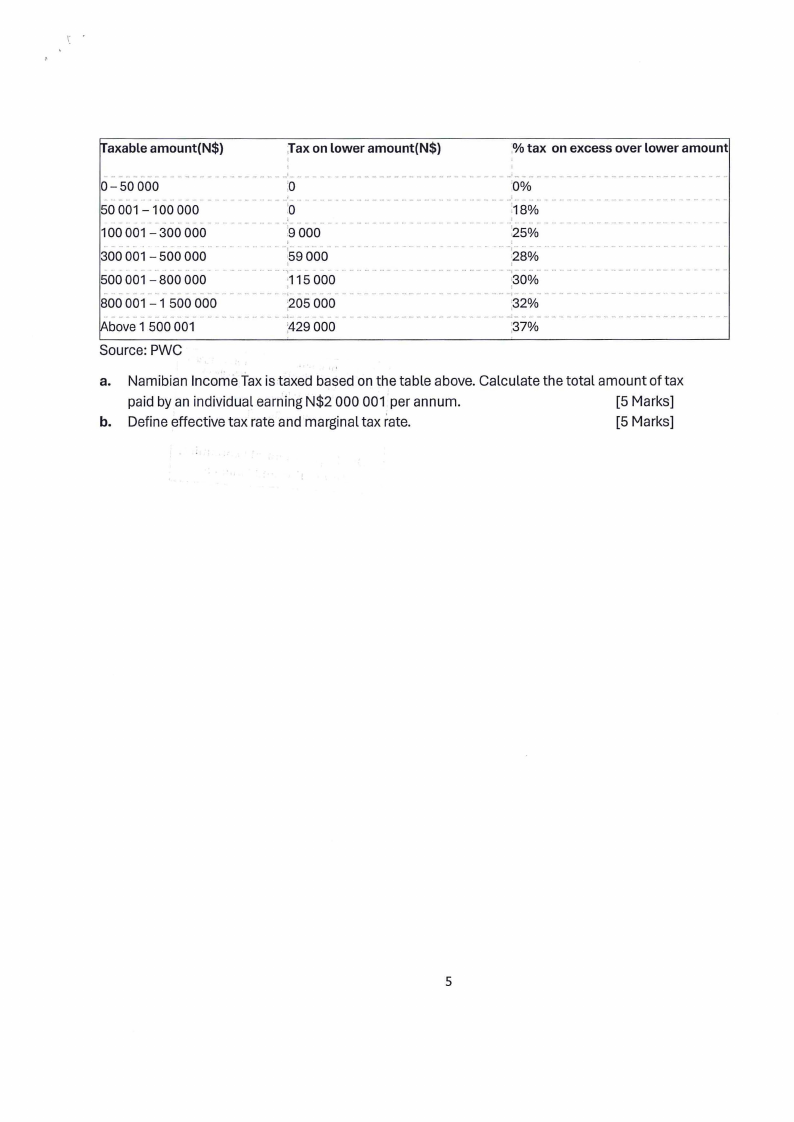
Based on the information provided in the table below answer the following Questions.
IncomeTaxin 2013
4
|
|
5 Page 5 |
▲back to top |
Taxable amount(N$)
··--------
0-50
000
________________
50 001-100000
100 001 - 300 000
300 001 - 500 000
500 001 - 800 000
800 001 -1 500 000
-----------------
Above 1 500 001
Source: PWC
;Taxon lower amount(N$)
i ______________________________
:o
'o
''.9000
..... ''59 000
'
:115 000
':20- 5
- -· ~.
000
--·------
-
'.429 000
-- -- --
;%tax on excess over lower amount
, _________________________
_
'0%
:18%
:25%
:28%
••• O> >•O -• H• •H -
:30%
>H •••
•• ••• ••
••
-•
••• •- H• ••• •••
:32%
:37%
a. Namibian Income Tax is taxed based on the table above. Calculate the total amount of tax
paid by an individual earning N$2 000 001 per annum.
[5 Marks]
b. Define effective tax rate and marginal tax rate.
[5 Marks]
5