PLU411S - PRINCIPLES OF LANGUAGE USE - 1ST OPP - NOVEMBER 2025


PLU411S - PRINCIPLES OF LANGUAGE USE - 1ST OPP - NOVEMBER 2025


1 Page 1

▲back to top


nAmlBIA unlVERSITY
OF SCI En CE Ano TECH n OLOGY
FACULTY OF COMMERCE, HUMAN SCIENCE AND EDUCATION
DEPARTMENT OF COMMUNICATION AND LANGUAGES
QUALIFICATION: VARIOUS
QUALIFICATION CODE: VARIOUS
COURSE CODE: PLU411S
LEVEL: 4
COURSE NAME: PRINCIPLES OF LANGUAGE USE
SESSION: OCTOBER/NOVEMBER 2025 PAPER:
DURATION: 3 HOURS
MARKS:
THEORY
100
FIRST OPPORTUNITY EXAMINATION QUESTION PAPER
EXAMINER(S)
Dr E. lthindi
Dr R. Nekongo
Dr R. Muyunda
Ms N. Ash imbuli
Ms V. Verbeeck
MODERATOR: Mr C. Gwasira
INSTRUCTIONS
1. Answer ALL the questions.
2. Write clearly and neatly.
3. Number the answers clearly.
4. Check instructions for each question carefully.
THIS QUESTION PAPER CONSISTS OF _10_ PAGES (Including this front page)
1

2 Page 2

▲back to top


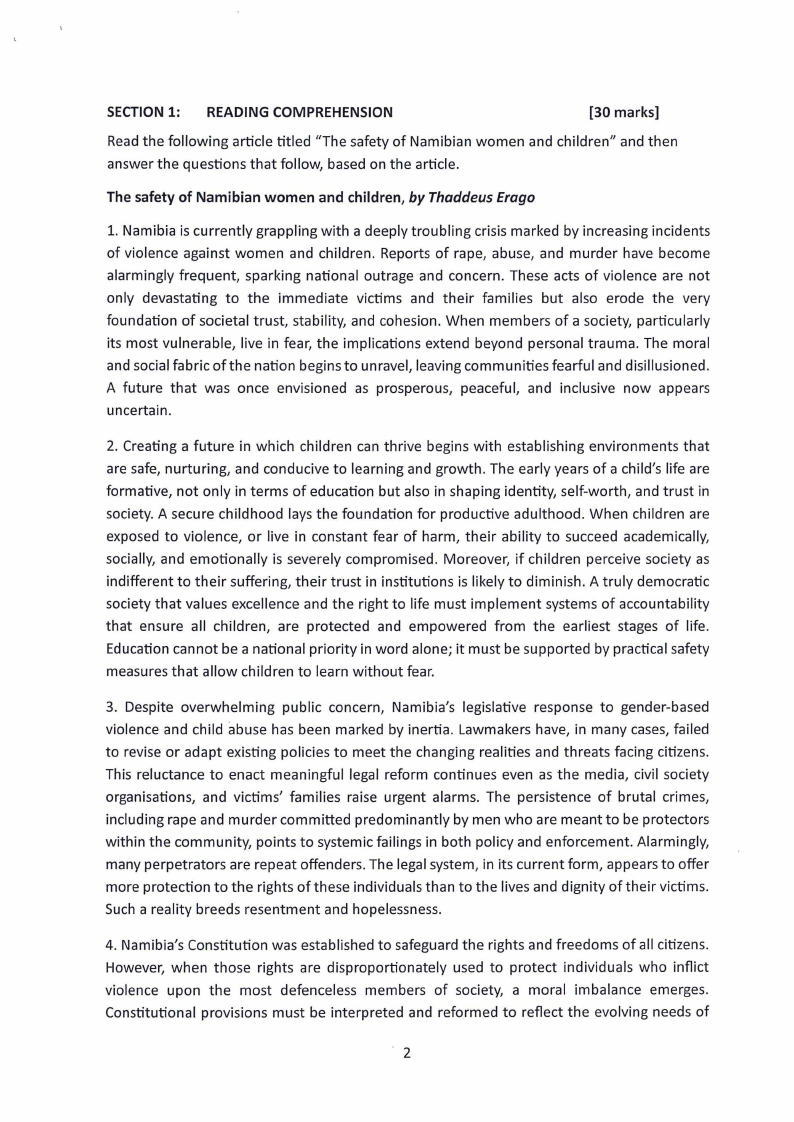
SECTION 1: READING COMPREHENSION
(30 marks]
Read the following article titled "The safety of Namibian women and children" and then
answer the questions that follow, based on the article.
The safety of Namibian women and children, by Thaddeus Erago
1. Namibia is currently grappling with a deeply troubling crisis marked by increasing incidents
of violence against women and children . Reports of rape, abuse, and murder have become
alarmingly frequent, sparking national outrage and concern. These acts of violence are not
only devastating to the immediate victims and their families but also erode the very
foundation of societal trust, stability, and cohesion . When members of a society, particularly
its most vulnerable, live in fear, the implications extend beyond personal trauma . The moral
and social fabric of the nation begins to unravel, leaving communities fearful and disillusioned.
A future that was once envisioned as prosperous, peaceful, and inclusive now appears
uncertain.
2. Creating a future in which ch ildren can thrive begins with establishing environments that
are safe, nurturing, and conducive to learning and growth. The early years of a child's life are
formative, not only in terms of education but also in shaping identity, self-worth, and trust in
society. A secure childhood lays the foundation for productive adulthood. When children are
exposed to violence, or live in constant fear of harm, their ability to succeed academically,
socially, and emotionally is severely compromised . Moreover, if children perceive society as
indifferent to their suffering, their trust in institutions is likely to diminish. A truly democratic
society that values excellence and the right to life must implement systems of accountability
that ensure all children, are protected and empowered from the earliest stages of life.
Education cannot be a national priority in word alone; it must be supported by practical safety
measures that allow children to learn without fear.
3. Despite overwhelming public concern, Namibia's legislative response to gender-based
violence and child abuse has been marked by inertia. Lawmakers have, in many cases, failed
to revise or adapt existing policies to meet the changing realities and threats facing citizens.
This reluctance to enact meaningful legal reform continues even as the media, civil society
organisations, and victims' families raise urgent alarms. The persistence of brutal crimes,
including rape and murder committed predominantly by men who are meant to be protectors
within the community, points to systemic failings in both policy and enforcement. Alarmingly,
many perpetrators are repeat offenders. The legal system, in its current form, appears to offer
more protection to the rights of these individuals than to the lives and dignity of their victims.
Such a reality breeds resentment and hopelessness.
4. Namibia's Constitution was established to safeguard the rights and freedoms of all citizens.
However, when those rights are disproportionately used to protect individuals who inflict
violence upon the most defenceless members of society, a moral imbalance emerges.
Constitutional provisions must be interpreted and reformed to reflect the evolving needs of
•2

3 Page 3

▲back to top


society. Protecting the sanctity of life should not mean extending equal protections to those
who demonstrate a blatant disregard for i!-If current constitutional protections are hindering
the state's ability to address violent crime effectively, then a national dialogue around reform
is not only justified; it is essential. Prioritising the rights of law-abiding citizens is not a
deviation from democratic values but a fulfillment of them. The long-standing stereotype of
Namibian men as protectors and providers is under serious threat, not because of a few
isolated incidents, but because of a pattern of unaddressed violence that casts doubt on this
once-honoured image.
5. Democracy functions best when it responds to the collective voice of its citizens. Public
sentiment in Namibia has increasingly leaned toward stronger punitive measures for
individuals who commit violent crimes against women and children . The argument for harsher
penalties, includ ing life imprisonment without parole or even capita l punishment, stems from
a desire to restore societal order and deter would-be offenders. While the issue of extreme
sentencing is contentious and must be weighed against international human rights standards,
the current state of impunity is equally unacceptable. Namibian children, by virtue of their
age and dependence, are inherently vulnerable. If laws do not exist, or are not adequately
enforced, to shield them from harm before it occurs, then the country is effectively gambling
with its own future.
6. In situations of national emergency, governments have a responsibility to act swiftly and
decisively. The surge in violent crimes targeting women and children constitutes such an
emergency. While legislative processes typically require time for consultation, review, and
approval, interim measures can and should be put in place to address the immediate threat.
These could include emergency protective laws, increased sentencing guidelines for repeat
offenders, and the establishment of specialised courts for crimes of gender-based violence.
There is also a need for proactive, community-based policing strategies that identify and
monitor high-risk individuals. The argument that imprisonment alone is sufficient is
increasingly untenable, especially when many offenders view prison time as a brief
interruption rather than a meaningful deterrent. In some cases, incarceration offers a level of
comfort and routine, paid for by the taxpayers. Such a situation demands urgent re-evaluation.
7. Namibia's freedom and stability are under threat, not from external forces, but from within.
The failure to confront violent crime decisively represents a breakdown in the contract
between government and citizen . When the people cry out for justice, and those cries go
unanswered, the legitimacy of the state comes into question. Namibians have wept for the
collapse of communal safety. These emotions must translate into action. The Namibian
government is now at a crossroads: either it can rise to meet this challenge with the urgency
and moral clarity it requires, or it can continue down a path of passive governance and reactive
policymaking. Only through decisive legislative reform, strong enforcement, and genuine
commitment to the safety of all citizens can the nation begin to heal and move forward.
Adapted from the Namibian National Teachers' Union Newsletter, Volume 2, 2025
3

4 Page 4

▲back to top


1.1 According to the article, what foundational role does a secure childhood play?
(1)
1.2 Answer the following questions by choosing the most appropriate answer from the given
options.
1.2.1 According to the article, how does violence against women and children affect
society as a whole?
(1)
A
It only causes trauma to the immediate victims and their families
B
It strengthens legal systems and encourages societal reform.
C
It mainly impacts economic growth and employment rates.
D
It undermines societal trust, stability, and cohesion, leading to fear and
disillusionment.
1.2.2 What does the author suggest is needed to truly protect children in Namibia? (1)
A
Making education a national priority
B
Practical safety measures and stronger laws
C
Hindering the state's ability to address violent crimes effectively
D
The legal system to breed resentment and hopelessness
1.2.3 What does the author suggest is necessary for Namibia to restore safety and
stability? Choose three options.
(3)
A
Proceeding with passive governance
B
Authentic commitment to the safety of the public
C
Decisive legislative reform
D
Advancing reactive policymaking
E
Strong enforcement
1.4 State whether the following statements taken from the article are True or False.
1.4.1 The Namibian government has responded swiftly and effectively to the rising cases of
gender-based violence and child abuse.
(1)
1.4.2 According to the article, Nam ibia's constitutional rights are currently being interpreted
in a way that adequately protects the most vulnerable citizens.
(1)
1.4.3 Violence against women and children in Namibia reduces the moral and social fabric of
the nation.
(1)
1.5 What does the highlighted pronoun "it" in Paragraph 4 refer to in the text?
(2)
4

5 Page 5

▲back to top


1.6 What outlook is envisaged in a society without incidents of violence against women and
children, according to the article?
(3)
1.7 Give two reasons why the author is against the view of simply imprisoning gender-based
violence offenders.
{2x2=4)
1.8 What aspects of a child's life may be at risk when they are exposed to acts of violent
crimes or constant personal trauma?
(3)
1.9 What short-term measures could be put in place to address the immediate threat of
violent crimes targeting women and children? Provide three points.
(3)
1.10 What does the author mean by the following statement? Use your own words.
(2)
"Democracy functions best when it responds to the collective voice of is citizens". (Paragraph
5)
1.11 Identify the words in the text that have similar meanings to the following words:
1.11.1 regular (Paragraph 1)
(1)
1.11.2 offenders (Paragraph 3)
(1)
1.11.3 preconception (Paragraph 4)
(1)
1.11.4 unjustifiable (Paragraph 6)
(1)
SECTION 2: GRAMMAR AND LANGUAGE USAGE
[30 marks]
Read the text below and answer all the questions that follow.
A new school of thought: China's Al education policy adopts multitiered approach to
ensure wide skill set from young age
1. Artificial intelligence {Al) is no longer a distant concept from science fiction. It has become
a force that can reshape industries, societies, and the very essence of human interaction.
Education, the cornerstone of social progress, is increasingly becoming intertwined with Al.
The way countries equip the next generation with Al skills could determine their technological
edge in the future, and they must ensure that these skills are widely accessible. In this area,
China is taking the lead.
2. While Western countries, especially the United States, have grabbed headlines for Al
breakthroughs, their approach to K-12 (kindergarten through 12th grade) Al education is
5

6 Page 6

▲back to top


cautious, fragmented, and largely pilot-driven. China's approach, in contrast, is a methodical,
policy-driven blueprint that lays a solid foundation for Al literacy from primary school level
upward. Across the country, Al-themed summer camps and integrated curricula are
emerging, forming a burgeoning Al education ecosystem that, beyond coding, is nurturing
broader cognitive skills and ethical reasoning.
3. China's rapid progress in Al education is no accident; it is the result of careful top-level
planning and coordinated action. National and local authorities have cooperated to ensure
that Al education is not just a novelty, but a structured part of students' learning journey.
Schools across China now include Al courses as a regular part of the curriculum; teachers
receive special training in Al, and digital learning platforms support Al teaching in class. This
nationwide push has created a well-organised framework, ensuring every student is given a
chance to learn foundational Al.
4. However, policy alone is not enough. China has established a collaborative mechanism
involving enterprises, universities and research institutions. It integrates leading tech
companies in co-designing curricula, training teachers, and building Al learning platforms.
The education policy embeds Al across traditional subjects such as the Chinese language, art,
and comprehensive practice courses, creating a "discipline integration and technology
empowerment" model. In many schools, art classes now incorporate Al image-generation
tools, encouraging students to co-create with machines. In other areas, generative Al is
integrated into writing courses, prompting students to critique, revise, and reimagine Al-
generated text.
5. Chi~a's Al education path contrasts with that of the US. While the US excels in Al research,
its K-12 implementation is decentralised and uneven, largely dependent on local initiatives or
partnerships with higher education institutions.
Adapted from China Daily, September 2025
2.1 The following words were taken from Paragraphs 1 and 2. Identify the parts of speech they
are.
{6}
2.1.1 distant
2.1.2 reshape
2.1.3 cornerstone
2.1.4 largely
2.1.5 methodical
2.1.6 across
6

7 Page 7

▲back to top


2.2 Carefully analyse the underlined sentence in Paragraph 1 and identify two pronouns used
in it. Then, state the type of each pronoun.
(2x2=4}
2.3 Identify two single word compound nouns used in paragraph 2.
(2}
2.4 Construct your own sentence in which you use an adjective and a common noun .
Underline each of these parts of speech.
(2}
2.5 . Identify the verb tenses of the following sentences that are adapted from the
passage.
2.5.1 This nationwide push has created a well-organised framework.
(2)
2.5.2 The education policy embeds Al across traditional subjects such as the Chinese
language, art, and comprehensive practice courses, creating a "discipline integration
and technology empowerment" model.
(2}
2.5.3 Generative Al is prompting students to critique, revise, and reimagine Al-
generated text.
(2)
2.6 Construct a sentence of your own in which you use the present perfect continuous,
to demonstrate your understanding of this tense.
(2)
2.7 The sentence "Schools across China now include Al courses as a regular part of the
curriculum." was taken from Paragraph 3. Change it into the following forms.
2.7.1 Negative form
(1}
2.7.2 Question form
(1)
2.8 For any statement or sentence in English to be correct, the subject verb-agreement
(rule of concord} is key. In the following sentence, identify the subject and the verb and
then indicate whether they agree or disagree.
From top-level design to local execution, curriculum reform to competitions, and
technical training to ethical literacy, China's Al education path is both structural and
gradual.
Subject:
(1)
Verb:
(1}
Agree/Disagree:
(1)
7

8 Page 8

▲back to top


2.9 Identify the sentence structures of the following sentences, e.g. simple or compound
sentences, etc. Do not copy the sentences.
2.9.1 For China, Al literacy is about developing foundational competency, and
students are taught to view Al as a digital language and medium for critical thinking,
because it is seen as essential for the future workforce.
(1)
2.9.2 Al education in the US is flexible and innovative, but it is also inconsistent in
coverage, continuity, and scale.
(1)
2.9.3 While the US excels in Al research, its K-12 implementation is decentralised
and uneven.
(1)
SECTION 3: PARAGRAPH AND ESSAY ANALYSIS
[30 marks]
Based on the structure of an academic essay that you were taught in this course, analyse the
essay below and then answer the questions that follow.
The importance of listening skills in effective communication
1. In today's fast-paced world, communication plays a vital role in personal, academic, and
professional success. While many people focus on speaking as the key to effective
communication, listening is equally important yet often overlooked. Listening skills are
essential for effective communication because they improve understanding, enhance learning
and strengthen relationships, and they can be developed through conscious effort and
practice.
2. To begin with, listening improves understanding as it requires more than simply hearing
words. In the first place, listening is more than simply hearing words. It involves actively paying
attention, interpreting meaning, and responding appropriately. Also, effective listening
requires focus, empathy, and the ability to process both verbal and non-verbal cues. For
example, nodding, maintaining eye contact, and responding thoughtfully all demonstrate
active listening. Moreover, good listeners are able to separate facts from opinions. This makes
them understand the speaker's intention rather than just their words. Therefore, listening is a
complex skill that demands both mental concentration and emotional engagement.
3. Furthermore, listening plays a critical role by enhancing the learning process. When
individuals listen attentively, they grasp information more effectively and apply it accurately
in different contexts. Consequently, they gain a deeper understanding of the message being
conveyed, which reduces conflicts and misunderstandings. Also, in workplaces, for instance,
employees who listen carefully are more likely to complete tasks accurately and collaborate
successfully with colleagues. Some people believe that listening to loud music every day
8

9 Page 9

▲back to top


improves intelligence, but there is no scientific evidence to support this theory. Similarly,
students who listen actively during lectures retain information better and perform well
academically. Thus, listening is an essential tool for gaining knowledge and achieving success
in both academic and professional environments.
4. In addition, good listening skills are vital for building and maintaining healthy relationships.
Whether in families, friendships, or professional environments, people feel valued and
respected when they are genuinely heard. For example, a friend who listens attentively can
offer better support and understanding during difficult times. Likewise, leaders who practice
active listening foster trust and create a positive atmosphere where everyone feels included.
Hence, effective listening nurtures empathy, encourages open communication, and
strengthens social bonds.
5. Moreover, listening skills can be improved through conscious practice and self-awareness.
One effective strategy is practicing active listening. This strategy involves maintaining eye
contact, avoiding interruptions, and asking clarifying questions. Additionally, minimising
distractions such as mobile phones or background noise helps improve focus during
conversations, taking notes during lectures or meetings also enhances understanding and
memory retention. Over time, these techniques not only sharpen listening abilities but also
increase overall communication effectiveness.
6. In conclusion, listening is a fundamental component of effective communication that
deserves as much attention as speaking. By improving understanding, strengthening
relationships, and supporting learning, good listening skills contribute to success in various
areas of life. Therefore, individuals should make a conscious effort to develop and practice
these skills regularly. When society collectively values listening as much as talking,
communication becomes more meaningful, relationships become stronger, and collaboration
becomes more effective.
Source: https://chatgpt.com
3.1. Among the types of essays you were taught, in which category does this essay belong?
Give a reason for your answer.
(3)
3.2. Identify the thesis statement of this essay.
(2)
3.3. Fill in the following statement by choosing the correct answer from the options given
below. The strategy used to introduce the topic under discussion in this essay is...
(2)
A.
Using a famous quote
B.
Moving from general to specific
C.
Using an anecdote
D.
None of the above
9

10 Page 10

▲back to top


3.4. Analyse Paragraph 2 carefully and identify three components of a body paragraph shown .
List the components and write down an example of each component from the paragraph. (6)
3.5. Identify a comma splice error hidden in Paragraph 5.
(2)
3.6. Rewrite and correct the sentence error you wrote in Question 3.5.
(2)
3.7. Answer the following questions based on Paragraph 4.
3.7.1. Identify and write down the topic sentence of Paragraph 4.
(2)
3.7.2. Identify and write down the topic of the topic sentence you have mentioned in Question
3.7 .1.
(2)
3.7.3. Identify the controlling idea of the topic sentence you wrote in Question 3.7.1 and write
it down
(2)
3.8. Identify three transitional words or phrases that are used to link ideas between the body
paragraphs.
(3)
3.9. Identify two transitional words within Paragraph 2 that are used to show sequence or
addition of ideas.
(2)
3.10. Identify an irrelevant sentence in Paragraph 3.
(2)
SECTION 4: PARAGRAPH WRITING
[10 marks]
Choose any one of the prompts or topics hereunder and write a body paragraph of about 100
words to demonstrate your understanding of the structure of an academic paragraph. Pay
attention to structure, coherence, punctuation, and language usage.
1. What is your opinion on the inaccessibility of healthcare services in rural areas?
Discuss.
2. The role of kindness in creating a better society
3. Explain why or how failure is an essential part of personal growth .
4. The influence of music on emotional well-being
5. To what extent does teamwork contribute to success in academics? Discuss.
6. Discuss the importance of maintaining cultural traditions in a fast-changing world .
10