


 |
LEC721S - LEGAL AND ETHICAL ISSUES IN COMMUNICATION - 1ST OPP - NOVEMBER 2025 |
|
|
1 Page 1 |
▲back to top |
t!J
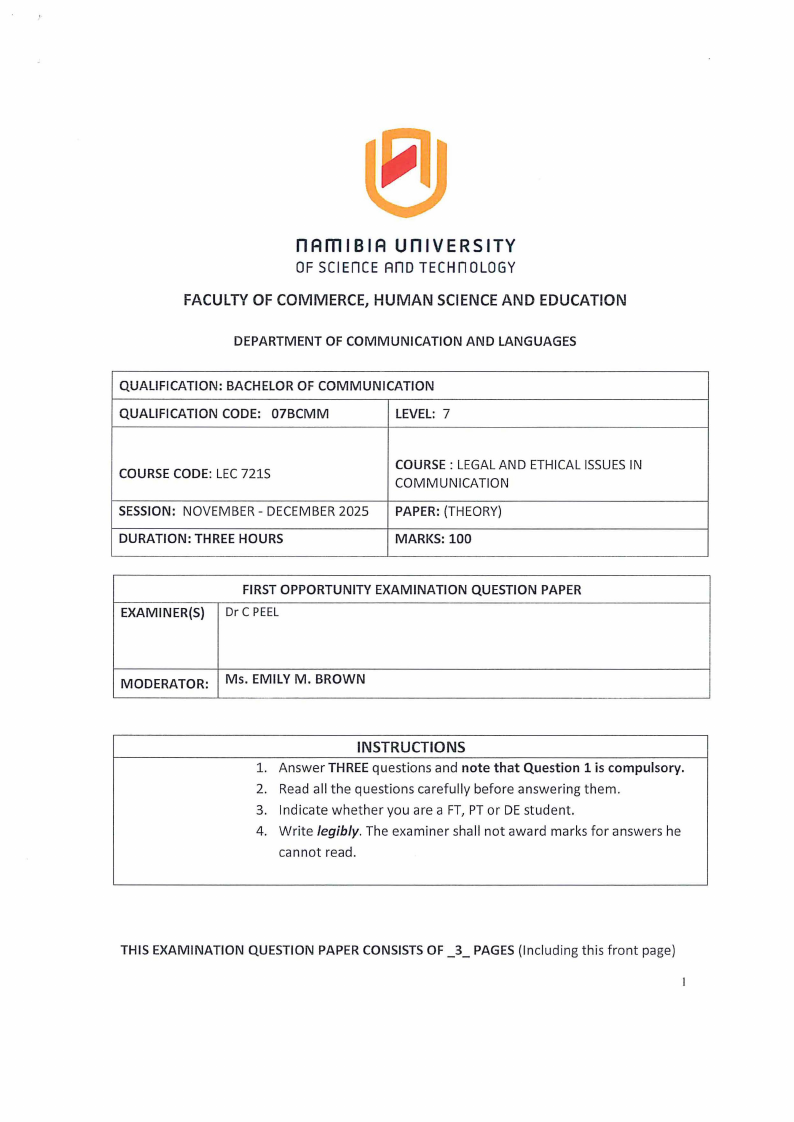
nAm I BIA un IVERSITY
OF SCIEnCE Ano TECHnOLOGY
FACULTY OF COMMERCE, HUMAN SCIENCE AND EDUCATION
DEPARTMENT OF COMMUNICATION AND LANGUAGES
QUALIFICATION: BACHELOR OF COMMUNICATION
QUALIFICATION CODE: 07BCMM
LEVEL: 7
COURSE CODE: LEC 721S
SESSION: NOVEMBER - DECEMBER 2025
DURATION: THREE HOURS
COURSE : LEGAL AND ETHICAL ISSUES IN
COMMUNICATION
PAPER: (THEORY)
MARKS: 100
EXAMINER(S)
FIRST OPPORTUNITY EXAMINATION QUESTION PAPER
Dr C PEEL
MODERATOR: Ms. EMILY M. BROWN
INSTRUCTIONS
1. Answer THREE questions and note that Question 1 is compulsory.
2. Read all the questions carefully before answering them .
3. Indicate whether you are a FT, PT or DE student.
4. Write legibly. The examiner shall not award marks for answers he
cannot read .
THIS EXAMINATION QUESTION PAPER CONSISTS OF _3_ PAGES (Including this front page)
|
|
2 Page 2 |
▲back to top |
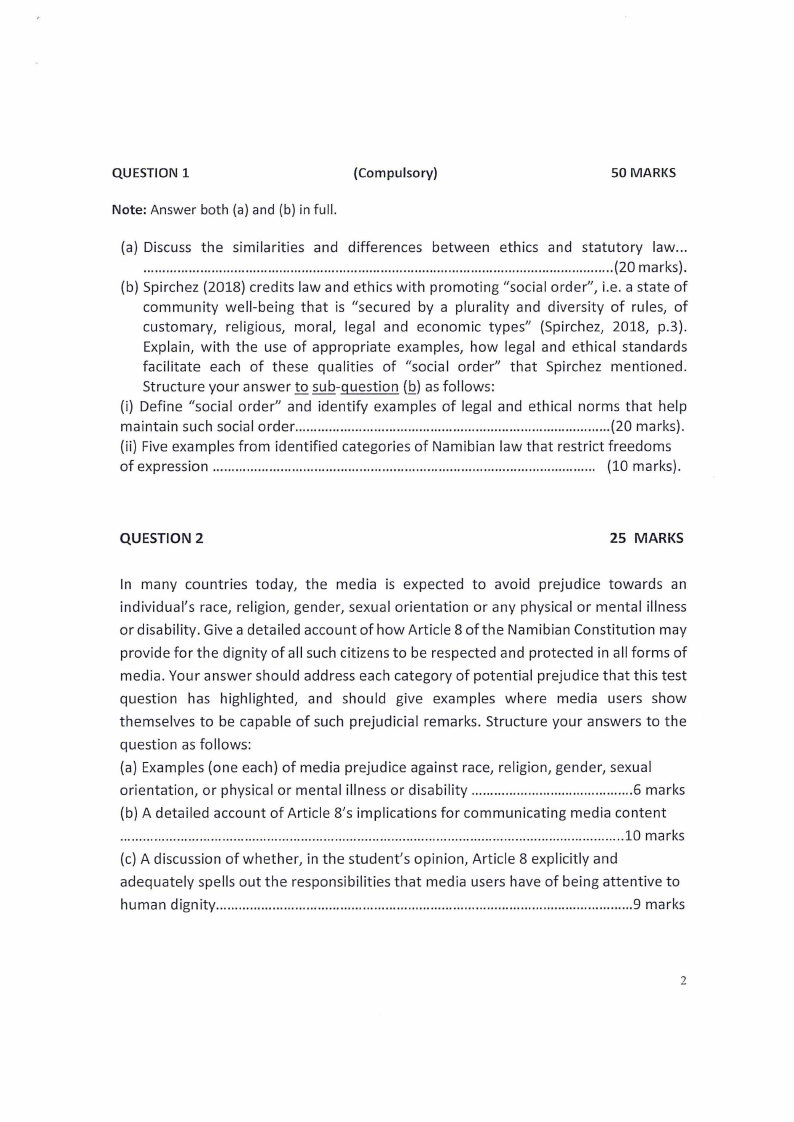
QUESTION 1
(Compulsory)
50 MARKS
Note: Answer both (a) and (b) in full.
(a) Discuss the similarities and differences between ethics and statutory law.. .
................... ..... ............................ .. ............... ... ....... ........ .................................. .... (20 marks).
(b) Spirchez (2018) credits law and ethics with promoting "social order", i.e . a state of
community well-being that is "secured by a plurality and diversity of rules, of
customary, religious, moral, legal and economic types" (Spirchez, 2018, p.3).
Explain, with the use of appropriate examples, how legal and ethical standards
facilitate each of these qualities of "social order" that Spirchez mentioned.
Structure your answer to sub-question (h) as follows:
(i) Define " social order" and identify examples of legal and ethical norms that help
maintain such social order... ... ........................ ............ ... ....... ........ ........................ (20 marks).
(ii) Five examples from identified catego ries of Namibian law that restrict freedoms
of expression ....... ............................................................................. ......... ... ...... (10 marks) .
QUESTION 2
25 MARKS
In many countries today, the media is expected to avoid prejudice towards an
individual's race, religion, gender, sexual orientation or any physical or mental illness
or disability. Give a detailed account of how Article 8 of the Namibian Constitution may
provide for the dignity of all such citizens to be respected and protected in all forms of
media . You r answer should address each category of potential prejudice that this test
question has highlighted, and should give examples where media users show
themselves to be capable of such prejudicial remarks. Structure your answers to the
question as follows:
(a) Examples (one each) of media prejudice against race, religion, gender, sexual
orientation, or physical or mental illness or disability ...... .. ................................... 6 marks
(b) A detailed account of Article S's implications for communicating media content
................... ........................ ............................. ........................ ............ ...... ......... ......... ..10 marks
(c) A discussion of whether, in the student's opinion, Article 8 explicitly and
adequately spells out the responsibilities that media users have of being attentive to
human dignity............................................. ........ ..... .............. .............................. ......... 9 ma r ks
2
|
|
3 Page 3 |
▲back to top |
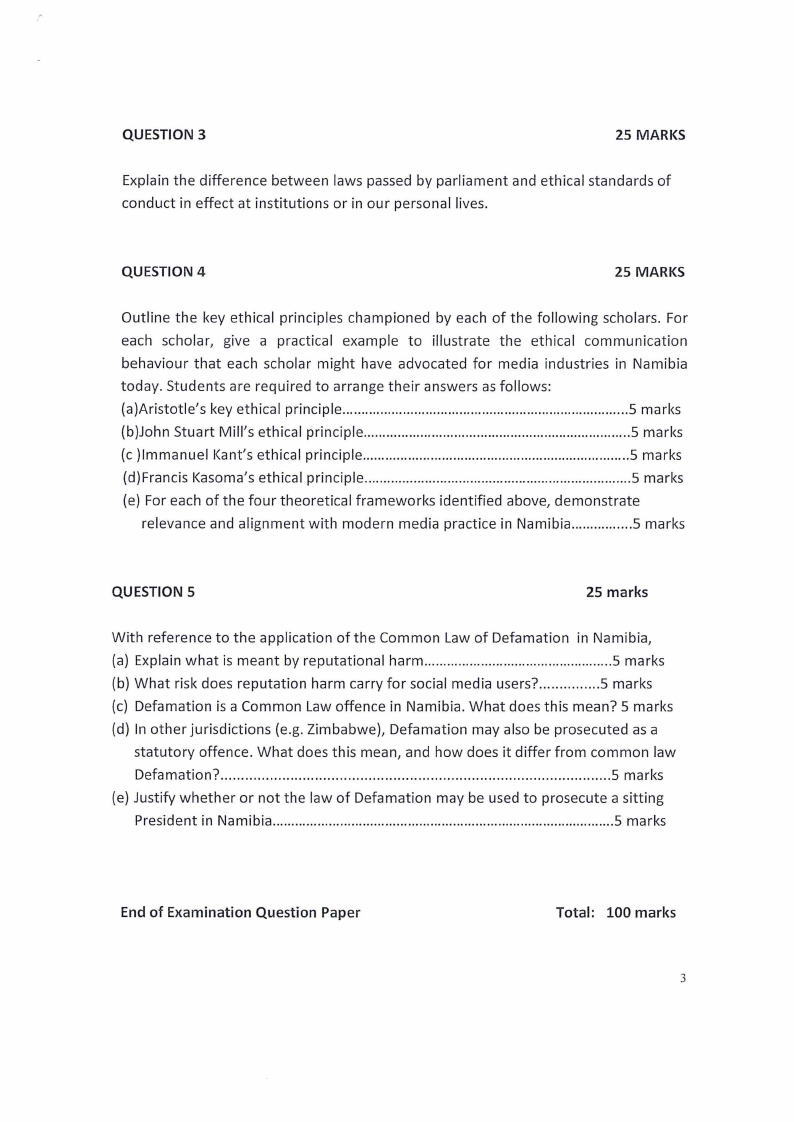
QUESTION 3
25 MARKS
Explain the difference between laws passed by parliament and ethical standards of
conduct in effect at institutions or in our personal lives.
QUESTION 4
25 MARKS
Outline the key ethical principles championed by each of the following scholars. For
each scholar, give a practical example to illustrate the ethical communication
behaviour that each scholar might have advocated for media industries in Namibia
today. Students are required to arrange their answers as follows:
(a)Aristotle's key ethical principle............................................................................5 marks
(b)John Stuart Mill's ethical principle......... ....... ....................... ................................5 marks
(c )Immanuel Kant's ethical principle..................... ..................................................5 marks
(d)Francis Kasoma's ethical principle ................ .......................................................5 marks
(e) For each of the four theoretical frameworks identified above, demonstrate
relevance and alignment with modern media practice in Namibia ................5 marks
QUESTION 5
25 marks
With reference to the application of the Common Law of Defamation in Namibia,
(a) Explain what is meant by reputational harm ....................................... ...........5 marks
(b) What risk does reputation harm carry for social media users? .............. .5 marks
(c) Defamation is a Common Law offence in Namibia. What does this mean? 5 marks
(d) In other jurisdictions (e.g. Zimbabwe), Defamation may also be prosecuted as a
statutory offence. What does this mean, and how does it differ from common law
Defamation? ..................... .... ...... ............. .................... ............... ... ...... ... ....5 marks
(e) Justify whether or not the law of Defamation may be used to prosecute a sitting
President in Namibia ... ...... .................. ............................... ..... .......... .. ......... .......5 marks
End of Examination Question Paper
Total: 100 marks
3