


 |
FEO810S-FINANCIAL ECONOMICS-2ND OPP-DEC 2025 |
|
|
1 Page 1 |
▲back to top |
nAmlBIA unlVERSITY
OF SCIEnCE Ano TECHnOLOGY
FACULTY OF COMMERCE, HUMAN SCIENCES AND EDUCATION
DEPARTMENT OF ECONOMICS, ACCOUNTING AND FINANCE
QUALIFICATION: BACHELOR OF ECONOMICS HONOURS
QUALIFICATION CODE: O8BECH
LEVEL: 8
COURSE CODE: FEO810S
COURSE NAME: FINANCIAL ECONOMICS
SESSION: DECEMBER 2025
DURATION: 3 HOURS
PAPER: THEORY
MARKS: 100
SECOND OPPORTUNITY EXAMINATION QUESTION PAPER
EXAMINER(S) Ms Kasnath Kavezeri
MODERATOR: Mr Immanuel Nashivela
INSTRUCTIONS
1. Answer ALL the questions.
2. Write clearly and neatly.
3. Number the answers clearly.
PERMISSIBLE MATERIALS
1. Pens/pencils/erasers
2. Calculator
3. Ruler
THIS QUESTION PAPER CONSISTS OF 8 PAGES {Including this front page)
|
|
2 Page 2 |
▲back to top |
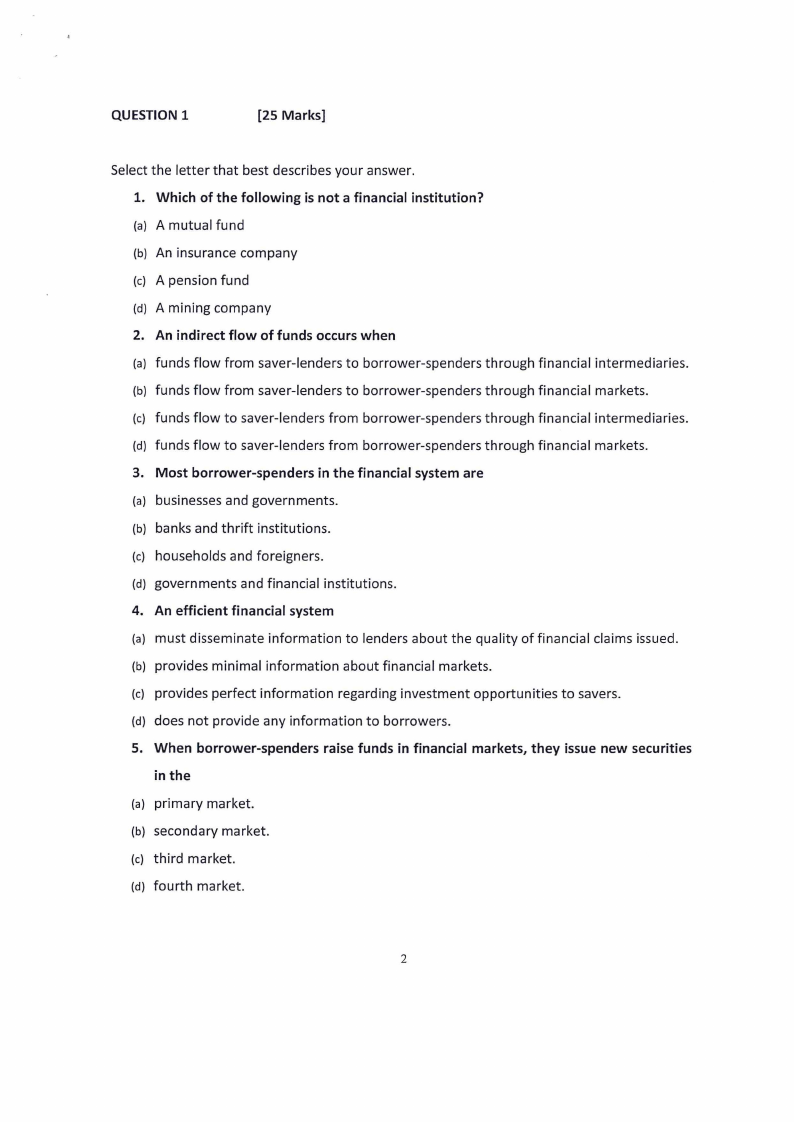
QUESTION 1
[25 Marks]
Select the letter that best describes your answer.
1. Which of the following is not a financial institution?
(a) A mutual fund
(bl An insurance company
(c) A pension fund
(d) A mining company
2. An indirect flow of funds occurs when
(a) funds flow from saver-lenders to borrower-spenders through financial intermediaries.
(b) funds flow from saver-lenders to borrower-spenders through financial markets.
(c) funds flow to saver-lenders from borrower-spenders through financial intermediaries.
(d) funds flow to saver-lenders from borrower-spenders through financial markets.
3. Most borrower-spenders in the financial system are
(a) businesses and governments.
(b) banks and thrift institutions.
(c) households and foreigners.
(d) governments and financial institutions.
4. An efficient financial system
(a) must disseminate information to lenders about the quality of financial claims issued.
(bl provides minimal information about financial markets.
(c) provides perfect information regarding investment opportunities to savers.
(d) does not provide any information to borrowers.
5. When borrower-spenders raise funds in financial markets, they issue new securities
in the
(a) primary market.
(b) secondary market.
(c) third market.
(d) fourth market.
2
|
|
3 Page 3 |
▲back to top |
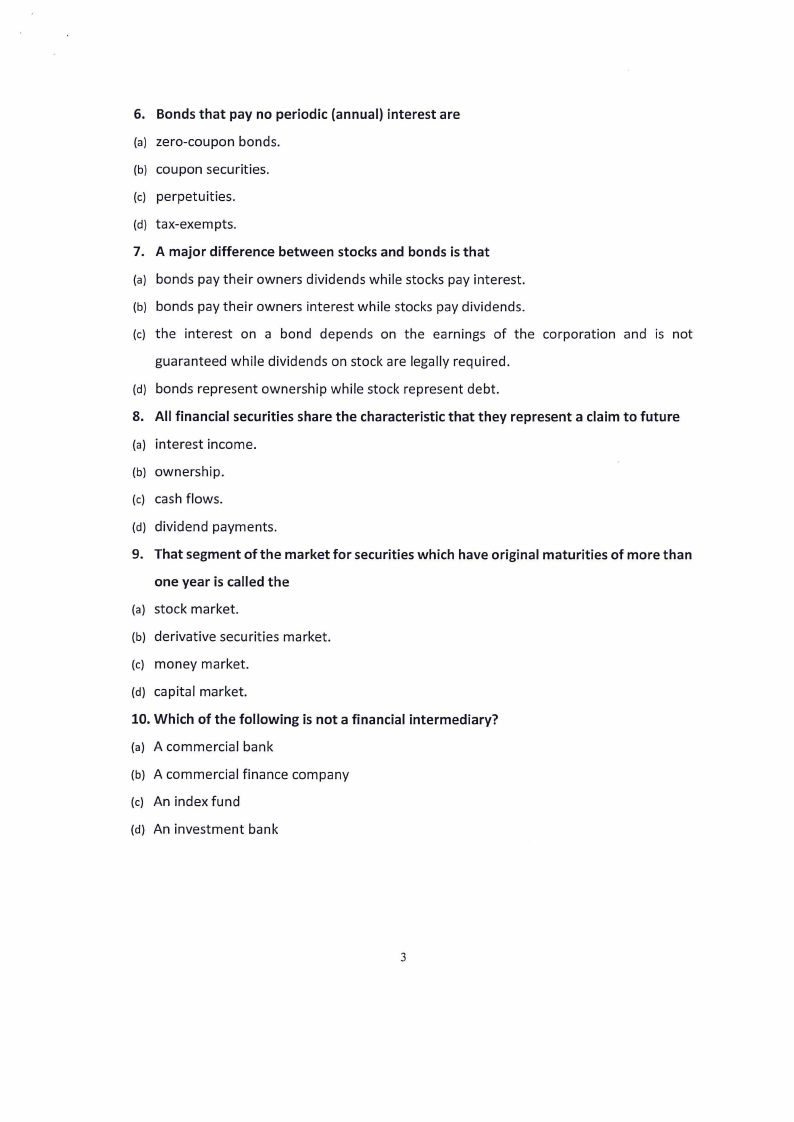
6. Bonds that pay no periodic (annual) interest are
(a) zero-coupon bonds.
(b) coupon securities.
(c) perpetuities.
(d) tax-exempts.
7. A major difference between stocks and bonds is that
(a) bonds pay their owners dividends while stocks pay interest.
(b) bonds pay their owners interest while stocks pay dividends.
(c) the interest on a bond depends on the earnings of the corporation and is not
guaranteed while dividends on stock are legally required.
(d) bonds represent ownership while stock represent debt.
8. All financial securities share the characteristic that they represent a claim to future
(a) interest income.
(bl ownership.
(c) cash flows.
(d) dividend payments.
9. That segment of the market for securities which have original maturities of more than
one year is called the
(a) stock market.
(b) derivative securities market.
(c) money market.
(d) capital market.
10. Which of the following is not a financial intermediary?
(a) A commercial bank
(bl A commercial finance company
(c) An index fund
(d) An investment bank
3
|
|
4 Page 4 |
▲back to top |
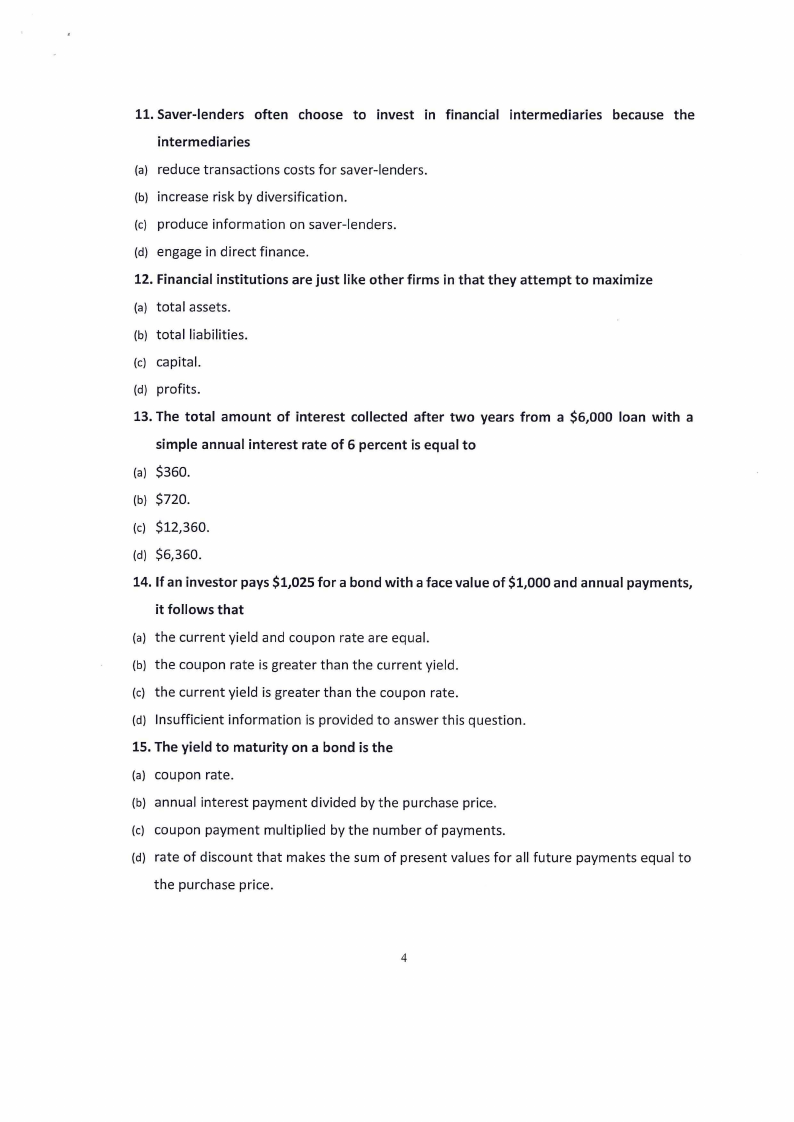
11. Saver-lenders often choose to invest in financial intermediaries because the
intermediaries
(a) reduce transactions costs for saver-lenders.
(b) increase risk by diversification.
(c) produce information on saver-lenders.
(d) engage in direct finance.
12. Financial institutions are just like other firms in that they attempt to maximize
(a) total assets.
(b) total liabilities.
(c) capital.
(d) profits.
13. The total amount of interest collected after two years from a $6,000 loan with a
simple annual interest rate of 6 percent is equal to
(a) $360.
(b) $720.
(c) $12,360.
(d) $6,360.
14. If an investor pays $1,025 for a bond with a face value of $1,000 and annual payments,
it follows that
(a) the current yield and coupon rate are equal.
(b) the coupon rate is greater than the current yield.
(c) the current yield is greater than the coupon rate.
(d) Insufficient information is provided to answer this question.
15. The yield to maturity on a bond is the
(a) coupon rate.
(b) annual interest payment divided by the purchase price.
(c) coupon payment multiplied by the number of payments.
(d) rate of discount that makes the sum of present values for all future payments equal to
the purchase price.
4
|
|
5 Page 5 |
▲back to top |
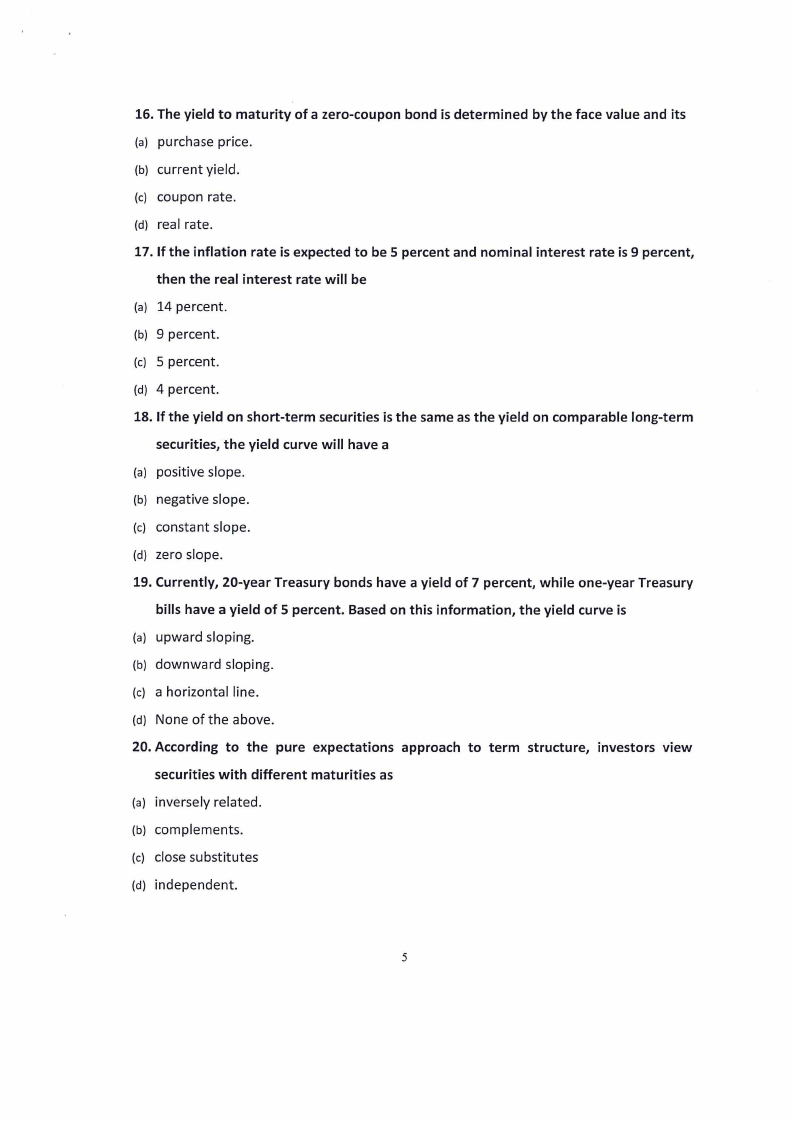
16. The yield to maturity of a zero-coupon bond is determined by the face value and its
(a) purchase price.
(b} current yield.
(c) coupon rate.
(d) real rate.
17. If the inflation rate is expected to be 5 percent and nominal interest rate is 9 percent,
then the real interest rate will be
(a) 14 percent.
(b) 9 percent.
(c) 5 percent.
(d) 4 percent.
18. If the yield on short-term securities is the same as the yield on comparable long-term
securities, the yield curve will have a
(a) positive slope.
(b) negative slope.
(c) constant slope.
(d) zero slope.
19. Currently, 20-year Treasury bonds have a yield of 7 percent, while one-year Treasury
bills have a yield of 5 percent. Based on this information, the yield curve is
(a) upward sloping.
(b) downward sloping.
(c) a horizontal line.
(d) None of the above.
20. According to the pure expectations approach to term structure, investors view
securities with different maturities as
(a) inversely related.
(bl complements.
(c) close substitutes
(d) independent.
5
|
|
6 Page 6 |
▲back to top |
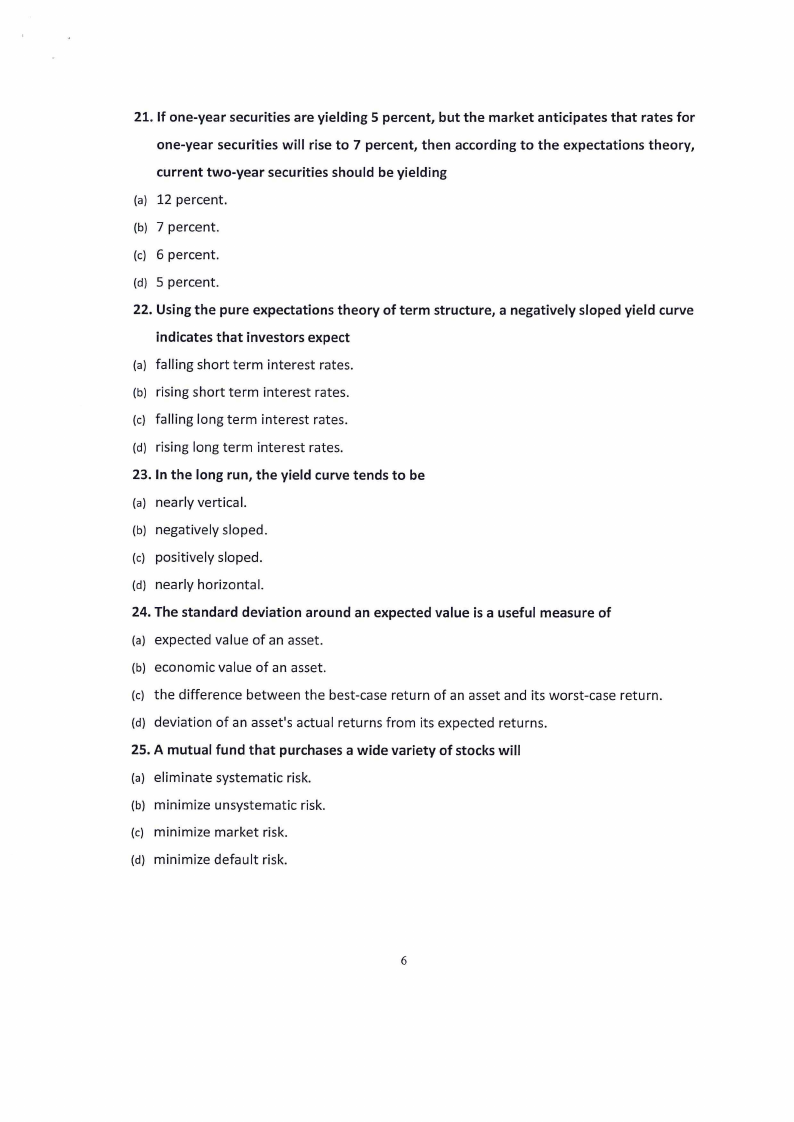
21. If one-year securities are yielding 5 percent, but the market anticipates that rates for
one-year securities will rise to 7 percent, then according to the expectations theory,
current two-year securities should be yielding
(a) 12 percent.
(b) 7 percent.
(c) 6 percent.
(d) 5 percent.
22. Using the pure expectations theory of term structure, a negatively sloped yield curve
indicates that investors expect
(a) falling short term interest rates.
(bl rising short term interest rates.
(c) falling long term interest rates.
(d) rising long term interest rates.
23. In the long run, the yield curve tends to be
(a) nearly vertical.
(bl negatively sloped.
(c) positively sloped.
(d) nearly horizontal.
24. The standard deviation around an expected value is a useful measure of
(a) expected value of an asset.
(bl economic value of an asset.
(c) the difference between the best-case return of an asset and its worst-case return.
(d) deviation of an asset's actual returns from its expected returns.
25. A mutual fund that purchases a wide variety of stocks will
(a) eliminate systematic risk.
(bl minimize unsystematic risk.
(c) minimize market risk.
(d) minimize default risk.
6
|
|
7 Page 7 |
▲back to top |
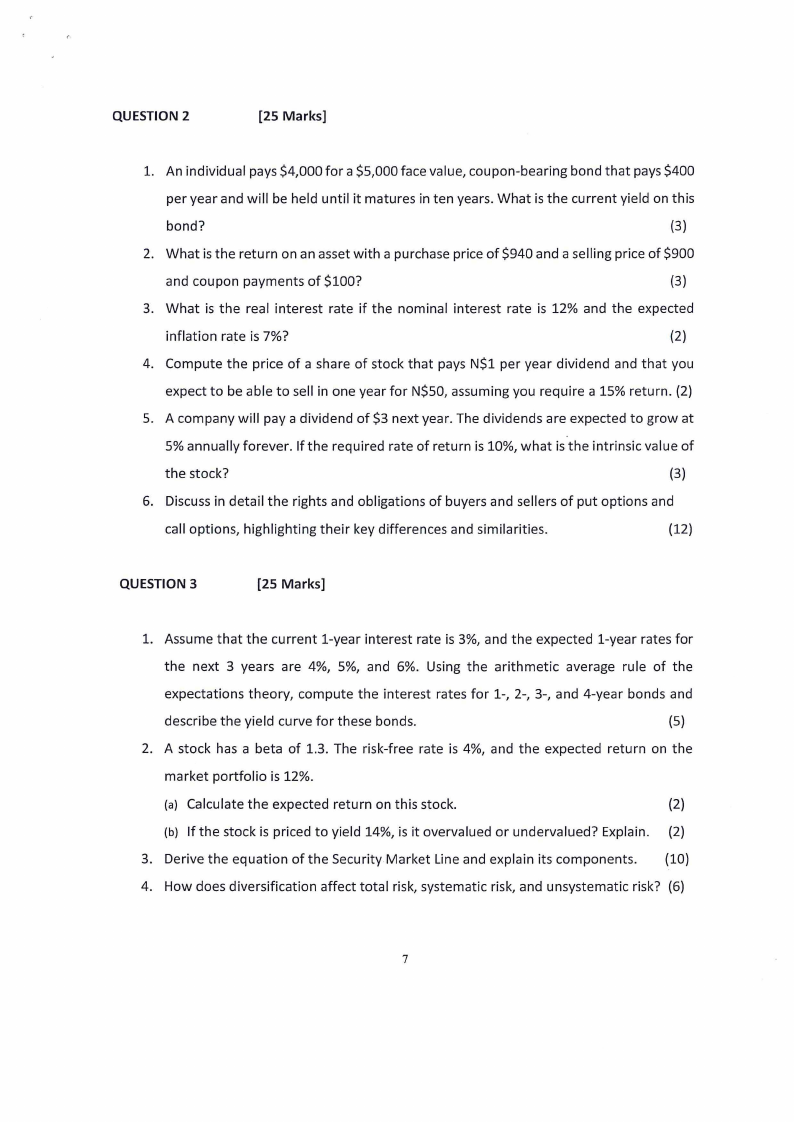
QUESTION 2
[25 Marks]
1. An individual pays $4,000 for a $5,000 face value, coupon-bearing bond that pays $400
per year and will be held until it matures in ten years. What is the current yield on this
bond?
(3)
2. What is the return on an asset with a purchase price of $940 and a selling price of $900
and coupon payments of $100?
{3)
3. What is the real interest rate if the nominal interest rate is 12% and the expected
inflation rate is 7%?
{2)
4. Compute the price of a share of stock that pays N$1 per year dividend and that you
expect to be able to sell in one year for N$50, assuming you require a 15% return. {2)
5. A company will pay a dividend of $3 next year. The dividends are expected to grow at
5% annually forever. If the required rate of return is 10%, what is the intrinsic value of
the stock?
(3)
6. Discuss in detail the rights and obligations of buyers and sellers of put options and
call options, highlighting their key differences and similarities.
{12)
QUESTION 3
[25 Marks]
1. Assume that the current 1-year interest rate is 3%, and the expected 1-year rates for
the next 3 years are 4%, 5%, and 6%. Using the arithmetic average rule of the
expectations theory, compute the interest rates for 1-, 2-, 3-, and 4-year bonds and
describe the yield curve for these bonds.
(5)
2. A stock has a beta of 1.3. The risk-free rate is 4%, and the expected return on the
market portfolio is 12%.
(a) Calculate the expected return on this stock.
{2)
(b) If the stock is priced to yield 14%, is it overvalued or undervalued? Explain. (2)
3. Derive the equation of the Security Market Line and explain its components. {10)
4. How does diversification affect total risk, systematic risk, and unsystematic risk? (6)
7
|
|
8 Page 8 |
▲back to top |
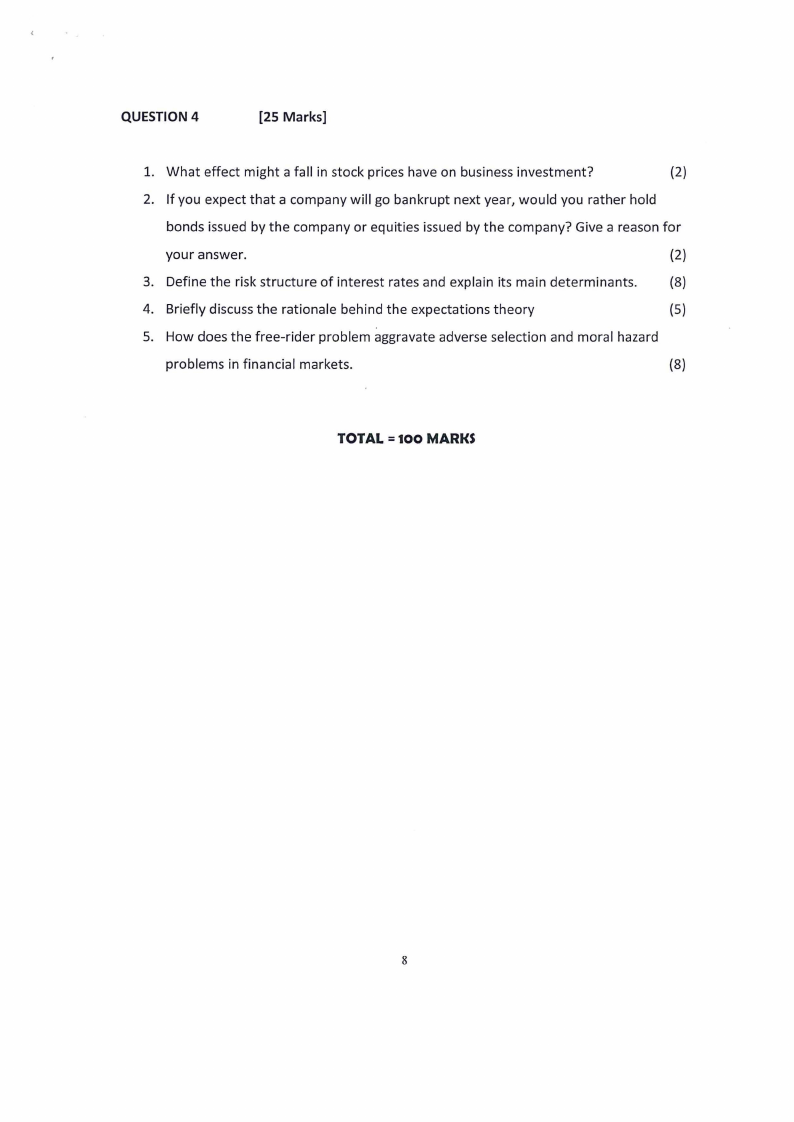
QUESTION 4
[25 Marks]
1. What effect might a fall in stock prices have on business investment?
(2)
2. If you expect that a company will go bankrupt next year, would you rather hold
bonds issued by the company or equities issued by the company? Give a reason for
your answer.
(2)
3. Define the risk structure of interest rates and explain its main determinants. (8)
4. Briefly discuss the rationale behind the expectations theory
(5)
5. How does the free-rider problem aggravate adverse selection and moral hazard
problems in financial markets.
(8)
TOTAL = 100 MARKS
8