


 |
LAL111S- LABOUR LAW 1A - 1ST OPP - JUNE - 2025 |
|
|
1 Page 1 |
▲back to top |
nAmlBIA unlVERSITY
OF SCIEnCE AnD TECHnOLOGY
FACULTYOF COMMERCE,HUMAN SCIENCESAND EDUCATION
DEPARTMENTOF SOCIALSCIENCES
QUALIFICATIONS:BACHELOROF HUMAN RESOURCESB; ACHELOROF HUMAN RESOURCES
MANAGEMENT; BACHELOROF BUSINESSAND INFORMATION ADMINISTRATION
QUALIFICATIONCODES: 21BHUR;
07BHRM; 07BBIA
COURSECODE: LAL111S
SESSION:JUNE 2025
DURATION: 2 HOURS
LEVEL: 5
COURSENAME: LABOURLAW 1A
PAPER:THEORY
MARKS: 100
FIRSTOPPORTUNITYEXAMINATION QUESTIONPAPER
EXAMINER(S)
Ms. KO CLAASEN
MODERATOR: Mrs. E. Wabomba
INSTRUCTIONS
1. This paper consists of 6 (six) questions.
2. All questions are compulsory.
3. All questions must be answered in your Examination Book
4. Read all questions carefully before answering.
5. Incorrect spelling and illegible handwriting may prevent mark allocation.
PERMISSIBLEMATERIALS
1. Calculator
THIS QUESTION PAPERCONSISTSOF 8 PAGES(Including this front page)
|
|
2 Page 2 |
▲back to top |
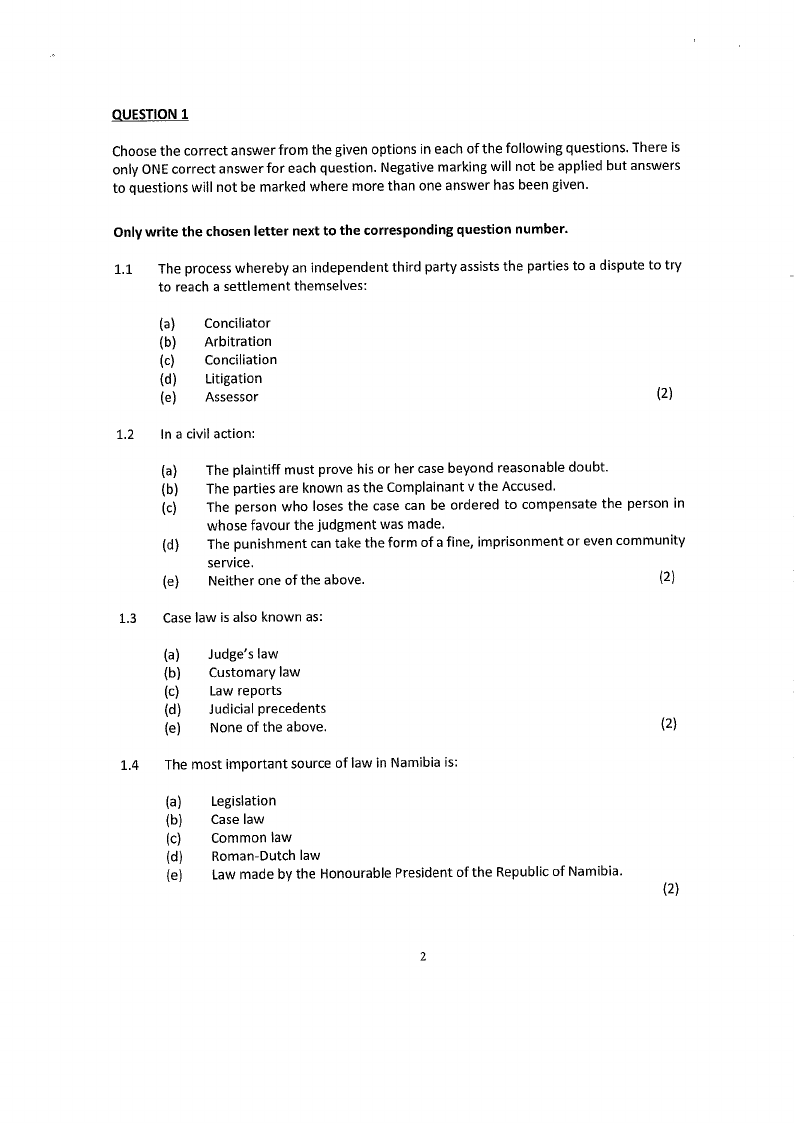
QUESTION1
Choosethe correct answer from the given options in each of the following questions. There is
only ONEcorrect answer for each question. Negative marking will not be applied but answers
to questions will not be marked where more than one answer has been given.
Only write the chosen letter next to the corresponding question number.
1.1 The processwhereby an independent third party assiststhe parties to a dispute to try
to reach a settlement themselves:
(a) Conciliator
(b) Arbitration
(c) Conciliation
(d) Litigation
(e) Assessor
(2)
1.2 In a civil action:
(a) The plaintiff must prove his or her case beyond reasonable doubt.
(b) The parties are known as the Complainant v the Accused.
(c) The person who loses the case can be ordered to compensate the person in
whose favour the judgment was made.
(d) The punishment can take the form of a fine, imprisonment or even community
service.
(e) Neither one of the above.
(2)
1.3 Caselaw is also known as:
(a) Judge's law
(b) Customary law
(c) Law reports
(d) Judicial precedents
(e) None of the above.
(2)
1.4 The most important source of law in Namibia is:
(a) Legislation
(b) Caselaw
(c) Common law
(d) Roman-Dutch law
(e) Law made by the Honourable President of the Republic of Namibia.
(2)
2
|
|
3 Page 3 |
▲back to top |

1.5 The Namibian Constitution restricts work done by children as follows:
(a) No person under the age of 14 years may perform any type of work.
(b) No person under the age of 16 years may perform any type of work.
(c) No person under the age of 21 years may perform night work.
(d) No person under the age of 16 years may perform work that is likely to be
hazardous or to interfere with their education, or to be harmful to their health
or physical, mental, spiritual, moral, or social development.
(e) Neither one of the above.
(2)
1.6 An employee on probation:
(a) May be dismissed for incompetence without a formal hearing.
(b) Must receive the same treatment as any other employee in relation to the
termination of services, i.e., the requirements of substantive and procedural
fairness.
(c) Can only be appointed for a fixed term.
(d) May not be appointed for an indefinite term.
(e) Neither one of the above options.
(2)
1.7 In order to protect its trade secrets after an employee's services had been terminated,
an employer can:
(a) Refuseto provide the employee with a certificate of service.
(b) Refuseto provide the employee with a testimonial.
(c) Provide the employee with a testimonial.
(d) Include a restraint of trade clause in the contract of employment.
(e) Include a condition in the contract of employment.
(2)
1.8 An employee must produce a medical certificate:
(a) Whenever the employer requires the employee to do so.
(b) If the employee has been absent from work due to incapacity for more than
two consecutive days, failing which, the employer is entitled to apply the
common law rule of "no work, no pay" rule.
(c) Whenever such employee wants to qualify for paid sick leave.
(d) If the employee has been absent from work due to incapacity for one day on
either a Friday or Monday.
(e) Both (b) and (d)
(2)
1.9 In terms of the Labour Act 11 of 2007, remuneration:
(a) May consist partly in cash and partly in kind, provided that the payment-in-kind
portion is by agreement, and it does not exceed one-third of the employee's
basic wage.
(b) Consists of that part of the salary that is paid in money only.
3
|
|
4 Page 4 |
▲back to top |
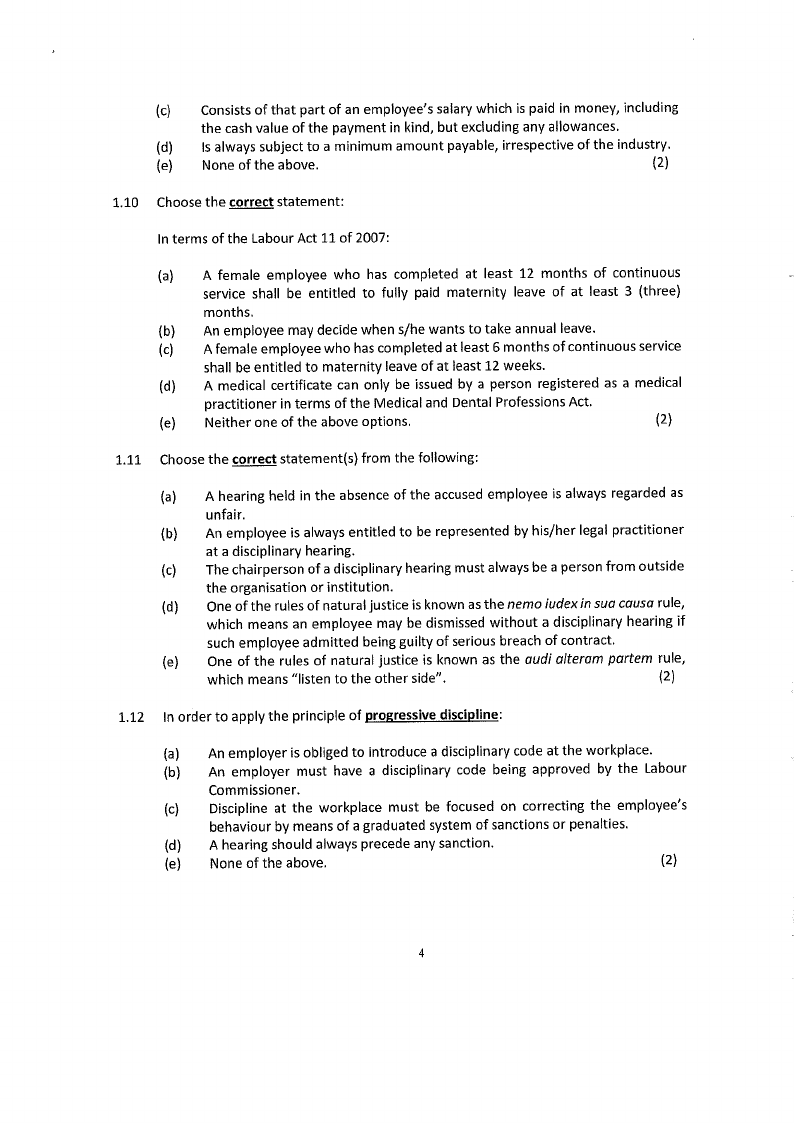
(c) Consists of that part of an employee's salary which is paid in money, including
the cash value of the payment in kind, but excluding any allowances.
(d) Is always subject to a minimum amount payable, irrespective of the industry.
(e) None of the above.
(2)
1.10 Choosethe correct statement:
In terms of the Labour Act 11 of 2007:
(a) A female employee who has completed at least 12 months of continuous
service shall be entitled to fully paid maternity leave of at least 3 (three)
months.
(b) An employee may decide whens/he wants to take annual leave.
(c) A female employee who has completed at least 6 months of continuous service
shall be entitled to maternity leave of at least 12 weeks.
(d) A medical certificate can only be issued by a person registered as a medical
practitioner in terms of the Medical and Dental Professions Act.
(e) Neither one of the above options.
(2)
1.11 Choosethe correct statement(s) from the following:
(a) A hearing held in the absence of the accused employee is always regarded as
unfair.
(b) An employee is always entitled to be represented by his/her legal practitioner
at a disciplinary hearing.
(c) The chairperson of a disciplinary hearing must always be a person from outside
the organisation or institution.
(d) One of the rules of natural justice is known as the nemo iudex in sua causa rule,
which means an employee may be dismissed without a disciplinary hearing if
such employee admitted being guilty of serious breach of contract.
(e) One of the rules of natural justice is known as the audi a/teram partem rule,
which means "listen to the other side".
(2)
1.12 In order to apply the principle of progressivediscipline:
(a) An employer is obliged to introduce a disciplinary code at the workplace.
(b) An employer must have a disciplinary code being approved by the Labour
Commissioner.
(c) Discipline at the workplace must be focused on correcting the employee's
behaviour by means of a graduated system of sanctions or penalties.
(d) A hearing should always precede any sanction.
(e) None of the above.
(2)
4
|
|
5 Page 5 |
▲back to top |
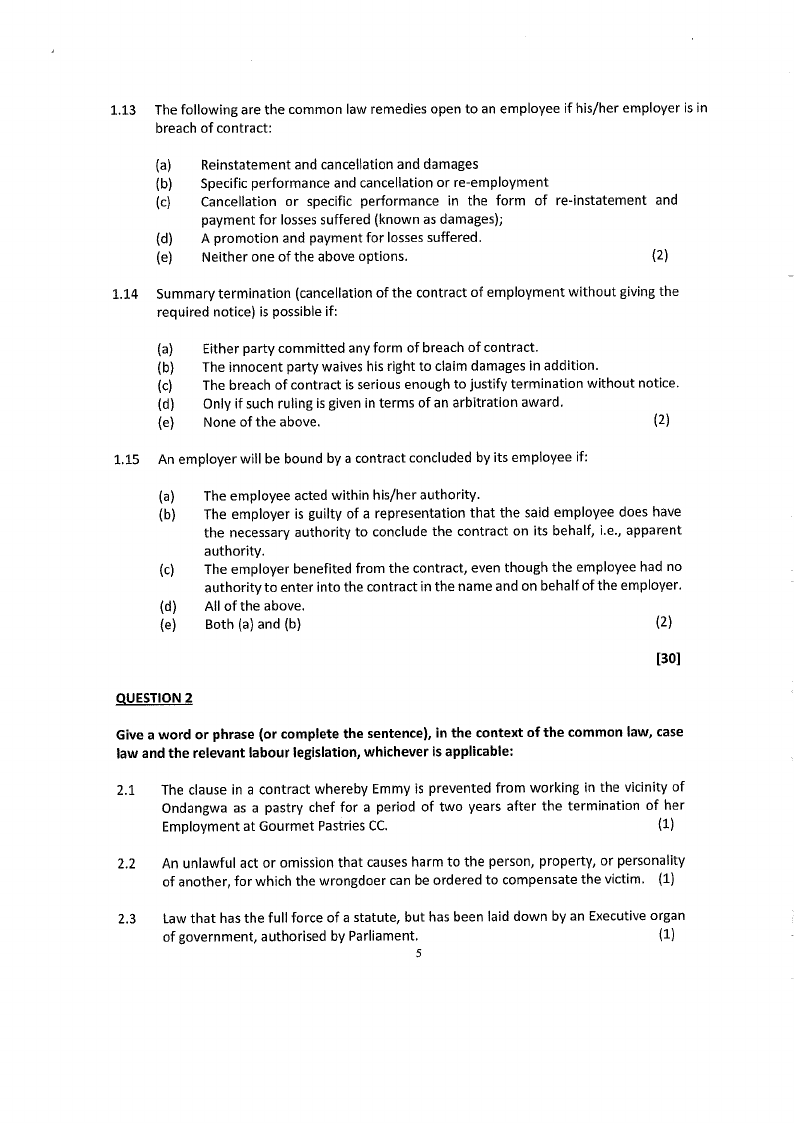
1.13 The following are the common law remedies open to an employee if his/her employer is in
breach of contract:
(a) Reinstatement and cancellation and damages
(b) Specific performance and cancellation or re-employment
(c) Cancellation or specific performance in the form of re-instatement and
payment for lossessuffered (known as damages);
(d) A promotion and payment for lossessuffered.
(e) Neither one of the above options.
(2)
1.14 Summary termination (cancellation of the contract of employment without giving the
required notice) is possible if:
(a) Either party committed any form of breach of contract.
(b) The innocent party waives his right to claim damages in addition.
(c) The breach of contract is serious enough to justify termination without notice.
(d) Only if such ruling is given in terms of an arbitration award.
(e) None of the above.
(2)
1.15 An employer will be bound by a contract concluded by its employee if:
(a) The employee acted within his/her authority.
(b) The employer is guilty of a representation that the said employee does have
the necessary authority to conclude the contract on its behalf, i.e., apparent
authority.
(c) The employer benefited from the contract, even though the employee had no
authority to enter into the contract in the name and on behalf of the employer.
(d) All of the above.
(e) Both (a) and (b)
(2)
[30]
QUESTION 2
Give a word or phrase (or complete the sentence), in the context of the common law, case
law and the relevant labour legislation, whichever is applicable:
2.1 The clause in a contract whereby Emmy is prevented from working in the vicinity of
Ondangwa as a pastry chef for a period of two years after the termination of her
Employment at Gourmet PastriesCC.
(1)
2.2 An unlawful act or omission that causes harm to the person, property, or personality
of another, for which the wrongdoer can be ordered to compensate the victim. (1)
2.3 Law that has the full force of a statute, but has been laid down by an Executive organ
of government, authorised by Parliament.
(1)
5
|
|
6 Page 6 |
▲back to top |
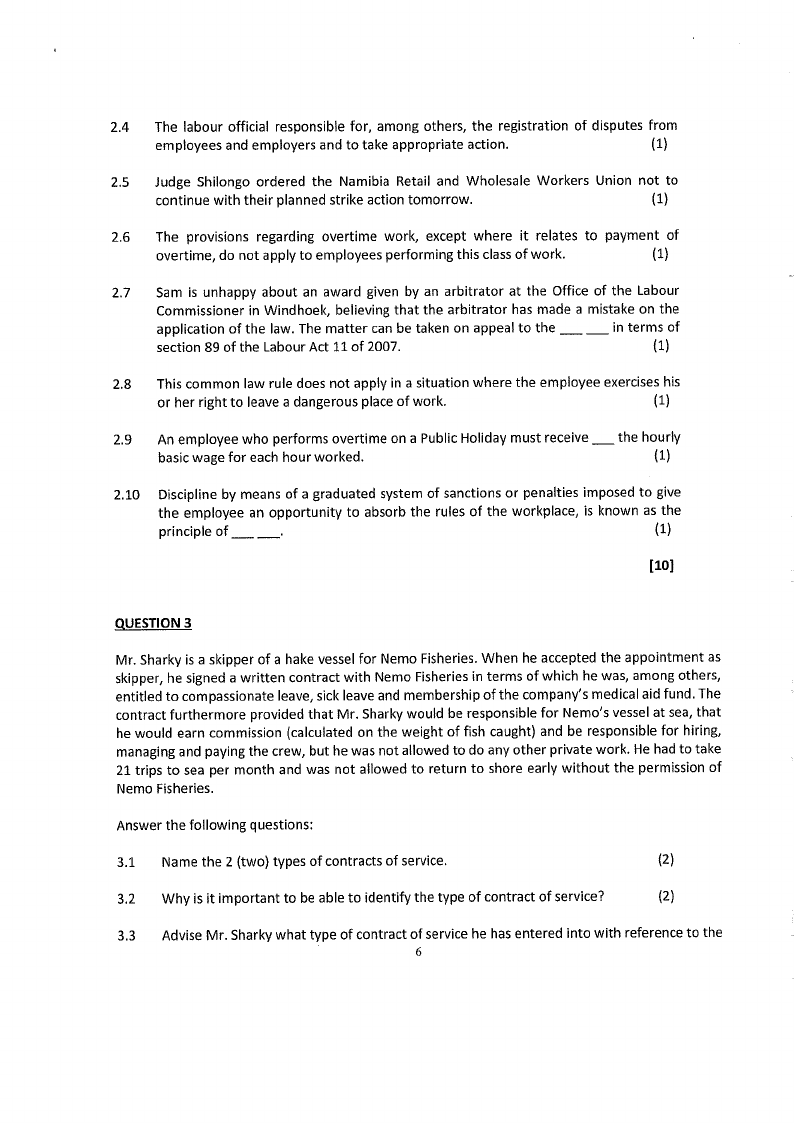
2.4 The labour official responsible for, among others, the registration of disputes from
employees and employers and to take appropriate action.
(1)
2.5 Judge Shilongo ordered the Namibia Retail and Wholesale Workers Union not to
continue with their planned strike action tomorrow.
(1)
2.6 The provisions regarding overtime work, except where it relates to payment of
overtime, do not apply to employees performing this classof work.
(1)
2.7 Sam is unhappy about an award given by an arbitrator at the Office of the Labour
Commissioner in Windhoek, believing that the arbitrator has made a mistake on the
application of the law. The matter can be taken on appeal to the __
in terms of
section 89 of the Labour Act 11 of 2007.
(1)
2.8 This common law rule does not apply in a situation where the employee exercises his
or her right to leave a dangerous place of work.
(1)
2.9 An employee who performs overtime on a Public Holiday must receive_ the hourly
basic wage for each hour worked.
(1)
2.10 Discipline by means of a graduated system of sanctions or penalties imposed to give
the employee an opportunity to absorb the rules of the workplace, is known as the
principle of __ .
(1)
[10]
QUESTION 3
Mr. Sharky is a skipper of a hake vessel for Nemo Fisheries.When he accepted the appointment as
skipper, he signed a written contract with Nemo Fisheriesin terms of which he was, among others,
entitled to compassionate leave, sick leave and membership of the company's medical aid fund. The
contract furthermore provided that Mr. Sharky would be responsible for Nemo's vessel at sea, that
he would earn commission (calculated on the weight of fish caught) and be responsible for hiring,
managing and paying the crew, but he was not allowed to do any other private work. He had to take
21 trips to sea per month and was not allowed to return to shore early without the permission of
Nemo Fisheries.
Answer the following questions:
3.1 Name the 2 (two) types of contracts of service.
(2)
3.2 Why is it important to be able to identify the type of contract of service?
(2)
3.3 Advise Mr. Sharky what type of contract of service he has entered into with reference to the
6
|
|
7 Page 7 |
▲back to top |
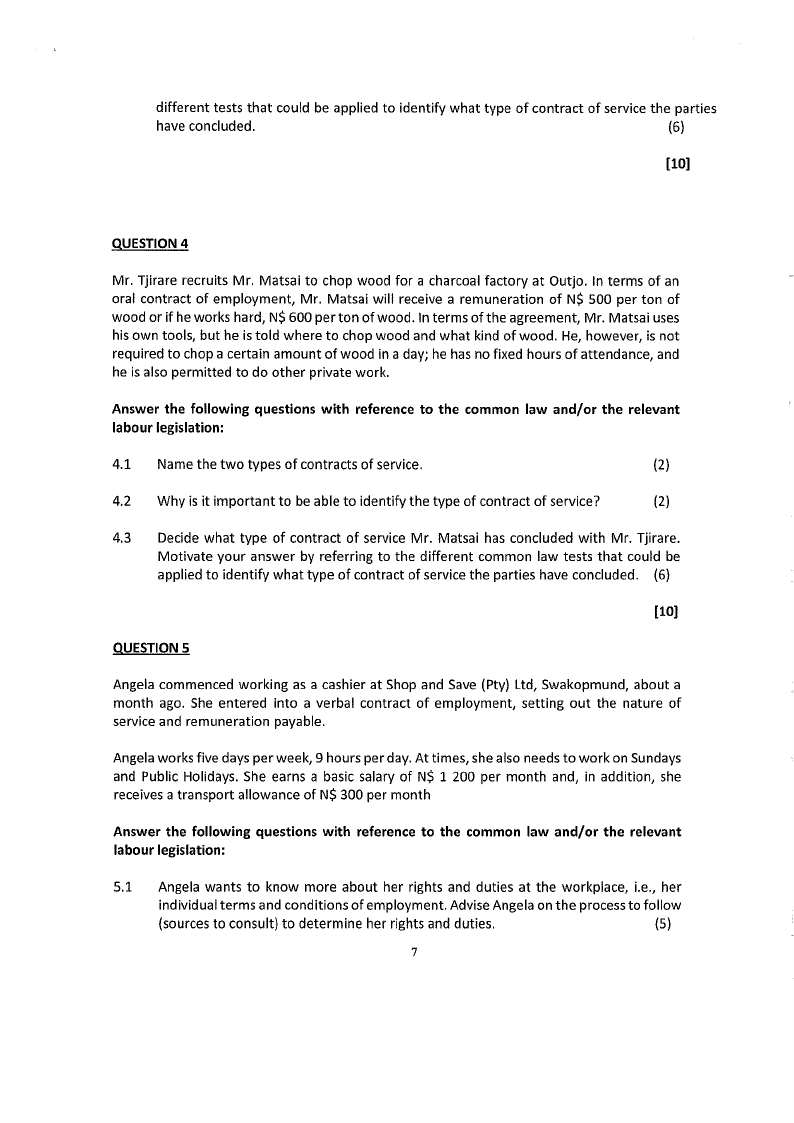
different tests that could be applied to identify what type of contract of service the parties
have concluded.
(6)
(10]
QUESTION 4
Mr. Tjirare recruits Mr. Matsai to chop wood for a charcoal factory at Outjo. In terms of an
oral contract of employment, Mr. Matsai will receive a remuneration of N$ 500 per ton of
wood or if he works hard, N$ 600 per ton of wood. In terms of the agreement, Mr. Matsai uses
his own tools, but he is told where to chop wood and what kind of wood. He, however, is not
required to chop a certain amount of wood in a day; he has no fixed hours of attendance, and
he is also permitted to do other private work.
Answer the following questions with reference to the common law and/or the relevant
labour legislation:
4.1 Name the two types of contracts of service.
(2)
4.2 Why is it important to be able to identify the type of contract of service?
(2)
4.3 Decide what type of contract of service Mr. Matsai has concluded with Mr. Tjirare.
Motivate your answer by referring to the different common law tests that could be
applied to identify what type of contract of service the parties have concluded. (6)
(10]
QUESTION 5
Angela commenced working as a cashier at Shop and Save (Pty) Ltd, Swakopmund, about a
month ago. She entered into a verbal contract of employment, setting out the nature of
service and remuneration payable.
Angela works five days per week, 9 hours per day. At times, she also needs to work on Sundays
and Public Holidays. She earns a basic salary of N$ 1 200 per month and, in addition, she
receives a transport allowance of N$ 300 per month
Answer the following questions with reference to the common law and/or the relevant
labour legislation:
5.1 Angela wants to know more about her rights and duties at the workplace, i.e., her
individual terms and conditions of employment. AdviseAngela on the processto follow
(sources to consult) to determine her rights and duties.
(5)
7
|
|
8 Page 8 |
▲back to top |

5.2 The maximum ordinary working hours per week Angela could be expected to work.
(1)
5.3 Suppose Angela had worked 2 (two) hours overtime this past Friday (not a Public
Holiday) and calculate her payment in respect of the said overtime work. (You must
also include in your answer an explanation of your method of calculation.)
(5)
5.4 Suppose a Public Holiday falls on an ordinary working day. Discusswhether employees
should be remunerated for such days (although they have not worked).
(4)
5.5 DiscussAngela's annual leave entitlement.
(3)
5.6 Briefly set out Angela's sick leave entitlement.
(2)
[20]
QUESTION 6
While operating a SO-ton vehicle at Black Mountain Uranium Mine (Pty) Ltd, Tombo, an
employee of the mine, caused an accident by allowing his vehicle to hook onto certain
electrical cables, dragging them down and seriously injured five of his fellow employees. In
the process,Tombo also bumped and fractured his skull againstthe side of the vehicle. Tombo
would not have been injured if he adhered to the company's safety requirements to wear a
hardhat on site. He was immediately taken to hospital, where he was treated and also tested
for the intake of alcohol. It was established that the alcohol content of his blood was
significantly beyond the legal limit. He also showed apparent symptoms of being under the
influence of alcohol; in particular, he smelt of alcohol, had red eyes and demonstrated a
general appearance of being intoxicated.
The manager ofTombo's employer, certain Mr. No Nonsense,approaches you for legal advice
on the following:
6.1 Mr. No Nonsensewants to summarily dismissTombo on the day after the incident took
place. Briefly set out the requirements for a fair dismissal in these circumstances.
(8)
6.2 Could the company be held liable for the injuries sustained by Tombo and the other
employees as a result of this incident?
(7)
6.3 Briefly discuss the legal duty of an employer to keep records of employees.
(5)
[20]
Grand Total: 100
GOOD LUCK!!
8