


 |
AMM721S - ADMINISTRATIVE MANAGEMENT 3 - 2ND OPP - JULY 2025 |
|
|
1 Page 1 |
▲back to top |
nAmI BI AunIVE RSITY
OF SCIEnCE Ano TECHnOLOGY
FACULTY OF COMMERCE, HUMAN SCIENCESAND EDUCATION
DEPARTMENT OF GOVERNANCE & MANAGEMENT SCIENCES
QUALIFICATION : BACHELOR OF BUSINESS AND INFORMATION ADMINISTRATION
QUALIFICATION CODE: 07BBIA
LEVEL: 7
COURSE CODE: AMM721S
COURSE NAME: ADMINISTRATIVE MANAGEMENT
3
SESSION: JULY 2025
DURATION: 2 HOURS
PAPER: THEORY (PAPER2)
MARKS: 100
EXAMINER:
2nd OPPORTUNITY EXAMINATION QUESTION PAPER2
Ms. Jelise Mooja
MODERATOR: Mr. Eugene A. Zealand
INSTRUCTIONS
1. Answer ALL the questions.
2. Read all the questions carefully before answering.
3. Number the answers clearly
THIS QUESTION PAPER CONSISTS OF 6 PAGES (Including this front page)
|
|
2 Page 2 |
▲back to top |
2
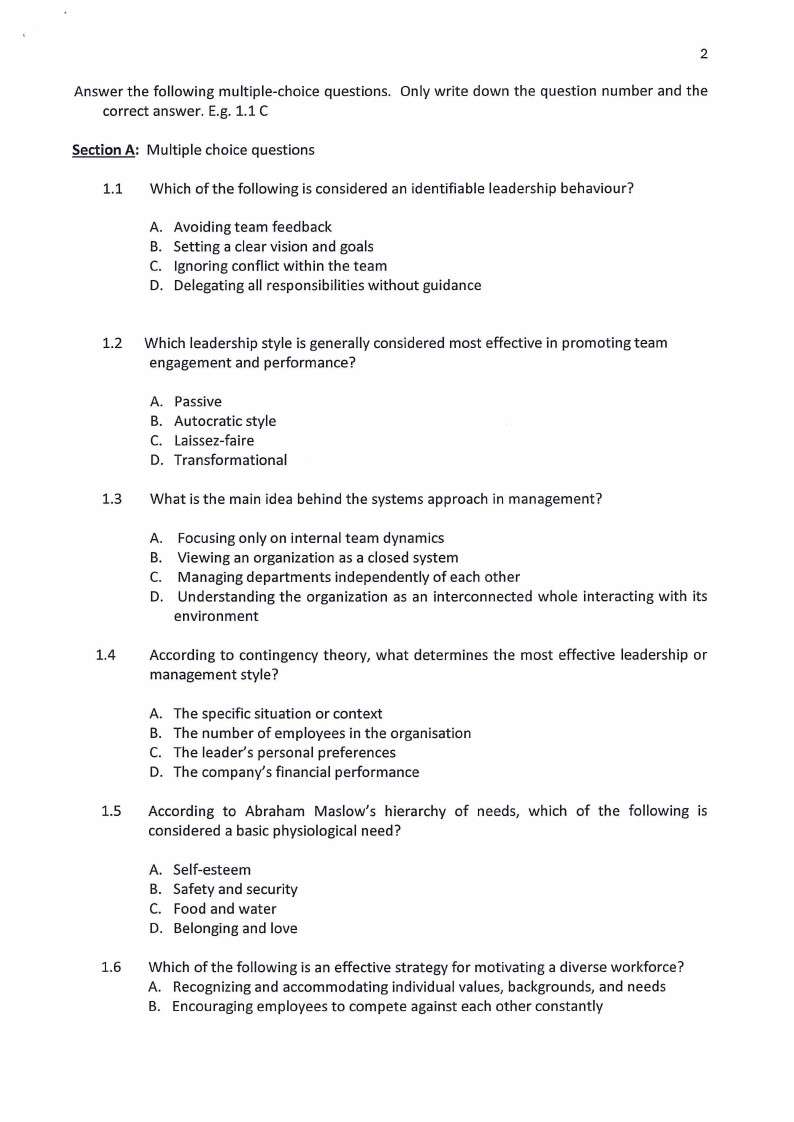
Answer the following multiple-choice questions. Only write down the question number and the
correct answer. E.g. 1.1 C
Section A: Multiple choice questions
1.1 Which of the following is considered an identifiable leadership behaviour?
A. Avoiding team feedback
B. Setting a clear vision and goals
C. Ignoring conflict within the team
D. Delegating all responsibilities without guidance
1.2 Which leadership style is generally considered most effective in promoting team
engagement and performance?
A. Passive
B. Autocratic style
C. Laissez-faire
D. Transformational
1.3 What is the main idea behind the systems approach in management?
A. Focusing only on internal team dynamics
B. Viewing an organization as a closed system
C. Managing departments independently of each other
D. Understanding the organization as an interconnected whole interacting with its
environment
1.4 According to contingency theory, what determines the most effective leadership or
management style?
A. The specific situation or context
B. The number of employees in the organisation
C. The leader's personal preferences
D. The company's financial performance
1.5 According to Abraham Maslow's hierarchy of needs, which of the following is
considered a basic physiological need?
A. Self-esteem
B. Safety and security
C. Food and water
D. Belonging and love
1.6 Which of the following is an effective strategy for motivating a diverse workforce?
A. Recognizing and accommodating individual values, backgrounds, and needs
B. Encouraging employees to compete against each other constantly
|
|
3 Page 3 |
▲back to top |
3
C. Applying the same rewards and recognition to all employees
D. Assuming all employees
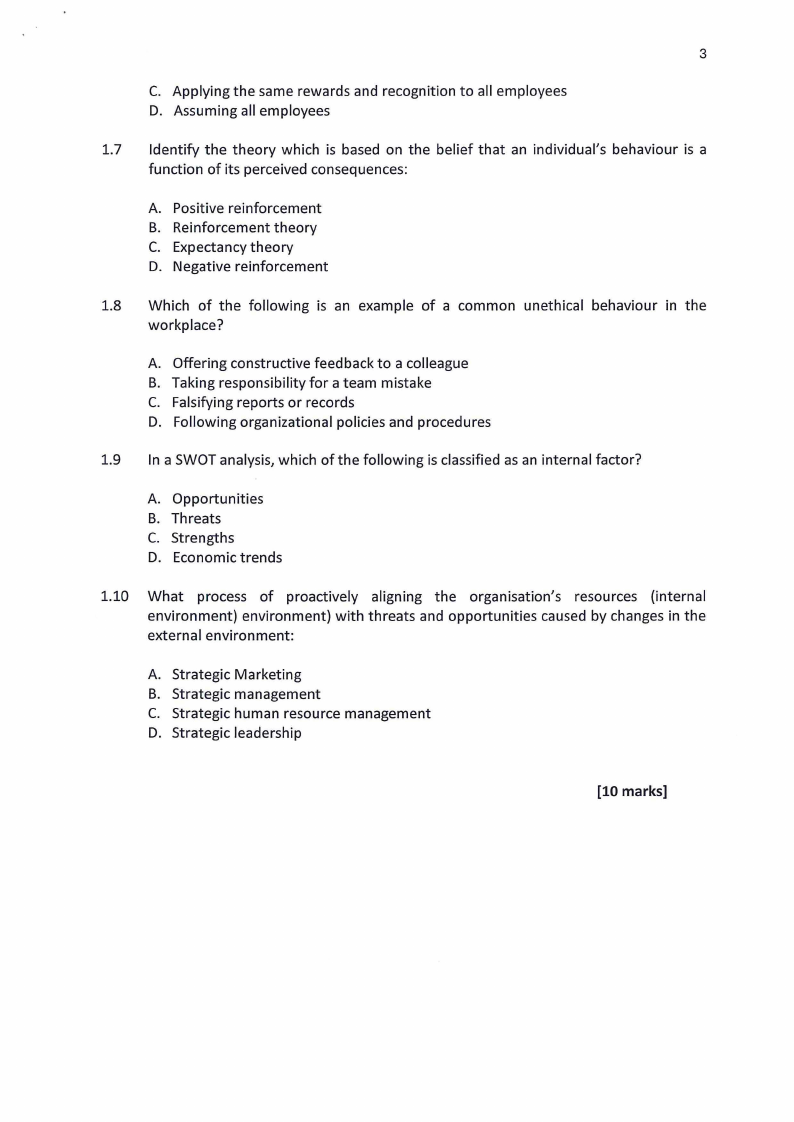
1.7 Identify the theory which is based on the belief that an individual's behaviour is a
function of its perceived consequences:
A. Positive reinforcement
B. Reinforcement theory
C. Expectancy theory
D. Negative reinforcement
1.8 Which of the following is an example of a common unethical behaviour in the
workplace?
A. Offering constructive feedback to a colleague
B. Taking responsibility for a team mistake
C. Falsifying reports or records
D. Following organizational policies and procedures
1.9 In a SWOT analysis, which of the following is classified as an internal factor?
A. Opportunities
B. Threats
C. Strengths
D. Economic trends
1.10 What process of proactively aligning the organisation's resources (internal
environment) environment) with threats and opportunities caused by changes in the
external environment:
A. Strategic Marketing
B. Strategic management
C. Strategic human resource management
D. Strategic leadership
[10 marks]
|
|
4 Page 4 |
▲back to top |
4
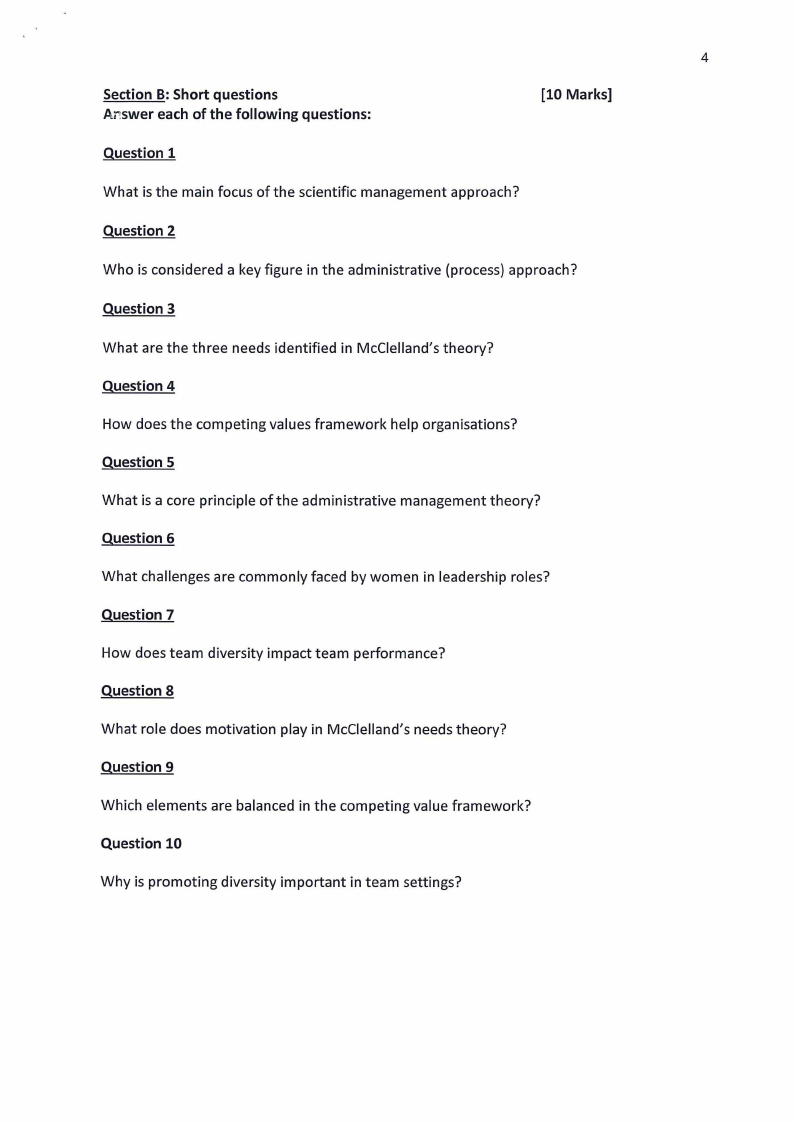
Section B: Short questions
A~swer each of the following questions:
[10 Marks]
Question 1
What is the main focus of the scientific management approach?
Question 2
Who is considered a key figure in the administrative (process) approach?
Question 3
What are the three needs identified in McClelland's theory?
Question 4
How does the competing values framework help organisations?
Question 5
What is a core principle of the administrative management theory?
Question 6
What challenges are commonly faced by women in leadership roles?
Question 7
How does team diversity impact team performance?
Question 8
What role does motivation play in McClelland's needs theory?
Question 9
Which elements are balanced in the competing value framework?
Question 10
Why is promoting diversity important in team settings?
|
|
5 Page 5 |
▲back to top |
5
Section C: Structured questions
Answer each of the following questions:
[80 Marks]
Questions 1
Case study:
ABCTech Solutions is a fast-growing software company with a diverse workforce. Recently,
the management received complaints about favouritism in promotions, misuse of company
resources, and a lack of transparency in decision-making. These issues have started affecting
employee morale and productivity. The HR department has suggested introducing a formal
ethics management program to address these concerns.
Based on the case above, answer the following:
1.1 Identify and explain three ethical issues faced by ABCTech Solutions.
(6)
1.2 Suggest four strategies the company can adopt to manage ethics effectively in the
workplace. Justify how each strategy can help improve the situation.
(9)
[15]
Question 2
Why do you think it's important to align the organisations' goals with employee?
needs? Explain with the use of five examples
[10]
Question 3
Discuss any five major factors that lead to change in an organization or society. Support your
answer with relevant examples.
[10]
Question 4
Critically evaluate the key principles of Frederick W. Taylor's Scientific Management
Approach. How can these principles be applied or adapted in modern organisations to
enhance efficiency and productivity?
[10]
Question 5
Explain McClelland's three categories of motivational needs. Using workplace examples,
analyse how each need can influence employee behaviour and performance in an
organisational setting.
[10]
|
|
6 Page 6 |
▲back to top |
6
Question 6
Identify five key factors that influence the recruitment process in an organisation and explain
how each factor can be applied to improve the effectiveness of recruitment strategies in a
real-world context.
[10]
Question 7
Case Study: Women as Leaders - The Journey of Indra Nooyi
Indra Nooyi, former CEOand Chairperson of PepsiCo, is globally recognized as one of the
most powerful women in business. Born and raised in India, Nooyi broke several barriers in
her rise to the top of one ofthe world's largest corporations. Under her leadership, PepsiCo
focused on sustainable growth by introducing healthier food options and reducing the
company's environmental impact.
She redefined the company's vision with her "Performance with Purpose" strategy,
balancing profitability with responsibility. Nooyi also made bold decisions, such as acquiring
Tropicana and Quaker Oats, which significantly expanded PepsiCo's product portfolio.
Despite challenges, including resistance from traditional shareholders and navigating a male-
dominated corporate environment, she remained resilient and focused.
Indra Nooyi is known for her empathetic leadership style, often emphasizing the importance
of humility, communication, and inclusivity. She has become a global role model, especially
for young women aspiring to leadership roles in business and beyond.
Questions:
7.1 Discuss two leadership qualities demonstrated by Indra Nooyi that contributed to
her success as a leader. {3 marks)
7.2 Explain the significance of the "Performance with Purpose" strategy in transforming
PepsiCo. {3 marks)
7.3 What challenges did Indra Nooyi face as a woman in a leadership position, and how
did she overcome them? {3 marks)
7.4 Why is Indra Nooyi considered as a role model for aspiring women leaders? Give two
reasons. {3 marks)
7.5 In your opinion, how can organizations encourage more women to take on
leadership roles? Suggest two measures. {3 marks)
[15]
[Section C: Total Marks: 80]
End of examination
TOTAL: 100