


 |
AMA811S-ADVANCED MANAGEMENT ACCOUNTING-2ND OPP-JULY 2025 |
|
|
1 Page 1 |
▲back to top |

nAmlBIA unlVERSITY
OF SCIEn CE Ano TECHn OLOGY
FACULTY OF COMMERCE, HUMAN SCIENCES AND EDUCATION
DEPARTMENT OF ACCOUNTING, ECONOMICS AND FINANCE
QUALIFICATION: BACHELOR OF ACCOUNTING HONOURS
QUALIFICATION
BGAC
CODE: 08 LEVEL: 8
COURSE CODE: AMA811S
COURSE NAME: ADVANCED MANAGEMENT
ACCOUNTING
DATE: MAY/JUNE 2025
DURATION: 3 HOURS
PAPER: THEORY AND CALCULATIONS
MARKS: 100
EXAMINER
MODERATOR:
2No OPPORTUNITY EXAMINATION
Dr. MOSES NYAKUWANIKA
LAZARUS SHINKEVA
INSTRUCTIONS
1. Capture your full name, student number and assessment number on the first
page
2. Answer ALL the questions and manage your time properly.
3. Number each page correctly
4. Write clearly and neatly.
5. Do not write in pencil and do not use tip-ex, as this will not be marked.
6. The names of people and businesses used throughout this assessment do not
reflect the reality and may be purely coincidental.
7. SHOW ALL WORKINGS!
THIS QUESTION PAPER CONSISTS OF 7 PAGES (excluding this front page)
11Page
|
|
2 Page 2 |
▲back to top |
QUESTION 1
CASE STUDY
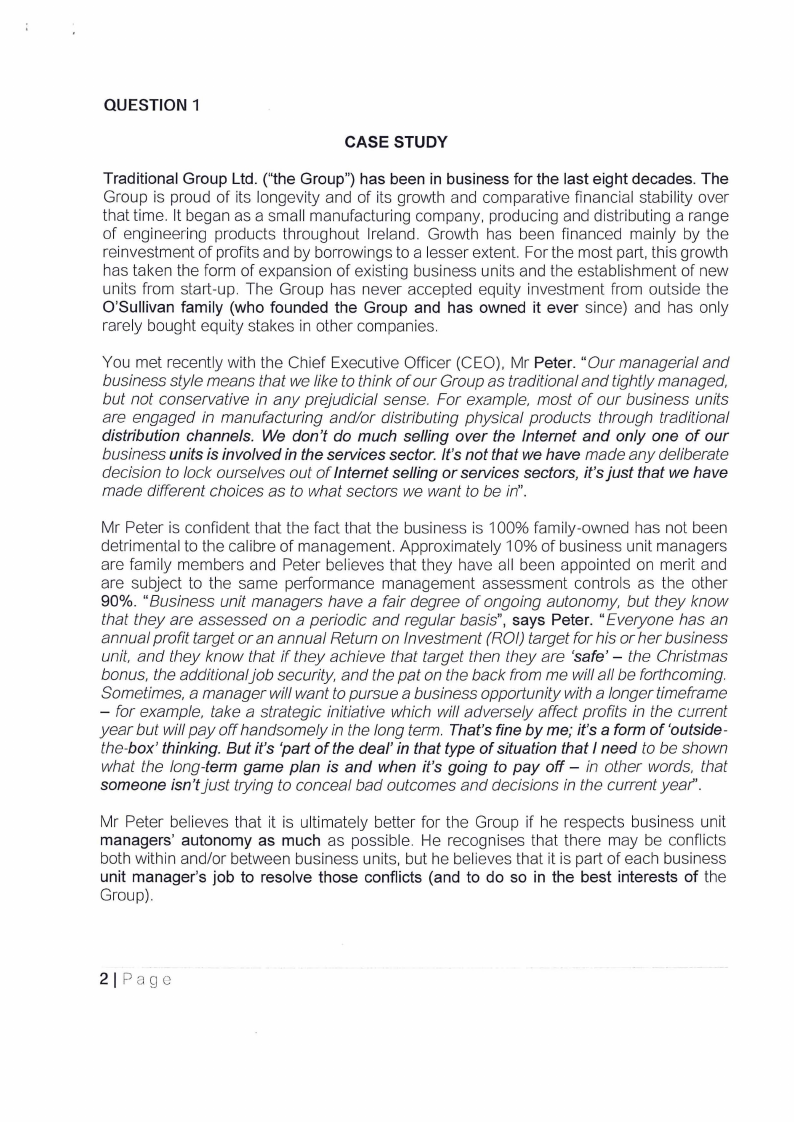
Traditional Group Ltd. ("the Group") has been in business for the last eight decades. The
Group is proud of its longevity and of its growth and comparative financial stability over
that time. It began as a small manufacturing company, producing and distributing a range
of engineering products throughout Ireland. Growth has been financed mainly by the
reinvestment of profits and by borrowings to a lesser extent. For the most part, this growth
has taken the form of expansion of existing business units and the establishment of new
units from start-up. The Group has never accepted equity investment from outside the
O'Sullivan family (who founded the Group and has owned it ever since) and has only
rarely bought equity stakes in other companies.
You met recently with the Chief Executive Officer (CEO), Mr Peter. "Our managerial and
business style means that we like to think of our Group as traditional and tightly managed,
but not conservative in any prejudicial sense. For example, most of our business units
are engaged in manufacturing and/or distributing physical products through traditional
distributionchannels. We don't do much selling over the Internet and only one of our
business unitsis involvedin the servicessector.It's not that we have made any deliberate
decision to lock ourselves out of Internetsellingor servicessectors,it'sjust that we have
made different choices as to what sectors we want to be in".
Mr Peter is confident that the fact that the business is 100% family-owned has not been
detrimental to the calibre of management. Approximately 10% of business unit managers
are family members and Peter believes that they have all been appointed on merit and
are subject to the same performance management assessment controls as the other
90%. "Business unit managers have a fair degree of ongoing autonomy, but they know
that they are assessed on a periodic and regular basis", says Peter. "Everyone has an
annual profit target or an annual Return on Investment (ROI) target for his or her business
unit, and they know that if they achieve that target then they are 'safe' - the Christmas
bonus, the additional job security, and the pat on the back from me will all be forthcoming.
Sometimes, a manager will want to pursue a business opportunity with a longer timeframe
- for example, take a strategic initiative which will adversely affect profits in the current
year but will pay off handsomely in the long term. That'sfine by me; it's a formof 'outside-
the-box'thinking.But it's 'partof the deal' in that type of situationthat I need to be shown
what the long-termgame plan is and when it's going to pay off - in other words, that
someone isn'tjust trying to conceal bad outcomes and decisions in the current year".
Mr Peter believes that it is ultimately better for the Group if he respects business unit
managers' autonomy as much as possible. He recognises that there may be conflicts
both within and/or between business units, but he believes that it is part of each business
unit manager's job to resolve those conflicts (and to do so in the best interests of the
Group).
21Page
|
|
3 Page 3 |
▲back to top |
You have had an opportunity to visit several business units and have made notes about
specific business problems and control issues which these face. Further details are
provided as follows:
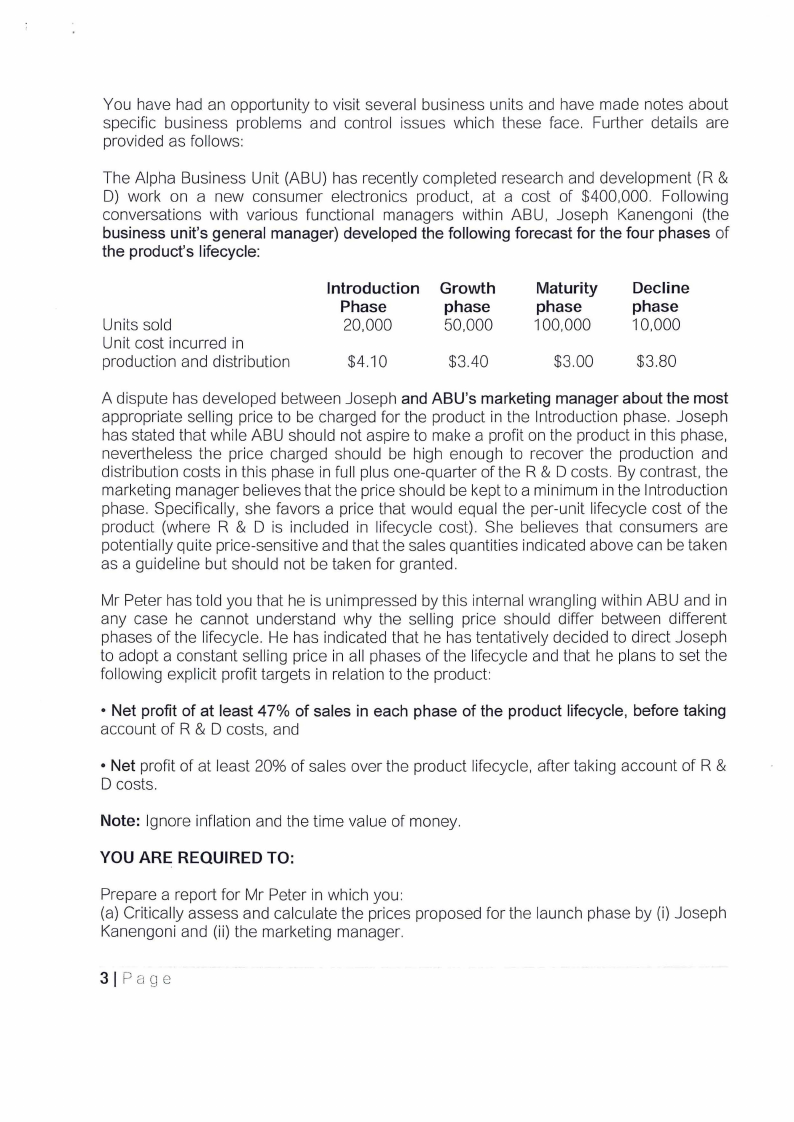
The Alpha Business Unit (ABU) has recently completed research and development (R &
D) work on a new consumer electronics product, at a cost of $400,000. Following
conversations with various functional managers within ABU, Joseph Kanengoni (the
business unit's general manager) developed the following forecast for the four phases of
the product's lifecycle:
Units sold
Unit cost incurred in
production and distribution
Introduction
Phase
20,000
Growth
phase
50,000
$4.10
$3.40
Maturity
phase
100,000
$3.00
Decline
phase
10,000
$3.80
A dispute has developed between Joseph and ABU's marketing manager about the most
appropriate selling price to be charged for the product in the Introduction phase. Joseph
has stated that while ABU should not aspire to make a profit on the product in this phase,
nevertheless the price charged should be high enough to recover the production and
distribution costs in this phase in full plus one-quarter of the R & D costs. By contrast, the
marketing manager believes that the price should be kept to a minimum in the Introduction
phase. Specifically, she favors a price that would equal the per-unit lifecycle cost of the
product (where R & D is included in lifecycle cost). She believes that consumers are
potentially quite price-sensitive and that the sales quantities indicated above can be taken
as a guideline but should not be taken for granted.
Mr Peter has told you that he is unimpressed by this internal wrangling within ABU and in
any case he cannot understand why the selling price should differ between different
phases of the lifecycle. He has indicated that he has tentatively decided to direct Joseph
to adopt a constant selling price in all phases of the lifecycle and that he plans to set the
following explicit profit targets in relation to the product:
• Net profit of at least 47% of sales in each phase of the product lifecycle, before taking
account of R & D costs, and
• Net profit of at least 20% of sales over the product lifecycle, after taking account of R &
D costs.
Note: Ignore inflation and the time value of money.
YOU ARE REQUIRED TO:
Prepare a report for Mr Peter in which you:
(a) Critically assess and calculate the prices proposed for the launch phase by (i) Joseph
Kanengoni and (ii) the marketing manager.
3IPage
|
|
4 Page 4 |
▲back to top |
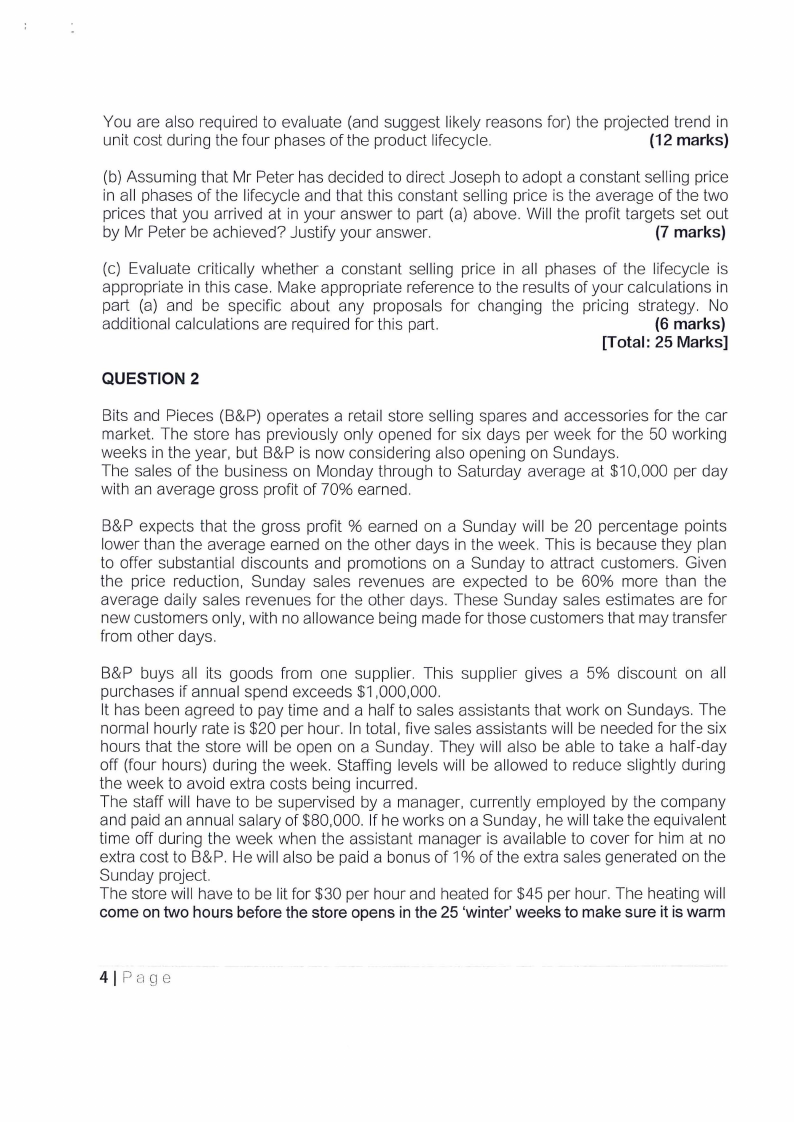
You are also required to evaluate (and suggest likely reasons for) the projected trend in
unit cost during the four phases of the product lifecycle.
(12 marks)
(b) Assuming that Mr Peter has decided to direct Joseph to adopt a constant selling price
in all phases of the lifecycle and that this constant selling price is the average of the two
prices that you arrived at in your answer to part (a) above. Will the profit targets set out
by Mr Peter be achieved? Justify your answer.
(7 marks)
(c) Evaluate critically whether a constant selling price in all phases of the lifecycle is
appropriate in this case. Make appropriate reference to the results of your calculations in
part (a) and be specific about any proposals for changing the pricing strategy. No
additional calculations are required for this part.
(6 marks)
[Total: 25 Marks]
QUESTION 2
Bits and Pieces (B&P) operates a retail store selling spares and accessories for the car
market. The store has previously only opened for six days per week for the 50 working
weeks in the year, but B&P is now considering also opening on Sundays.
The sales of the business on Monday through to Saturday average at $10,000 per day
with an average gross profit of 70% earned.
B&P expects that the gross profit % earned on a Sunday will be 20 percentage points
lower than the average earned on the other days in the week. This is because they plan
to offer substantial discounts and promotions on a Sunday to attract customers. Given
the price reduction, Sunday sales revenues are expected to be 60% more than the
average daily sales revenues for the other days. These Sunday sales estimates are for
new customers only, with no allowance being made for those customers that may transfer
from other days.
B&P buys all its goods from one supplier. This supplier gives a 5% discount on all
purchases if annual spend exceeds $1,000,000.
It has been agreed to pay time and a half to sales assistants that work on Sundays. The
normal hourly rate is $20 per hour. In total, five sales assistants will be needed for the six
hours that the store will be open on a Sunday. They will also be able to take a half-day
off (four hours) during the week. Staffing levels will be allowed to reduce slightly during
the week to avoid extra costs being incurred.
The staff will have to be supervised by a manager, currently employed by the company
and paid an annual salary of $80,000. If he works on a Sunday, he will take the equivalent
time off during the week when the assistant manager is available to cover for him at no
extra cost to B&P. He will also be paid a bonus of 1% of the extra sales generated on the
Sunday project.
The store will have to be lit for $30 per hour and heated for $45 per hour. The heating will
come on two hoursbeforethe store opens inthe 25 'winter'weeks to make sure it iswarm
41Page
|
|
5 Page 5 |
▲back to top |
enough for customers to come in at opening time. The store is not heated in the other
weeks.
The rent of the store amounts to $420,000 per annum.
YOU ARE REQUIRED TO:
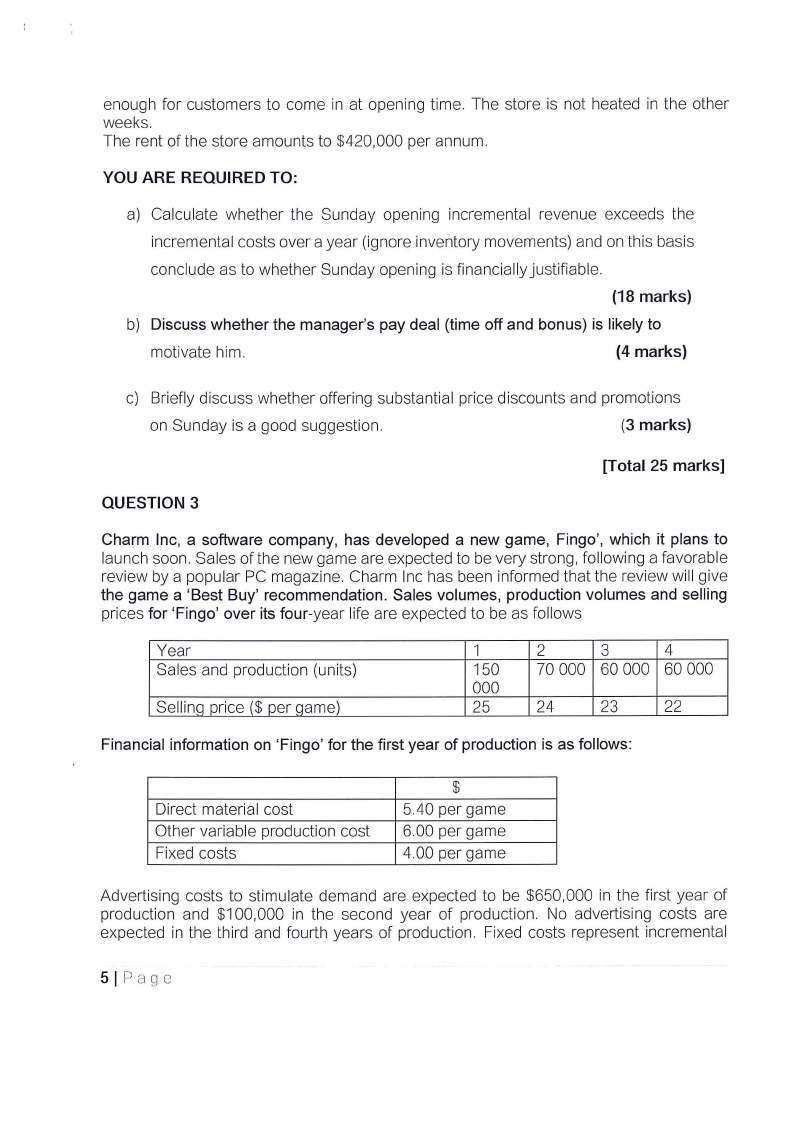
a) Calculate whether the Sunday opening incremental revenue exceeds the
incremental costs over a year (ignore inventory movements) and on this basis
conclude as to whether Sunday opening is financially justifiable.
(18 marks)
b) Discuss whether the manager's pay deal (time off and bonus) is likely to
motivate him.
(4 marks)
c) Briefly discuss whether offering substantial price discounts and promotions
on Sunday is a good suggestion.
(3 marks)
[Total 25 marks]
QUESTION 3
Charm Inc, a software company, has developed a new game, Fingo', which it plans to
launch soon. Sales of the new game are expected to be very strong, following a favorable
review by a popular PC magazine. Charm Inc has been informed that the review will give
the game a 'Best Buy' recommendation. Sales volumes, production volumes and selling
prices for 'Fingo' over its four-year life are expected to be as follows
Year
Sales and production (units)
Sellinq price ($ per qame)
1
2
3
4
150 70 000 60 000 60 000
000
25
24
23
22
Financial information on 'Fingo' for the first year of production is as follows:
Direct material cost
Other variable production cost
Fixed costs
$
5.40 per game
6.00 per game
4.00 per game
Advertising costs to stimulate demand are expected to be $650,000 in the first year of
production and $100,000 in the second year of production. No advertising costs are
expected in the third and fourth years of production. Fixed costs represent incremental
51Page
|
|
6 Page 6 |
▲back to top |
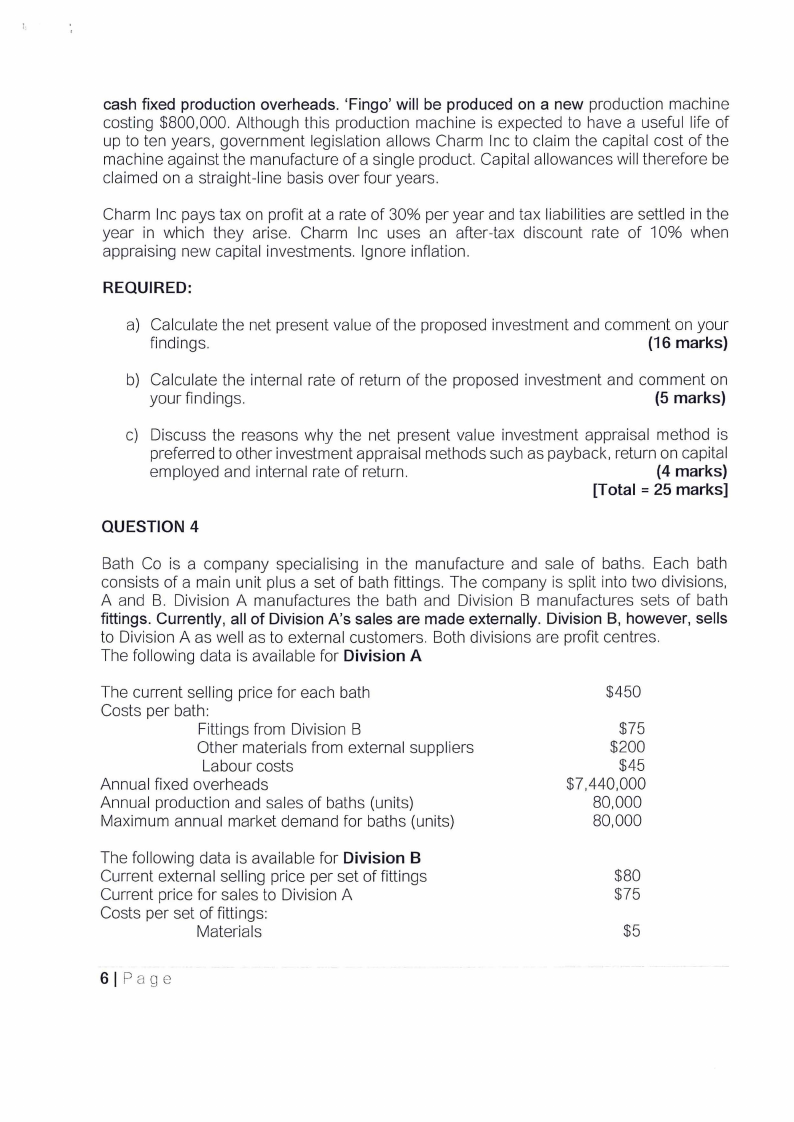
cash fixed production overheads. 'Fingo' will be produced on a new production machine
costing $800,000. Although this production machine is expected to have a useful life of
up to ten years, government legislation allows Charm Inc to claim the capital cost of the
machine against the manufacture of a single product. Capital allowances will therefore be
claimed on a straight-line basis over four years.
Charm Inc pays tax on profit at a rate of 30% per year and tax liabilities are settled in the
year in which they arise. Charm Inc uses an after-tax discount rate of 10% when
appraising new capital investments. Ignore inflation.
REQUIRED:
a) Calculate the net present value of the proposed investment and comment on your
findings.
(16 marks)
b) Calculate the internal rate of return of the proposed investment and comment on
your findings.
(5 marks)
c) Discuss the reasons why the net present value investment appraisal method is
preferred to other investment appraisal methods such as payback, return on capital
employed and internal rate of return.
(4 marks)
[Total= 25 marks]
QUESTION 4
Bath Co is a company specialising in the manufacture and sale of baths. Each bath
consists of a main unit plus a set of bath fittings. The company is split into two divisions,
A and B. Division A manufactures the bath and Division B manufactures sets of bath
fittings. Currently, all of Division A's sales are made externally. Division B, however, sells
to Division A as well as to external customers. Both divisions are profit centres.
The following data is available for Division A
The current selling price for each bath
Costs per bath:
Fittings from Division B
Other materials from external suppliers
Labour costs
Annual fixed overheads
Annual production and sales of baths (units)
Maximum annual market demand for baths (units)
$450
$75
$200
$45
$7,440,000
80,000
80,000
The following data is available for Division B
Current external selling price per set of fittings
$80
Current price for sales to Division A
$75
Costs per set of fittings:
Materials
$5
61Page
|
|
7 Page 7 |
▲back to top |
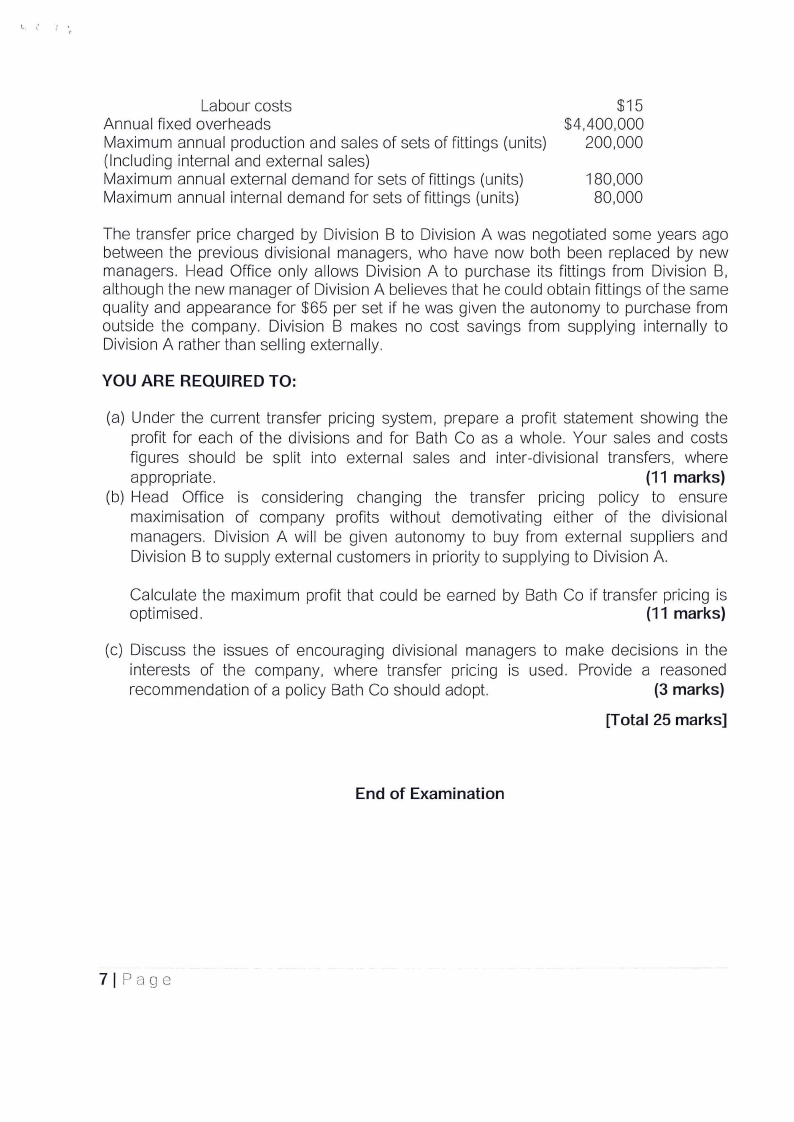
Labour costs
Annual fixed overheads
Maximum annual production and sales of sets of fittings (units)
(Including internal and external sales)
Maximum annual external demand for sets of fittings (units)
Maximum annual internal demand for sets of fittings (units)
$15
$4,400,000
200,000
180,000
80,000
The transfer price charged by Division B to Division A was negotiated some years ago
between the previous divisional managers, who have now both been replaced by new
managers. Head Office only allows Division A to purchase its fittings from Division B,
although the new manager of Division A believes that he could obtain fittings of the same
quality and appearance for $65 per set if he was given the autonomy to purchase from
outside the company. Division B makes no cost savings from supplying internally to
Division A rather than selling externally.
YOU ARE REQUIRED TO:
(a) Under the current transfer pricing system, prepare a profit statement showing the
profit for each of the divisions and for Bath Co as a whole. Your sales and costs
figures should be split into external sales and inter-divisional transfers, where
appropriate.
(11 marks)
(b) Head Office is considering changing the transfer pricing policy to ensure
maximisation of company profits without demotivating either of the divisional
managers. Division A will be given autonomy to buy from external suppliers and
Division B to supply external customers in priority to supplying to Division A.
Calculate the maximum profit that could be earned by Bath Co if transfer pricing is
optimised.
(11 marks)
(c) Discuss the issues of encouraging divisional managers to make decisions in the
interests of the company, where transfer pricing is used. Provide a reasoned
recommendation of a policy Bath Co should adopt.
(3 marks)
[Total 25 marks]
End of Examination
71Page